
In This Article
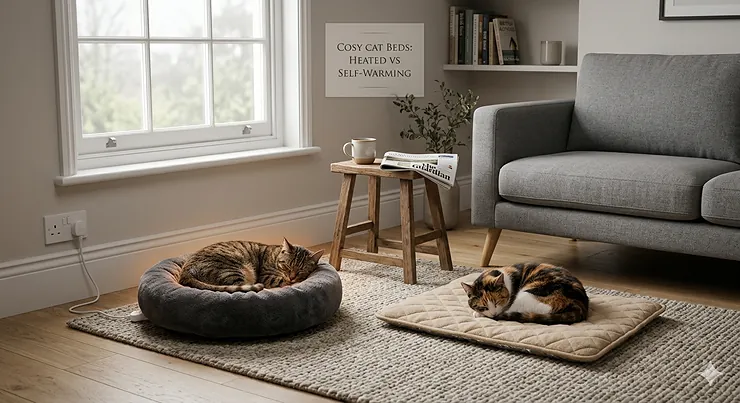
If you’ve ever watched your cat commandeer the radiator or sprawl across your laptop keyboard during a chilly British evening, you’ll already know that felines are rather particular about warmth. The question isn’t whether your cat wants a cosy sleeping spot — it’s whether you should invest in a heated cat bed vs self warming option, and which technology actually delivers on those promises of purr-inducing comfort.
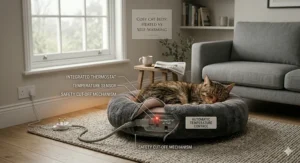
Here’s the thing most Amazon listings won’t tell you: heated and self-warming beds work on completely different principles, and choosing the wrong one for your situation can mean wasted money and a distinctly unimpressed cat. Heated beds use electrical elements to generate warmth actively, whilst self-warming beds use reflective thermal layers to bounce your cat’s own body heat back at them. One requires a plug socket and ongoing electricity costs; the other works anywhere you plonk it down but relies entirely on your cat’s natural body temperature.
In this guide, I’ll walk you through seven carefully selected options available on Amazon.co.uk, explain the science behind both technologies in plain English, and help you match the right bed to your specific British living situation — whether you’re in a draughty Victorian terrace in Bristol, a compact flat in Manchester, or a modern semi in the Home Counties. What works brilliantly for an elderly cat in an unheated conservatory won’t be the same solution for a healthy young moggy in a centrally heated bedroom. Let’s sort the genuinely useful from the marketing fluff.
Quick Comparison: Heated vs Self-Warming Cat Beds at a Glance
| Feature | Heated (Electric) Beds | Self-Warming Beds |
|---|---|---|
| Heat Source | Electrical heating element (230V UK plug) | Reflective mylar layer bounces body heat back |
| Temperature Range | Adjustable 25-40°C typically | Ambient +5-8°C (body heat dependent) |
| Running Cost | £2-5/month electricity | £0 (completely free to run) |
| Setup Required | Needs plug socket within 2m | Place anywhere — no power needed |
| Best For | Elderly cats, outdoor shelters, medical recovery | Healthy adults, portable use, energy efficiency |
| UK Price Range | £25-£50 for quality models | £10-£35 for most options |
| Safety Consideration | Chew-proof cords essential; auto shut-off recommended | No electrical hazards whatsoever |
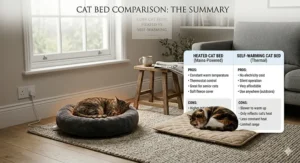
From this comparison, you can already see the fundamental trade-offs. Heated beds deliver controllable, consistent warmth but tie you to a power source and add to your electricity bill — not massive amounts, mind you, but in today’s energy market, every pound counts. Self-warming beds cost nothing to run and work brilliantly for healthy cats in moderately cool rooms, but they won’t rescue a genuinely cold cat from a freezing garage or unheated outbuilding. A self-warming bed in a 5°C shed is just an expensive cushion; a heated bed in the same spot could be a lifesaver for a stray you’re trying to shelter through February.
💬 Just one click — help others make better buying decisions too! 😊
✨ Don’t Miss These Exclusive Deals!
🔍 Take your cat’s comfort to the next level with these carefully selected products. Click on any highlighted item to check current pricing and availability on Amazon.co.uk. These picks will help you find exactly what your feline needs!
Top 7 Heated and Self-Warming Cat Beds: Expert Analysis for UK Buyers
1. NICREW Pet Heating Pad with Auto Shut-Off (Electric)
The NICREW Pet Heating Pad sits at the top of the electric category for good reason — it’s built with UK safety standards in mind and comes with the UK plug already fitted (no dodgy adapters required). This 40 x 45 cm mat delivers adjustable temperature control across four settings, with an auto shut-off timer that cycles through 4, 8, or 12-hour intervals, or stays on continuously if you prefer.
What sets this apart from cheaper alternatives is the steel-wrapped power cable entrance. Anyone who’s owned a bored cat knows they’ll chew through anything remotely interesting, and exposed heating wires are both expensive to replace and genuinely dangerous. The MET safety listing provides additional peace of mind — it’s been independently tested to exceed UK electrical safety standards. The removable fleece cover is machine washable, which you’ll appreciate after the inevitable muddy paw prints or the occasional hairball incident.
In practice, the NICREW heats to approximately your cat’s natural body temperature (around 38°C on the highest setting), which feels barely warm to human touch but is precisely what cats seek out. UK reviewers consistently mention it works particularly well for arthritic senior cats during the damp British winter, when joint pain tends to flare up. According to veterinary guidance on caring for elderly cats, maintaining warmth is crucial for senior pets’ comfort and mobility. One owner noted their elderly cat abandoned every other bed in the house once this arrived — high praise from a notoriously fickle species. The pad does take about 15-20 minutes to reach full temperature, so don’t expect instant warmth.
Pros:
✅ Adjustable temperature suits different preferences and seasons
✅ Steel-wrapped cord prevents chewing disasters
✅ Auto shut-off timer adds safety and energy efficiency
Cons:
❌ Occupies a socket — problematic in rooms with limited outlets
❌ Some reviewers found it runs slightly cooler than expected on medium settings
Around £30-£35, this represents solid value for a heated option that’ll last multiple winters. For elderly cats, arthritic pets, or outdoor shelter situations where you can run a weatherproof extension lead, it’s well worth considering.
2. Petace Cat Self-Heating Pad (60 x 45 cm)
The Petace Self-Heating Pad strips away all electrical complexity and relies instead on a heat-reflecting mylar film layer that works like those space blankets marathon runners wrap themselves in. Your cat lies down, radiates body heat, and the mylar bounces it straight back rather than letting it dissipate into the room. Simple physics, no running costs, and absolutely nothing to go wrong electrically.
This particular model measures 60 x 45 cm — generous enough for a full-grown British Shorthair to stretch out properly, which many cheaper self-warming pads are not. The dual-layer construction combines the reflective thermal sheet with thickened cotton filling for cushioning, whilst the non-slip bottom keeps it stable on hardwood or laminate floors (particularly useful if your cat does that aggressive kneading thing before settling down). The absence of internal wires means it’s completely noiseless — some cheaper heated pads produce a faint electrical hum that bothers sound-sensitive cats.
UK buyers specifically appreciate the portability. You can move it from the sofa to the cat tree to the spare room without hunting for another socket, and it folds up for storage during summer months. It’s also brilliant for car journeys to the vet or holidays in pet-friendly cottages. That said, self-warming technology only works when the cat is actually on it — if your moggy hops off for 20 minutes, it cools back to room temperature. For healthy adult cats in homes kept above 16°C, this isn’t an issue. For genuinely cold environments or cats with poor circulation, it won’t provide enough warmth.
Pros:
✅ Zero running costs — never adds a penny to electricity bills
✅ Machine washable and completely portable
✅ Safe for chronic cord-chewers
Cons:
❌ Only as warm as your cat’s body heat permits (no external heat source)
❌ Older or ill cats may not generate enough warmth for comfort
You’ll find this in the £15-£25 range, making it one of the more affordable options that still delivers genuine thermal performance rather than just being a cushion with marketing claims.
3. NICREW Cat Heating Pad 70 x 40 cm (Electric, Temperature Adjustable)
The larger NICREW 70 x 40 cm model takes everything good about the standard version and supersizes it — essential if you’re dealing with a Maine Coon, Norwegian Forest Cat, or just a cat that insists on sprawling rather than curling. The rectangular shape fits beautifully into standard cat beds, transforming them into heated sleeping pods without needing to buy an entirely new bed.
Temperature adjustment here is more granular than many competitors, and UK reviewers particularly value the auto-off timer function during overnight use. Set it to shut down after eight hours, and you’re not wasting electricity heating an empty bed all day whilst your cat patrols the neighbourhood. The 75W maximum power draw is modest — roughly equivalent to running a laptop charger — so even with energy prices what they are, you’re looking at perhaps £3-4 per month if it’s on for several hours daily.
The grey colourway is refreshingly neutral compared to the garish patterns many pet products come in, so it doesn’t look completely ridiculous in your living room. The fleece cover provides adequate cushioning but isn’t particularly plush — some owners layer a blanket on top for cats that prefer extra softness. Worth noting: this is designed as a heating element to go inside an existing bed rather than a standalone bed itself. If you’re starting from scratch, you’ll need to factor in the cost of an outer bed as well.
Pros:
✅ Larger size accommodates bigger breeds comfortably
✅ Energy-efficient 75W consumption keeps running costs reasonable
✅ Fits inside most standard cat beds
Cons:
❌ Not a complete bed — requires additional outer structure
❌ Cover could be plusher for premium feel
Priced around £28-£32, this works out as excellent value per square centimetre of warmth, particularly if you already own a quality cat bed that just needs a thermal boost.
4. Mora Pets Self-Heating Cat Blanket (56 x 43 cm)
The Mora Pets Self-Heating Blanket takes a slightly different approach — it’s a reversible thermal mat rather than a structured bed, giving you flexibility to use it inside existing beds, on furniture, or draped over a cat tree platform. One side features soft faux fur; flip it over for a smoother fleece texture. Some cats develop strong preferences for specific textures, so having both options on one product is genuinely useful.
The thermal layer here is embedded between the two fabric sides, creating what the manufacturer calls “electric-free heat” — which is accurate if a bit optimistic. It doesn’t generate heat; it recycles the heat your cat’s already producing. In a room kept around 18-20°C (typical British central heating), healthy adult cats will find this adds a noticeable warmth boost. In genuinely cold spaces — think unheated utility rooms or conservatories — the effect is more subtle.
UK customers mention this works brilliantly as a lap blanket during the day, then gets moved to the cat’s bed at night. The 56 x 43 cm dimensions are compact enough to be truly portable but large enough for most cats to lie on comfortably. Machine washable on a gentle cycle, though you’ll want to air dry rather than tumble dry to preserve the thermal layer’s effectiveness. After a year of regular washing, some thermal blankets lose a bit of their reflective capability, but at this price point, you’re not investing a fortune.
Pros:
✅ Reversible design offers texture variety
✅ Compact and lightweight for multi-room use
✅ Works as lap blanket or bed liner
Cons:
❌ Smaller size won’t suit large breeds
❌ Thermal effectiveness degrades slightly with repeated washing
Expect to pay around £12-£18, which makes this one of the most budget-friendly self-warming options that still uses genuine thermal technology rather than just being thick fabric.
5. Pets at Home Heated Square Puppy Bed Grey
Despite being marketed primarily for puppies, the Pets at Home Heated Square Bed has become rather popular with cat owners who want a complete heated bed solution in one package. The key feature here is the removable microwavable heat pack rather than a plug-in electrical element. You heat the pack in your microwave for 3-4 minutes, insert it into the base compartment, and it radiates warmth for approximately 6-8 hours.
This hybrid approach gives you controllable heat without needing a socket near the bed’s location. Particularly useful for outdoor cat houses or garden sheds where running electrical cables would be impractical or unsafe. The raised sides create a nest-like environment that many cats find psychologically comforting — it mimics the enclosed feeling of curling up in a cardboard box (which, let’s face it, most cats prefer to the £100 cat castle you bought them).
The grey fluffy cover is removable and machine washable, which matters because microwavable heat packs can develop a slightly musty smell over time if the outer bed isn’t regularly cleaned. UK winter temperatures mean you’ll likely need to reheat the pack twice daily to maintain consistent warmth — once in the morning and again in the evening. This is more labour-intensive than electric or self-warming options but gives you precise control over when heat is available.
Pros:
✅ No electrical components whatsoever — completely safe
✅ Portable heat solution for locations without power
✅ Raised sides provide security-focused cats with comfort
Cons:
❌ Requires manual reheating every 6-8 hours
❌ Heat pack can feel overly warm immediately after microwaving (let it cool for 5 minutes)
Available around £18-£25, this occupies an interesting middle ground between fully electric and passive self-warming beds.

6. Bedsure Donut Cat Bed with Self-Warming Technology
The Bedsure Donut Bed combines the hugely popular donut bed design — that raised ring shape cats love to rest their heads on — with a self-warming base layer. The donut style naturally creates a microclimate within the circular walls, which the thermal bottom layer then helps maintain. It’s clever design meeting practical physics.
This model uses a dual-layer bottom construction: a reflective thermal sheet beneath a thick faux fur surface. When your cat settles into the centre, their body heat gets trapped by the raised walls and reflected back by the base layer. The result feels noticeably warmer than a standard donut bed, though again, we’re talking ambient temperature plus 5-6°C rather than anything approaching an electric blanket.
UK reviewers consistently mention the non-slip base actually stays put on laminate and tile floors — an often-overlooked detail that becomes irritating when beds slide around during enthusiastic digging and turning. The entire bed is machine washable, though you’ll want to use a low temperature and gentle cycle to preserve both the outer faux fur and the internal thermal layer. Available in multiple sizes (small, medium, large), with the medium being suitable for average-sized British Shorthairs and similar breeds.
The raised ring design particularly appeals to cats that like to rest their chin or paw on a surface whilst sleeping — you’ll know if you have one of these cats because they’re constantly draping themselves over the arm of your sofa or the edge of your bed. It’s also excellent for anxious cats who feel more secure in partially enclosed spaces.
Pros:
✅ Donut design creates naturally warmer microclimate
✅ Non-slip base prevents frustrating bed migration
✅ Multiple sizes accommodate different breeds
Cons:
❌ Very large or long cats may find even the large size a bit snug
❌ Faux fur can attract more visible cat hair than short-pile fabrics
You’ll find these in the £20-£30 range depending on size, representing decent value for a bed that combines structural design with thermal technology.
7. K&H Self-Warming Pet Pad (Reversible Design)
The K&H Self-Warming Pet Pad brings American engineering to the UK market via Amazon.co.uk, and whilst it’s not the cheapest option, the build quality justifies the modest premium. This reversible pad features the brand’s proprietary two-layer system: an insulating layer that captures body heat, topped by a metallised reflective layer that bounces it back. Both sides are covered in soft microfleece, with different colours on each side (typically grey/cream or chocolate/tan combinations).
K&H pioneered self-warming pet bed technology, and their products tend to outperform cheaper imitators in independent temperature testing — we’re talking 1-2°C additional warmth retention compared to generic alternatives. That might sound negligible, but for a cat sitting on the bed for eight hours overnight, those extra degrees compound into noticeably improved comfort. The 53 x 38 cm dimensions work well for most cats without being so large that the bed becomes unwieldy.
The completely flat design makes this supremely versatile. Slide it into a cat igloo, drape it over a windowsill perch, place it inside a cardboard box (cats being cats), or use it standalone on the floor. UK buyers particularly value this flexibility in smaller homes where space is at a premium. It’s also brilliant for travel — rolls up small enough to pack in a suitcase for holidays in pet-friendly cottages.
Durability is where K&H products shine. Whilst cheaper thermal pads often lose effectiveness after 6-12 months of regular washing, K&H’s construction maintains thermal performance for multiple years. Several UK reviewers mention pads still working well after three years of weekly washing — at that longevity, the initial price premium becomes a non-issue.
Pros:
✅ Superior thermal performance vs cheaper alternatives
✅ Exceptional durability through repeated washing
✅ Reversible design offers colour options
Cons:
❌ Higher initial cost than basic self-warming pads
❌ Flat design doesn’t provide raised sides for cats that prefer them
Expect to pay around £25-£35 depending on retailer and size, positioning this at the premium end of self-warming options but below entry-level electric beds.
How Self-Warming Cat Beds Actually Work: The Science British Cat Owners Should Understand
Self-warming beds sound like marketing nonsense until you understand the physics, which is surprisingly straightforward. Cats maintain a body temperature around 38°C — considerably warmer than humans. When a cat lies on a standard polyester-filled bed, that heat conducts into the filling and gradually dissipates. You’ve witnessed this yourself if you’ve ever sat in a chair immediately after your cat vacated it — it’s noticeably warm for a few minutes, then cools to room temperature.
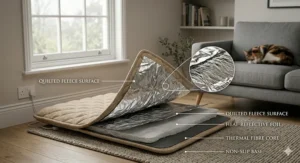
Self-warming beds interrupt this heat loss using a reflective thermal layer, typically made from mylar film (the same material in emergency blankets). This layer sits just beneath the sleeping surface. When your cat’s body heat radiates downward, instead of conducting into the bed padding and then into the floor, the mylar reflects it back upward. Think of it like a mirror for infrared radiation. The result: the bed surface temperature rises to approximately 5-8°C above ambient room temperature when occupied.
This technology is legitimately effective, but it has clear limitations. A self-warming bed in a 20°C centrally heated home will reach perhaps 25-28°C when your cat’s on it — comfortably warm for most healthy adult cats. The same bed in a 10°C conservatory or garage will only reach 15-18°C — better than nothing, but not warm enough to prevent heat loss in genuinely cold conditions. This is where heated beds with active electrical elements become necessary.
British homes, with their often-variable heating (central heating on timers, rooms that are heated versus those that aren’t), present interesting use cases. A self-warming pad in your bedroom might work brilliantly whilst the heating’s on in the evening, but that same pad in the kitchen overnight when the boiler’s off won’t provide sufficient warmth for an elderly or ill cat. Understanding this helps you match technology to situation rather than expecting one solution to work everywhere.
UK Climate Considerations: Damp Matters More Than Cold
Here’s something self-warming bed manufacturers rarely mention but British cat owners quickly discover: damp conditions reduce thermal effectiveness significantly. The UK’s perpetually high humidity — we average 75-85% relative humidity year-round — affects how well reflective thermal layers work. Moisture in the air and fabric increases thermal conductivity, meaning heat escapes more readily despite the reflective layer.
This is why self-warming beds work noticeably better in centrally heated, dehumidified rooms than in draughty hallways or damp conservatories. If you live in an older property prone to condensation — those lovely Victorian terraces with single-glazed windows and minimal insulation — you’ll get better results from self-warming beds if you also address ambient humidity with a small dehumidifier in the room. It sounds excessive, but the improved thermal performance benefits both human comfort and makes your cat more likely to actually use the expensive bed you bought them.
Heated beds handle damp conditions more effectively because they’re actively generating heat rather than recycling it. The electrical element compensates for the increased heat loss, maintaining consistent temperature even in humid environments. This makes heated beds more reliable in typically British problem areas: conservatories, utility rooms, garages, and outdoor sheltered spaces.
Choosing Between Heated Cat Bed vs Self Warming: Your UK Decision Framework
The choice between heated and self-warming beds isn’t about which technology is “better” — it’s about matching the solution to your specific situation. Here’s a practical decision tree based on what actually matters:
Choose a heated (electric) bed if:
- Your cat is elderly (10+ years), has arthritis, or is recovering from illness
- The bed will be used in an unheated space (garage, conservatory, outdoor shelter)
- You need consistent, predictable warmth regardless of cat activity
- You have reliable socket access within 2 metres of the bed location
- You’re willing to pay £2-5 monthly in electricity costs
- Your cat doesn’t chew cords (or you can protect cables effectively)
Choose a self-warming bed if:
- Your cat is healthy, adult, and has normal body temperature regulation
- The bed will be in a room kept above 16°C with heating
- You want zero running costs and maximum portability
- Socket access is limited or inconvenient
- Your cat is a notorious cord chewer
- You need a travel-friendly option for holidays or vet visits
Choose the microwavable hybrid approach if:
- You need warmth in a location without power (outdoor shelter, garden shed)
- You’re willing to manually reheat every 6-8 hours
- Your schedule allows twice-daily reheating (morning and evening)
- You want the safest possible option with zero electrical components
- Initial cost is a concern but some heat is essential
For most British households with healthy adult cats, self-warming beds represent the sweet spot: they deliver noticeable comfort improvement at zero running cost, work anywhere without sockets, and eliminate all electrical safety concerns. The thermal performance genuinely works — you can test this yourself by placing a hot water bottle on one for 20 minutes and feeling the retained warmth.
However, if you’re trying to help an arthritic 14-year-old cat through a British winter, or providing shelter for outdoor strays during February’s freezing nights, heated beds justify their higher cost and electricity consumption. The active heat generation makes the difference between a cat choosing to use the bed and abandoning it for the radiator.
💡 Don’t Miss These Exclusive Deals!
🔍 Click any highlighted product to check current stock on Amazon.co.uk. Prime members enjoy free next-day delivery on most cat beds!
Igloo vs Cave vs Donut Bed: Which Style Works Best with Heating?
The bed style you choose — igloo, cave, donut, or flat pad — significantly affects how both heated and self-warming technologies perform. This isn’t just aesthetics; the physical structure creates different thermal environments that either enhance or undermine the heating method.
Igloo/cave beds with enclosed tops create a microclimate that traps warm air. When combined with self-warming technology in the base, this amplifies the thermal effect. Warm air rises from the cat’s body, hits the enclosed roof, and circulates back down rather than dissipating into the room. This makes igloo beds with self-warming bases punches above their weight thermally. The downside: some cats feel claustrophobic in fully enclosed spaces and refuse to use them regardless of how warm they are. Research shows that cats prefer enclosed spaces for stress reduction, though individual preferences vary considerably. British Shorthairs and Maine Coons, in particular, often prefer open beds where they can survey their kingdom.
Donut beds with raised circular walls create a middle ground. The walls trap some heat whilst maintaining visibility. When you add either a heated element or self-warming layer to the base, the donut walls act like a heat-retaining bowl. This works brilliantly for cats that like to curl up in a ball (most cats most of the time). Less effective for sprawlers who lie fully extended — the heat concentrates in the centre where the walls are highest, whilst the cat’s back legs extend beyond the warm zone.
Flat pads offer maximum flexibility but minimum heat retention. The heat generated (or reflected) disperses in all directions without structural barriers to contain it. This makes them ideal for slipping inside existing beds, placing on furniture, or using on cat trees. However, standalone flat heated or self-warming pads work less efficiently than structured beds — you’re essentially heating the open air around the cat rather than creating a contained warm zone.
For UK buyers specifically, consider where the bed will live. An igloo bed in a draughty hallway near the front door works better than a flat pad because the structure blocks drafts. Conversely, a donut bed on a radiator shelf becomes pointlessly hot (cats have been known to abandon beds that are too warm), whilst a flat pad in the same location provides just-right temperature layering.
Common Mistakes When Buying Cat Beds in the UK (And How to Avoid Them)
Mistake #1: Buying Based on Advertised Size, Not Actual Measurements
British cats are getting larger — average domestic cats now weigh 4-5 kg versus 3.5-4 kg two decades ago. Yet many cat beds still use sizing standards from the 1990s. A “large” bed might measure only 45 cm diameter, which forces a 5 kg cat to curl uncomfortably tight. Always check actual dimensions in centimetres and compare to your cat’s stretched-out length. A good rule: the bed diameter should be at least 1.3x your cat’s nose-to-tail length for comfortable sprawling. For self-warming beds in particular, a cat crammed into too-small space can’t maximise body contact with the thermal layer, reducing effectiveness.
Mistake #2: Ignoring Voltage and Plug Type for Imported Heated Beds
Amazon.co.uk hosts sellers shipping from China, the US, and EU. Some heated beds arrive with EU plugs (fine with an adapter but adds bulk), American 110V models (completely incompatible with UK 230V), or worse, Chinese plugs with no safety certification whatsoever. Always verify the product listing explicitly states “UK plug” and “230V”. Proper UK models should mention UKCA marking or BS safety certification. Dodgy adapters on heating elements are a genuine fire risk — this isn’t worth saving £5. Under the Consumer Rights Act 2015, products must be safe and as described.
Mistake #3: Expecting Self-Warming Beds to Work in Genuinely Cold Spaces
The most common complaint in UK reviews: “This bed doesn’t work, it’s not warm at all!” Investigation reveals the bed is in an unheated conservatory at 8°C. Self-warming technology can only reflect your cat’s body heat; it cannot generate additional warmth. In very cold environments, the cat loses heat faster than the reflective layer can bounce it back. Physics wins. If you need warmth below 12°C, you need electrical heating, not thermal reflection.
Mistake #4: Buying Non-Washable or Difficult-to-Clean Beds
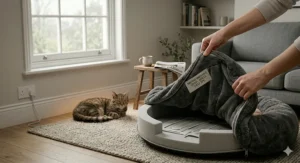
Cats are wonderful creatures who sometimes vomit, track litter, shed profusely, and occasionally have accidents. A heated or self-warming bed that can’t be machine washed becomes disgusting within months. Yet many cheaper heated beds have non-removable covers or prohibit machine washing due to electrical components. Similarly, some self-warming beds lose their thermal layer functionality after washing. Verify the washing instructions before buying — you want removable, machine-washable covers at minimum, or better yet, entirely washable beds for self-warming models.
Mistake #5: Underestimating British Damp’s Impact on Longevity
British homes stay damp compared to most of Europe and all of North America. This moisture degrades fabric beds faster than advertised. That plush donut bed rated for “years of use” might develop musty smells or matted fur within 18 months if you live in a particularly damp region (looking at you, Wales and Scotland). Heated beds with electrical components are especially vulnerable — moisture infiltration can cause shorts or failures. If your home runs damp (condensation on windows, musty smells, visible mould in bathrooms), invest in beds with water-resistant covers and consider a small dehumidifier in the room where the bed lives.
Real-World Scenario: Matching Beds to British Cat Owners
Sarah in Edinburgh: Three Cats, Victorian Tenement, Limited Sockets
Sarah’s situation is quintessentially British: gorgeous high-ceilinged Victorian flat with original features and precisely four functioning sockets in the entire living room. She can’t practically run heated beds for three cats without socket splitters everywhere (fire hazard waiting to happen). Her solution: three self-warming pads in varying sizes — one K&H in the window seat that catches afternoon sun (amplifies the thermal effect), one Bedsure donut on the sofa (where the cats fight for territory), and one flat Petace pad inside a cardboard box (because cats gonna cat). Total electricity cost: £0. Total happiness: significant improvement during Edinburgh’s brutal February winds.
The self-warming technology works brilliantly here because Sarah keeps her flat at 18-20°C with old cast-iron radiators. The thermal pads augment that baseline warmth to cat-comfortable levels. During particularly cold snaps, she adds a microwavable wheat bag (£8 from Boots) to the largest cat’s preferred bed for extra warmth without needing another socket.
James in Cornwall: Outdoor Shelter for Neighbourhood Strays
James runs an informal feeding station for semi-feral cats in his garden shed. No mains power to the shed, but he’s happy to refresh microwavable heat packs twice daily when he does feeding rounds. His setup: a large outdoor-rated cat shelter with a Pets at Home microwavable bed inside. He heats two packs in rotation — one in use whilst the other’s in the microwave — maintaining constant warmth during the coldest months.
This hybrid approach works where self-warming pads would fail (the shed drops to 5-8°C overnight) and electric heated beds would require running extension leads through his garden (messy, expensive, and potentially dangerous in wet conditions). The manual reheating is labour-intensive but unavoidable without power access. Cost: approximately £25 for the bed plus £3 monthly for the increased electricity from microwave use.
Priya in London: Elderly Cat, Arthritis, Centrally Heated Flat
Priya’s 16-year-old cat struggles with arthritis that worsens noticeably during cold, damp weather — basically October through April in London. Despite her flat being well-heated, the cat constantly sought out the warmest available spot, often sprawling directly on the hot water pipes. Priya invested in a NICREW heated pad (£32) placed in the cat’s preferred sleeping location near the radiator.
The heated bed provides consistent therapeutic warmth regardless of whether the central heating’s currently on or off. The cat abandoned all other sleeping spots immediately — unambiguous approval. Priya runs the bed on setting 3 (of 5) for approximately 18 hours daily, using the auto shut-off during the six hours she’s definitely at work. Estimated electricity cost: £3.50 monthly at current rates. She considers this excellent value for noticeably improved quality of life in her cat’s final years.
Long-Term Costs and Maintenance: What UK Owners Actually Pay
Let’s talk honest numbers, not marketing fluff. The purchase price of a cat bed is only part of the total cost of ownership. Here’s what you’ll actually spend over a typical three-year lifespan:
Self-Warming Bed (£20 initial cost):
- Electricity: £0
- Replacement thermal liner (if degraded after 2 years): £8-12
- Washing costs (weekly, 150 cycles): £15 in electricity/water
- Total 3-year cost: £43-47
Heated Electric Bed (£35 initial cost):
- Electricity (6 hours daily, October-March, 3 years): £48-54
- Replacement fleece cover (every 18 months): £12-15
- Washing costs (fortnightly, 75 cycles): £8 in electricity
- Total 3-year cost: £103-112
Microwavable Bed (£22 initial cost):
- Electricity (2x daily microwave use, October-March, 3 years): £18-22
- Replacement heat packs (every 2 years): £12-15
- Washing costs (monthly, 36 cycles): £4 in electricity
- Total 3-year cost: £56-63
These calculations assume typical British usage patterns — heating season runs roughly October through March (6 months), central heating maintains baseline warmth, and you’re not trying to warm an outdoor shelter year-round. Your mileage will genuinely vary.
The maintenance burden differs significantly too. Self-warming beds require the least intervention — occasional washing, that’s it. Heated beds need regular safety checks (inspect cords for damage, ensure auto shut-off works, verify temperature settings haven’t drifted), plus more frequent washing if the electrical element makes the cover warmer and thus more attractive to hair and dirt. Microwavable beds demand the most human effort — twice-daily reheating isn’t huge labour but it’s non-negotiable if you want consistent warmth.
For most British households, self-warming beds offer the best value proposition: lowest total cost, zero maintenance beyond washing, maximum flexibility. Heated beds justify their higher cost when therapeutic warmth is genuinely necessary — elderly cats, medical recovery, outdoor shelters. Microwavable beds occupy a niche for situations where you need warmth but can’t access mains power and are willing to manually refresh.
UK Safety Regulations and Certifications You Should Actually Check
British electrical safety standards exist for good reasons — dodgy heating elements in pet beds have caused house fires, though thankfully they’re rare. Here’s what actually matters when buying heated beds:
UKCA Marking: Post-Brexit, this replaced the EU’s CE marking for products sold in England, Scotland, and Wales (Northern Ireland still uses CE). Heated beds should display UKCA marking confirming they meet UK electrical safety requirements. Be aware that many imported products still show CE marking and claim UK compliance — this is legally acceptable during the transition period but less reassuring than proper UKCA marking.
BS EN 60335-2-71: This British Standard specifically covers electrical safety requirements for heating appliances for animals and small pets. Quality heated beds will mention compliance with this standard in their specifications. If a heated bed makes no mention whatsoever of British Standards compliance, treat that as a warning flag.
MET Safety Listing: Some American brands (like K&H) use MET Labs testing, which verifies compliance with international safety standards including UK requirements. MET listing is legitimate and indicates proper safety testing, even though it’s not a British organisation.
Chew-Proof Cord Requirements: There’s no formal British Standard specifically for chew resistance, but quality heated beds should have either steel-wrapped cords or heavily reinforced cable guards. Some manufacturers wrap the first 30-40 cm of cable (the section most likely to be chewed) in steel braiding or hard plastic tubing. This isn’t just about preventing damage to the bed — chewed-through heating cables can cause electrical fires.
For self-warming beds, safety concerns are minimal since there are no electrical components. The main consideration is material safety — fabrics should be non-toxic and any reflective layers should be properly encased (you don’t want mylar film breaking free and being eaten). However, since there’s no formal regulation of thermal reflection layers, you’re relying on manufacturer quality control. Established brands like K&H and NICREW maintain better standards than anonymous Chinese sellers shipping via Amazon.co.uk.
Frequently Asked Questions
❓ Can I use a heated cat bed outdoors in the UK winter?
❓ Do self-warming cat beds actually work or is it just marketing nonsense?
❓ How much does it cost to run a heated cat bed in the UK with current electricity prices?
❓ Are heated cat beds safe to leave on overnight while sleeping?
❓ Will my cat actually use a heated or self-warming bed or will they just stick to the radiator?
Conclusion: Making the Right Choice for Your British Cat
The heated cat bed vs self warming debate ultimately comes down to matching technology to your specific circumstances rather than declaring one superior. Self-warming beds deliver brilliant value for healthy adult cats in heated British homes — they work well, cost nothing to run, and eliminate electrical hazards entirely. For owners dealing with elderly cats, arthritic pets, outdoor shelters, or genuinely cold spaces, heated electric beds justify their higher purchase price and modest running costs through reliable, controllable warmth.
What matters most is understanding what each technology actually delivers rather than believing marketing claims. Self-warming beds add 5-8°C when your cat’s on them; they’re not magical heat generators. Heated beds provide consistent active warmth but tie you to socket locations and add electricity costs. Neither is inherently better — they solve different problems.
For most readers of this guide, I’d recommend starting with a quality self-warming pad like the K&H or Petace models (£15-30) and seeing how your cat responds. If they use it consistently and seem comfortable through typical British winter conditions, you’re sorted. If your cat still seeks out the radiator constantly or if they’re elderly/ill and struggling with cold, then upgrade to a heated bed like the NICREW (£30-40) for areas where they spend most time.
Remember: the best cat bed is the one your cat actually uses. British cats have survived millennia of damp, cold islands by being adaptable little furnaces. The goal isn’t to create tropical conditions — it’s to provide a comfortable temperature boost that acknowledges their higher body temperature and preference for cosy sleeping spots. With the options covered in this guide, you’re well-equipped to make an informed choice rather than gambling on Amazon’s “best seller” list.
Recommended for You
- Cat Bed for British Shorthair: 7 Best Beds UK 2026
- Best Insulated Cat House UK: 7 Top Choices for Winter 2026
- 7 Best Weatherproof Cat Shelters UK 2026
Disclaimer: This article contains affiliate links. As an Amazon Associate, I earn from qualifying purchases. If you purchase products through these links, we may earn a small commission at no additional cost to you.
✨ Found this helpful? Share it with your mates! 💬🤗
