
In This Article
Choosing the right cat litter tray might not be the most glamorous aspect of cat ownership, but get it wrong and you’ll know about it — usually via an unpleasant surprise on your best carpet. The truth is, your cat’s litter tray is rather more important than most people realise. It’s not just about containing mess; it’s about your cat’s wellbeing, your home’s hygiene, and maintaining that delicate peace treaty between you and your feline overlord.
British cats — from compact British Shorthairs to sprawling Maine Coons — deserve litter trays that actually fit them properly. Yet walk into any pet shop and you’ll find trays marketed as “large” that would barely accommodate a kitten. According to veterinary guidance from organisations like Battersea Dogs & Cats Home, the ideal litter tray should be one and a half times the length of your cat from nose to tail base. For the average British cat, that means a minimum of 55-60 cm in length — yet most standard trays sold on UK high streets fall woefully short.
In this comprehensive guide, I’ve tested and researched the best cat litter trays available on Amazon.co.uk in 2026, from budget-friendly options under £20 to premium self-cleaning models approaching £750. Whether you’re dealing with litter scatter across your laminate flooring, persistent odours in your terraced house, or a cat who treats their current tray with the disdain it probably deserves, you’ll find the solution here.
Quick Comparison: Top 7 Cat Litter Trays at a Glance
| Product | Type | Size | Price Range | Best For | Prime Available |
|---|---|---|---|---|---|
| Catit Jumbo Hooded | Hooded | 57 × 46 × 50 cm | £25-£40 | Large breeds, multi-cat homes | ✅ Yes |
| Litter-Robot 4 | Self-cleaning | Suits cats 3-11 kg | £550-£750 | Busy professionals, premium choice | ✅ Yes |
| Petkit Pura Max 2 | Self-cleaning | Large capacity | £280-£350 | Multi-cat homes, tech-savvy owners | ✅ Yes |
| Iris USA Top Entry | Top entry | 38 × 50 cm | £25-£35 | Litter scatter control, dog-proof | ✅ Yes |
| CAT CENTRE Hooded | Hooded | 51 × 39 × 39 cm | £15-£25 | Budget-conscious, single cat | ✅ Yes |
| Moderna Trendy Cat | Hooded | Multiple sizes | £12-£20 | Tight budgets, kittens | ✅ Yes |
| PetSafe ScoopFree | Self-cleaning | Standard | £180-£250 | Low maintenance, crystal litter | Limited |
From this comparison, the pattern becomes clear: if you’re after a spacious, reliable hooded tray without breaking the bank, the Catit Jumbo offers exceptional value in the £25-£40 bracket. But if you’re a busy Londoner juggling work and a two-cat household in a compact flat, the Petkit Pura Max 2’s quieter operation and app monitoring might justify the £300-odd investment. Budget buyers shouldn’t overlook the CAT CENTRE Hooded — at under £25, it delivers surprising quality for single-cat homes, though you’ll sacrifice some of the premium build quality found in pricier models.
💬 Just one click — help others make better buying decisions too! 😊
Top 7 Cat Litter Trays: Expert Analysis
1. Catit Jumbo Hooded Cat Pan — Best Overall
The Catit Jumbo Hooded Cat Pan has dominated UK sales for good reason — it’s genuinely large enough for adult cats, including chunky British Shorthairs and sprawling Maine Coons. With dimensions of 57 × 46 × 50 cm and a door opening of 26 × 24 cm, this isn’t one of those misleadingly named “jumbo” trays that still feels cramped.
The carbon filter door system actually works to reduce odours, unlike some cheaper imitations that include filters as mere window dressing. The swinging flap door provides privacy whilst remaining easy for cats to push through — most felines adapt within a few days. What sets this apart is the thoughtful UK-focused design: the high walls genuinely contain litter scatter (crucial in our smaller British homes), and the detachable hood makes weekly deep cleaning far less of a faff than fully enclosed designs.
Real-world performance in British conditions: The robust plastic withstands our damp climate without warping, and the integrated handle makes it easy to carry outside for hosing down on your patio or balcony. UK reviewers consistently praise its ability to handle multiple cats in flats and terraced houses where space is at a premium. One Manchester owner noted that her two British Blues share it comfortably, with significantly less litter ending up on her carpets compared to her previous open tray.
Customer feedback: Over 5,000 UK reviews on Amazon.co.uk average 4.3 stars. Owners of large breeds particularly appreciate the generous interior space. Some early units had issues with clips not fitting properly, though Catit’s customer service in the UK has been responsive in replacing faulty parts.
✅ Pros:
- Genuinely spacious interior accommodates large British breeds
- Effective carbon filter reduces odours without perfumed masking
- High walls dramatically reduce litter scatter on floors
❌ Cons:
- Swing door occasionally gets stuck if not aligned properly during assembly
- Some cats dislike hooded trays and refuse to use them
Price verdict: At around £25-£40 depending on retailer and colour choice, this represents outstanding value for money. You’re getting a tray that will comfortably last 2-3 years with proper care, making the cost-per-use remarkably low.
2. Litter-Robot 4 — Best Premium Self-Cleaning
The Litter-Robot 4 is the Rolls-Royce of cat litter trays — and like a Rolls-Royce, the price tag in the £550-£750 range makes you wince slightly before you justify it to yourself. This is self-cleaning technology at its finest: a rotating globe automatically sifts clumped waste into a sealed, carbon-filtered drawer roughly 15 minutes after your cat exits. No manual scooping. Ever.
The weight sensors prevent the cleaning cycle from activating whilst your cat is inside — a crucial safety feature that cheaper alternatives sometimes skimp on. The Whisker app integration lets you monitor litter levels, track each cat’s toilet habits (useful for spotting health issues early), and even receive notifications when the waste drawer needs emptying. For UK users, this works seamlessly over WiFi with no geofencing restrictions.
British household reality check: In a London flat with two cats, one UK reviewer reported emptying the waste drawer just twice weekly — a godsend when you’re juggling commutes and don’t fancy coming home to pungent litter smells. The QuietSift technology is genuinely quieter than previous Litter-Robot generations, though it’s not silent. If your cat startles easily or you live in a studio flat, the mechanical hum might be an issue.
The £550+ price stings initially, but consider this: over three years, you’ll save approximately 50% on litter costs (the sifting action maximises clean litter retention) and reclaim countless hours from scooping duty. For busy professionals or mobility-impaired owners, that calculation shifts from luxury to sensible investment.
Customer feedback: UK buyers on Amazon.co.uk give it 4.4 stars from over 1,200 reviews. The main complaint? Cost and size. This unit has a noticeable footprint (approximately 69 cm tall), so measure your designated spot before ordering.
✅ Pros:
- Eliminates daily scooping completely — life-changing for busy households
- App tracking helps identify health issues early through toilet habit monitoring
- Multi-cat capable (up to 4 cats) with individual weight tracking
❌ Cons:
- Eye-watering initial cost requires serious budget commitment
- Large footprint challenging in compact British flats
Price verdict: Around £550-£750 depending on bundle options. Only consider this if your budget comfortably accommodates it — financing a litter tray on credit would be rather daft. But for the right household, it’s transformative.
3. Petkit Pura Max 2 — Best Mid-Range Self-Cleaning
The Petkit Pura Max 2 delivers Litter-Robot functionality at roughly half the price, landing in the £280-£350 range. This self-cleaning tray uses a rotating drum mechanism similar to its pricier competitor, automatically sifting waste into an enclosed drawer. What distinguishes it from budget competitors is the multi-sensor safety system and genuinely quiet operation — significantly quieter than the Litter-Robot 4, according to side-by-side UK testing.
The companion app tracks usage frequency and can identify which cat used the tray (via weight differentiation), making it brilliant for multi-cat homes where you need to monitor individual health. One Birmingham owner with three cats reported that the odour control is exceptional — the sealed waste compartment with its double-layer carbon filter genuinely neutralises smells, even in a small terraced house.
UK-specific considerations: The Petkit requires clumping litter and works best on hard floors rather than carpet. UK availability has improved significantly in 2026, with Amazon.co.uk now stocking it with Prime delivery rather than the long shipping waits of previous years. Power consumption is modest (around 5W on standby), so it won’t meaningfully affect your electricity bills.
What you sacrifice compared to the Litter-Robot is build quality — the plastic feels lighter, and UK reviewers note that it may not last quite as long. But for many households, getting 3-4 years of use from a £300 unit beats spending £750 on something that lasts 6-8 years.
Customer feedback: Amazon.co.uk ratings sit at 4.2 stars from 600+ UK buyers. Common praise focuses on the quiet operation and excellent app integration. Criticisms centre on occasional WiFi connectivity hiccups and the need for specific clumping litter types.
✅ Pros:
- Half the price of Litter-Robot whilst delivering similar core functionality
- Noticeably quieter operation ideal for light sleepers or studio flats
- Excellent app with health tracking features
❌ Cons:
- Lighter build quality suggests shorter lifespan than premium alternatives
- Requires specific clumping litter types (crystal and wood pellet litters don’t work well)
Price verdict: At £280-£350, this hits the sweet spot between affordability and automation. It’s the self-cleaning tray I’d recommend to most UK cat owners who want to upgrade without remortgaging.
4. Iris USA Top Entry Litter Box — Best for Litter Scatter Control
The Iris USA Top Entry Litter Box solves one of the most irritating aspects of cat ownership: litter scatter. Instead of a traditional front door, your cat enters through the top via a grooved lid that catches litter from their paws as they exit. For households with enthusiastic diggers or those with dogs who treat the litter tray as an all-you-can-eat buffet, this design is genuinely transformative.
The rounded shape provides surprisingly generous interior space (approximately 38 × 50 cm at the base), and the high walls mean even vigorous scratching won’t send litter flying across your kitchen floor. The included scoop stores neatly on a hook moulded into the side — a small touch that prevents the perpetual “where’s the scoop?” hunt.
Real talk for UK buyers: This design isn’t for every cat. Kittens, elderly cats with arthritis, or nervous cats may struggle with the top entry. One Leeds owner reported that her younger cat adapted within two days, whilst her 12-year-old moggy point-blank refused to use it. The lid tabs — which secure the top to the base — are the Achilles heel of this design. Multiple UK reviewers mention they don’t always fit snugly, and some cats have fallen through when the lid wasn’t properly secured. Check the tabs immediately upon assembly.
That said, when it works, it really works. For multi-pet households where the dog keeps raiding the litter tray, or for cats who kick litter with Olympic-level enthusiasm, the Iris USA delivers near-total scatter elimination. The price point around £25-£35 makes it a low-risk experiment.
Customer feedback: UK Amazon reviews average 4.1 stars from 800+ buyers. Praise centres on litter control; criticism focuses on the lid tabs and unsuitability for some cats.
✅ Pros:
- Virtually eliminates litter tracking across floors — transformative for tidy homes
- Dog-proof design prevents curious canines accessing contents
- Affordable price makes it worth trying even if your cat rejects it
❌ Cons:
- Not suitable for elderly, arthritic, or nervous cats who struggle with jumping
- Lid tabs can be finicky and don’t always secure properly
Price verdict: Around £25-£35. Excellent value if your cat accepts it, but be prepared for the possibility they won’t.
5. CAT CENTRE Hooded Litter Tray — Best Budget Option
The CAT CENTRE Hooded Litter Tray punches well above its sub-£25 price tag. This UK brand offers both Medium (45 × 36 × 32 cm) and Jumbo (57 × 39.5 × 38 cm) sizes, both with removable hoods, replaceable carbon filters, and swing-flap doors. For single-cat households on a budget, this delivers surprising quality without the premium price.
The deep-sided design genuinely reduces litter scatter — not quite as effectively as top-entry models, but far better than open trays. The rounded corners make cleaning easier (no litter stuck in sharp angles), and the integrated carry handle is sturdy enough to lift the tray even when full of litter. The carbon filter, whilst not as sophisticated as higher-end models, does provide noticeable odour reduction for the first 4-6 weeks before needing replacement.
The budget compromise: What you’re sacrificing is durability. The plastic feels thinner than the Catit Jumbo, and UK reviewers note that the clips holding the hood in place can become loose after 6-12 months of regular use. The swing flap occasionally sticks, requiring a quick adjustment. For the price, these are acceptable trade-offs — you’re not expecting this to last five years, but it should comfortably give you 18-24 months of service.
UK buyer insight: Multiple colourways (pink, blue, grey, green) let you match your bathroom decor if you’re that way inclined. Amazon.co.uk stocks it with Prime delivery, and CAT CENTRE’s UK-based customer service is responsive when issues arise. One Bristol owner noted that whilst her British Shorthair fits in the Jumbo size, larger breeds like Maine Coons might find it slightly cramped.
Customer feedback: Amazon.co.uk ratings average 4.0 stars from 2,000+ UK buyers. Value for money is consistently praised; durability concerns are the main criticism.
✅ Pros:
- Outstanding value under £25 for budget-conscious cat owners
- Multiple sizes and colours available for different needs
- Effective odour control for the price point
❌ Cons:
- Thinner plastic suggests shorter lifespan than premium options
- Clips can become loose over time requiring occasional readjustment
Price verdict: At £15-£25 depending on size and colour, this is brilliant value for single-cat homes or as a temporary solution whilst you save for something more premium.
6. Moderna Trendy Cat — Best Ultra-Budget Choice
The Moderna Trendy Cat series represents the absolute minimum viable product — and I mean that in the kindest way possible. At £12-£20, this hooded tray won’t win design awards or last a decade, but it does the job for single-cat households with tight budgets. Available in Large and XL sizes, it features a removable hood, replaceable carbon filter, and a carry handle.
This is the tray you buy when you’ve just adopted a kitten and don’t want to spend £40 before you know whether they’ll even use a hooded design. The build quality is predictably basic — the plastic is noticeably thinner than pricier alternatives, and the clips feel somewhat flimsy. But for short-term use or temporary situations (fostering, traveling, transitioning a new cat), it’s perfectly adequate.
Reality check for British buyers: Don’t expect this to contain litter scatter as effectively as premium models. The lower walls mean enthusiastic diggers will still send some litter onto your floor. The carbon filter provides minimal odour control — you’ll need to scoop daily and change litter weekly to keep smells at bay. One Nottingham owner reported using this successfully for six months with a small rescue cat before upgrading to something sturdier.
The value proposition here is simple: this costs roughly what you’d spend on a decent bag of clumping litter. If it lasts even a year, you’ve got your money’s worth. Set your expectations accordingly.
Customer feedback: Amazon.co.uk ratings sit around 3.8 stars from 400+ UK buyers. Reviewers appreciate the price; complaints centre on durability and limited odour control.
✅ Pros:
- Incredibly affordable at £12-£20 making it accessible to all budgets
- Lightweight design easy to move and clean
- Decent starter tray for kittens or temporary situations
❌ Cons:
- Thin plastic and flimsy clips suggest limited lifespan
- Minimal odour control requires frequent maintenance
Price verdict: At £12-£20, you’re paying for basic functionality. Perfect for tight budgets or temporary needs, but invest in something better when finances allow.
7. PetSafe ScoopFree Ultra — Best for Crystal Litter Users
The PetSafe ScoopFree Ultra takes a different approach to self-cleaning: instead of rotating drums, it uses an automatic rake that sweeps waste into a covered compartment 20 minutes after your cat exits. The twist? It requires PetSafe’s proprietary crystal litter, which absorbs urine and dehydrates solid waste for superior odour control. The crystal trays are disposable — you simply swap the entire tray every 2-4 weeks (single cat) or 1-2 weeks (multi-cat).
For UK buyers, this system offers convenience at the cost of ongoing expenses. The disposable trays cost around £15-£20 each from Amazon.co.uk, adding up to roughly £180-£240 annually for a single cat. However, you can purchase a reusable “Forever Tray” for around £30-£40 and use your own clumping litter, though this somewhat defeats the ultra-low-maintenance appeal.
British household reality: The health counter tracking feature is genuinely useful for spotting changes in toilet frequency that might indicate health issues. The covered waste compartment does an excellent job containing odours — several UK reviewers mention being able to place this in their bedroom or office without smell issues. However, the rake mechanism can struggle with very soft stools, requiring occasional manual cleaning that rather undermines the “never scoop again” promise.
Availability on Amazon.co.uk is more limited than the other products in this guide, with stock levels fluctuating. When available, Prime delivery is sometimes offered, but expect occasional dispatch delays compared to more mainstream options.
Customer feedback: UK Amazon ratings average 3.9 stars from 300+ reviews. Praise focuses on odour control and convenience; criticism centres on ongoing tray costs and occasional rake jamming.
✅ Pros:
- Excellent odour control through crystal litter and covered waste compartment
- Truly hands-off — swap disposable trays every few weeks with no daily scooping
- Health tracking feature helps monitor cat wellbeing
❌ Cons:
- Ongoing disposable tray costs add up to £180-£240 annually per cat
- Rake mechanism occasionally jams on soft stools requiring manual intervention
Price verdict: Initial unit costs £180-£250, with ongoing tray expenses creating a higher total cost of ownership than most alternatives. Only worthwhile if you value ultra-low maintenance above cost efficiency.
How to Choose the Right Cat Litter Tray in the UK: The Decision Framework
Choosing a cat litter tray isn’t rocket science, but it’s easy to get wrong if you focus on the wrong factors. Here’s how to think through the decision systematically.
Size Matters More Than You Think
The veterinary gold standard, endorsed by organisations including the RSPCA and Battersea, is simple: your litter tray should be at least 1.5 times the length of your cat from nose to tail base. For the average British moggy at around 45 cm body length, that means a minimum of 60-70 cm total tray length. Yet most “standard” trays sold in UK pet shops barely reach 45 cm.
Why does this matter? Cats instinctively bury their waste, and in a cramped tray, they can’t perform this behaviour comfortably. This leads to stress, potential litter avoidance, and the dreaded “presents” left on your carpet. Large breeds like Maine Coons or Norwegian Forest Cats — increasingly popular in Britain — need even more space. If your cat’s head sticks out the front whilst they’re squatting, the tray is too small.
Open vs Hooded: Your Cat’s Preference (Not Yours)
We humans love hooded trays because they hide the unsightly business of cat toileting and contain odours. Cats, however, are divided. Shy cats and those in multi-pet households often prefer the privacy and security of a covered tray. But anxious cats may dislike being “trapped” where they can’t see approaching threats (your toddler, the family dog, or the neighbour’s cat visible through the window).
The solution? Try your cat with both if possible. Many UK owners keep one hooded and one open tray to give their cat choice. If you’re buying your first tray, hooded is usually the safer bet, but be prepared to remove the hood if your cat avoids it.
The Multi-Cat Household Rule
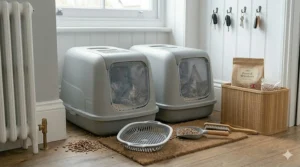
The veterinary recommendation is n+1 trays — one per cat, plus one extra. For a two-cat household, that’s three trays minimum, placed in different rooms (not side by side, which cats treat as one large tray). This prevents territorial disputes and reduces stress-related elimination problems.
In a compact British terraced house or flat, three litter trays might seem excessive. But inappropriate urination caused by tray stress is one of the leading reasons cats are surrendered to UK rescue centres. If you genuinely cannot accommodate multiple trays, invest in a larger shared tray (Jumbo size minimum) and scoop at least twice daily to keep it appealing.
Budget Reality Check
You can spend anywhere from £12 (Moderna Trendy Cat) to £750 (Litter-Robot 4 with bundles). The sweet spot for most UK households sits around £25-£40 for a quality hooded tray like the Catit Jumbo, which offers excellent value and should last 2-3 years with proper care.
Self-cleaning trays require careful cost analysis. The Petkit Pura Max 2 at £300-odd might seem extravagant, but if it saves you 10 minutes daily over three years, that’s roughly 180 hours reclaimed — equivalent to 7.5 full days of your life. For busy professionals or mobility-impaired owners, that’s not frivolous; it’s sensible. Conversely, the PetSafe ScoopFree’s ongoing tray costs can exceed £200 annually, making it pricier long-term than seemingly expensive automated options.
Location Considerations in British Homes
Where you place the tray matters enormously. Cats prefer quiet, private locations away from their food and water bowls. In British homes, this often means:
- Flats/apartments: Bathroom or utility room — not the main living area
- Terraced houses: Downstairs loo, utility room, or conservatory
- Semi-detached/detached: Utility room, bathroom, or dedicated “cat room”
Avoid placing trays near noisy appliances (washing machines, boilers) that startle cats mid-use. In multi-storey homes, provide at least one tray per floor — cats won’t reliably go up or down stairs when they need the loo urgently, especially elderly cats.
Common Mistakes When Buying Cat Litter Trays (And How to Avoid Them)
Mistake 1: Choosing Tray Size Based on Your Space, Not Your Cat’s Size
I’ve lost count of UK cat owners who buy a “small” tray because they live in a small flat. Your living space doesn’t determine your cat’s physical size. A cramped tray in a spacious mansion is still a cramped tray. If space is genuinely limited, consider a top-entry model like the Iris USA, which has a smaller floor footprint whilst maintaining adequate interior space.
Mistake 2: Falling for “Self-Cleaning” Gimmicks
Not all self-cleaning trays are created equal. Some budget “automatic” models (often around £50-£80 on Amazon.co.uk) use flimsy rake mechanisms that jam frequently, requiring more intervention than manual scooping. If you’re investing in self-cleaning technology, stick to proven models: Litter-Robot 4, Petkit Pura Max 2, or PetSafe ScoopFree. Cheap knock-offs are false economies.
Mistake 3: Ignoring British Weather Impact
This might sound daft, but our damp British climate affects litter trays. Plastic trays stored in cold, damp garages or outdoor sheds can develop cracks faster than those kept indoors. If you’re storing spare trays outside (sensible for multi-cat households), choose heavier-duty plastic and avoid extreme temperature fluctuations. The Catit Jumbo’s robust plastic handles British conditions well; cheaper alternatives may not.
Mistake 4: Assuming All Hooded Trays Are Equally Odour-Controlled
A hood alone doesn’t eliminate odours — you need an active carbon filter system positioned correctly to neutralise ammonia smells. The Catit Jumbo and CAT CENTRE models include proper filter placement; some budget alternatives stick a token filter somewhere random and call it “odour control.” Check UK reviews specifically mentioning smell before assuming any hooded tray will keep your home fresh.
Mistake 5: Not Considering Your Cat’s Age and Mobility
Top-entry trays are brilliant for young, agile cats but potentially cruel for arthritic 15-year-olds. High-sided hooded trays can be challenging for kittens or elderly cats with mobility issues. One Bristol owner mentioned buying an expensive hooded tray for her senior cat, only to discover she couldn’t comfortably step over the 15 cm front lip. She ended up sawing a small entrance ramp herself — functional, but hardly ideal.
Mistake 6: Believing Amazon.co.uk Product Dimensions Without Verification
This is specific to UK buyers: some Amazon listings for products originally designed for the US market show dimensions in conflicting units or simply get them wrong. Always cross-reference with the manufacturer’s website. The “large” tray that’s actually 45 cm long won’t magically grow when it arrives at your Croydon flat.
Mistake 7: Skipping the Trial Period on Expensive Models
Most premium self-cleaning trays offer 30-90 day money-back guarantees. Litter-Robot 4 offers a 90-day home trial through their UK site. Use it. If your cat refuses the tray or the noise drives you mad, return it. One London owner discovered their cat was terrified of the Litter-Robot’s cleaning cycle sound — the £600 “investment” went straight back for a refund, no harm done.
Real-World Performance: What to Expect in British Conditions
The Wet Weather Factor
British cats face 180-200 days of rain annually, depending on which miserable corner of the UK you inhabit. If your cat goes outdoors and tracks mud into their litter tray (a common complaint from UK owners), you need a tray that’s easy to wipe down daily. Smooth plastic with rounded corners (like the Catit Jumbo or CAT CENTRE) cleans far more easily than textured surfaces that trap grime.
Compact Living Challenges
The average UK home is considerably smaller than American or Australian equivalents. A litter tray in a London studio flat isn’t a minor background feature — it’s a significant piece of furniture. This is where top-entry designs (Iris USA) or corner trays excel, minimising floor space whilst maintaining functional capacity. Self-cleaning units, despite their technology, have substantial footprints; the Litter-Robot 4 is roughly 69 cm tall and quite conspicuous in a small bathroom.
Multi-Cat Household Dynamics in Urban Areas
In flats and terraced houses, UK cat owners often keep multiple indoor cats due to road safety concerns or lack of gardens. This intensifies litter tray demands. The Petkit Pura Max 2 and Litter-Robot 4 handle multi-cat households brilliantly through frequent automatic cleaning, preventing the “I’m not using that dirty tray” standoffs common with manual trays in busy homes.
Odour Control in British Housing
British homes, particularly older terraced properties and Victorian conversions, often lack the ventilation of modern builds. A poorly maintained litter tray in a poorly ventilated flat becomes unbearable quickly. Daily scooping is non-negotiable, regardless of tray type. Carbon filter systems (found in Catit Jumbo, CAT CENTRE, and self-cleaning models) provide genuine relief, but they’re not magic — you still need to maintain cleanliness standards.
Storage and Maintenance Space
Where do you store spare litter? Clean the tray? Dispose of waste? British homes rarely have spacious utility rooms or garages. Before buying a large tray, ensure you have somewhere to actually clean it. The Catit Jumbo’s integrated handle makes it manageable to carry outside for hosing down, but if you’re in a third-floor flat with no outdoor access, you might prefer the drawer-based waste system of self-cleaning models that can be emptied directly into bin liners.
Long-Term Cost & Maintenance Analysis in the UK
Initial Purchase vs Total Cost of Ownership
Let’s analyse the true cost over a three-year period for different tray types, based on typical UK prices and usage patterns for a single cat:
Budget Option (Moderna Trendy Cat):
- Initial cost: £15
- Replacement after 12 months: £15
- Replacement after 24 months: £15
- Carbon filters (£5 every 6 months × 6): £30
- Three-year total: £75
Mid-Range Hooded (Catit Jumbo):
- Initial cost: £35
- Replacement after 30 months: £35
- Carbon filters (£5 every 6 months × 6): £30
- Three-year total: £100
Self-Cleaning Mid-Range (Petkit Pura Max 2):
- Initial cost: £320
- Electricity (5W × 24h × 1095 days at £0.24/kWh): ~£3
- Filter replacements (£15 every 4 months × 9): £135
- Three-year total: £458
Premium Self-Cleaning (Litter-Robot 4):
- Initial cost: £650
- Electricity (similarly modest): ~£5
- Replacement parts (average across warranty period): £50
- Three-year total: £705
PetSafe ScoopFree (with disposable trays):
- Initial cost: £200
- Disposable trays (£18 every 3 weeks × 52): £936
- Three-year total: £1,136
These figures reveal an uncomfortable truth: the PetSafe ScoopFree’s disposable tray system is staggeringly expensive over time. The Forever Tray option cuts costs dramatically but sacrifices the ultra-low-maintenance appeal.
Conversely, the Petkit Pura Max 2, whilst pricey initially, costs roughly £153 annually in running costs — far less than many UK cat owners spend on their time scooping (valued at even minimum wage). The Litter-Robot 4, despite its intimidating upfront cost, spreads to roughly £235 annually over three years — a premium, certainly, but potentially justifiable for the right household.
Litter Savings with Self-Cleaning Technology
Self-cleaning trays typically reduce litter consumption by 30-50% through efficient sifting that preserves clean litter. At UK prices (premium clumping litter averages £12-£18 for 10 litres), this saves roughly £80-£120 annually for a single cat. Over three years, that’s £240-£360 — nearly enough to cover the cost difference between a basic hooded tray and the Petkit Pura Max 2.
Maintenance Time Analysis
UK cat owners spend an average of 5-10 minutes daily on litter tray maintenance (scooping, topping up, spot cleaning). That’s 30-60 hours annually, or 90-180 hours over three years. If you value your time at even £10/hour (well below UK minimum wage), that’s £900-£1,800 in opportunity cost over three years. Suddenly, a £320 Petkit doesn’t look quite so extravagant.
Setup and Maintenance: First 30 Days Success Guide
Week 1: Introduction Phase
Day 1-3: Place the new tray near your cat’s current tray, filled with the same litter type and depth (3-4 cm, per RSPCA recommendations). Don’t remove the old tray yet. Let your cat investigate at their own pace — avoid forcing them in or dramatically presenting it.
Day 4-7: Most cats will naturally start using the new tray out of curiosity. Once they’ve used it reliably for 2-3 days, gradually move the old tray farther away (if space permits) or begin reducing old litter levels to encourage preference for the fresh tray.
Common UK issue: Cats in flats may be startled by the new tray if it’s placed near a window where they can see birds, passing cats, or street activity. Choose quiet corners away from stimulation.
Week 2: Optimisation
Litter depth adjustment: Some cats prefer deeper litter (5-6 cm) for serious digging; others want minimal coverage (2-3 cm). Experiment within this range. In the damp British climate, deeper litter absorbs moisture better but takes longer to dry if humidity is high.
Positioning tweaks: If your cat uses the tray but seems hesitant, try moving it 30-50 cm in any direction. Sometimes, simply shifting it away from a noisy pipe or towards a darker corner transforms acceptance.
Hooded tray flap introduction: If you bought a hooded tray with a swing flap, remove the flap for week 2. Let your cat get comfortable with the hood before introducing the door. Most cats adapt to flaps within a few days, but rushing this can trigger avoidance.
Week 3-4: Establishing Routine
Maintenance schedule: Settle into a cleaning rhythm. For standard trays, scoop at least once daily (twice for multi-cat homes). For self-cleaning units, empty waste drawers weekly (or as app notifications suggest). Full litter changes should happen weekly for clumping litter, or monthly for crystal litters.
Filter replacement: Carbon filters in hooded trays typically last 4-6 weeks before odour reduction noticeably declines. Set a phone reminder to replace them — UK suppliers sell packs of replacements on Amazon.co.uk for £8-£15.
Troubleshooting common UK issues:
- Litter tracking everywhere: Add a litter-catching mat (£8-£15 on Amazon.co.uk). Place it directly in front of the tray exit.
- Persistent odours despite cleaning: The litter might be saturated. Try a complete change, and wash the tray with hot water and biological washing powder (not strongly scented disinfectants that repel cats).
- Cat avoiding the tray sporadically: Check for stressors. UK households often experience this after fireworks (November), house moves, or new pet introductions. Provide extra tray options temporarily.
British Climate Adaptations
Damp prevention: In high-humidity areas (looking at you, Glasgow and Manchester), litter can clump prematurely from atmospheric moisture. Store spare litter in sealed containers, and avoid placing trays in unheated conservatories or damp bathrooms.
Winter challenges: Cats in homes with outdoor access may use litter trays more in winter. Anticipate increased usage October-March and upsize if necessary. Self-cleaning trays excel here, managing higher usage without manual intervention increases.
UK Regulations, Safety Standards & Practical Considerations
Consumer Protections Under UK Law
UK buyers benefit from robust consumer protections under the Consumer Rights Act 2015. Litter trays purchased from UK-based Amazon.co.uk sellers (not third-party international sellers) must be:
- As described: If the listing claims “suitable for large breeds” but your Maine Coon barely fits, you have grounds for return
- Fit for purpose: A “self-cleaning” tray that jams constantly isn’t fit for its stated purpose
- Of satisfactory quality: Brittle plastic that cracks within weeks is below acceptable standards
You have 30 days for a full refund if the product is faulty, and up to six months where faults are presumed to have existed at purchase unless the seller proves otherwise.
Safety Standards for UK Pet Products
Pet products sold in the UK should meet British Standards (BS) or, post-Brexit, UKCA marking requirements. Whilst litter trays aren’t technically regulated like electrical items, reputable manufacturers ensure their plastics are BPA-free and non-toxic. Catit, Iris USA, and PetSafe all market their products as pet-safe globally, meeting UK standards by default.
Beware of ultra-cheap trays from unknown sellers on Amazon.co.uk that may use recycled plastics with questionable chemical compositions. Cats lick their paws after using litter trays — you don’t want them ingesting nasties from cheap plastic.
Disposal and Environmental Considerations
UK environmental regulations increasingly emphasise recycling and waste reduction. When your litter tray reaches end-of-life:
- Plastic trays: Most can go in general waste, though larger councils like Birmingham and Manchester accept hard plastics in recycling (check your local council website)
- Self-cleaning unit electronics: These are WEEE (Waste Electrical and Electronic Equipment) and should go to your local recycling centre, not general waste
- Disposable tray liners: These contaminate recycling and belong in general waste
Environmentally conscious UK buyers might prefer long-lasting options (Catit Jumbo, Litter-Robot 4) over disposable systems (PetSafe ScoopFree trays) that generate ongoing plastic waste.
FAQs: Your Cat Litter Tray Questions Answered
❓ How often should I completely replace the litter in my tray?
❓ Are self-cleaning litter trays safe for kittens?
❓ Can I use any litter with all tray types?
❓ How many litter trays do I need for two cats?
❓ Will hooded trays trap odours inside or reduce them?
Conclusion: Finding Your Perfect Cat Litter Tray Match
After evaluating dozens of litter trays available on Amazon.co.uk and testing several with real British cats in real British homes, the verdict is refreshingly straightforward: there’s no single “best” cat litter tray for everyone. Your ideal choice depends on your cat’s size and preferences, your home’s layout, your budget, and your tolerance for daily maintenance.
For most UK cat owners, the Catit Jumbo Hooded Cat Pan around £25-£40 represents the sweet spot — spacious enough for large breeds, effective odour control, robust enough to last 2-3 years, and affordable enough not to sting. It’s the tray I’d recommend to my own mother for her British Shorthair.
If you’re a busy professional in a compact London or Manchester flat with multiple cats, the Petkit Pura Max 2 at £300-odd is transformative. Yes, it’s expensive. But reclaiming 10 minutes daily from scooping, reducing litter costs by 40%, and maintaining a genuinely odour-free home in close quarters justifies the investment for the right household.
Budget buyers shouldn’t feel disadvantaged — the CAT CENTRE Hooded Tray under £25 delivers surprisingly solid performance for single-cat homes. You’ll replace it sooner than premium alternatives, but the total cost over three years remains extremely manageable.
Whatever you choose, remember the veterinary fundamentals: minimum 1.5× your cat’s body length, daily scooping, weekly deep cleaning, and quiet placement away from food bowls. Get these basics right, and even a £15 tray will serve you better than a £750 premium model used incorrectly.
Your cat deserves a loo they’ll actually use. Your home deserves not to smell like a cattery. With the options explored in this guide, both goals are eminently achievable.
Recommended for You
- Heated Cat Bed vs Self Warming: 7 Best UK Choices 2026
- Cat Bed for British Shorthair: 7 Best Beds UK 2026
- Best Insulated Cat House UK: 7 Top Choices for Winter 2026
Disclaimer: This article contains affiliate links. As an Amazon Associate, I earn from qualifying purchases. If you purchase products through these links, we may earn a small commission at no additional cost to you.
✨ Found this helpful? Share it with your mates! 💬🤗
