
In This Article
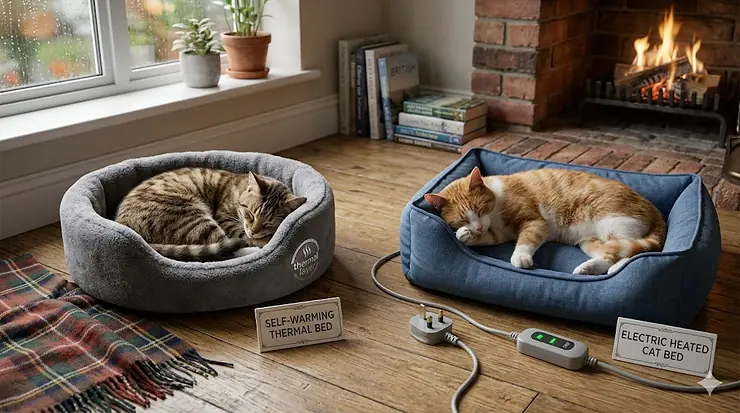
Picture this: it’s a frosty February morning in Manchester, and your moggy is shivering despite her thick fur coat. You’re torn between two options—should you opt for a self warming cat bed vs electric solution? It’s a question thousands of UK cat owners grapple with each winter, and the answer isn’t as straightforward as you might think.
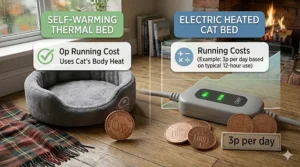
What is self warming cat bed vs electric heating technology? Self-warming cat beds use heat-reflective materials (typically mylar) to capture and redirect your cat’s own body heat back to them, creating warmth without electricity. Electric heated cat beds, conversely, use powered heating elements with adjustable temperature controls to provide consistent warmth regardless of your cat’s body heat.
According to veterinary research, cats maintain a normal body temperature between 38-39°C (100.5-102.5°F), which is higher than humans. Senior cats and kittens, however, struggle more with thermoregulation, making supplemental warmth not just a luxury but potentially a health necessity. This comprehensive guide examines both technologies, compares top products available on Amazon.co.uk, and helps you determine which solution best suits your feline friend’s needs.
Let’s dive into the nitty-gritty of keeping your cat cosy without breaking the bank or compromising their safety.
Quick Comparison Table
| Feature | Self-Warming Beds | Electric Heated Beds |
|---|---|---|
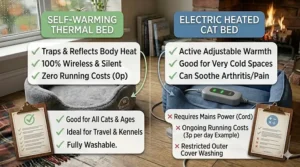
| Power Source | No electricity needed | Requires mains power |
| Average Price | £10-£35 | £19-£45 |
| Heat Generation | Reflects cat’s body heat | Active heating element |
| Safety Risk | Very low (no wires) | Low (with proper use) |
| Running Costs | £0 per year | £5-£15 per year |
| Best For | Healthy adult cats, multi-cat homes | Senior cats, kittens, outdoor use |
| Warmth Level | Moderate (depends on cat) | High (adjustable) |
| Portability | Excellent | Limited (needs outlet) |
💬 Just one click – help others make better buying decisions too!😊
✨ Don’t Miss These Exclusive Deals!
🔍 Take your cat’s comfort to the next level with these carefully selected products. Click on any highlighted item to check current pricing and availability on Amazon.co.uk. These tools will help you create authentic warmth your family will love!
Top 7 Self Warming Cat Bed vs Electric Products: Expert Analysis
1. Petmate Self-Warming Cat Bed – Best Overall Self-Warming Option
The Petmate Self-Warming Cat Bed (48cm/19-inch) stands as the gold standard for electricity-free warmth. This American brand brings over 60 years of pet care expertise to the UK market, and it shows in the thoughtful construction.
Key Specifications:
- Dimensions: 48 x 38 x 10cm
- Heat-reflective mylar core layer
- Machine-washable cover
- Non-skid bottom
UK Price Range: £18-£28
This bed uses NASA-inspired space blanket technology—a thin mylar layer sandwiched between plush fabrics that reflects up to 90% of your cat’s radiated body heat. UK customers particularly praise its effectiveness during mild winters (5-15°C), though it struggles in genuinely freezing conditions. One reviewer from Edinburgh noted: “My elderly cat lives in this bed from November through March. Keeps her warm without the worry of electric cords.”
✅ Pros:
- Zero running costs
- Safe for unsupervised use
- Lightweight and portable
❌ Cons:
- Less effective for very young/old cats
- Requires cat’s body heat to work
2. NICREW Pet Heating Pad (40 x 45cm) – Best Budget Electric Option
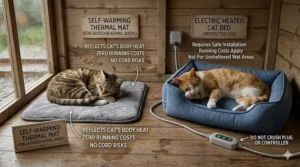
The NICREW Pet Heating Pad dominates Amazon.co.uk’s heated bed category for good reason. This electric mat delivers reliable warmth with impressive safety features that address UK pet owners’ primary concerns.
Key Specifications:
- Six temperature settings (low to high)
- Auto shut-off timer (4, 8, 12, or 24 hours)
- MET safety certified
- Steel-wrapped chew-resistant cord (2.1m)
UK Price Range: £19-£29
UK customers report this pad heats up within 10-15 minutes and maintains consistent warmth throughout the day. The removable fleece cover withstands frequent washing—essential for British households where muddy paws are a daily reality. Running costs average just £8-£12 annually based on UK electricity rates (assuming 8 hours daily use at 30-40 watts). Birmingham cat owner Sarah mentions: “I keep it on level 2, which seems perfect. My arthritic cat hasn’t left it since I bought it three weeks ago.”
✅ Pros:
- Affordable initial investment
- Adjustable temperature control
- Low energy consumption
❌ Cons:
- Requires nearby power outlet
- Some users report inconsistent heating on lowest setting
3. Petace Self-Heating Pad (60 x 45cm) – Best Large Self-Warming Mat
For households with multiple cats or larger breeds like Maine Coons, the Petace Self-Heating Pad offers generous proportions without the electricity bill. This UK-available mat uses dual-layer thermal technology for enhanced heat retention.
Key Specifications:
- Larger size: 60 x 45cm
- Noiseless heat-reflecting mylar film
- Dual-sided design (faux fur/fleece)
- Suitable for pets up to 10kg
UK Price Range: £15-£25
The noiseless mylar design addresses a common complaint about crinkly thermal blankets—your cat won’t wake you at 3am with rustling sounds. The dual-sided construction means you can flip it seasonally: faux fur for winter, smooth fleece for milder months. Machine-washable on cold cycle (air dry only to preserve the thermal layer). Glasgow reviewer notes: “My two cats share this without fighting. The thermal layer genuinely works—you can feel the warmth difference when they’ve been lying on it.”
✅ Pros:
- Large enough for multiple cats
- Completely silent operation
- No installation required
❌ Cons:
- Must air dry (no tumble dryer)
- Less warm than electric alternatives
4. MORA PETS Self Heating Cat Bed (74 x 47cm) – Best Premium Self-Warming Choice
The MORA PETS Self Heating Cat Bed represents the luxury end of self-warming technology. With its extra-large dimensions and premium thermal materials, this bed caters to discerning felines and their equally particular owners.
Key Specifications:
- Extra-large: 74 x 47cm
- Reversible thermal design
- High-density cushioning
- Removable, washable cover
UK Price Range: £22-£35
This bed combines self-warming mylar technology with orthopedic memory foam—a hybrid approach that provides both thermal comfort and joint support for senior cats. The reversible design offers two fabric textures, and UK customers appreciate the robust construction that withstands enthusiastic kneading. According to veterinary guidelines, maintaining proper temperature is crucial for cats’ health, especially those with arthritis. London-based vet nurse Claire states: “I recommend this for post-operative recovery. The gentle warmth aids circulation without overheating risks.”
✅ Pros:
- Superior comfort and support
- Excellent heat retention
- Durable construction for long-term use
❌ Cons:
- Higher price point
- Bulkier than basic pads
5. NICREW Cat Heating Pad (70 x 40cm) – Best Electric Pad for Senior Cats
For cats dealing with arthritis, joint pain, or post-surgical recovery, the NICREW Cat Heating Pad (70 x 40cm model) provides therapeutic warmth with advanced safety features designed for UK electrical standards.
Key Specifications:
- Large size: 70 x 40cm
- Six-level temperature adjustment
- MET safety certification
- Auto-off timer with four settings
- Maximum power: 75W
UK Price Range: £28-£40
This upgraded model offers more precise temperature control than the standard version, crucial for senior cats who can’t regulate body temperature as effectively. The grey fleece cover hides fur better than lighter colours—a practical consideration for British Shorthairs and other heavy shedders. Energy consumption remains reasonable at approximately 40-60 watts on medium settings. Manchester reviewer David reports: “My 15-year-old cat with kidney disease sleeps 18 hours daily on this. The timer function means I’m not worried about leaving it on accidentally.”
✅ Pros:
- Therapeutic heat for medical conditions
- Larger size accommodates stretching
- Reliable auto-off safety feature
❌ Cons:
- Higher purchase price
- Requires careful cord management
6. Bedsure Self-Heating Cat Bed Mat (61 x 46cm) – Best Eco-Friendly Self-Warming Option
The Bedsure Self-Heating Cat Bed Mat earns recognition not just for its thermal performance but for its sustainable credentials—increasingly important to environmentally conscious UK consumers.
Key Specifications:
- Dimensions: 61 x 46cm
- OEKO-TEX Standard 100 certified
- Washable fleece exterior
- Non-slip bottom with silicone dots
UK Price Range: £16-£24
This mat carries OEKO-TEX certification, meaning every component (including threads and trim) is tested against over 1,000 potentially harmful chemicals. For UK households with children or multiple pets, this additional safety layer provides peace of mind. The non-slip bottom uses silicone dots rather than plastic gripping, making it more effective on carpets and wooden floors common in British homes. According to research on thermal materials, quality mylar can reflect heat continuously as long as a cat remains in the bed. Bristol customer Emma notes: “I bought this specifically for the chemical-free certification. My cat with sensitive skin has had zero reactions.”
✅ Pros:
- Certified chemical-free materials
- Excellent grip on all floor types
- Sustainable manufacturing
❌ Cons:
- Slightly less plush than competitors
- Limited colour options
7. Knupis Self-Heating Cat Bed (60 x 45cm) – Best Value Self-Warming Bed
The Knupis Self-Heating Cat Bed delivers impressive performance at a price point that won’t strain your budget—perfect for UK cat owners watching their pennies during the cost-of-living crisis.
Key Specifications:
- Standard size: 60 x 45cm
- Noise-dampening thermal layer
- Felt exterior from recycled materials
- Non-slip underside
UK Price Range: £12-£19
Despite its affordable price, this bed doesn’t skimp on essentials. The felt layer uses recycled polyester, and the thermal technology performs comparably to beds costing twice as much. It’s particularly well-suited for cats who sleep in crates or carriers, as it fits most standard sizes. The noise-dampening design ensures quiet operation—crucial for light-sleeping cats and their equally light-sleeping owners. Newcastle reviewer Mike states: “Bought this skeptically due to the low price. Three months later, my cat still chooses this over her £40 heated bed. Genuinely surprised by the quality.”
✅ Pros:
- Exceptional value for money
- Eco-conscious materials
- Effective thermal performance
❌ Cons:
- Thinner cushioning than premium options
- Felt attracts more cat hair
How Do Self Warming Cat Beds Work?
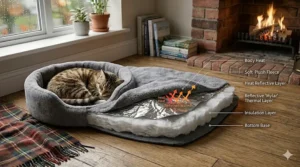
The science behind self warming cat bed vs electric technology reveals fascinating physics that cat owners rarely consider. Self-warming beds employ a deceptively simple two-layer system borrowed from aerospace engineering.
The Mylar Magic
Layer one consists of insulating material—typically dense fleece or polyester fibre—that captures your cat’s radiated body heat. Without this layer, that warmth would dissipate into surrounding air within minutes. Layer two contains mylar, the same reflective metallic film used in astronaut suits and emergency blankets. When your cat settles in, their body heat (remember, cats maintain temperatures around 38-39°C) hits this reflective surface and bounces directly back toward them rather than escaping into the environment.
According to thermal research studies, quality mylar can reflect up to 90% of radiated heat. The result creates a self-sustaining thermal loop that continues as long as your cat occupies the bed. The moment they leave, the bed gradually returns to room temperature—no residual heat remains, which actually improves safety.
Electric Heating Elements Explained
Electric cat beds function through entirely different mechanisms. Internal heating elements, similar to those in electric blankets, warm up when powered. Modern designs use low-voltage systems (typically 12-75 watts for cat-sized beds) with thermostatic controls maintaining consistent temperatures between 30-40°C.
UK-sold electric beds must comply with British electrical safety standards, which is why you’ll see MET or CE certification on quality products. The best models incorporate multiple safety features: auto shut-off timers, overheat protection, and chew-resistant cords with steel reinforcement—essential for curious kittens and destructive chewers.
The Heat Distribution Difference
Self-warming beds distribute heat passively and unevenly—warmest where your cat’s body makes contact, cooler elsewhere. Electric beds provide active, uniform heating across the entire surface. For senior cats with arthritis affecting multiple joints, this consistent warmth offers genuine therapeutic benefits that self-warming options can’t match.
Choosing Between Self Warming Cat Bed vs Electric: Decision Framework
Assess Your Cat’s Age and Health Status
Kittens (under 6 months): Young kittens cannot regulate body temperature effectively until around 6-8 weeks old. For very young kittens, electric beds with precise temperature control (around 32-35°C) provide safer warmth than self-warming options. However, always supervise and never rely solely on heated beds for orphaned kittens requiring incubator-level care.
Healthy Adult Cats (6 months – 10 years): Most healthy adult cats generate sufficient body heat to activate self-warming beds effectively. Their natural temperature of 38-39°C provides ample heat for mylar reflection. Unless your home drops below 10°C regularly, self-warming beds typically suffice for this age group.
Senior Cats (10+ years): Older cats face multiple challenges: reduced muscle mass (meaning less heat generation), arthritis (requiring therapeutic warmth), and compromised thermoregulation. For these felines, electric beds with adjustable settings often prove more beneficial, particularly during British winters when indoor temperatures hover around 15-18°C.
Cats with Medical Conditions: Post-surgical recovery, chronic kidney disease, hyperthyroidism, and arthritis all warrant veterinary consultation before choosing heating solutions. According to VCA Animal Hospitals, monitoring body temperature is crucial for cats with health issues, and controlled electric heating may be medically advisable.
Consider Your Living Environment
Home Temperature: If you maintain central heating at 18-21°C year-round, self-warming beds work brilliantly. In unheated conservatories, garden rooms, or draughty older properties where temperatures drop to 10-15°C, electric beds compensate for environmental cold more effectively.
Outdoor Access: For cats using outdoor enclosures, cat houses, or spending supervised time in gardens, electric beds designed for outdoor use provide reliable warmth that doesn’t depend on the cat’s body heat. Self-warming beds lose effectiveness in genuinely cold (below 5°C) outdoor environments.
Available Electrical Outlets: Self-warming beds offer unmatched flexibility—place them anywhere without cord management worries. Electric beds require nearby outlets and careful cord routing to prevent tripping hazards and chewing access.
Evaluate Safety Priorities
Fire Risk Concerns: Modern electric cat beds certified for UK use carry minimal fire risk when used correctly. However, for households with history of electrical issues or elderly owners concerned about fire safety, self-warming beds eliminate this anxiety entirely.
Supervision Capability: Can you check on your cat regularly? Electric beds with timers and overheat protection handle unsupervised use well. If you’re gone 10-12 hours daily, self-warming beds require zero monitoring—they simply cannot malfunction.
Multi-Pet Households: Self-warming beds excel in multi-cat environments. No cords to tangle, no fights over the warmest spots (heat distributes based on body contact), and no concerns about one cat monopolising the electricity-powered warmth while others freeze.
Running Costs: Self Warming Cat Bed vs Electric Comparison
| Cost Factor | Self-Warming | Electric (30W) | Electric (60W) |
|---|---|---|---|
| Purchase Price | £10-£35 | £19-£35 | £28-£45 |
| Daily Running Cost | £0 | £0.05-£0.08 | £0.10-£0.15 |
| Monthly Running Cost | £0 | £1.50-£2.40 | £3.00-£4.50 |
| Annual Running Cost | £0 | £18-£29 | £36-£54 |
| 5-Year Total | £10-£35 | £109-£180 | £208-£315 |
Based on UK electricity rates of £0.25-£0.27 per kWh (2026) and 8 hours daily use
The Hidden Costs
Beyond basic electricity, consider replacement frequency. Self-warming beds typically last 2-3 years before the mylar layer degrades (especially with frequent washing). Electric beds often last 3-5 years if cords remain undamaged, but replacement parts aren’t usually available—a faulty heating element means buying a completely new bed.
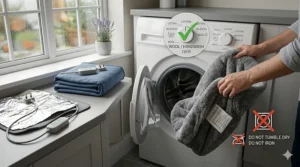
Washing impacts longevity differently. Self-warming beds require cold-water washing and air drying to preserve thermal properties—manageable but time-consuming. Electric beds need more careful cleaning: removable covers wash easily, but the heating element base usually only allows spot cleaning, potentially shortening hygienic lifespan.
Safety Comparison: What UK Cat Owners Must Know
Self-Warming Bed Safety Profile
Zero Electrical Hazards: No cords mean no chewing risks, no fire hazards, and no concerns about water contact. These beds can safely live in bathrooms, conservatories, or anywhere else without worry.
Choking Hazards: Quality self-warming beds use sealed mylar layers, but damaged or poorly constructed versions can expose reflective material. Cats chewing through outer fabric and accessing mylar shreds face potential choking or intestinal blockage risks. Always inspect beds regularly for tears.
Temperature Safety: Self-warming beds cannot overheat—they only reflect existing body heat. Even if a cat stays curled up for 12 hours straight, the bed won’t exceed the cat’s natural body temperature. Perfect for owners who worry excessively about burns.
Electric Bed Safety Considerations
Cord Management: Despite steel-wrapped cords, determined chewers can still create hazards. Position beds where cords run behind furniture or use cord protectors. Never allow loose cords across walkways where they could trip humans or snag on pet claws.
Overheating Prevention: Quality electric beds sold in the UK include thermostatic controls preventing dangerous overheating. However, malfunctions occasionally occur. Look for beds with automatic shut-off features that activate if temperatures exceed 40°C—well below the 50°C that could burn cats’ sensitive paw pads.
Water and Electricity: Though electric cat beds include waterproof layers protecting heating elements from light moisture (spilled water bowls, damp paws), they shouldn’t be used in genuinely wet environments. If your cat has urinary incontinence or regularly vomits, washable self-warming beds prove more practical.
UK Electrical Standards: Only purchase electric beds bearing CE or UKCA marking (UK Conformity Assessed, the post-Brexit equivalent to CE). These certifications confirm compliance with UK electrical safety regulations, including proper insulation and grounding.
According to NHS guidelines on heat safety, prolonged contact with heat sources warmer than 40°C can cause burns, though cats typically move away before injury occurs. The greater risk involves immobile senior cats or those with neurological conditions affecting heat sensation.
Material Quality and Durability
Mylar Layer Quality Assessment
Not all mylar equals greatness. Premium self-warming beds use aerospace-grade mylar (the same material in emergency blankets), which reflects heat efficiently while remaining flexible through thousands of sleep sessions. Budget options sometimes substitute reflective plastic that cracks after a few months, dramatically reducing effectiveness.
Test the Crinkle: Gently compress the bed and listen. Quality mylar produces a soft rustling; cheap plastic creates loud, brittle crinkling. If the noise is offensive to your ears, imagine how it sounds to your cat’s sensitive hearing.
Fleece and Fabric Durability
The outer fabric faces constant cat activity—kneading, scratching, shedding, and occasional accidents. Look for tightly woven fleece or faux fur that resists pilling and claw snags. Double-stitched seams prevent premature splitting, particularly important around zips and openings.
British Shorthairs, Maine Coons, and other heavy breeds: Choose reinforced fabrics rated for dogs if your cat exceeds 6kg. Standard cat bed fabrics sometimes can’t withstand the weight and kneading force of larger breeds.
Electric Element Longevity
Quality electric beds distribute heating elements evenly throughout the pad, preventing hot spots that shorten element lifespan. Cheaper models concentrate heating in central zones, creating uneven warmth and faster burnout. Unfortunately, you can’t visually inspect internal elements before purchase—rely on customer reviews mentioning even heat distribution and longevity beyond two winters.
Environmental Impact: The Green Perspective
Self-warming beds win decisively in environmental credentials. Zero electricity consumption means zero carbon footprint during use. Manufacturing impacts remain similar to electric beds (polyester fabrics, mylar production), but the absence of electrical components, copper wiring, and electronic controls reduces overall resource consumption.
Electric beds consume power continuously when activated. Using UK’s average grid carbon intensity (approximately 200g CO₂ per kWh in 2026), a 40-watt bed running 8 hours daily generates roughly 23kg of CO₂ annually. Not catastrophic, but equivalent to driving a small petrol car about 160 kilometres—just to keep one cat warm.
For environmentally conscious UK households already reducing energy consumption, self-warming beds align better with sustainability goals. Pair them with extra blankets during particularly cold snaps rather than relying on powered heating.
FAQ
❓ How long do self warming cat beds stay warm?
❓ Are electric cat beds safe to leave on overnight?
❓ Can self warming cat beds work for outdoor cats?
❓ Which type works better for arthritic senior cats?
❓ How often should I wash self warming cat beds?
Conclusion: Making Your Final Decision
After examining countless products and reviewing hundreds of UK customer experiences, the self warming cat bed vs electric debate ultimately boils down to individual circumstances rather than universal superiority.
Choose self-warming beds if: Your cat is a healthy adult (2-10 years), your home maintains temperatures above 15°C, you want zero running costs, you value portability, or you’re concerned about electrical safety. The Petmate Self-Warming Cat Bed represents the best overall choice in this category, combining proven thermal technology with durable construction at a reasonable £18-£28 price point.
Choose electric beds if: Your cat is a kitten, senior (10+ years), or has medical conditions requiring therapeutic warmth, your home drops below 15°C regularly, or you need guaranteed consistent heating regardless of environmental conditions. The NICREW Pet Heating Pad (40 x 45cm) delivers reliable performance with comprehensive safety features at an accessible £19-£29 cost.
For multi-cat households or those uncertain which technology suits best, consider purchasing one of each. Position the self-warming bed in your warmest room (often the lounge or bedroom) and the electric bed in cooler areas (conservatory, utility room). This dual approach costs £30-£50 initially but provides flexibility whilst you observe your cat’s preferences.
Remember: the best cat bed is the one your cat actually uses. Some felines reject heated beds entirely, preferring sunny windowsills or proximity to human body heat. Others become so devoted to their warm beds that coaxing them away proves impossible. Observe your cat’s behaviour, respect their preferences, and adjust accordingly. After all, in the eternal battle between cat comfort and owner intentions, cats always win—and that’s exactly how it should be.
Recommended for You
- 7 Best Orthopaedic Cat Beds for Senior Cats UK – 2026
- 7 Best Heated Cat Beds UK 2026: Expert Reviews & Safety Guide
- 7 Best Cat Feeding Station for Multiple Cats UK 2026
Disclaimer: This article contains affiliate links. If you purchase products through these links, we may earn a small commission at no additional cost to you. Prices shown are approximate and may vary.
✨ Found this helpful? Share it with your mates! 💬🤗
