
In This Article
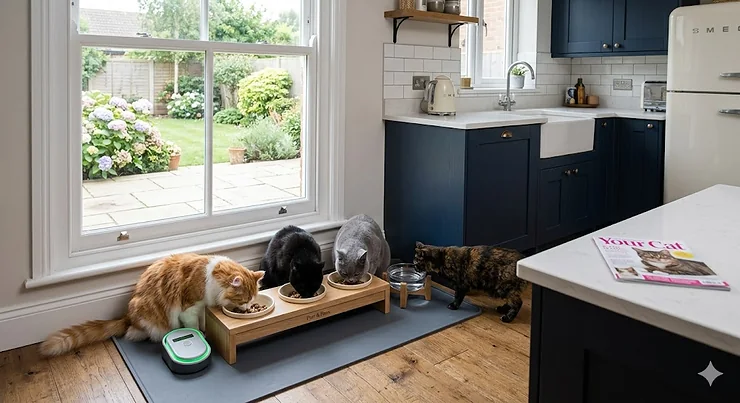
If you’ve ever witnessed the chaotic mealtime scramble in a multi-cat household, you’ll know that feeding multiple felines isn’t simply about plonking down a single bowl and hoping for the best. I’ve seen it all—from the greedy tabby who hoovers up everyone’s dinner in record time to the timid Persian who waits anxiously in the corner, too stressed to approach the shared feeding area.
The truth is, cats are solitary hunters by nature, and sharing feeding spaces can trigger stress, territorial aggression, and even health problems. According to research published in the Journal of Feline Medicine and Surgery, approximately half of multi-cat households only provide one food dish for multiple cats, which can force cats to eat whilst feeling significant stress or anxiety rather than forgo a meal altogether.
That’s where a proper cat feeding station for multiple cats becomes absolutely essential. Whether you’re managing two cats or a houseful of felines, the right feeding setup can transform mealtime from a battlefield into a peaceful dining experience. In this comprehensive guide, I’ll walk you through the seven best feeding stations available on Amazon.co.uk in 2026, helping you choose the perfect solution for your furry family.
Quick Comparison Table
| Product | Type | Price Range (£) | Best For | Rating |
|---|---|---|---|---|
| PETLIBRO Granary Dual-Food Trays | Automatic WiFi | £105.99-£149.99 | Tech-savvy households with 2 cats | 4.4/5 |
| SureFeed Microchip Pet Feeder | Microchip-activated | £120.00-£140.00 | Cats on special diets | 4.5/5 |
| Cat Mate C500 | 5-bowl automatic | £32.72+ | Budget-conscious families | 4.3/5 |
| GHIAKQYT 3-Bowl Bamboo Station | Raised static | £15.00-£25.00 | Ergonomic feeding | 4.4/5 |
| Cat Mate C200 | 2-meal automatic | £21.60+ | Weekend getaways | 4.3/5 |
| Optyuwah Wooden Station | 3-bowl raised | £20.00-£30.00 | Style-conscious owners | 4.5/5 |
| Cat Mate C300 | 3-meal automatic | £25.00-£35.00 | Scheduled feeding | 4.2/5 |
💬 Just one click – help others make better buying decisions too! 😊
Top 7 Cat Feeding Stations for Multiple Cats: Expert Analysis
1. PETLIBRO Granary Dual-Food Trays Automatic Pet Feeder
The PETLIBRO Granary Dual-Food Trays is a game-changer for households with two cats who need separate portions but don’t necessarily require entirely different diets. With its impressive 5-litre capacity and dual stainless steel bowls, this WiFi-enabled feeder brings 21st-century convenience to your multi-cat home.
Key Specifications:
- 5L total capacity with dual food trays
- 5GHz and 2.4GHz WiFi compatibility
- Up to 10 meals per day with customisable portions (20-240ml per meal)
Price: £105.99-£149.99 (depending on camera model)
UK cat owners rave about the app control feature, which allows you to programme feeding schedules remotely—perfect for those long commutes or unexpected late nights at the office. One Brighton-based buyer noted: “Game-changer for our two Bengals. The app sends notifications when feeding occurs, and I can adjust portions on the go.”
✅ Pros:
- Dual power supply (mains + battery backup)
- 10-second voice recording feature
- Infrared sensor prevents clogging
❌ Cons:
- Higher price point
- Requires stable WiFi connection
Best for: Tech-savvy households with two cats needing portion control
2. SureFeed Microchip Pet Feeder
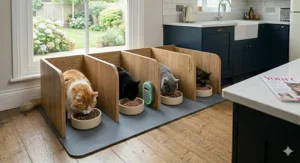
If you’ve got one cat on a prescription diet whilst the others eat standard fare, the SureFeed Microchip Pet Feeder is nothing short of revolutionary. This clever device reads your cat’s existing microchip (or RFID collar tag) and only opens for authorised felines—no more food thieves!
Key Specifications:
- Compatible with all UK/EU microchip formats
- Stores up to 32 different microchip IDs
- 400ml bowl capacity (suitable for 2 wet food pouches)
Price: £120.00-£140.00
The sealed bowl design keeps food fresh and fly-free, whilst the training mode helps nervous cats adjust gradually. A Manchester cat owner shared: “Our diabetic Russian Blue can now eat his special food in peace without our other cats stealing it. Worth every penny after spending over £1,000 on vet bills.”
✅ Pros:
- Perfect for special dietary requirements
- 6-month battery life (4 x C batteries)
- Dishwasher-safe bowls and lids
❌ Cons:
- Only accommodates one cat at a time
- Some cats may need extended training period
Best for: Multi-cat households where dietary separation is crucial
3. Cat Mate C500 Automatic 5 Bowl Digital Timer-Controlled Pet Feeder
For those seeking excellent value without compromising functionality, the Cat Mate C500 delivers brilliantly. This rotating carousel-style feeder serves up to five meals on a digital timer, making it ideal for extended absences or strict feeding schedules.
Key Specifications:
- 5 compartments holding up to 330g each
- Digital LCD timer for precise scheduling
- Includes twin ice packs for wet food
Price: £32.72+
The design allows you to pre-programme meals up to 5 days in advance—a godsend for weekend getaways. UK buyers appreciate the dishwasher-safe bowls and the ability to use both wet and dry food. One London reviewer mentioned: “The ice packs keep wet food fresh for hours. My two cats are fed on time even when I’m working late shifts.”
✅ Pros:
- Exceptional value for money
- Versatile (wet or dry food)
- Low running costs (3 x AA batteries last ~12 months)
❌ Cons:
- Bowls quite deep (may cause whisker fatigue for some cats)
- Ice pack coverage doesn’t extend to all compartments
Best for: Budget-conscious families needing scheduled feeding
4. GHIAKQYT Cat Feeding Station with 3 Stainless Steel Bowls
This beautifully crafted bamboo feeding station brings both elegance and ergonomic benefits to your multi-cat household. The GHIAKQYT 3-Bowl Station features adjustable height settings and a sturdy wooden frame that complements any modern kitchen.
Key Specifications:
- 3 x food-grade stainless steel bowls (350ml each)
- 2 adjustable height positions
- Sustainable bamboo construction
Price: £15.00-£25.00
The raised design reduces neck strain—particularly beneficial for senior cats or those with arthritis. The non-slip base prevents the dreaded “bowl chase” across your kitchen floor during enthusiastic eating sessions. A Glasgow buyer shared: “Our three cats can eat side-by-side without squabbling. The raised height has really helped our elderly tabby.”
✅ Pros:
- Excellent price point
- Dishwasher-safe bowls
- Water-repellent bamboo finish
❌ Cons:
- No automated features
- Requires manual refilling
Best for: Households wanting ergonomic, stylish static feeding
5. Cat Mate C200 Automatic 2 Meal Timer-Controlled Pet Feeder
The Cat Mate C200 offers brilliant simplicity for two-cat households or weekend feeding automation. This twin-compartment feeder uses reliable quartz timers to serve two separate 400g meals up to 48 hours apart.
Key Specifications:
- 2 large compartments (400g each)
- 48-hour quartz timers
- Lid-link clip for simultaneous opening
Price: £21.60+
The included ice pack keeps food fresh even during warmer months, whilst the lid-link feature allows both compartments to open simultaneously—perfect for preventing dinner-time disputes. One Edinburgh owner noted: “Brilliant for weekend trips. Both my cats get fed on schedule, and the ice pack keeps their wet food perfectly fresh.”
✅ Pros:
- Simple, reliable operation
- Dishwasher-safe components
- Tamper-resistant design
❌ Cons:
- Limited to 2 meals only
- Requires 1 x AA battery
Best for: Weekend getaways and simple scheduled feeding
6. Optyuwah Cat Bowl Pet Feeding Station
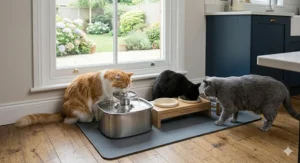
The Optyuwah Wooden Station combines aesthetic appeal with practical functionality. This three-bowl setup sits on an attractive wooden stand that adds a touch of Scandinavian-inspired design to your feeding area.
Key Specifications:
- 3 detachable stainless steel bowls
- Solid wood construction with anti-slip feet
- Dimensions: 44 x 14.5 x 10 cm
Price: £20.00-£30.00
The elevated design promotes better posture during eating, whilst the stainless steel bowls resist bacteria buildup. UK buyers praise the sturdy construction and the fact that bowls stay firmly in place even with enthusiastic eaters. A Cardiff reviewer mentioned: “Looks gorgeous in our kitchen, and our three cats no longer push their bowls around the floor.”
✅ Pros:
- Attractive natural wood finish
- Antimicrobial stainless steel
- Stable, won’t tip over
❌ Cons:
- Manual feeding only
- Wood requires occasional maintenance
Best for: Style-conscious owners wanting quality static feeding stations
7. Cat Mate C300 Automatic 3 Meal Pet Feeder with Digital Timer
Rounding out our selection, the Cat Mate C300 provides a middle-ground solution with three timed meals and digital precision. This feeder serves one immediate meal plus two scheduled servings—ideal for cats who thrive on routine.
Key Specifications:
- 3 compartments (330g each)
- Digital LCD timer with precise scheduling
- Ice pack included
Price: £25.00-£35.00
The digital timer allows for exact meal scheduling, whilst the compartments accommodate both wet and dry food. The fly-proof, tamper-resistant design ensures food stays fresh and secure. One Birmingham buyer shared: “Perfect for our three-cat household. I can stagger their feeding times to reduce competition.”
✅ Pros:
- Mid-range pricing
- Precise digital timing
- Suitable for various food types
❌ Cons:
- Requires 3 x AA batteries
- Slightly smaller portions than C500
Best for: Routine-focused households needing scheduled feeding
Understanding Your Multi-Cat Feeding Challenges
Managing mealtimes in a multi-cat household presents unique challenges that go far beyond simply providing enough food. Research from the National Centre for Biotechnology Information reveals that when cats are required to share feeding bowls or stations, they may experience significant stress or anxiety, with some cats even fighting before and during feeding due to crowding.
The Science Behind Feline Feeding Behaviour
Cats are solitary hunters by evolutionary design. Unlike pack animals such as dogs, cats haven’t developed specific behavioural mechanisms for regulating conflict around shared resources. According to Royal Canin’s veterinary research, free-ranging cats establish rigid personal routines for hunting, feeding, and territorial behaviour—they simply don’t share well.
In the wild, cats eat approximately 10-20 small meals throughout a 24-hour period, with each “meal” representing a single captured prey item. This natural feeding pattern contrasts sharply with the typical household practice of offering one or two large meals at a single feeding station—a setup that can lead to inactivity, distress, and often overconsumption.
Common Multi-Cat Feeding Problems
Food Aggression and Bullying
One dominant cat monopolising the food bowl whilst timid cats go hungry is alarmingly common. Research from the National Centre for Biotechnology Information indicates that cats may develop gorging behaviours, eating rapidly and subsequently vomiting, simply to avoid stressful encounters with other household cats during mealtimes.
Dietary Management Issues
When one cat requires prescription food or portion control whilst others eat standard fare, shared feeding becomes nearly impossible. The American Association of Feline Practitioners notes that unsuccessful stress-related coping behaviours in multi-cat households often stem from inadequate feeding arrangements.
Territorial Stress
Approximately 10% of household cats exhibit aggressive behaviours related to territoriality, according to recent veterinary studies. Food resources represent critical territory for cats, and competition can escalate stress levels significantly—one study found that cats in harmonious multi-cat homes had 35% lower cortisol levels compared to those in conflict-prone environments.
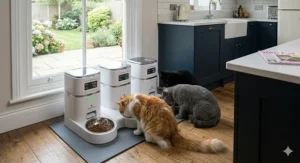
Essential Features to Look For in Multi-Cat Feeding Stations
Separate Dining Areas
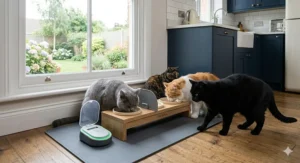
The golden rule for multi-cat feeding? Provide individual spaces. Research published in the Journal of Feline Medicine and Surgery recommends that cats be fed at least a cat’s body length apart from one another. For nervous or resource-guarding cats, completely separate rooms work best.
Material Quality and Hygiene
Stainless steel bowls offer superior hygiene compared to plastic alternatives. Pet food bowls rank amongst the most bacteria-laden kitchen surfaces, making daily washing essential. According to research on pet food safety, stainless steel provides an antimicrobial surface that, when cleaned regularly, prevents bacterial buildup and potential illnesses.
Ceramic bowls present another excellent option—they’re heavy enough to resist tipping, non-porous, and dishwasher-safe. Avoid plastic bowls where possible, as they can harbour bacteria in scratches and may leach chemicals over time.
Size and Capacity Considerations
Bowl dimensions matter enormously. Recent attention to “whisker stress”—the discomfort cats experience when whiskers touch bowl sides whilst eating—suggests that shallow, wide bowls suit most cats better than deep, narrow alternatives. Though empirical evidence on whisker stress remains limited, many UK cat owners report their felines preferring wider dishes.
For automatic feeders, capacity becomes crucial. A 3-5 litre hopper typically suffices for 2-3 cats over a weekend, whilst larger households might require multiple units or larger capacity models.
Automation Level
Your lifestyle determines whether manual or automatic feeding suits you best. Busy professionals often benefit from programmable feeders, whilst work-from-home cat parents might prefer the engagement of manual feeding with static raised stations.
WiFi-enabled feeders offer the ultimate convenience—adjust portions remotely, receive feeding notifications, and monitor consumption patterns via smartphone apps. However, they require stable internet connectivity and cost considerably more than basic automatic or manual alternatives.
Wall Mounted Cat Feeding Stations: Space-Saving Solutions
For those struggling with limited floor space or seeking to create vertical feeding territories, wall mounted cat feeding stations provide an ingenious solution. These elevated systems transform unused wall space into functional feeding areas whilst capitalising on cats’ natural preference for height.
Benefits of Wall-Mounted Systems
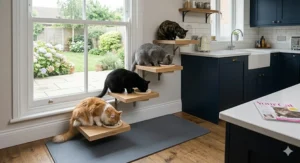
Mounting feeding stations at varying heights creates natural separation between cats, reducing competition and territorial disputes. Dominant cats typically claim elevated positions, whilst subordinate cats feel secure with lower retreats—this vertical hierarchy helps maintain peace during mealtimes.
Wall-mounted stations also keep feeding areas away from floor-level hazards like enthusiastic toddlers, vacuum cleaners, or dogs who might be tempted to help themselves to feline fare. Additionally, they simplify floor cleaning and create a tidier, more organised appearance.
Installation Considerations
When installing wall-mounted feeders, ensure you’re mounting into solid walls or studs capable of supporting the combined weight of the feeder, bowls, food, and your cat. Most adult cats weigh 3.6-4.5 kilograms (8-10 pounds), though larger breeds like Maine Coons can reach 8 kilograms (18 pounds) or more.
Position feeders at comfortable heights—generally 15-30 centimetres (6-12 inches) off the ground for standard cats, though senior or arthritic cats may require lower placement. Ensure cats can access their food without jumping or straining, particularly important for elderly felines or those with mobility issues.
Feeding Stations for Large Cats: Special Considerations
Large cat breeds such as Maine Coons, Norwegian Forest Cats, and Ragdolls require thoughtful feeding station selection. These magnificent felines can weigh 6-9 kilograms (13-20 pounds) or more, presenting unique challenges for standard feeding equipment.
Sturdy Construction
Large cats need robust feeding stations that won’t tip during enthusiastic eating. Look for wide bases, heavy materials (solid wood, thick ceramics, or weighted metals), and non-slip feet. Flimsy plastic stations simply won’t cope with a hefty Maine Coon tucking into dinner.
Generous Bowl Dimensions
Standard cat bowls often prove too small for large breeds. Extra-wide, shallow bowls (15-20 centimetres diameter) accommodate broader faces and longer whiskers comfortably. Bowl depth should remain modest—5-8 centimetres deep—to prevent whisker contact and strain.
Elevated Height Options
Larger cats particularly benefit from raised feeding stations. Elevating bowls 10-15 centimetres reduces neck and back strain, promoting better posture and digestion. Some veterinarians suggest that raised feeding may help reduce bloating and vomiting in cats, though research remains ongoing.
Multi-Level Cat Feeding: Creating Vertical Territories
Implementing multi-level feeding arrangements taps into cats’ natural affinity for vertical space whilst reducing territorial conflicts. This approach proves especially effective in households with distinct social hierarchies amongst cats.
The Vertical Territory Concept
In multi-cat colonies, cats naturally establish vertical territories—some cats prefer high perches, others middle levels, and some feel most secure at ground level. By offering feeding stations at various heights, you allow each cat to select their comfort zone, dramatically reducing mealtime stress.
Research on feline territorial behaviour suggests that environmental enrichment, including vertical spaces, can reduce stress levels and promote positive interactions amongst cats. Creating three-dimensional feeding environments helps ease territorial tensions that often manifest during mealtimes.
Practical Implementation
Start with one feeding station at floor level, one at counter height (approximately 90 centimetres), and one at an intermediate level (45 centimetres). Observe which cats gravitate towards which levels, then adjust accordingly. Some confident cats will claim the highest spots, whilst more timid felines might prefer lower positions where they feel less exposed.
Cat trees with integrated feeding platforms offer an excellent multi-level solution, combining vertical territory, exercise opportunities, and designated dining areas. Ensure platforms provide stable, secure surfaces—cats won’t eat confidently on wobbly perches.
Household Multi-Pet Solutions: Dogs, Cats, and Beyond
Managing feeding when your household includes both cats and dogs requires strategic planning. Dogs often view cat food as an irresistible delicacy (it’s higher in protein and fat), whilst cats understandably resent canine dinner thieves.
Physical Separation Strategies
Feeding cats in elevated locations that dogs can’t access provides the simplest solution. Counter tops, high cat trees, or dedicated cat-only rooms work brilliantly. Microchip-activated feeders like the SureFeed prevent dogs from accessing cat food, though determined dogs may still find ways around standard barriers.
Baby gates with cat-sized openings allow felines to access feeding areas whilst excluding larger dogs. Alternatively, feed cats in rooms with doors that can be secured during mealtimes, ensuring peaceful, stress-free dining.
Timing and Supervision
Some households successfully manage multi-species feeding through careful timing—feed dogs first (they eat quickly), then provide cat meals in separate areas. Supervision during initial implementation helps identify potential issues and allows you to intervene if conflicts arise.
Never punish pets for food-related conflicts, as this increases stress and may worsen behaviour. Instead, reward calm behaviour during mealtimes with praise and occasional treats, reinforcing positive associations with the feeding routine.
How to Choose the Right Cat Feeding Station for Your Household
Step 1: Assess Your Cat Population
Count your cats (obviously!), but also consider their personalities, ages, and health requirements. Do you have one dominant cat and several timid ones? Are some cats on special diets? Do any cats have mobility issues requiring accessible feeding positions?
Make a list noting each cat’s:
- Dietary requirements (standard, prescription, weight management)
- Eating speed (leisurely grazer vs rapid gobbler)
- Temperament (confident vs anxious)
- Physical limitations (arthritis, dental issues)
Step 2: Evaluate Your Space
Measure available feeding areas in your home. Multi-cat households need multiple feeding stations—ideally one per cat plus one extra. Consider both floor space and vertical opportunities (shelves, counters, cat trees).
Remember the body-length separation rule: cats should be fed at least one cat’s body length apart, or in entirely separate areas for households with significant inter-cat tension.
Step 3: Determine Your Budget
Quality feeding stations range from £15 for basic raised bowls to £150+ for sophisticated automatic feeders with cameras and WiFi connectivity. Decide what features justify the investment for your specific situation.
Budget-conscious households might combine one automatic feeder for scheduled meals with several static raised stations for supplementary feeding, creating a cost-effective multi-station setup.
Step 4: Consider Automation Needs
Evaluate your lifestyle honestly. If you work long hours, travel frequently, or have irregular schedules, automatic feeders provide invaluable consistency for your cats. However, if you’re home regularly and enjoy the ritual of feeding your cats, manual stations might suffice.
Step 5: Match Features to Requirements
Cross-reference your cat population assessment with available products:
- Special diets required → Microchip feeders (SureFeed)
- Two cats, portion control needed → Dual automatic feeders (PETLIBRO)
- Multiple cats, budget-conscious → Combination of automatic (Cat Mate C500) plus static raised stations
- Large breeds → Robust, elevated stations with extra-wide bowls
- Senior cats → Raised stations with easy access
Setting Up Your Multi-Cat Feeding Station: Best Practices
Location, Location, Location
Choose quiet, low-traffic areas away from litter boxes (cats prefer their dining and toilet facilities separated). Avoid placing feeding stations near washing machines, tumble dryers, or other noisy appliances that might startle cats during meals.
If possible, position stations near walls rather than in open spaces—cats feel more secure with their backs protected whilst eating. Ensure adequate lighting, as cats prefer to see their food clearly, though avoid positioning directly under harsh overhead lights.
Introducing New Feeding Arrangements
Cats resist change, so transition gradually. Place new feeding stations near existing bowls initially, then slowly move them to desired locations over several days. Use high-value treats to create positive associations with the new setup.
For automatic feeders, many cats require a training period. Most quality automatic feeders include training modes that introduce movement gradually—start with the lid stationary, then progress to slow opening/closing, eventually working up to normal operation.
Maintaining Cleanliness
Establish a strict cleaning routine:
- Daily: Wash food bowls with hot, soapy water
- Weekly: Deep-clean feeding stations, including mats and bases
- Monthly: Inspect automatic feeders for food buildup in mechanisms
Replace plastic bowls every 6-12 months as scratches harbour bacteria. Stainless steel and ceramic bowls last indefinitely with proper care but should be inspected regularly for chips or damage.
Troubleshooting Common Multi-Cat Feeding Issues
One Cat Eating Everyone’s Food
This classic problem requires strategic intervention. Microchip feeders provide the ultimate solution, granting access only to designated cats. Alternatively, try feeding in separate rooms with doors closed, or implement supervised mealtimes where you monitor and redirect food thieves.
For less severe cases, positioning feeding stations at different heights sometimes works—greedy cats typically won’t bother climbing to steal food if their own bowl remains accessible at ground level.
Cats Refusing New Feeding Stations
Patience and positive reinforcement prove essential. Place favourite treats near the new station, gradually moving them closer to the bowls over several days. Some cats respond well to having their regular food placed in the new station whilst the old bowl remains available—they’ll eventually transition once they realise the food source has moved.
Never force the issue by removing all alternative feeding options immediately, as this creates stress and may lead to food aversion or anxiety.
Aggressive Behaviour at Mealtimes
Aggression signals that current feeding arrangements aren’t working. Increase distance between feeding stations—if cats currently eat 1 metre apart, try 3-4 metres. Persistent aggression may require feeding in completely separate rooms.
Consider whether feeding schedule contributes to tension. Some cats become food-aggressive when meals arrive unpredictably or infrequently. Splitting daily portions into smaller, more frequent meals sometimes reduces territorial behaviour around food.
Consult your veterinarian if aggression escalates or persists despite environmental modifications—underlying medical issues occasionally manifest as food aggression, and professional guidance may be necessary.
FAQ: Your Multi-Cat Feeding Questions Answered
❓ How many feeding stations do I need for 3 cats?
❓ Can automatic feeders work for wet food in the UK climate?
❓ Should feeding stations be raised or floor-level for multiple cats?
❓ How far apart should feeding bowls be for multiple cats?
❓ Do microchip cat feeders work with UK pet microchips?
Conclusion: Creating Harmony at Mealtime
Implementing proper feeding stations for your multi-cat household transforms more than just mealtimes—it enhances overall feline wellbeing, reduces stress-related health issues, and creates a more peaceful home environment for both cats and humans alike. Whether you opt for high-tech automatic feeders, simple raised stations, or a combination approach, the investment pays dividends in happier, healthier cats.
Remember that every cat household is unique. What works brilliantly for your neighbour’s three British Shorthairs might not suit your mixed-breed crew. Observe your cats’ behaviour, remain flexible in your approach, and don’t hesitate to adjust arrangements as needed. Some cats adapt quickly to new feeding systems, whilst others require patient, gradual introduction.
The products featured in this guide represent the best options currently available on Amazon.co.uk for UK cat owners in 2026. From budget-friendly manual stations to sophisticated WiFi-enabled automatic feeders, there’s a solution for every household size, budget, and lifestyle. The key lies in matching features to your specific requirements—dietary separation, portion control, scheduled feeding, or simply providing peaceful dining spaces.
By understanding feline feeding behaviour, selecting appropriate equipment, and implementing thoughtful feeding strategies, you can eliminate mealtime conflicts and create an environment where each of your cats feels secure, valued, and well-nourished. Here’s to harmonious mealtimes and content, well-fed felines!
Recommended for You
- 7 Best Raised Cat Feeding Station with Storage UK 2026 Guide
- Best Cat Feeding Station UK 2026: 7 Expert Picks
- 7 Best Cat Puzzle Feeder for Weight Loss UK | 2026
Disclaimer: This article contains affiliate links. If you purchase products through these links, we may earn a small commission at no additional cost to you. Prices shown are approximate and may vary.
✨ Found this helpful? Share it with your mates! 💬🤗
