
In This Article
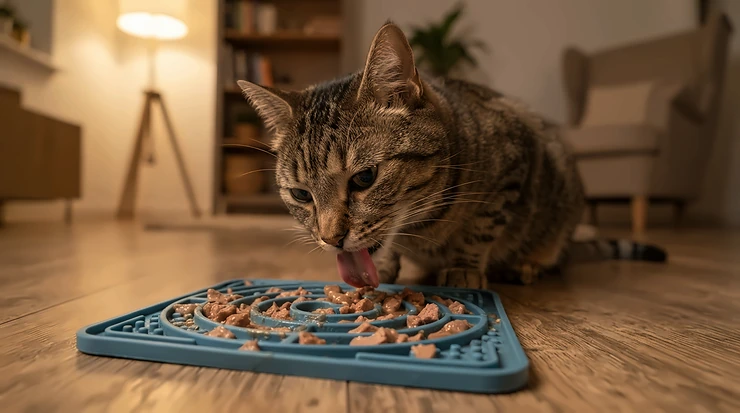
A food puzzle toy for cats is a feeder that makes your cat work, using paws, nose or tongue, to release kibble, wet food or treats instead of eating from an open bowl. It turns mealtime into a small hunting game, slowing fast eaters and giving bored indoor cats a mental workout.
Picture the average indoor cat’s day. Breakfast arrives in a dish, disappears in ninety seconds, and then comes eleven hours of staring at a radiator. Nobody would design a life for a predator that way on purpose. Yet that is the default setting for millions of British cats.
International Cat Care describes puzzle feeders as containers that hold food and have to be manipulated to release it. That makes meals last longer, increases physical activity and gives your cat a “brain teaser”. It also points to a published review finding that all cats can use them, including seniors, kittens, three-legged cats and blind cats.
This guide covers seven real, widely available options for UK homes, from a budget rolling ball to a five-module activity board. Every pick comes with an honest read of the specs, the recurring themes in owner reviews and who it suits. We also dig into feline cognition, foraging behaviour and mealtime enrichment, because knowing why these toys work helps you pick the right one.
One caution before we start. Nothing here replaces advice from your vet if your cat has a medical condition or weight problem. Prices are given as ranges, so check the current price before buying.
Quick Comparison: 7 Food Puzzle Toy for Cats Options at a Glance
| Product | Format | Food type | Best for |
|---|---|---|---|
| Nina Ottosson Buggin’ Out | Peg-and-flap board | Dry food, treats | Clever cats needing adjustable difficulty |
| Catit Senses 2.0 Digger | Paw-fishing tubes | Dry food, treats | Fast eaters, first-time puzzlers |
| Trixie Activity Fun Board | Five-module board | Dry food, treats, liquid treats | Cats who love variety |
| LickiMat Slomo Cat | Lick mat | Wet, dry, raw | Wet-food feeders, gulpers |
| PetSafe Slimcat Feeder Ball | Rolling ball | Dry food only | Budget buyers, active cats |
| Cat Amazing Classic | Cardboard maze | Dry treats | Beginners, eco-minded owners |
| Catstages Kitty Lickin’ Layers | Spinning layers | Wet or dry | Kittens, small appetites, treats |
Look at the “Food type” column first. It narrows the field faster than any rating. If your cat eats mostly pouches, the LickiMat Slomo Cat and Catstages Kitty Lickin’ Layers are your realistic options, because the ball and tube designs only cope with dry food. If your cat is a seasoned problem-solver, the Nina Ottosson Buggin’ Out and Trixie Activity Fun Board offer more room to grow.
💬 Just one click — help others make better buying decisions too!😊
Top 7 Picks for a Food Puzzle Toy for Cats: Expert Analysis
1. Nina Ottosson Buggin’ Out — adjustable difficulty for clever cats
Its standout trick is flexibility: you can set the challenge to match your cat’s skill on the day.
This Level 2 board has 16 compartments, with 8 hidden treat cups and 8 movable pegs. Cats swivel the leaf-shaped flippers and scoot the ladybug pegs to reach the food. It measures about 35 x 29 cm and holds roughly a quarter of a cup. In practice that suits treats, a measured portion of kibble or a single small meal. It will not cover a hungry adult’s whole dinner. The adjustable difficulty is its best feature, because a puzzle your cat has fully solved quickly becomes an expensive bowl.
Based on the spec comparison, this suits curious, food-motivated cats who have already met a simple feeder. Beginners should start with treats in the open base compartments only.
Reviews across retailer listings are broadly positive, with ratings around the mid-4s out of 5 on a major US retailer. Owners often say it slows fast eaters. A recurring complaint is that small kibble can get trapped between the layers, and a few say their cat solved it within a day.
Pros:
- ✅ Adjustable difficulty keeps clever cats engaged
- ✅ Doubles as a slow-feeding bowl
- ✅ Food-safe materials, free from BPA, PVC and phthalates
Cons:
- ❌ Kibble can jam between layers
- ❌ Small capacity for full adult meals
Expect to pay somewhere in the mid-£10s to mid-£20s range. Check current price. It is good value if your cat enjoys a challenge.
2. Catit Senses 2.0 Digger — the easiest first puzzle feeder
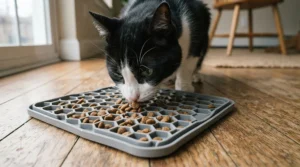
This is the “pawing” puzzle, and it taps one of the most natural cat behaviours there is: fishing food out of a hole.
You drop kibble or treats into five rounded cups, three short and narrow and two long and wide, then your cat paws them out piece by piece. The sloped base funnels stray bits into a front basin, so there is always an easy win to draw your cat in. The long cups are harder than the short ones, so you control the difficulty by choosing where the food goes. Cups are removable and hand-washable, which matters because cleaning is where many puzzles fall down.
Honestly, this is a gentle puzzle. It slows eating more than it truly tests the brain, so it is better for gulpers and newcomers than for Einsteins.
Reviewers frequently praise the ease of cleaning and say it suits food-obsessed or older cats. One senior owner called it an incredible compromise for a cat uninterested in other toys. The main critique is that some cats empty it in seconds, and it only works with dry food.
Pros:
- ✅ Very easy to disassemble and clean
- ✅ Two cup sizes give simple difficulty control
- ✅ Gentle on older paws
Cons:
- ❌ Too easy for puzzle veterans
- ❌ Dry food and treats only
Expect roughly £10-£20. Check current price. It offers solid value as an entry point.
3. Trixie Activity Fun Board — five brain games in one
Variety is its party piece: five modules, each needing a different combination of paws, nose and patience.
The board is about 30 x 40 cm, with modules known as globe, peg, alley, tongue and tunnel. The globe is a fish-bowl-style fish-it-out challenge. The peg module makes your cat map a route to a visible treat, and the tongue module suits liquid treats because the slits stop paw access. Rubber feet keep it planted, and it is dishwasher-safe. At around 1.4 kg, it is heavy enough to stay put when a determined cat bats it.
The spec sheet says this works for small to average cats, with an XXL version for bigger ones. It is also a good fit for multi-cat homes, since two cats can work different modules at once.
Review sentiment is positive on build quality and cleaning, though some owners think the price is high for a plastic board. A few say certain mechanisms frustrate their cat.
Pros:
- ✅ Five modules offer real variety
- ✅ Heavy base with non-slip rubber feet
- ✅ Dishwasher-safe for easy cleaning
Cons:
- ❌ Pricier than most rivals here
- ❌ Some mechanisms may frustrate beginners
Expect around £20-£30. Check current price. It is worth it if variety matters to you.
4. LickiMat Slomo Cat — the wet food specialist
If your cat eats from pouches and trays, this is the one most likely to fit your actual routine.
The LickiMat Slomo Cat is a flat 20 x 20 x 1.7 cm mat with dual-texture surfaces, square pockets plus raised nubs, in food-grade rubber on a polypropylene base. The shape matters more than it looks. Cats must lick rather than gulp, and there is no tall rim to press against their whiskers. It handles wet, dry and raw food, and it is dishwasher-, freezer- and microwave-safe, so you can freeze a smear of food for a longer-lasting session.
Think of it as a licking puzzle rather than a thinking one. It excels at slowing pace and calming mealtimes, but it will not challenge a genius.
Owners commonly report that it slows down eaters who bolt wet food. The recurring caveats are that determined chewers may nibble the edges, so supervise early use, and that some older cats struggle to get every last bit out of tighter patterns.
Pros:
- ✅ Handles wet, dry and raw food
- ✅ Whisker-friendly flat design
- ✅ Dishwasher, freezer and microwave safe
Cons:
- ❌ Chewers may damage the edges
- ❌ Less mental challenge than board puzzles
Expect roughly £8-£14. Check current price. It is cheap, flexible and excellent value for wet-food homes.
5. PetSafe Slimcat Feeder Ball — the budget rolling feeder
Cheap, cheerful and a classic for a reason: your cat bats the ball, and kibble falls out.
This ball is about 8 cm across (roughly 3¼ inches) and holds up to around two-thirds of a cup of dry food. A twist-and-lock top adjusts the openings, so you can set it for kibble size and speed. The movement element is the key difference from the other options. Unlike stationary puzzles, it rewards chasing, which suits energetic cats who need exercise as much as brainwork.
The adjustment is coarse rather than fine-tuned, so it will not suit every kibble. It only works with dry food.
Reviewers like the adjustable holes and say it slows eating, but a few cats ignore it entirely. Others dislike that the settings are either too open or too tight, and some cats learn to pick it up and drop it to speed things along.
Pros:
- ✅ Rewards chasing and batting
- ✅ Adjustable openings for different kibble
- ✅ Holds a full meal for many cats
Cons:
- ❌ Coarse adjustment settings
- ❌ Some cats ignore it completely
Expect under £10. Check current price. This is the lowest-risk way to find out whether your cat likes foraging.
6. Cat Amazing Classic — a cardboard maze with three levels
Every cat owner knows the truth: cats love boxes. This one makes the box work.
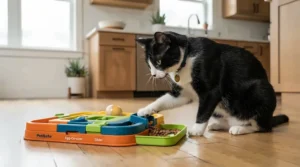
The Cat Amazing Classic is made from 30% recycled, fully recyclable cardboard with a colour-coded interior insert for three difficulty levels. Openings sit at the bottom for beginners, move to the sides and finally to the top for “top cat” difficulty, and the brand also hints at a secret fourth level. You drop treats in and your cat scoops them out through the holes. It is light, so it slides around, and cardboard has an obvious downside: claws.
It suits curious cats who enjoy scratching, and owners who like eco-friendly materials. Plan to replace it eventually, and supervise a shredder.
Reviews are more mixed than for most picks here, with ratings around 4 out of 5 on a major US retailer. Fans say it keeps cats busy for about twenty minutes. Critics find it pricey for cardboard, and some cats simply rip it up.
Pros:
- ✅ Three adjustable difficulty levels
- ✅ Recyclable, metal-free ink cardboard
- ✅ Easy to assemble and store flat
Cons:
- ❌ Claws will eventually destroy it
- ❌ Lightweight and slides around
Expect roughly £15-£28 depending on retailer. Check current price. Value is decent, but only for non-shredders.
7. Catstages Kitty Lickin’ Layers — spinning layers for wet or dry food
This one is a puzzle and a slow feeder in one, with three rotating layers hiding more than 70 compartments.
Your cat spins the layers by paw and nose to uncover food, and you can load it with wet or dry. It is about 6.6 inches across, with a rubber base for stability, and the manufacturer says it is top-rack dishwasher-safe. One expert round-up noted it holds about half a cup. That makes it a lovely treat or kitten feeder, but small for a hungry adult’s full meal.
Based on the specs, it suits small appetites, kittens and owners who want something compact. Do not expect it to be someone’s entire dinner.
Owners often report slower eating and less post-meal vomiting. The consistent complaint is that the top layers can stick to each other, which makes it harder for some cats to solve.
Pros:
- ✅ Works with wet and dry food
- ✅ Over 70 compartments slow eating well
- ✅ Stable rubber base stays put
Cons:
- ❌ Layers can stick together
- ❌ Small for adult-sized meals
Expect roughly £12-£20. Check current price. It is good value for treats and small portions.
How to Choose a Food Puzzle Toy for Cats
Choosing well saves you from buying a very expensive ornament. Work through these steps in order.
- Check your cat’s food first. Wet-food cats need lick mats or layered feeders, while dry-food cats can use almost anything. A great puzzle your cat’s food cannot fit through is useless.
- Match the difficulty to experience. Beginners need open designs with visible food. Start easy and increase difficulty only when your cat succeeds calmly.
- Consider your cat’s body. Large paws need bigger openings, and older cats with arthritis may prefer flat, low designs.
- Weigh capacity against purpose. Small boards are fine for treats and top-ups. If you want the puzzle to deliver full meals, check how much it actually holds.
- Think about cleaning. Dishwasher-safe or removable parts are what keep you using a puzzle in month three.
- Count your cats. In multi-cat homes, buy more puzzles than cats and spread them apart.
- Budget for rotation. Two or three cheap puzzles beat one expensive one, because novelty matters.
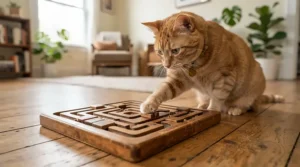
Features That Actually Matter (And Those That Don’t)
Marketing loves a long feature list. Most of it is noise.
What matters is stability, because a puzzle that slides away from your cat’s paw teaches frustration. It also matters that the food release is achievable, that cleaning is easy and that the materials are food-safe. Adjustable difficulty is the next-most important feature, because it extends the life of the product.
What matters less is the number of “compartments”. Seventy hiding spots sounds impressive, but a cat only needs enough to stay interested for a few minutes. Colour-coded levels are charming but are brand design rather than proven science. Fancy shapes and bright finishes are nice to look at, though your cat does not care.
What many buyers overlook is capacity. A beautiful puzzle that holds only a quarter of a cup becomes a treat toy rather than a meal feeder. That is perfectly fine, as long as you know it before you buy.
Puzzle Feeder for Cats vs a Plain Bowl: What Really Changes?
| Factor | Plain bowl | Puzzle feeder for cats |
|---|---|---|
| Eating speed | Seconds to minutes | Often much slower |
| Mental stimulation | None | Moderate to high |
| Physical activity | Minimal | Pawing, batting, chasing |
| Cleaning effort | Low | Low to moderate |
| Cost | Very low | Low to moderate |
| Best for | Cats who dislike change | Indoor, bored or fast-eating cats |
The table shows a clear trade-off. A bowl wins on simplicity and low maintenance, while a puzzle feeder for cats wins on enrichment. For most indoor cats, the extra washing-up is a small price for a more satisfying mealtime. The sensible compromise is to keep a bowl for some meals and use a puzzle for others, especially while your cat is learning.
You also do not need to spend money to start. Best Friends Animal Society suggests scatter feeding, tossing kibble on the floor, as a simple DIY foraging game. It is a free way to test whether your cat enjoys working for food before you buy anything.
Food Puzzle for Indoor Cats: Who Benefits Most?
A food puzzle for indoor cats matters because indoor cats have lost most of their natural outlets. Outdoors, they would stalk, chase and search. Indoors, a bowl removes the search entirely.
The cats most likely to gain are:
- Fast eaters, who gulp and then bring it back up. A slower feeder spreads the same food over more minutes.
- Bored cats, who show it through scratching furniture, night-time yowling or pestering you.
- Overweight cats, because slower feeding plus extra activity can help portion control, though your vet should guide any weight plan.
- Seniors, who often enjoy gentle puzzles when other toys lose their charm.
- Kittens, for whom puzzles can be a safe way to burn energy.
Caution is needed too. Cats with dental pain, arthritis or poor eyesight may need easier, flatter designs. If your cat eats noticeably less when you switch to a puzzle, go back to a bowl and ask your vet.
Brain Game Toy for Cats: Matching Difficulty to Your Cat
A brain game toy for cats should feel like a game your cat can win. That is the whole secret.
Think of difficulty in three tiers. Tier one is open and visible: the Catit Senses 2.0 Digger with food in the short cups, or a LickiMat Slomo Cat smeared with a familiar treat. Tier two adds simple manipulation, such as the PetSafe Slimcat Feeder Ball on a wide setting or the Cat Amazing Classic at beginner level. Tier three needs sequences and strategy, like the Nina Ottosson Buggin’ Out with food under the sliding cups, or the peg module on the Trixie Activity Fun Board.
Signs your cat is ready to level up: they clear the puzzle calmly, quickly and with little interest left. Signs you have gone too far: walking away, forceful pawing, vocalising or eating less. When that happens, step back one level rather than giving up.
Feline Cognition, Foraging Behaviour and Mealtime Enrichment: The Science
Feline cognition
Feline cognition is the study of how cats think, learn and solve problems. It is a younger field than canine research, and honesty matters here: the evidence for food puzzles specifically is thinner than the marketing suggests. A veterinary review in the Journal of Feline Medicine and Surgery says few empirical studies of food puzzle benefits in companion cats exist, though current welfare guidelines suggest cats should be able to express the predatory sequence, including active acquisition of food.
Foraging behaviour
Foraging behaviour is the drive to seek, work for and earn food. Wild cats hunt many small meals. A bowl delivers one large reward for zero effort. A puzzle restores some of that effort, which is why many behaviourists treat it as core enrichment for indoor cats.
Mealtime enrichment
Mealtime enrichment simply means making eating more interesting. That can be a puzzle, a lick mat, scattered kibble or a hidden snack. The goal is variety, because cats like different challenges, so rotating two or three puzzle types is better than relying on one.
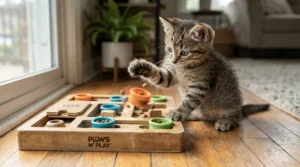
Practical Usage Guide: Your Cat’s First 30 Days With a Puzzle
Here is a simple plan that avoids the classic mistake of confusing and frustrating your cat.
Days 1-3: Make it familiar. Place the empty puzzle near the usual food spot and sprinkle a few kibbles around it. Let your cat sniff it. Keep the normal bowl available.
Days 4-10: Easy wins only. Put a small portion of the meal in the puzzle at its easiest setting, and keep the bowl for the rest. Pick a time when your cat is hungry but not desperate.
Days 11-20: Increase the share. Move to half the meal in the puzzle. Switch food type or position occasionally to keep it interesting.
Days 21-30: Raise the difficulty. Move up one level, but only if your cat is succeeding calmly.
Three optimisation tricks that listings rarely mention. First, use part of the measured daily ration rather than extra treats, so you do not accidentally add calories. Second, wash after every use, as old food puts cats off. Third, rotate puzzles weekly to keep novelty alive.
Problem → Solution Guide: When Your Cat Won’t Play Along
Problem: my cat ignores the puzzle. Make it obvious. Put smelly, high-value food in the open slots and sprinkle some around the outside. Introduce it next to the usual bowl.
Problem: my cat solved it in a day. Move up one difficulty level, or switch to a different type. A Nina Ottosson Buggin’ Out with food under the sliding cups is harder than with food in the open base.
Problem: my cat gets frustrated. Step back. Return to the easiest setting and rebuild confidence with the Catit Senses 2.0 Digger or a LickiMat Slomo Cat.
Problem: my cat chews it. Supervise, and choose sturdier materials. Avoid cardboard like the Cat Amazing Classic for known shredders.
Problem: my cat vomits after meals. Gulping is a common cause, so a slower feeder may help. If vomiting continues, see your vet rather than assuming it is only speed.
Real-World Scenarios: Matching Puzzles to Cats
These are illustrative profiles, not reports of my own testing. Use them as a thinking framework.
Scenario 1: the flat-dweller with a gulper. A single cat eats pouches in under a minute and then sulks by the radiator. The budget is modest and wet food is the staple. A LickiMat Slomo Cat is the sensible start, because it fits wet food and slows the pace. The second step might be the Catstages Kitty Lickin’ Layers for variety.
Scenario 2: the busy household with a bright cat. An adult cat eats dry food and is bored by day. The owners want a challenge and can spend a little more. The Trixie Activity Fun Board offers five modules, while the Nina Ottosson Buggin’ Out adds adjustable difficulty. Rotating both keeps things fresh.
Scenario 3: the cautious senior. An older cat has lost interest in toys and eats dry food. The owner wants gentle and easy to clean. The Catit Senses 2.0 Digger is a sensible start, because it is low, simple and forgiving. Keep sessions short and supervise.
Long-Term Cost and Maintenance: What You Will Really Spend
| Product | Price range | Likely lifespan | Maintenance |
|---|---|---|---|
| PetSafe Slimcat Feeder Ball | Under £10 | Long | Hand wash |
| LickiMat Slomo Cat | £8-£14 | Long, unless chewed | Dishwasher safe |
| Catit Senses 2.0 Digger | £10-£20 | Long | Hand wash cups |
| Catstages Kitty Lickin’ Layers | £12-£20 | Long | Top-rack dishwasher |
| Cat Amazing Classic | £15-£28 | Short to moderate | Wipe clean, replace |
| Nina Ottosson Buggin’ Out | £15-£25 | Long | Hand wash |
| Trixie Activity Fun Board | £20-£30 | Long | Dishwasher safe |
Prices are indicative ranges at the time of research and vary by retailer, so check current price.
The most expensive option is not automatically the best value. The PetSafe Slimcat Feeder Ball and LickiMat Slomo Cat are cheap and durable, so they carry very low risk. The Cat Amazing Classic costs more per month of use if your cat shreds it. Cost-per-use favours sturdier plastic designs, as long as your cat actually uses them. For most homes, two or three inexpensive puzzles beat one premium board, because rotation keeps interest high.
Common Mistakes When Buying a Food Puzzle Toy for Cats
Starting too hard. The commonest error is buying the most advanced puzzle first. Easy wins build confidence.
Replacing the bowl overnight. A survey of feeding practices published in the Journal of Feline Medicine and Surgery found that almost half of owners had tried food puzzles, but they were seldom used as the main way of providing meals. That suggests many people dabble and drop it. Change gradually and keep the bowl available while your cat learns.
Ignoring food compatibility. Check that kibble fits the openings, and that wet food suits the design.
Adding extra calories. Puzzles loaded with bonus treats can quietly cause weight gain. Use part of the daily allowance instead.
Forgetting multi-cat dynamics. One confident cat can guard a single puzzle. Provide more puzzles than cats and place them apart.
Skipping the vet. If your cat seems unwell, eats less or loses weight, see your vet before blaming the toy.
✨ Don’t Miss These Exclusive Deals!
🔍 Take your cat’s mealtimes to the next level with these carefully selected products. Click on any highlighted item to check current pricing and availability. These picks will help you create a more stimulating, happier routine for your cat!
FAQ
❓ Can you put wet food in a food puzzle toy for cats?
❓ How long should a cat spend on a puzzle feeder?
❓ Are puzzle feeders safe for overweight cats?
❓ Why does my cat ignore a brain game toy for cats?
❓ Do I need one food puzzle for each cat?
Conclusion
A bowl feeds a cat. A puzzle lets a cat act like a cat. That difference is small on the shelf and large on the living-room floor.
If you want a safe starting point, the Catit Senses 2.0 Digger or the PetSafe Slimcat Feeder Ball are gentle, affordable introductions for dry-food cats. For wet food, the LickiMat Slomo Cat and Catstages Kitty Lickin’ Layers do the job well. If your cat loves a challenge, the Nina Ottosson Buggin’ Out and Trixie Activity Fun Board give you room to grow. The Cat Amazing Classic is the eco-friendly wildcard, as long as your cat does not treat it as a scratching post.
Whatever you choose, remember three rules. Start easy, use part of the daily ration, and watch your cat’s behaviour for frustration. The research on food puzzles is still growing, so treat them as one useful piece of enrichment rather than a miracle cure. Pair them with play, climbing space and a quiet routine, and you will have a happier indoor cat.
Recommended for You
- Treat Dispensing Cat Toy: 7 Best Picks For UK Cats (2026)
- Top Ball Track Toy For Cats: 7 Best Picks For UK Homes (2026)
- Motion Activated Cat Toy For Senior Cats: 7 Gentle Picks (2026)
Disclaimer: This article contains affiliate links. As an Amazon Associate, I earn from qualifying purchases. If you purchase products through these links, we may earn a small commission at no additional cost to you.
✨ Found this helpful? Share it with your friends! 💬🤗
