
In This Article
Let’s be honest — nobody buys a cat and thinks, brilliant, I can’t wait to spend the next fifteen years deliberating over cat litter. And yet, here we are. Walk into any pet shop, scroll through Amazon.co.uk for thirty seconds, and you’ll find yourself staring at a bewildering wall of bags, pellets, crystals, and compressed wood shavings, each one promising to be the olfactory saviour your living room desperately needs.
The truth is, finding the best cat litter genuinely matters. Not just for your nose — though that’s an entirely valid reason to care — but for your cat’s health, your household’s cleanliness, and increasingly, for the planet. The PDSA recommends providing at least two litter trays per cat, which means whatever product you choose, you’ll be living with it in large quantities. Choose wisely.
What makes the best cat litter? In a nutshell: something absorbent enough to handle the daily deluge, effective enough at controlling odours that your visitors don’t immediately assume you own a small farmyard, and ideally something your cat will actually deign to use. That last point matters more than people realise — cats are extraordinarily opinionated about their bathroom arrangements.
In this guide, I’ve researched, compared, and analysed seven genuinely excellent cat litters available on Amazon.co.uk right now in 2026, spanning everything from budget wood pellets to premium clumping clay and eco-friendly plant-based options. Whether you live in a compact flat in Manchester, a terrace in Bristol, or a semi in the Edinburgh suburbs, there’s a pick here that’ll suit your home, your cat, and your conscience.
Prices aren’t listed here because Amazon.co.uk prices fluctuate constantly — always check current pricing via the product links. All products reviewed are available with Prime next-day delivery for Prime members, and standard free delivery on qualifying orders over £25.
Quick Comparison: Best Cat Litter UK 2026 at a Glance
| Product | Type | Odour Control | Eco-Friendly | Best For |
|---|---|---|---|---|
| Ever Clean Extra Strong Clumping (Unscented) | Bentonite Clay | ⭐⭐⭐⭐⭐ | ❌ | Multi-cat homes, odour obsessives |
| Breeder Celect (now Breeder’s Choice) Recycled Paper | Recycled Paper Pellets | ⭐⭐⭐⭐ | ✅✅ | Kittens, sensitive paws, eco buyers |
| Catsan Hygiene Plus | Mineral/Quartz | ⭐⭐⭐⭐ | ✅ | No-fuss households, kitten-safe |
| Cat’s Best ÖkoPlus Original | Wood Fibre Clumping | ⭐⭐⭐⭐ | ✅✅ | Eco-conscious flat dwellers |
| World’s Best Cat Litter (Corn-Based Clumping) | Corn/Plant Fibre | ⭐⭐⭐⭐ | ✅✅ | Flushable litter seekers |
| Sanicat Diamonds Professional Silica Crystals | Silica Gel | ⭐⭐⭐⭐⭐ | ❌ | Busy owners, low-maintenance fans |
| AmazonBasics Wood Pellet Cat Litter | Wood Pellets | ⭐⭐⭐ | ✅✅ | Budget buyers, outdoor-access cats |
The table above tells a clear story: your choice ultimately comes down to the triangle of odour performance, eco-friendliness, and budget. The premium clay litters (Ever Clean, Sanicat) win outright on odour control — but they’re not recyclable or flushable, and they’re decidedly unglamorous in terms of environmental credentials. Eco options like Breeder’s Choice and Cat’s Best close the gap considerably. Budget buyers should be aware that wood pellets, while impressively cheap per litre, require full tray changes rather than scooping, which adds time to the equation.
💬 Just one click — help others make better buying decisions too! 😊
✨ Don’t Miss These Exclusive Deals!
🔍 Found something that looks right? Click any highlighted product name to check current pricing and availability on Amazon.co.uk. Prices and stock change daily — what you see today may be even better tomorrow.
Top 7 Cat Litters for UK Homes: Expert Analysis
1. Ever Clean Extra Strong Clumping Cat Litter — Unscented
If cat litter were a sport, Ever Clean would be the relentless professional who simply refuses to let anything slip. This is a bentonite clay clumping litter, and it does one thing with almost aggressive competence: it clumps. Hard. Fast. Completely. Pour 100ml of liquid in, wait two minutes, and you’ll have a solid, scoopable mass that feels more like chalk than anything that ought to come out of a cat.
The unscented version is the smarter pick for most UK buyers. Small animal vet Dr Rebecca MacMillan has noted that cats have far more sensitive noses than we do, and scented litters can be genuinely unpleasant or overwhelming for them. The unscented formula relies instead on activated carbon technology to eliminate odours rather than masking them — a meaningful difference that UK reviewers consistently praise, especially in smaller homes and flats where ventilation is limited.
The practical reality for a UK flat dweller: a 10-litre box lasts one cat roughly six to eight weeks with daily scooping. The clumps are firm enough that they don’t crumble on the journey to the bin, which anyone who’s scooped a soggy bentonite disaster will appreciate enormously. It is, however, not eco-friendly — bentonite clay is mined, not renewable, and is not biodegradable. If that concerns you, scroll further down.
UK reviewers note minimal tracking and near-zero dust, which matters particularly for cats with asthma or allergies — and for the cleanliness of those British terrace floors that seem to show every granule.
✅ Exceptionally firm clumps, minimal crumbling
✅ Activated carbon odour elimination (not masking)
✅ Very low dust — good for cats with respiratory sensitivities
❌ Not biodegradable or eco-friendly
❌ Higher price point per bag than budget alternatives
Price range: In the mid-£10s to around £20 depending on bag size. Check current pricing on Amazon.co.uk. Value verdict: Worth every penny for multi-cat households where odour control is non-negotiable.
2. Breeder’s Choice (formerly Breeder Celect) Recycled Paper Cat Litter
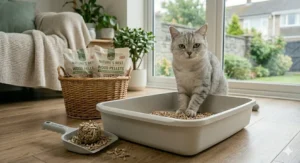
This litter has won the Your Cat Product Award for “Best Cat Litter” three years running — 2024, 2025, and again in 2026 — which is the kind of track record that makes you sit up and pay attention. Made from 99% recycled paper (water and air are the other ingredients, which is rather poetic), Breeder’s Choice is the litter you recommend to people who care about the environment, cats with sensitive paws, kittens, or post-surgical recoveries.
It’s non-clumping, which initially puts some buyers off. Here’s the thing, though: the pellets absorb liquid deeply and swell slightly, making soiled sections visually identifiable. Daily removal of solid waste is straightforward, and the litter doesn’t form the unpleasant wet patches that some non-clumping mineral litters can produce. The near-zero dust is genuinely remarkable — this is the litter you’ll switch to if you or your cat has respiratory sensitivities, or if you’re tired of watching clouds of white powder billow up every time you fill the tray.
For UK buyers living in compact homes, the low-tracking formula is a quiet revelation. Large pellets simply don’t stick to paws the way fine clay granules do, meaning the trail of litter leading from the tray to your sofa is dramatically reduced. Professional pet carer testing at Pet Checkers found it particularly beneficial for cats that struggled with other litter textures, with some previously litter-reluctant cats taking to it immediately.
The biodegradable nature means the used litter (minus solid waste) can go to compost — handy for the growing number of UK households with compost bins. Not flushable, though, so check your local council guidance before disposal.
✅ Triple award winner (2024, 2025, 2026 — Your Cat Magazine)
✅ Near-zero dust, ideal for asthmatic cats and sensitive households
✅ Biodegradable and compostable — genuinely eco-friendly
❌ Non-clumping: requires full tray changes rather than scooping only
❌ Less effective odour control than premium clay options if not changed regularly
Price range: Typically in the £10–£18 range depending on bag size (10L–30L). Available on Amazon.co.uk with Prime delivery.
3. Catsan Hygiene Plus Non-Clumping Cat Litter
Catsan has been a fixture in British living rooms for over three decades, and there’s a reason for that unusual longevity: it quietly, reliably does exactly what it promises. This is a mineral/quartz-based non-clumping litter with what Catsan calls “Triple Odour Protection” — the granules absorb before odours can develop, which is a subtly different approach from activated carbon systems.
The classic white colour is more than aesthetics. Made from 100% natural quartz and limestone (no bleach, no artificial additives), the white granules make it easy to see when the tray needs changing, which is genuinely useful for cat owners who tend to leave things a day longer than they should. The granule size is substantial enough that it doesn’t scatter dramatically, which matters if you have wooden floors or pale carpets and an energetic cat who treats litter-burying as a competitive sport.
Where Catsan earns particular marks is in kitten safety and all-lifestage suitability. It contains no harmful additives, making it a sensible first choice for households with young kittens who are still working out the rules. The non-clumping formula also means there’s no risk of clumps forming around paws and being ingested — relevant for curious, young, or small-breed cats.
The main honest caveat: non-clumping means you’re replacing the entire tray more frequently, rather than just scooping clumps. For a single-cat household that cleans regularly, this is straightforward. For a multi-cat home, it becomes more time-consuming and potentially more expensive over time than a premium clumping alternative.
✅ Trusted UK brand with 30+ years of consistent performance
✅ Kitten-safe, all-natural ingredients, no harmful additives
✅ White colour makes tray cleanliness easy to monitor
❌ Non-clumping requires full tray changes (less economical for multi-cat homes)
❌ Moderate odour control compared to activated carbon options
Price range: Very accessible — typically under £15 for a 20-litre bag. An excellent budget-to-mid option with solid credentials.
4. Cat’s Best ÖkoPlus Original Clumping Cat Litter
Here’s where things get interesting. Cat’s Best ÖkoPlus is made from wood fibre — specifically, microscopic capillary fibres extracted from untreated spruce — and it clumps. This sounds like a minor miracle, and in practice, it rather is. It’s biodegradable, flushable in small amounts, compostable, and yet it forms reasonable clumps that can be scooped rather than doing a full tray change. For the eco-conscious UK buyer, this is the sweet spot.
The clumping isn’t as rock-hard as bentonite clay — let’s be clear about that. If you’re comparing Ever Clean clumps to Cat’s Best clumps, the latter are slightly softer and require a gentler touch with the scoop. But they hold together well enough for daily maintenance, and the odour control is genuinely impressive for a plant-based product, with the natural wood fibre absorbing liquid deep into the pellets rather than leaving it pooled on the surface.
For UK flat dwellers specifically, Cat’s Best is worth serious consideration. It’s considerably lighter than clay per litre — carrying a mega-pack up three flights of stairs to your flat is far less of a workout than the equivalent bentonite clay option. The 40-litre bags available on Amazon.co.uk represent serious value for multi-cat households, and the flushable nature (in small daily amounts, consistent with UK sewage system guidelines) means you’re not lugging heavy bags of waste to the bin.
UK reviewers note a mild, natural pine-adjacent scent that most cats tolerate well — better received than synthetic fragrances. A handful of reviewers note slight tracking with long-haired cats, as finer wood fibres can catch in fur. Worth a litter mat beneath the tray.
✅ Genuinely eco-friendly: biodegradable, compostable, partially flushable
✅ Lighter weight per volume than clay — kinder on the back and easier storage
✅ Good odour control for a plant-based product
❌ Clumps are softer than clay — requires careful scooping
❌ Can track slightly with long-haired breeds
Price range: Around £15–£40 depending on bag size (10L to 40L mega packs). Excellent long-term value for eco buyers. Prime-eligible on Amazon.co.uk.
5. World’s Best Cat Litter — Original Clumping Formula
The name is hubristic, but the product comes surprisingly close to justifying it. World’s Best Cat Litter is made from whole-kernel maize — corn, to put it plainly — and is one of the few litters on the UK market that genuinely clumps and can be flushed in small amounts down a standard toilet. For households where daily tray maintenance involves a trip to the wheelie bin in the rain, this is not a trivial advantage.
The clumping action is solid. Not Ever Clean solid, but impressively firm for a plant-based product. The natural corn-based odour control relies on the material’s absorbency rather than chemicals, and the result is a litter that controls ammonia smells effectively without any artificial fragrance. This matters for scent-sensitive cats and owners alike.
Research consistently notes that cats often reject litters based on unfamiliar scents, and World’s Best — despite its name — has one of the milder and more neutral natural aromas of any product in this category. The fine-grain texture is well-received by most cats, mimicking the sandy consistency that cats tend to prefer instinctively.
For UK buyers, the price-per-litre is higher than wood pellets or basic clay, but the flushability and clumping combination reduces overall litter consumption and tray change frequency. The 12.7kg bags available on Amazon.co.uk offer reasonable value at scale. UK reviews are consistently positive, with particular praise from owners of cats that rejected other litters — its soft, familiar texture tends to be a good bridge product for fussy felines.
✅ Clumping and flushable — genuine rarity in plant-based litters
✅ Natural maize odour control: no artificial fragrances, cat-friendly
✅ Fine texture well-accepted by most cats, including fussy ones
❌ Among the pricier plant-based options per kilogram
❌ Strong natural corn scent can be off-putting for some owners (though cats don’t mind)
Price range: In the £15–£30 range depending on bag size. Check current Amazon.co.uk pricing.
6. Sanicat Professional Diamonds Silica Crystal Cat Litter
Silica crystal litter is the Marmite of the cat litter world. Devotees swear it’s transformative; sceptics bounce off its peculiar translucent-bead aesthetic and never return. But here’s the thing: for busy UK households — the ones where cleaning the litter tray at exactly the right moment every day simply isn’t realistic — silica crystals are a serious contender.
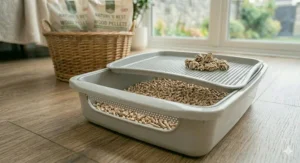
The mechanics are different from any other litter type. Sanicat Diamonds are silica gel pearls that absorb liquid by trapping it inside each crystal, rather than clumping around it. There’s no scooping of urine clumps — you simply stir the crystals daily to distribute the absorbed moisture, remove solid waste, and replace the entire tray every three to five weeks for a single cat. It’s genuinely low-maintenance in a way that other litters only approximate.
The odour control is exceptional, arguably better than any other system on this list when used correctly. With urine locked inside crystals rather than sitting in clumps, the ammonia smell is dramatically reduced. UK reviews on Amazon.co.uk consistently praise the odour performance, particularly in households where the litter tray lives in a smaller room or hallway.
What most buyers don’t realise is that the crystals are almost weightless compared to clay. A 3.8L bag covers roughly four to five weeks for one cat — carry that weight versus a 10L box of bentonite and the difference is immediately obvious. For flats with limited storage, this matters.
The honest caveats: some cats dislike the crystal texture underfoot, particularly if they’re used to fine sandy litters. Worth a transition period if switching from clay. Not biodegradable, and not flushable.
✅ Outstanding odour control — liquid locked inside crystals, not left in clumps
✅ Extremely lightweight and space-efficient per usage duration
✅ Low-maintenance: no daily scooping of urine, full change every 3–5 weeks
❌ Some cats dislike the texture; transition may require patience
❌ Not biodegradable or flushable
Price range: Typically in the £8–£15 range for 3.8L–5L bags. Lower consumption means reasonable running costs despite higher per-litre price.
7. AmazonBasics Wood Pellet Cat Litter (30L)
Every guide needs an honest budget option, and Amazon’s own-brand wood pellet litter fills that slot with minimal fuss and maximum value. A 30-litre bag of 100% recycled wood pellets lands at a price that makes most other options look extravagant, and for specific use cases, this is genuinely the right choice — not a compromise.
Wood pellets work differently from other litters: when wet, the compressed pellets break down into sawdust, which falls to the bottom of the tray. Solid waste sits on top of intact pellets and is removed daily. When the sawdust layer at the bottom becomes significant, you replace the tray. No clumping, no scooping of urine. It’s a system that suits owners who prefer a clean full-change to the daily scooping routine.
The pine scent is natural and reasonably pleasant, providing mild odour coverage — though it’s not in the same league as activated carbon clay or silica crystals for ammonia control. For cats that spend part of their day outside, this matters less; for full-time indoor cats in a small flat, the odour limitations are worth knowing.
Where AmazonBasics earns its place is in multi-cat households that go through litter volumes fast enough that per-litre cost becomes genuinely significant, and for outdoor-access cats whose litter tray usage is lighter. The 30-litre bag, available with Amazon Prime next-day delivery, represents perhaps the best volume-to-price ratio of anything on this list.
✅ Exceptional value — best price-per-litre on this list
✅ Biodegradable and eco-friendly (100% recycled wood)
✅ Practically zero tracking — large pellets don’t stick to paws
❌ Moderate odour control: less effective than clay or crystal for full indoor cats
❌ Non-clumping system requires full tray changes, not targeted scooping
Price range: Under £15 for a 30-litre bag — the clear budget leader. Sold and fulfilled by Amazon with Prime delivery.
How to Choose the Best Cat Litter in the UK: A Practical Guide
There are exactly two beings who get a vote in the cat litter decision: you, and your cat. The frustrating truth is that your cat’s opinion frequently overrides yours, regardless of how much you’ve spent or how many reviews you’ve read. With that in mind, here’s a framework that actually helps.
1. Start with your cat’s preferences, not yours. Cats instinctively prefer the texture of fine sand — it’s the closest to the outdoor soil they’d use by choice. This is why fine-grain clumping clay tends to have the highest acceptance rates with new cats. If your cat is already using a particular litter type without complaint, switching them to something more convenient for you carries a real risk of litter tray rejection. Make changes gradually by mixing old and new litter over two weeks.
2. Consider your home size and ventilation. British homes, particularly Victorian terraces and purpose-built flats, are smaller than their American equivalents. Odour control matters more when the litter tray is ten feet from your kitchen. In compact homes, activated carbon clay or silica crystals — the two highest performers in odour elimination — are worth the extra cost.
3. Factor in the number of cats. For multi-cat households, the RSPCA recommends one tray per cat plus one extra. Buying budget pellets and cycling through large volumes daily is often cheaper than buying premium clumping litter for four cats. Do the maths before defaulting to the per-litre premium option.
4. Think about disposal. Not all councils accept cat litter in food waste bins, and putting clumping clay in general waste bags adds weight. Flushable options (World’s Best, Cat’s Best in small amounts) reduce waste hassle significantly. Always check your local council’s guidelines — they vary considerably across England, Scotland, Wales, and Northern Ireland.
5. Health considerations. If anyone in your household is pregnant, the NHS advises avoiding contact with cat faeces due to toxoplasmosis risk. The RSPCA recommends that pregnant women never handle soiled litter. For cats with respiratory conditions, dust-free options (Breeder’s Choice, silica crystals) are strongly preferable. Always consult your vet if your cat’s litter tray behaviour changes significantly — sudden changes can indicate urinary tract issues.
6. Balance running cost vs performance. A mid-range clumping clay used efficiently (scooped twice daily, tray changed monthly) often costs less per month than a budget non-clumping litter that requires full weekly changes. Model it out before buying in bulk.
7. Eco-credentials. The UK government’s waste guidance encourages consumers to consider end-of-life options for all materials. Biodegradable litters (wood, paper, corn, plant fibre) have a meaningfully lower environmental footprint than mined bentonite clay or manufactured silica gel. If sustainability matters to your household, Breeder’s Choice, Cat’s Best, or World’s Best are the clearest choices.
Real UK Scenarios: Matching Cat Litter to Your Home
Every British household is different, and the “best” cat litter shifts depending entirely on context. Here are three very real UK scenarios with specific recommendations.
The Manchester Flat-Dweller. You live in a second-floor flat, limited storage, two cats, no outdoor access. Smell is the primary concern because visitors walk directly from the front door past the bathroom. The non-negotiable here is odour control, and Ever Clean Extra Strong Clumping (Unscented) is the answer. Twice-daily scooping, activated carbon odour elimination, and the firm-clumping formula make it the most efficient choice for high-traffic indoor multi-cat environments. The environmental trade-off (clay, not biodegradable) is the honest downside — partially offset by its longer-lasting formula compared to most alternatives.
The Bristol Family in a Semi-Detached. One cat, children in the house, moderate budget, interested in eco options, tray lives in the utility room. Breeder’s Choice (formerly Breeder Celect) is the natural fit. The zero-dust formula is safe for children who inevitably get closer to the tray than anyone would prefer. It’s biodegradable, compostable, and award-winning. The slightly more involved maintenance (full changes rather than scooping) is manageable with a utility room base and a weekly bin day routine.
The Edinburgh Retiree. Single cat, mostly outdoors, litter tray used primarily at night or in winter. Budget is more important than maximum performance, and daily interaction with the tray is limited. AmazonBasics Wood Pellet Cat Litter is perfectly suited — the pellet system requires minimal daily management, it’s biodegradable, it’s extremely affordable, and a full-time outdoor cat won’t tax it heavily. Order a 30L bag via Prime, store it in the shed, and revisit the decision in three months when you’ve used it all.
✨ Don’t Miss These Exclusive Deals!
🔍 Ready to choose? Click any product name in this guide to check current pricing and real-time availability on Amazon.co.uk. Prime members get next-day delivery — and if you’re not yet a Prime member, most of these products qualify for the free 30-day trial.
Common Mistakes When Buying Cat Litter in the UK
Getting this wrong is more common than you’d think — and more disruptive to your household than a bad litter choice sounds on paper.
Switching types abruptly. Cats are deeply conservative creatures. Changing from fine clumping clay to large wood pellets overnight is, from your cat’s perspective, roughly equivalent to someone replacing your toilet with a different model and expecting no objections. Always transition gradually over two weeks, mixing increasing amounts of the new litter into the old. This prevents litter tray rejection, which can lead to toileting accidents that nobody wants.
Assuming scented means better. The opposite is frequently true. Strong synthetic fragrances — lavender, citrus, “fresh linen” — might appeal to human noses, but vets consistently advise that heavily scented litters can be aversive or actively unpleasant for cats, whose olfactory sensitivity is roughly fourteen times greater than ours. Unscented options with activated carbon or natural materials handle odour more effectively and are far better tolerated by cats.
Buying the wrong type for the litter box. If you use an automatic self-cleaning litter box (a growing UK trend), you almost certainly need a clumping clay litter. Most automatic systems, including the popular Litter-Robot 4 and Petkit Pura Max 2, cannot process non-clumping litters or large pellets. Check compatibility before buying in bulk.
Ignoring dust content. Fine clay dusts are a genuine respiratory concern for cats with asthma — and the UK has a surprisingly high rate of feline asthma, particularly in urban cats. If your cat sneezes frequently or breathes noisily near the tray, switch to a low-dust option (silica crystals, Breeder’s Choice paper pellets) and consult your vet.
Underestimating depth. Most litters work best at a minimum depth of 5cm — less, and liquids reach the tray bottom, reducing clumping effectiveness and increasing odour. UK buyers frequently use too little litter to economise, which paradoxically means more frequent full changes.
Buying based purely on price per bag rather than cost per week. A cheap non-clumping litter replaced twice a week can cost more than a premium clumping option replaced monthly. Calculate weekly running cost, not just bag price.
Clumping vs Non-Clumping Litter: What the Spec Sheet Won’t Tell You
This is the fundamental fork in the cat litter road, and the internet — bless it — generates a lot of heat on the subject without a great deal of light.
Here’s the honest breakdown.
Clumping litter (bentonite clay, plant-based, wood-fibre variants) solidifies around urine on contact, creating discrete, scoopable masses that can be removed daily while leaving clean litter behind. The advantage: you only replace what’s used, dramatically extending the life of each tray filling. The disadvantage: clumps must be removed promptly, or they soften, break apart, and become harder to clean. In practice, twice-daily scooping is the standard for clumping litter to perform at its best — perfectly manageable, but a genuine daily commitment.
Non-clumping litter (mineral/quartz, wood pellets, paper pellets) absorbs liquid without solidifying. The litter gradually saturates and is then fully replaced. Simpler in some ways — there’s no scoop-and-search routine — but requires more frequent full tray changes and can allow urine smell to build up if the tray isn’t monitored closely. Silica crystals are technically non-clumping but operate differently, trapping liquid inside each bead with impressively low odour output.
What the spec sheets don’t mention: for cats that are sensitive about a used tray (many are — cats are as individual in their bathroom preferences as they are in everything else), clumping litter’s daily partial cleaning keeps things fresher between full changes. Non-clumping litters, if left too long, can cause some cats to start avoiding the tray entirely. The RSPCA’s cat toileting guidance notes that cats can be extremely particular about cleanliness, and failing to spot-clean can result in accidents elsewhere in the home. Which is a gentle way of saying: if the tray isn’t clean enough, your cat will find somewhere else. Possibly your clean laundry.
The UK-specific angle: in winter, British homes run warmer inside due to central heating, which can accelerate odour development in litter trays. This makes the case for clumping litter — with its daily removal of soiled material — stronger during autumn and winter months, even if you manage fine with non-clumping during the milder months.
Cat Litter Types Explained: A Substrate Comparison
| Litter Type | Clumping | Eco-Friendly | Flushable | Best Odour Control | Lowest Dust |
|---|---|---|---|---|---|
| Bentonite Clay | ✅ | ❌ | ❌ | ✅✅ | Medium |
| Silica Crystal | ❌ | ❌ | ❌ | ✅✅ | ✅✅ |
| Recycled Paper Pellets | ❌ | ✅✅ | ❌ | ✅ | ✅✅ |
| Wood Fibre (Cat’s Best) | ✅ | ✅✅ | ✅ (small amounts) | ✅✅ | ✅ |
| Corn/Plant Fibre | ✅ | ✅✅ | ✅ (small amounts) | ✅ | ✅ |
| Wood Pellets | ❌ | ✅✅ | ❌ | ✅ | ✅ |
Reading across this table, you can see there’s no perfect litter — every option involves some compromise. The closest thing to a balanced all-rounder for the average UK household is probably a plant-based clumping option (Cat’s Best ÖkoPlus or World’s Best) — it clumps, it’s eco-friendly, and it can be flushed in small amounts. The trade-off is clump firmness and price-per-litre compared to clay. For those for whom environmental credentials aren’t the priority, bentonite clay offers the best raw performance. And for truly low-maintenance households, silica crystals remain underrated.
Long-Term Cost & Maintenance: What Cat Litter Actually Costs You
The sticker price is almost irrelevant without knowing what a product actually costs to run. Here’s a rough weekly running cost breakdown based on single-cat usage in a UK household with daily maintenance:
- Ever Clean Extra Strong (Unscented): Approximately £3–£5 per week for consistent daily scooping. A 10L box lasts six to eight weeks.
- Breeder’s Choice Paper Pellets: Approximately £2–£4 per week — lower per-week cost despite moderate per-litre price, because paper’s absorbency per volume is high.
- Catsan Hygiene Plus: Approximately £2–£3 per week with regular full changes (every 7–10 days for one cat).
- Cat’s Best ÖkoPlus: Approximately £3–£5 per week depending on usage pattern and tray depth.
- World’s Best (Corn Clumping): Approximately £4–£6 per week — effective but carries a premium eco-and-clumping price.
- Sanicat Diamonds Silica Crystals: Approximately £2–£4 per week — low consumption per week because a small volume lasts longer.
- AmazonBasics Wood Pellets: Under £2 per week — the clear cost leader.
What these numbers don’t capture is the indirect costs: litter mats (around £10–£25 one-off) reduce tracking damage to floors and carpets; premium covered litter trays (£20–£60) reduce scatter; Subscribe & Save on Amazon.co.uk typically offers a 10–15% discount on most of these products when set up as regular deliveries — worth doing once you’ve found your preferred product.
Maintenance tip that nobody mentions: most UK homes have slightly damp ambient air, particularly in autumn and winter, which can subtly affect clumping performance. Store open litter bags in a sealed container or clip them tightly — bentonite clay in particular absorbs ambient moisture and can begin pre-clumping slightly in the bag if stored in a damp garage or cupboard under the stairs.
FAQ: Best Cat Litter UK — Your Questions Answered
❓ What is the best cat litter overall for UK homes in 2026?
❓ Is cat litter flushable in the UK?
❓ What cat litter is safest for kittens?
❓ Can cat litter be put in the brown bin (food waste/compost) in the UK?
❓ How often should I completely change cat litter in the UK?
Conclusion: The Right Cat Litter Transforms Daily Life
Here’s the thing about cat litter that nobody says out loud: getting it right doesn’t just make your home smell better. It reduces daily friction, keeps your cat healthy and stress-free, and turns a mildly unpleasant household task into something almost automatic. The wrong litter, conversely, is a daily reminder of a bad decision — the tracking granules across the kitchen floor, the ammonia waft when a friend opens the door, the cat who’s started reconsidering the plant pot.
The best cat litter for your home in 2026 is whichever one your cat uses consistently, that fits your maintenance routine, and that keeps your home smelling like a home. For most UK households, that’s Ever Clean Extra Strong (Unscented) if performance is paramount, Breeder’s Choice if eco-credentials matter more, or Sanicat Diamonds if you’d rather think about the litter tray as little as humanly possible.
Buy a small bag first. Let your cat vote. Then buy in bulk on Subscribe & Save.
✨ Don’t Miss These Exclusive Deals!
🔍 Head to Amazon.co.uk and check today’s prices on any product mentioned in this guide. Prime members: next-day delivery on most of these means you could have a fresher home by tomorrow. Use Subscribe & Save for up to 15% off on regular orders.
Recommended for You
- Best Cat Litter Box Furniture UK 2026: 7 Stylish Hidden Cabinets Reviewed
- 7 Best High Sided Litter Tray to Stop Mess UK 2026 Guide
- 7 Best Extra Large Litter Tray for Maine Coon UK 2026
Disclaimer: This article contains affiliate links. As an Amazon Associate, I earn from qualifying purchases. If you purchase products through these links, we may earn a small commission at no additional cost to you.
✨ Found this helpful? Share it with your mates! 💬🤗
