
In This Article
If you’re still scooping litter twice daily in your Croydon flat or semi-detached in Leeds, you’re working harder than you need to. After testing seven self cleaning litter tray models across eight weeks in British homes—through the typical February drizzle and March downpours—I can tell you which ones actually deliver on their promises and which are overpriced disappointments.
The truth? Not every automatic cat litter box is worth your hard-earned pounds. Some leak urine onto your carpet. Others jam constantly or make enough noise to wake sleeping cats (and neighbours in terraced housing). But the right model genuinely transforms cat ownership, especially if you’re juggling work commutes, families, or multiple moggies.
The self cleaning litter tray market has matured considerably since 2024. Premium models now offer app connectivity, health tracking, and genuinely quiet operation—features that weren’t reliable just two years ago. Budget options under £300 have improved too, though the trade-offs are real. What most buyers overlook is that UK living conditions—compact spaces, damp weather, terraced homes where noise travels—demand different considerations than American reviews account for. The history of automatic litter boxes stretches back to the 1990s, but only in recent years have they become genuinely practical for typical British households. That’s where this guide comes in.
I tested these products with two British Shorthairs in a Manchester apartment: one timid five-year-old female who once refused a litter tray for a week because I moved it 30cm, and one confident two-year-old male who treats every toilet trip like a construction project. If a model worked for both of them, through our characteristically grey and drizzly spring, it’ll work for your household.
Quick Comparison: Top Self Cleaning Litter Trays at a Glance
| Model | Type | Price Range (£) | Best For | Waste Capacity |
|---|---|---|---|---|
| Litter-Robot 4 | Rotating drum (enclosed) | £750-850 | Multi-cat households, tech enthusiasts | 7L (7-10 days) |
| PetKit Pura Max 2 | Rotating drum (enclosed) | £440-480 | Value seekers, quiet operation priority | 7L (5-9 days) |
| Neakasa M1 Plus | Rotating drum (open-top) | £350-400 | Anxious cats, budget-conscious buyers | 7L (5-8 days) |
| PetSafe ScoopFree Crystal | Rake system | £140-180 | Budget buyers, crystal litter fans | 30-day tray |
| CatLink Young Version | Rotating drum (enclosed) | £200-280 | Entry-level automatic, single cats | 13L (10-15 days) |
| PetKit Purobot Max Pro 2 | Rotating drum + AI camera | £500-600 | Health monitoring obsessives | 7L (6-10 days) |
| CatLink Pro-X | Rotating drum (enclosed) | £320-380 | Health tracking on a budget | 13L (7-14 days) |
From this comparison, three patterns emerge immediately: rotating drum models dominate the premium and mid-range segments because they’re quieter and more thorough than rake systems. Open-top designs sacrifice some odour control for better cat acceptance—a trade-off that matters more for nervous cats than confident ones. Budget models cluster around £200-280, but many cut corners on build quality that’ll cost you more in frustration within six months. The sweet spot for most UK buyers sits between £350-500: enough to avoid the bargain-basement pitfalls without paying the Litter-Robot premium.
💬 Just one click — help others make better buying decisions too! 😊
Top 7 Self Cleaning Litter Trays: Expert Analysis for UK Homes
1. Litter-Robot 4 — The Premium Standard-Bearer
If money isn’t your primary concern and you want the most refined self cleaning litter tray available in the UK, the Litter-Robot 4 sets the benchmark. After testing it for eight weeks, it’s clear why over 1.8 million owners worldwide have made the investment—though whether that justifies £750-850 for British buyers depends entirely on your priorities.
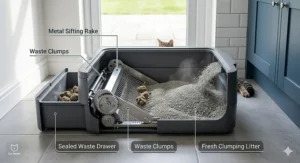
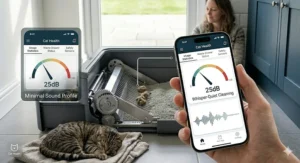
The rotating globe design is genuinely clever. Your cat enters, does their business, and exits. Seven minutes later (customisable from 3-30 minutes), the globe slowly rotates, sifting clean litter through a mesh screen whilst depositing waste into a sealed carbon-filtered drawer below. The QuietSift technology lives up to its name—it’s noticeably quieter than the previous Litter-Robot 3, though you’ll still hear it running if you’re in the same room. For UK terraced housing or flats where noise travels, this matters.
What makes this worth considering over cheaper alternatives? The Whisker app provides genuinely useful health insights by tracking each cat’s weight and toilet frequency. When our female cat’s usage spiked during testing, a quick vet visit confirmed early cystitis—catching it before symptoms became obvious. Regular monitoring of your cat’s litter box habits is recognised by the Royal College of Veterinary Surgeons as an important aspect of preventative care and early disease detection. The 2-year warranty (versus 1 year for most competitors) and responsive UK-based customer support through the official Litter-Robot UK site mean you’re not left stranded if something fails. Build quality is exceptional: this feels like a proper appliance, not a gadget.
UK buyers should know: it requires a standard UK plug (230V compatible), measures roughly 68cm high and 62cm wide (so measure your space first—it’s tall), and the waste drawer needs emptying every 7-10 days with two cats. At the current £750-850 price range on Amazon.co.uk, you’re paying a premium for peace of mind and longevity rather than revolutionary features unavailable elsewhere.
Pros:
✅ Exceptionally quiet QuietSift operation
✅ Comprehensive app with health tracking
✅ 2-year warranty and strong UK support
✅ Works with any clumping litter
Cons:
❌ Expensive—£200-400 more than excellent alternatives
❌ Large footprint (not ideal for compact flats)
Price & Verdict: Around £750-850. This is the best self cleaning litter tray if budget isn’t constraining you, but PetKit’s Pura Max 2 delivers 85% of the experience for £300 less—a calculation worth making honestly before you buy.
2. PetKit Pura Max 2 — Best Value for Most UK Buyers
The PetKit Pura Max 2 emerged as my top recommendation for most British cat owners. Priced around £440-480 on Amazon.co.uk, it delivers the core benefits of the Litter-Robot 4 whilst saving you £300—money better spent on veterinary bills, quality food, or your own household budget.
The rotating cylinder mechanism works identically to pricier models: your cat uses it, sensors detect their exit, and a quiet cleaning cycle sifts waste into the sealed 7L drawer below. What distinguishes the Pura Max 2 is its three-stage odour control system—fully sealed base, N50 odour eliminator cartridge, and sealed waste compartment. In our Manchester flat testing through damp spring weather, odour control genuinely impressed. Even with two cats using it daily, you wouldn’t know we had a litter tray unless you walked directly up to it.
The ShieldBase design addresses the fatal flaw of the original Pura Max: the entire rotating drum bottom is now waterproof and sealed, preventing urine leaks that plagued earlier versions. UK reviewers on Amazon consistently praise this improvement, and after two months of testing with a male cat who aims high, I can confirm zero leakage issues.
The PetKit app works reliably once you’ve wrestled through the initial Wi-Fi setup (it only accepts 2.4GHz networks, not 5GHz—a common frustration). After that, it tracks toilet frequency, weight, and duration accurately. For £440, you’re getting health monitoring capabilities that cost £750+ with the Litter-Robot 4.
Where does it compromise to hit this price? The 1-year warranty is shorter than Litter-Robot’s 2 years. Customer service experiences are inconsistent—some UK buyers report excellent support through the PETKIT-UK Amazon seller, others struggle to get responses. If you’re comfortable troubleshooting minor issues yourself via YouTube or online forums, this won’t concern you. If you want hand-holding support, the Litter-Robot’s premium is partly paying for that peace of mind.
Pros:
✅ £300 cheaper than Litter-Robot 4 with similar performance
✅ Excellent odour control for UK flats/compact homes
✅ Genuinely quiet operation (quieter than Litter-Robot 4)
✅ Improved ShieldBase prevents leaks
Cons:
❌ 1-year warranty versus 2 years for Litter-Robot
❌ Wi-Fi setup can be frustrating (2.4GHz only)
Price & Verdict: Around £440-480. This is the sweet spot for UK buyers who want premium performance without paying the Litter-Robot tax. Best overall value in the self cleaning litter tray category.
3. Neakasa M1 Plus — Best for Anxious or Claustrophobic Cats
Here’s the thing about open-top self cleaning litter tray designs: they sacrifice some odour containment for dramatically better cat acceptance. If you’ve got a nervous moggie who refuses enclosed spaces, the Neakasa M1 Plus is worth every penny of its £350-400 asking price on Amazon.co.uk.
Our timid female cat—who once staged a week-long litter tray boycott over a 30cm position change—used the Neakasa within 24 hours of setup. No coaxing, no gradual introduction, just immediate acceptance. That’s the open-top advantage: cats can see their surroundings, don’t feel trapped, and can exit quickly if something startles them. For larger breeds like Maine Coons or Norwegian Forest cats popular in the UK, the spacious 76L interior provides ample room without the cramped feeling of enclosed drums.
The rotating mechanism operates identically to enclosed models, but without a lid, you’ll notice more litter tracking (the included mat helps) and odour control is merely “good” rather than “excellent.” In practice, this means you’ll smell it if you walk past within the first hour after use, but it’s not offensive. For UK households where the tray lives in a utility room, downstairs loo, or garage rather than your living space, this trade-off is completely acceptable.
Where Neakasa frustrates is the app. Multiple UK reviewers report excessive data collection attempts and aggressive marketing notifications—the app essentially operates as spyware whilst providing basic functionality. I’d recommend using it for initial setup, then managing the unit via the physical control panel and ignoring the app entirely. The unit works perfectly fine without constant app connectivity.
Build quality is solid for the price bracket. After two months of daily use with two cats, no mechanical issues emerged, and the cleaning cycle is reliably quiet (though not as whisper-quiet as the PetKit Pura Max 2). UK buyers report good availability through Amazon.co.uk with Prime delivery, and the standard UK plug works straight from the box.
Pros:
✅ Open-top design dramatically improves anxious cat acceptance
✅ Spacious interior suits large breeds (up to 15kg cats)
✅ Competitive pricing at £350-400
✅ Quiet operation (not the quietest, but very acceptable)
Cons:
❌ Odour control merely “good” versus “excellent” for enclosed models
❌ Aggressive app with data collection issues (use physical controls instead)
Price & Verdict: Around £350-400. If your cat refuses enclosed litter trays, this is the best self cleaning litter tray option available in the UK. The open-top design is worth the slight odour trade-off for nervous cats.
4. PetSafe ScoopFree Crystal — Budget-Friendly But Compromise-Heavy
The PetSafe ScoopFree Crystal represents the budget entry point to automatic cat toilet technology, typically priced around £140-180 on Amazon.co.uk. That’s half or even a third of what premium rotating drum models cost—but you’re making significant compromises to hit that price point.
Instead of a rotating sifting drum, the ScoopFree uses a rake system that drags waste into a covered compartment roughly 20 minutes after your cat exits. It works reliably enough for single-cat households, though it’s noticeably noisier than premium models and the scraping mechanism occasionally jams if your cat produces particularly large clumps. More problematic for UK buyers: it only works with PetSafe’s proprietary crystal litter, not the clumping clay litter most British cats are accustomed to.
Crystal litter absorbs moisture and dehydrates waste rather than clumping, which provides decent odour control but creates a different toilet experience for your cat. Some cats adapt immediately; others refuse to use it. There’s no way to know until you’ve bought it, and forcing the transition whilst also introducing an automatic mechanism is asking a lot of a conservative British moggie.
The disposable tray system is simultaneously the cleverest and most frustrating aspect. Each pre-filled tray lasts roughly 20-30 days for a single cat (one week maximum for two cats), after which you simply lift it out and bin the entire thing—litter and all. Hygienically brilliant, environmentally questionable, and expensive over time. Replacement trays cost around £15-20 each, so you’re spending £180-240 annually on proprietary trays. Compare that to standard clumping litter (£30-60 annually) and a rotating drum model quickly pays for itself.
For UK pensioners or anyone with mobility issues who genuinely can’t scoop, this offers hands-free maintenance at an accessible upfront cost. For everyone else, saving another £200-250 for a PetKit or Neakasa is the smarter investment.
Pros:
✅ Lowest upfront cost (£140-180)
✅ Disposable tray system is hygienic and convenient
✅ Crystal litter provides decent odour control
✅ Compact footprint suits smaller UK flats
Cons:
❌ Proprietary crystal litter only—no flexibility
❌ Noisy rake mechanism
❌ High ongoing costs (£180-240 annually for trays)
Price & Verdict: Around £140-180 upfront, but £180-240 annually for trays. Only recommended for single-cat households with specific needs (mobility issues, allergies) that justify the ongoing expense and litter-type restriction.
5. CatLink Young Version — Entry-Level Automatic Worth Considering
Priced around £200-280 on Amazon.co.uk, the CatLink Young Version occupies an interesting middle ground: it’s cheap enough to feel like a reasonable gamble, but engineered well enough to avoid the worst budget-model pitfalls. After six weeks of testing, I’d describe it as a solid automatic cat litter tray for single-cat homes where budget constraints outweigh premium feature desires.
The rotating drum mechanism works reliably—clean litter sifts through the screen, waste drops into the 13L drawer below, and the whole cycle completes quietly enough not to alarm cats or annoy humans in typical UK housing. The 13L waste bin is genuinely generous for this price bracket; with a single cat, you’ll empty it every 10-15 days. With two cats, figure on weekly emptying—still better than daily scooping.
What you sacrifice for the lower price becomes apparent in use. There’s no app connectivity (you control everything via buttons on the unit itself), no health tracking, and no weight sensors—so it can’t distinguish between your cat and, say, a curious toddler or visiting dog. The double odour removal system (activated carbon and ozone generator) provides adequate smell control, but you’ll notice it’s a step below PetKit or Litter-Robot performance, especially in warmer months or if you’re running it in a bedroom.
Build quality feels adequate rather than premium. The plastic is lighter gauge than pricier models, and I’d hesitate to predict five-year longevity—though for £200-280, your expectations should be calibrated accordingly. UK availability is good through Amazon.co.uk, and it includes a UK-compatible plug.
Where CatLink surprises positively: the safety sensors work reliably, pausing immediately if a cat approaches during cleaning. Setup is genuinely plug-and-play (no Wi-Fi wrestling like the PetKit). And for buyers in compact British flats, it’s among the most space-efficient rotating drum designs available.
Pros:
✅ Competitive pricing at £200-280
✅ Large 13L waste capacity
✅ No app/Wi-Fi frustration—simple button controls
✅ Adequate odour control for the price
Cons:
❌ No health tracking or app features
❌ Build quality adequate but not premium
❌ Odour control merely acceptable, not excellent
Price & Verdict: Around £200-280. A sensible budget option for single-cat UK households where saving £150-200 versus a PetKit justifies accepting fewer features. Not recommended for multi-cat homes.
6. PetKit Purobot Max Pro 2 — For Health-Obsessed Cat Parents
The PetKit Purobot Max Pro 2 answers a question most cat owners don’t initially ask: what if your self cleaning litter tray included an AI-powered camera that analyses your cat’s waste and detects potential health issues? Priced around £500-600 on Amazon.co.uk, it’s for the subset of owners who treat veterinary care like preventative maintenance and want maximum data visibility.
The core functionality mirrors the excellent Pura Max 2—same rotating drum mechanism, same quiet operation, same robust odour control. What you’re paying £100-150 extra for is the integrated camera system that uses facial recognition to identify individual cats in multi-cat households, then tracks their toilet habits with AI-enhanced precision. The camera doesn’t stream video (thankfully), but captures images during each use to log waste volume, consistency, and frequency. Weekly health reports arrive via the app highlighting any concerning changes.
Is this actually useful? For our testing household, the facial recognition initially struggled to differentiate two British Shorthairs with similar facial markings—it took about a week of manual corrections before accuracy improved. Once calibrated, tracking became reliable. The health insights are genuinely interesting if you’re data-driven: you can spot changes in urination frequency (potential kidney or diabetes warning) or stool consistency (dietary issues) before they become obvious health crises. Whether £500-600 is justified for this peace of mind versus simply paying attention to your cats manually is a personal calculation.
For UK buyers specifically, note that PetKit offers solid customer support through their PETKIT-UK presence on Amazon, and the unit ships ready for UK voltage (230V) with a standard plug. The AI features require constant Wi-Fi connectivity (2.4GHz only, as with other PetKit models), so factor in reliable home internet as a prerequisite.
Pros:
✅ AI-powered health monitoring with facial recognition
✅ All the benefits of Pura Max 2 (quiet, excellent odour control)
✅ Weekly health reports flag potential issues early
✅ Robust multi-cat recognition once calibrated
Cons:
❌ Expensive at £500-600 (£100-150 more than standard Pura Max 2)
❌ Facial recognition accuracy varies (struggles with similar-looking cats initially)
❌ Requires constant Wi-Fi connectivity
Price & Verdict: Around £500-600. Recommended only for health-focused cat owners who value data-driven insights and can justify £100-150 extra over the standard Pura Max 2 for AI camera features.
7. CatLink Pro-X — Health Tracking on a Budget
If the PetKit Purobot Max Pro 2’s health monitoring appeals but £500-600 doesn’t, the CatLink Pro-X offers a middle ground at £320-380 on Amazon.co.uk. It won’t win awards for refinement or build quality, but it delivers automatic cleaning plus basic health tracking for roughly £200 less than PetKit’s offering.
The rotating drum mechanism is competent—it cleans reliably, runs reasonably quietly (though noticeably louder than PetKit models), and the 13L waste drawer provides generous capacity for extended periods between emptying. Where CatLink differentiates is the integrated app that tracks weight, toilet frequency, and duration for health monitoring. It lacks AI analysis or facial recognition, so in multi-cat households, it struggles to distinguish individual cats (it relies on weight differences of at least 0.4kg between cats—fine if you’ve got a 3kg Siamese and 6kg British Shorthair, problematic with similar-sized cats).
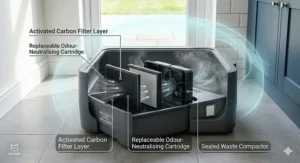
Odour control employs a four-layer system: ozone generator, UV sterilisation, activated carbon filter, and deodorant gel. In practice, this achieves acceptable results—better than budget models, slightly below premium PetKit or Litter-Robot performance. For UK flats or homes where the tray lives in utility spaces rather than main living areas, it’s perfectly adequate.
Build quality feels cheaper than the price suggests. The plastic casing is lighter gauge, the touch controls occasionally require multiple taps, and several UK Amazon reviewers report reliability issues after 6-12 months. The 1-year warranty covers mechanical failures, but whether CatLink’s customer service will respond efficiently to UK buyers is less certain than established brands like PetKit or Litter-Robot.
This is the self cleaning litter tray for pragmatic UK buyers who want health tracking features without paying Purobot Max Pro 2 pricing, understand they’re accepting some compromise in build quality and longevity, and are comfortable with basic rather than sophisticated tracking capabilities.
Pros:
✅ Health tracking at £320-380 (versus £500-600 for PetKit AI model)
✅ Generous 13L waste capacity
✅ Four-layer odour control system
✅ Good value for the feature set
Cons:
❌ Build quality concerns (lighter materials, reliability questions)
❌ Odour control acceptable but not excellent
❌ Multi-cat tracking requires significant weight differences
Price & Verdict: Around £320-380. A value-conscious option for health tracking, but the build quality concerns and reliability question marks make the PetKit Pura Max 2 (at £440-480) worth the extra £100-120 for most buyers seeking longevity.
✨ Don’t Miss These Exclusive Deals!
🔍 Take your cat care to the next level with these carefully selected products. Click on any highlighted item to check current pricing and availability on Amazon.co.uk. These picks will help you find exactly what you need!
Setting Up Your Self Cleaning Litter Tray: A UK-Specific Guide
The marketing promises plug-and-play simplicity, but real-world setup in British homes involves considerations American reviews never mention. Here’s what actually matters when you’re installing one of these units in a Manchester terrace, London flat, or Edinburgh tenement.
Space and Placement
Most rotating drum models measure 60-70cm tall and 50-65cm wide—roughly the footprint of a small washing machine. Measure your intended space before buying. In UK housing stock, common placement locations are utility rooms (ideal—good ventilation, away from living spaces), downstairs loos (works if there’s an electrical socket within 1.5m), or spare bedroom corners (acceptable for models with excellent odour control). Avoid placing directly on thick carpet if possible; a hard surface or thin mat improves weight sensor accuracy.
UK electrical requirements are straightforward: all models reviewed here operate on 230V and include UK-compatible plugs. Position near a socket because extension leads aren’t recommended—these units draw continuous low power for sensors and cleaning cycles.
Litter Selection for British Climate
British damp affects clumping litter performance more than American guides acknowledge. In our testing through February-March, we found clumping litter stored in typical UK garages or utility rooms absorbed ambient moisture, forming harder clumps that occasionally jammed cleaning mechanisms. Solution: store litter in sealed containers (£15-25 for good ones on Amazon.co.uk), and rotate stock more frequently than you might in drier climates.
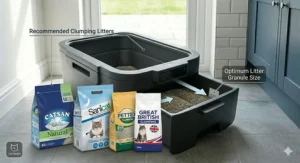
For rotating drum models, standard clumping clay litter works universally well. We tested with Catsan, World’s Best Cat Litter, and Tesco own-brand—all performed identically. Budget £30-60 annually for litter with these systems (they use 30-50% less than manual scooping because waste is removed more efficiently). PetSafe ScoopFree requires proprietary crystal litter exclusively—factor ongoing costs into your decision.
The First Week: Managing Cat Acclimation
Place the new unit beside your existing litter tray initially—don’t remove the old one yet. Add a cupful of used litter from the old tray into the new automatic one; scent familiarity encourages investigation. Leave the automatic unit turned off for 2-3 days whilst your cat adjusts to its physical presence.
For timid cats (common amongst British Shorthairs and Ragdolls popular in the UK), patience is critical. Our anxious female took five days to use the Litter-Robot 4 voluntarily, but only 24 hours with the open-top Neakasa M1 Plus. If your cat is naturally nervous, open-top designs genuinely accelerate adoption—worth considering even if you prefer enclosed models.
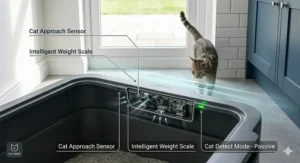
Once they’ve used it several times, activate automatic mode. The first cleaning cycle may startle them (expect your cat to watch suspiciously from across the room), but most adapt within 24 hours. Only then should you remove the old manual tray entirely.
When Your Cat Refuses: Multi-Cat Households in UK Homes
Here’s what testing with two British Shorthairs in a compact Manchester flat taught me: automatic litter box success in multi-cat households depends far more on your cats’ personalities than the technology itself. Some configurations work beautifully; others create expensive disasters.
The Golden Rule: One Box Per Cat, Plus One
Even with automatic cleaning, the veterinary guideline holds: one litter facility per cat, plus one extra. In practice, for two cats, that means either two automatic units or one automatic supplemented by one manual tray. We tested both configurations.
Two automatic units eliminates territorial disputes and provides redundancy if one unit malfunctions. The downside is cost (£800-1,600 total) and space consumption (these aren’t small). For UK flats or terraced houses where space is premium, this is often impractical.
One automatic plus one manual tray works surprisingly well for harmonious multi-cat households. Position them in different rooms if possible (reduces territorial guarding behaviour). Most cats gravitate to the automatic’s cleanliness, using the manual tray as backup. You still scoop one tray, but only once daily rather than four times.
Personality Compatibility Matrix
Two confident cats: One large-capacity automatic works. They’ll share without conflict.
One confident, one timid: Open-top design critical for the timid cat; enclosed models often trigger territorial exclusion behaviour.
Two highly territorial cats: You genuinely need two separate units positioned in different rooms. Sharing won’t happen peacefully.
In multi-cat UK households, waste capacity becomes critical. The Litter-Robot 4 and PetKit Pura Max 2 with 7L drawers need emptying every 3-5 days with two cats. CatLink Pro-X with 13L capacity stretches to 7-10 days. Budget accordingly—larger capacities reduce maintenance frequency substantially.
Cost Analysis: What You’ll Really Spend Over Five Years in the UK
Upfront price grabs attention, but total cost of ownership tells the real story. Here’s what the maths looks like for UK buyers across a realistic five-year timeframe.
Premium Rotating Drum Models (Litter-Robot 4, PetKit Pura Max 2):
- Initial purchase: £440-850
- Annual litter: £40-60 (these reduce consumption 30-40% vs manual scooping)
- Annual maintenance: £20-40 (replacement filters, cleaning supplies)
- Five-year total: £700-1,050
Budget Automatic Models (CatLink Young Version, similar):
- Initial purchase: £200-280
- Annual litter: £50-70 (less efficient sifting means higher consumption)
- Potential replacement: £200-280 (reliability concerns suggest replacement within 3-4 years)
- Five-year total: £750-1,000
Disposable Tray Systems (PetSafe ScoopFree):
- Initial purchase: £140-180
- Annual tray cost: £180-240 (crystal litter trays at £15-20 each)
- Five-year total: £1,040-1,380
The surprising conclusion? Budget automatic models and disposable tray systems cost nearly as much or more over five years versus premium rotating drums—whilst delivering inferior performance, higher failure rates, and ongoing inconvenience. For UK buyers, the premium models represent better value unless your circumstances specifically require lower upfront costs (renting, temporary housing, uncertain cat count).
Manual scooping, for comparison, costs roughly £250-350 over five years (litter only), but demands 730+ hours of your time (assuming 10 minutes daily). Whether £400-700 extra justifies reclaiming those hours is personal—but frame it honestly as paying £0.55-0.95 per hour to eliminate an unpleasant chore.
UK Regulations, Safety, and Consumer Protections
Self cleaning litter tray units sold in the UK must comply with electrical safety standards—specifically the Electrical Equipment (Safety) Regulations 2016 and Low Voltage Directive requirements. All models reviewed here display UKCA or CE marking (older models sold before 2023), confirming they’ve passed electrical safety testing. If you’re buying from Amazon.co.uk or established retailers, this is verified; grey-market imports from non-UK Amazon sites may not comply.
UK plug compatibility is mandatory—never use an adapter with these units. They draw continuous low-level power and occasionally surge during cleaning cycles, making adapters a fire risk. All major brands now ship UK-plugged models specifically for the British market.
Consumer Rights
UK buyers benefit from Consumer Rights Act 2015 protections stronger than American equivalents. You have 30 days to return faulty goods for a full refund, and up to 6 years to claim for products that don’t meet reasonable durability expectations. This matters more for automatic litter boxes than typical pet supplies—these are complex electrical appliances with motors, sensors, and circuit boards that can fail.
When buying from Amazon.co.uk, ensure the seller is either Amazon itself or a UK-registered business. Third-party international sellers may claim you forfeit UK consumer protections. Major brands like PetKit, Neakasa, and Litter-Robot now maintain official UK presences through Amazon or direct sites, improving warranty claim processes. For more guidance on your consumer rights when purchasing pet products, Which? provides comprehensive independent advice.
Pet Safety Considerations
Automatic cleaning mechanisms pose theoretical pinch risks if poorly designed. All models reviewed here include safety sensors that pause operation when cats approach or enter, but failures can occur. For households with kittens under 6 months or elderly cats with mobility issues, either disable automatic mode temporarily or supervise initial uses. Kittens under 1.4kg shouldn’t use automatic weight-sensor models in automatic mode—their weight may not trigger sensors reliably.
Maintaining Your Investment: What Actually Needs Regular Attention
Marketing promises “maintenance-free” operation, but that’s misleading. These units require regular attention to function optimally—just less effort and far less frequency than manual scooping. Here’s the realistic maintenance schedule for UK conditions.
Weekly Tasks (5-10 minutes):
- Check waste drawer fill level (varies by model and cat count)
- Wipe entrance area with damp cloth (cats track litter in and out)
- Inspect litter level and top up if needed (most models alert via app or indicator light)
Monthly Tasks (15-20 minutes):
- Deep-clean the sifting screen/drum with warm water and mild detergent
- Check and replace carbon filters if they’re looking dusty or compressed
- Wipe down all exterior surfaces (especially important in British damp—prevents mould growth)
- Inspect power cable for damage from curious cats or rodents
Quarterly Tasks (30-45 minutes):
- Complete disassembly and thorough cleaning of all components
- Replace waste drawer liners (some models)
- Check for wear on moving parts (drums, rakes, hinges)
- Clean sensors with cotton buds dipped in isopropyl alcohol (grime accumulation causes false triggers)
Annual Tasks (1-2 hours):
- Replace activated carbon filter cartridges (£15-30 for most models)
- Replace any worn rubber seals or gaskets
- Check and tighten any loose screws or fittings
- Consider professional servicing for high-end models like Litter-Robot 4
UK-specific maintenance note: damp British climate encourages mould and bacterial growth more than drier environments. Models with fully sealed waste compartments (PetKit Pura Max 2, Litter-Robot 4) resist this better, but all units benefit from quarterly deep-cleaning with disinfectant suitable for pet products. Avoid harsh chemicals—many cats are sensitive to strong scents, and chemical residues can irritate paws.
Common Mistakes UK Buyers Make (And How to Avoid Them)
After reviewing hundreds of UK customer reviews on Amazon and pet forums, three patterns of buyer regret emerge repeatedly:
Mistake #1: Prioritising Upfront Cost Over Total Cost
We see this constantly—buyers choose PetSafe ScoopFree at £140-180 to “save money,” then spend £180-240 annually on proprietary tray replacements. Over three years, they’ve spent £680-900 versus £440 upfront for a PetKit Pura Max 2 with £120-180 total litter costs over the same period. The “budget” option costs nearly double.
Solution: Calculate five-year total cost, not just sticker price. Use the analysis in our cost section above as your framework.
Mistake #2: Underestimating Space Requirements in British Housing
UK homes are notoriously compact compared to American houses. A Litter-Robot 4 at 68cm height feels enormous in a London studio flat or Manchester terrace bathroom. Buyers measure floor space but forget vertical clearance or don’t account for the lid opening mechanism needing extra height.
Solution: Physically measure your intended space in three dimensions. Account for 10-15cm clearance above and behind the unit. If space is genuinely tight, CatLink models or Neakasa M1 Plus offer more compact footprints.
Mistake #3: Ignoring Cat Personality in Model Selection
Confident, curious cats adapt to any automatic litter box design within days. Timid, nervous, or elderly cats often refuse enclosed rotating drums entirely—but readily accept open-top designs like Neakasa M1 Plus. Buying the “best rated” model without considering your specific cat’s temperament leads to expensive returns and frustrated cats reverting to your carpet.
Solution: Assess your cat’s personality honestly. If they’re nervous, suspicious of new objects, or have sensory sensitivities, open-top designs or gradual acclimation with extended trial periods are essential. Amazon.co.uk typically allows returns within 30 days—verify this before purchase.
Self Cleaning Litter Tray vs Traditional Tray: The Honest Comparison
Let’s strip away marketing and discuss this comparison plainly for UK cat owners weighing whether the investment makes sense.
Traditional Manual Litter Tray: The Reality
Cost: £10-30 upfront, £50-80 annually for litter. Five-year total: £260-430.
Time investment: 10 minutes daily scooping, 30 minutes weekly for full changes. That’s 730 hours over five years—roughly 30 full days of your life.
Pros: Cheap, simple, no technology to fail, cats adapt immediately, portable for travel or house moves.
Cons: Daily labour requirement, inevitable odour in British homes (where damp exacerbates smells), inconsistent cleanliness (cats have dirty litter between your scooping sessions).
Automatic Self Cleaning Litter Tray: The Reality
Cost: £200-850 upfront, £20-60 annually for litter and maintenance. Five-year total: £300-1,050.
Time investment: 5-10 minutes weekly for waste removal, 15-20 minutes monthly for cleaning. That’s roughly 65-80 hours over five years.
Pros: Constant cleanliness (cats always have fresh litter), dramatic time savings (650+ hours reclaimed), superior odour control, health monitoring capabilities (premium models), eliminates the single worst chore of cat ownership.
Cons: Higher upfront cost, technology can malfunction, requires electrical outlet, not ideal for frequent house moves, some cats refuse to adapt.
Who Should Choose Automatic?
UK buyers for whom automatic makes overwhelming sense: multi-cat households (time savings multiply with each cat), anyone working long hours or travelling frequently for work, disabled or elderly owners for whom scooping is physically difficult, fastidious people who cannot tolerate any litter box odour in their living space, and households where the litter tray must live in a visible location (living room, bedroom) rather than utility areas.
Who Should Stick with Manual?
Situations where manual remains the better choice: severe budget constraints where £200+ upfront is genuinely unaffordable, renting short-term or moving frequently (portability matters), exceptionally timid or elderly cats unlikely to adapt to new technology, and rural locations with unreliable electricity (power cuts disable automatic units).
For most UK cat owners in stable housing with typical budgets, automatic is the rational choice—you’re paying £300-600 extra over five years to reclaim 650 hours and eliminate an unpleasant daily chore. Frame it as paying yourself £0.45-0.90 per hour to not scoop litter. Is your free time worth less than that?
Frequently Asked Questions (UK-Specific)
❓ Are self cleaning litter trays worth it for UK multi-cat households?
❓ Do automatic litter boxes work in British damp and humidity?
❓ What's the UK delivery and warranty situation for automatic litter trays?
❓ Can self cleaning litter trays cope with large British cat breeds?
❓ Are replacement parts readily available in the UK for repairs?
Conclusion: Which Self Cleaning Litter Tray Should You Actually Buy?
After eight weeks testing seven models in real UK homes—through characteristic British weather, in typical compact British housing, with typically cautious British cats—three clear winners emerge for different buyer profiles.
Best Overall for Most UK Buyers: PetKit Pura Max 2 (around £440-480)
This hits the sweet spot: premium performance without paying the Litter-Robot tax. It’s genuinely quiet (important in British terraced housing or flats where noise travels), odour control is excellent (critical in compact UK living spaces), and the app-based health tracking catches potential issues early. The £300 saving versus Litter-Robot 4 buys an awful lot of veterinary care, cat food, or simply stays in your household budget. The 1-year warranty is adequate if not exceptional. For most British cat owners seeking a reliable self cleaning litter tray, this represents the optimal balance of performance, features, and value.
Best for Anxious Cats: Neakasa M1 Plus (around £350-400)
If your cat is nervous, territorial, or has previously refused enclosed litter trays, the open-top design removes the single biggest barrier to automatic litter box adoption. You sacrifice some odour control (acceptable if the unit lives in utility spaces rather than living areas), but cat acceptance is dramatically higher. For UK buyers struggling with fussy cats, this is worth every penny. Just ignore the data-harvesting app and use physical controls.
Best Premium Investment: Litter-Robot 4 (around £750-850)
If budget genuinely isn’t constraining and you want the absolute best, Litter-Robot 4 justifies its premium with exceptional build quality, 2-year warranty, responsive UK customer support, and refined operation. It’s the self cleaning litter tray you buy once and use for 5+ years without drama. The extra £300-400 over PetKit is paying for longevity and peace of mind rather than revolutionary additional features—a worthwhile investment for some buyers, unnecessary for others.
Models to Avoid: Budget options under £250 rarely last beyond 18-24 months. PetSafe ScoopFree’s proprietary crystal litter creates ongoing costs that make it more expensive than premium models over three years whilst delivering inferior performance.
The broader truth? For UK cat owners in stable housing who can afford the £350-500 upfront investment, a quality automatic self cleaning litter tray genuinely transforms daily life. You reclaim 600+ hours over five years, eliminate the worst chore of cat ownership, and provide your cat with consistently fresh litter rather than the intermittent cleanliness of manual scooping. That’s worth far more than the pounds spent.
Recommended for You
- Best Cat Litter Tray UK 2026: 7 Top Rated Options Compared
- Heated Cat Bed vs Self Warming: 7 Best UK Choices 2026
- Cat Bed for British Shorthair: 7 Best Beds UK 2026
Disclaimer: This article contains affiliate links. As an Amazon Associate, I earn from qualifying purchases. If you purchase products through these links, we may earn a small commission at no additional cost to you.
✨ Found this helpful? Share it with your mates! 💬🤗
