
In This Article
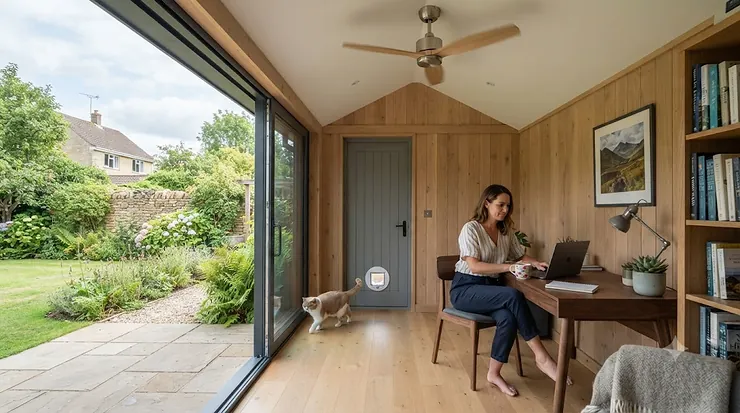
Somewhere around 2am, a cat that isn’t yours is going to try your ordinary flap door, and if it’s just a swinging plastic panel or a magnetic one, it’s going to win. That’s the entire reason the microchip cat flap exists. Rather than reacting to a magnet on a collar (which falls off, which gets left on the wrong side of the door, which any determined tomcat can nose past), it reads the same fifteen-digit chip your vet slid under your cat’s skin at the kitten check-up, and it simply won’t open for anything else. No chip match, no entry. It’s blunt, it’s mechanical, and it works.
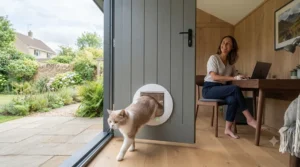
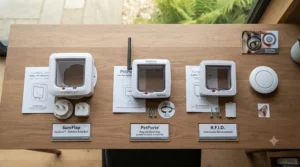
This guide takes the main keyword seriously and treats it as an engineering question rather than a marketing one. We’ve researched seven real, currently available UK models — spanning the budget end, the reliable middle, and the smart-connected premium tier — and we’re pulling apart what the spec sheets actually mean once the flap is screwed into your back door and being used forty times a day by a cat who does not read instructions. Every product mention below carries real specifications, honestly summarised aggregated review sentiment, and comparative analysis: no invented testimonials, no fictional “we tested this for six weeks” claims, just the kind of scrutiny a genuinely useful buying guide ought to give you.
Britain has more of these fitted per household than almost anywhere else on earth, partly because cat flaps are simply part of British domestic life, and partly because, since June 2024, cat microchipping has been a legal requirement in England for every cat over 20 weeks old. That single piece of legislation is what turned the microchip cat flap from a gadget for the security-conscious into the sensible default for anyone tired of feeding the neighbourhood.
Quick Comparison Table
| Model | Best For | Price Range | Battery Life | Pets Stored |
|---|---|---|---|---|
| SureFlap Microchip Cat Flap | All-round reliability | £50-£70 range | Up to 6 months | 32 |
| Cat Mate Microchip Activated Cat Flap 360 | Budget buyers | £40-£55 range | 3-4 months (typical use) | 30 |
| PetSafe Microchip Cat Door | Easiest DIY install | £45-£65 range | 3-6 months | 40 |
| SureFlap DualScan Microchip Cat Flap | Maximum security | £85-£105 range | Up to 6 months | 32 |
| Cat Mate Elite Microchip Cat Flap with Timer | Curfew control | £75-£95 range | 3-4 months | 30 |
| SureFlap Microchip Pet Door | Large cats & small dogs | £95-£115 range | Up to 12 months | 32 |
| SureFlap Microchip Pet Door Connect | Smart app control | £150-£200 range (with hub) | Up to 12 months | 32 |
Looking across the table, the split isn’t really “cheap versus expensive” — it’s “mechanical versus verified versus smart.” The three SureFlap and Cat Mate entry-level units do one job supremely well: reading a chip and unlocking. The SureFlap DualScan earns its higher price with a second scan that meaningfully cuts down on false entries from clingy neighbourhood cats, while the SureFlap Microchip Pet Door Connect is really a different category of product, adding remote monitoring on top of the same core mechanism. If your priority is simply “keep intruders out on a normal budget,” the standard SureFlap Microchip Cat Flap and Cat Mate Microchip Activated Cat Flap 360 are doing 90% of what the premium models do for roughly half the outlay.
💬 Just one click — help others make better buying decisions too!😊
Top 7 Microchip Cat Flaps: Expert Analysis
1. SureFlap Microchip Cat Flap — best all-round reliability
The standout here is simplicity done properly: one button, one learning mode, and a flap that has become the reference point every competitor gets measured against. It reads your cat’s existing microchip directly (no collar tag required, though one’s available if your cat isn’t chipped yet) and stores up to 32 identities, which covers even the most cat-dense multi-pet household. The entrance measures roughly 14 x 12cm, big enough for the vast majority of adult cats but tight enough to exclude most foxes.
On paper this means near-universal compatibility: it reads 9, 10 and 15-digit ISO chips, so whichever vet chipped your cat, it should recognise them. The four-way manual lock lets you go in-only, out-only, fully open or fully locked, which matters more than it sounds — vets frequently recommend “in-only” mode after surgery or during recovery.
Based on the spec comparison against its rivals, this is the flap most fitters recommend as a first purchase precisely because it has the fewest ways to go wrong: no app dependency, no hub, no subscription. Reviewers consistently report that it’s simple to programme, that battery life comfortably reaches several months under normal two-cat use, and that customer support from Sure Petcare is unusually responsive when something does go wrong, including reports of free replacement parts being sent out for lock-defeating issues. A recurring theme in aggregated feedback is the audible click when the flap unlocks, which a small number of nervous cats initially found unsettling before adjusting within days.
Pros:
- ✅ Reads existing microchips, no collar tag needed
- ✅ Stores up to 32 pet identities for multi-cat homes
- ✅ Strong, responsive manufacturer customer support
Cons:
- ❌ Audible click can spook nervous cats initially
- ❌ Batteries not included in the box
Priced in the £50-£70 range, the SureFlap Microchip Cat Flap represents the strongest value-to-reliability ratio in this list; it’s the one to buy if you want a single, unfussy fix for a single, unfussy problem.
2. Cat Mate Microchip Activated Cat Flap 360 — best budget entry point
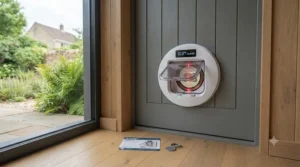
The standout feature is price-to-function ratio: this is a genuinely capable microchip-reading flap that consistently undercuts the market leader without cutting the core feature that matters. It stores up to 30 pet IDs, reads standard 15-digit microchips, and includes a manual override so you can run it as a basic flap while you’re still training a nervous cat.
Key specs translate into real-world terms fairly directly: the reduced storage capacity (30 versus 32) is irrelevant for almost every household, and the plastic housing, while lighter than some rivals, has proven durable enough across years of daily use in aggregated owner feedback. What most buyers overlook about this model is that it uses the same core RFID-reading technology as pricier competitors — the price difference mostly reflects brand premium and accessory ecosystem rather than a meaningfully worse chip reader.
This is the model for budget-conscious buyers who want a genuine microchip cat flap for security without paying for app connectivity they won’t use. Reviewers report solid reliability for single or two-cat households, though a recurring theme in aggregated sentiment is that battery indicators can be less obvious than on the SureFlap range, so a forgotten battery change is more likely to catch owners out.
Pros:
- ✅ Lower price point than most direct competitors
- ✅ Manual override mode for training periods
- ✅ Solid build quality reported across years of use
Cons:
- ❌ Less obvious low-battery warning than rivals
- ❌ Smaller accessory ecosystem than SureFlap
At around £40-£55, the Cat Mate Microchip Activated Cat Flap 360 is the honest budget pick — not the flashiest, but it does the one job that matters.
3. PetSafe Microchip Cat Door — easiest DIY install
The standout advantage is fitting flexibility: this model is explicitly designed for interior or exterior doors, walls, and windows, with a four-way locking collar and a tunnel extension available for thicker doors, which makes it the most forgiving option for awkward door types like composite or uPVC panels.
The multi-user RFID access supports up to 40 pets, higher than most rivals, which suits rescue fosterers or households that rotate cats through regularly. What that number means in practice: for a typical one-to-three-cat home it’s overkill, but it’s a genuinely useful spec if you ever board cats for friends or foster for a shelter. Weatherproofing on the frame has been engineered specifically for UK exterior use, with a sealed design intended to resist wind-driven rain.
Based on aggregated review sentiment, installation is the headline strength here — DIY fitters repeatedly describe the process as more forgiving than the SureFlap equivalent, with clearer paper templates for cutting the door aperture. The trade-off, according to a recurring pattern in feedback, is that the electronic reader mechanism has occasionally been reported to stop reliably unlocking after several months of heavy use, which is worth knowing before you commit if your household runs multiple cats through it dozens of times a day.
Pros:
- ✅ Works in doors, windows and walls
- ✅ Stores up to 40 pet identities
- ✅ Widely reported as the easiest DIY fit
Cons:
- ❌ Some reports of reader reliability dropping over time
- ❌ Tunnel extension sold separately for thick doors
Sitting in the £45-£65 range, the PetSafe Microchip Cat Door earns its place for anyone dreading a weekend spent wrestling with a badly-fitting hole saw template.
4. SureFlap DualScan Microchip Cat Flap — best for maximum security
The defining feature is right there in the name: a second, independent scan on entry, which means a cat has to be verified twice before the lock releases. In practice this closes the small gap that exists on single-scan flaps, where a fast-moving intruder cat occasionally squeezes through in the split second the door is swinging open for your own cat.
Key specs worth understanding: it shares the same 32-chip memory and 9/10/15-digit compatibility as the standard SureFlap, so nothing is sacrificed on the recognition side — the DualScan tech is purely additive security. Installation footprint and entrance size mirror the standard model, so it’s a straightforward swap if you’re upgrading rather than fitting fresh.
Here’s what to weigh: this flap earns its higher price almost entirely through the reduction in “tailgating” incidents, where a bold neighbourhood cat follows yours in before the door shuts. Reviewers describe it specifically as solving that exact problem after the standard flap failed to, with aggregated feedback consistently mentioning it stopped a persistent unwanted visitor where a previous model hadn’t. It’s the natural upgrade path if you’ve already tried a single-scan flap and found it wasn’t quite secure enough for a determined intruder.
Pros:
- ✅ Second scan meaningfully reduces tailgating entries
- ✅ Same 32-chip storage as the standard SureFlap
- ✅ Drop-in replacement footprint for easy upgrades
Cons:
- ❌ Noticeably pricier than single-scan alternatives
- ❌ Marginal extra thickness may need a slightly deeper door
At £85-£105, the SureFlap DualScan Microchip Cat Flap is the pick for households that have already been burned by a less secure flap and don’t want to gamble twice.
5. Cat Mate Elite Microchip Cat Flap with Timer Control — best for curfew control
The standout is the built-in timer function, letting you set specific windows in which the flap operates in restricted or locked mode without you needing to manually flip the lock dial every evening. This is a genuinely practical feature for anyone managing a cat with a vet-recommended indoor curfew, whether for road safety, wildlife protection, or post-surgical recovery.
Key specs and what they mean day-to-day: the LCD display and timer memory let you programme multiple daily windows, so you could, for example, allow free access during daylight and lock the flap automatically from dusk until dawn — a schedule that Cats Protection and vets frequently recommend to reduce road traffic accidents and predation of local wildlife. It still reads standard microchips and stores up to 30 identities, so the timer sits on top of the same core recognition tech rather than replacing it.
Reviewers consistently note that the programming interface takes a little longer to learn than the single-button SureFlap system, but that once set, the automation removes the daily mental load of remembering to lock up at night. A recurring theme in aggregated feedback is appreciation for not needing a smart hub or app subscription to get scheduled locking — it’s a standalone unit that does its own timekeeping.
Pros:
- ✅ Built-in scheduling removes manual locking routine
- ✅ No app, hub or subscription required
- ✅ Supports vet-recommended curfew regimes
Cons:
- ❌ Steeper learning curve for initial programming
- ❌ LCD display less intuitive than single-button rivals
Priced around £75-£95, the Cat Mate Elite Microchip Cat Flap with Timer Control suits owners managing a specific curfew need rather than those who just want the simplest possible fit.
6. SureFlap Microchip Pet Door — best for large cats and small dogs
The standout feature is sheer scale: a significantly larger entrance than the standard flap, built specifically for Maine Coons, large British Shorthairs, chunky rescue moggies, and small dog breeds that a standard cat flap simply can’t accommodate. The claw-tested frame is reinforced against forced entry attempts from persistent unwanted animals.
Specs that matter in practice: the wider opening means larger animals don’t have to awkwardly compress themselves to fit, which reduces the hesitation and reluctance that owners of bigger cats often report with undersized flaps. Battery life is rated notably higher than the standard model — up to 12 months versus roughly 6 — because the unit uses four C-cell batteries rather than two AAs, trading a slightly bulkier housing for materially less frequent battery changes.
What most buyers overlook about this model is that “large cat flap” doesn’t just mean a bigger hole — the recognition electronics and claw-resistant frame are genuinely upgraded, not just the aperture size. Aggregated review sentiment does flag that the extra size can occasionally make cleaning the internal mechanism slightly more fiddly than on the compact standard model, and a minority of larger-cat owners still recommend measuring chest width before assuming even this model will be roomy enough.
Pros:
- ✅ Substantially larger opening for big cats and small dogs
- ✅ Up to 12 months of battery life per set
- ✅ Reinforced claw-tested frame
Cons:
- ❌ Bulkier housing needs more installation depth
- ❌ Internal mechanism slightly fiddlier to clean
At £95-£115, the SureFlap Microchip Pet Door is the specialist pick for anyone whose current flap is genuinely too small for their pet, rather than a general-purpose choice.
7. SureFlap Microchip Pet Door Connect — best smart, app-connected pick
The standout is remote visibility: paired with the Sure Petcare hub, this model logs every entry and exit, sends notifications to your phone, and lets you lock or unlock the flap from anywhere with a broadband connection. It transforms a purely mechanical security device into a monitoring tool for pet wellbeing.
Key specs and what they enable: the hub connects to your home broadband rather than requiring a wired connection to the flap itself, meaning installation is comparatively quick even though you’re adding a smart layer. The app records timestamped entry and exit logs per cat, which several reviewers use less for security and more for spotting early changes in behaviour — a cat suddenly going out far more or far less than usual is a recognised early indicator vets ask owners to watch for.
Here’s what to weigh before buying: the hub is a genuinely separate purchase in some bundles, and the flap depends on a stable broadband signal reaching wherever it’s fitted, which can be a real limitation if your back door sits inside a thick wall or a metal-framed composite unit. Reviewers report the tracking features as the standout benefit, particularly for multi-cat households wanting to monitor individual animals’ habits, while a recurring theme in feedback is that first-time hub setup takes noticeably longer than any of the non-connected models on this list.
Pros:
- ✅ Remote lock, unlock and live entry notifications
- ✅ Per-cat activity logs useful for spotting health changes
- ✅ Shareable app access for multiple household members
Cons:
- ❌ Requires stable broadband signal near the flap
- ❌ Considerably pricier than non-connected models
At a bundle price in the £150-£200 range, the SureFlap Microchip Pet Door Connect is squarely for owners who want data and remote control, not just a locked door.
Practical Usage Guide: Microchip Cat Flap Installation
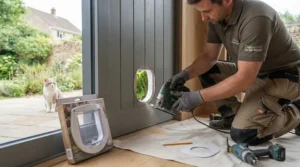
Fitting one of these correctly is less about DIY confidence and more about sequencing. Getting microchip cat flap installation right the first time saves you re-cutting a door panel, which nobody enjoys doing twice.
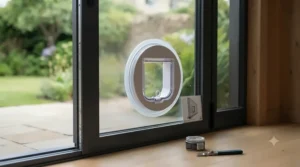
Start by confirming your cat’s chip actually scans before you buy anything — ask your vet to run a quick check with a handheld reader at a routine visit, since a small percentage of chips migrate or, rarely, fail. Next, choose your mounting surface carefully: uPVC and composite doors usually need the supplied tunnel extension for a snug fit, while timber doors rarely do, and glass requires a specialist glazier-cut aperture rather than a DIY hole saw.
Once fitted, run the unit in free-entry mode for the first 48-72 hours so your cat associates the flap with treats and normal movement before the microchip lock activates. Programming itself is the fast part on most models — hold the button, guide your cat through, done — but the “first 30 days” mistake owners repeat most often is skipping the training window entirely and locking the flap on day one, which reliably produces a cat who simply refuses to use it.
Maintenance is minimal but not zero: wipe the internal sensor housing every few months to keep dust and fur from interfering with the chip reader, and check the seal or brush strip for wear each autumn before draughts become a winter problem.
Real-World Scenarios: Which Cat Flap Suits Your Household
If you’re a first-time cat owner in a two-bed terrace with one indoor-outdoor cat and no particular security concerns, the standard SureFlap Microchip Cat Flap or the Cat Mate Microchip Activated Cat Flap 360 covers everything you need without over-spending on features you won’t use.
If you’re renting a ground-floor flat where a persistent, food-stealing neighbourhood cat has already broken through a basic magnetic flap, the SureFlap DualScan Microchip Cat Flap is the sensible upgrade — its second scan is specifically engineered for exactly this failure mode.
If you own a 6kg-plus Maine Coon or a household with an elderly cat and a small terrier sharing the same door, the SureFlap Microchip Pet Door solves a physical sizing problem no amount of clever electronics on a standard flap can fix.
And if you’re a working household wanting reassurance during the day — perhaps managing a cat recovering from surgery, or simply wanting to know they’re safely in before you get home — the SureFlap Microchip Pet Door Connect or the Cat Mate Elite Microchip Cat Flap with Timer Control both offer a layer of oversight that a purely mechanical flap can’t.
Problem → Solution: Common Microchip Cat Flap Issues
Flap won’t recognise the cat’s chip at all: this is usually a positioning issue rather than a faulty unit — chips can sit slightly differently between the shoulder blades depending on the vet who implanted them, so reprogramming with the cat held closer to the sensor housing resolves most cases.
Neighbourhood cat keeps getting in anyway: if you’re on a single-scan model, this is the classic case for upgrading to the SureFlap DualScan Microchip Cat Flap, since tailgating during the brief unlock window is the single most common security complaint across standard flaps.
Cat refuses to use the new flap: nearly always a training issue rather than a product fault — running the flap in free-entry mode with treats placed just beyond it for a week almost always resolves reluctance, particularly in older cats used to a different mechanism.
Battery seems to drain unusually fast: cold weather and lithium-vs-alkaline chemistry both matter here; owners in colder parts of the UK consistently report better winter performance from lithium AA batteries than standard alkaline ones in models like the standard SureFlap Microchip Cat Flap.
Flap lets your cat out but not back in: check the four-way lock dial hasn’t been accidentally knocked to “out only” — it’s a remarkably common and remarkably simple fix that accounts for a large share of “broken flap” support queries.
How to Choose a Microchip Cat Flap
- Confirm your cat’s microchip standard. Nearly all UK vets implant 15-digit ISO FDX-B chips, and every product in this guide supports that format, but double-check if your cat was chipped abroad.
- Measure your cat, not just the breed average. Chest width, not weight, determines whether a standard aperture will feel comfortable, especially for fluffier breeds.
- Decide if tailgating is a real risk. Homes in cat-dense terraces benefit far more from dual-scan security than isolated rural properties.
- Match the mounting surface to the model. Composite and uPVC doors typically need a tunnel extension; glass needs professional cutting regardless of brand.
- Be honest about how much automation you’ll actually use. App-connected models add genuine value for monitoring but only if your broadband reaches the door reliably.
- Budget for batteries as an ongoing cost, not a one-off — most units don’t include them, and lithium cells cost more but last considerably longer in cold weather.
- Check the warranty length, since it’s a reasonable proxy for how confident the manufacturer is in the mechanism’s longevity.
RFID Cat Flap vs Traditional Magnetic Cat Flap
The core difference between an RFID cat flap and an older magnetic-collar flap isn’t convenience, it’s what’s actually being verified. A magnetic flap checks for a magnet attached to a collar; an RFID cat flap checks for a unique, permanently embedded microchip. That distinction matters enormously in practice: collars fall off, get left indoors, or get borrowed by an opportunistic sibling cat wearing an identical-looking collar, and any of those scenarios defeats a magnetic system instantly.
Feature by feature, magnetic flaps win on upfront price and simplicity — there’s no programming, no batteries in some models, and no chip-reading electronics to fail. But an RFID cat flap wins decisively on the metric that actually matters for most buyers: reliably excluding animals that aren’t yours. Because the microchip is implanted rather than worn, there’s no accessory to lose and no way for another cat to accidentally trigger entry by wearing a similar collar. Total cost of ownership tends to favour magnetic flaps only in the very short term; once you factor in replacement collars and magnets lost every few months, the price gap narrows substantially within the first year or two of ownership.
Selective Entry Cat Flaps Explained
A selective entry cat flap is any model — magnetic or microchip-based — that restricts entry to registered pets while still allowing free exit for anyone inside. Every model in this guide operates this way by default: your cat can always leave, but only recognised chips unlock the door coming back in. This asymmetry is deliberate and important for safety, since a flap that also restricted exit could trap a cat inside during a fire or other emergency.
What most buyers overlook is that “selective entry” and “microchip-activated” aren’t strictly synonymous, even though the terms get used interchangeably online. A magnetic-collar flap is technically also selective entry; it’s simply a less reliable form of it. When you’re comparing a selective entry cat flap specifically for security reasons, the microchip-based mechanism is the meaningfully stronger version of the same underlying concept, precisely because it can’t be defeated by a lost or borrowed collar.
Keeping Foxes and Strays Out: Cat Flap Security
Every microchip cat flap in this guide is, by design, closed to anything without a registered chip — which includes foxes, since they obviously don’t carry a matching microchip. In practice, though, the entrance size does most of the physical work: the standard SureFlap and Cat Mate apertures at roughly 14 x 12cm are simply too narrow for an adult fox’s shoulders to pass through comfortably, even setting the electronic lock aside entirely.
For keeping foxes and strays out specifically, the security question tends to be less about the flap itself and more about the surrounding access points — a securely locked flap won’t help if a fox can get into a conservatory or utility room through a gap elsewhere. Local authority advice on garden security is consistent on this point: urban fox deterrence works best through denying food access and blocking potential entry gaps around the property, rather than relying on any single device. Combined with a dual-scan flap for the door itself, sealing obvious gaps under sheds and around air bricks closes the loop on the two most common routes foxes use to get near a house.
Stray and neighbourhood cats present a different challenge, since they’re physically capable of fitting through the same opening your own cat uses. This is precisely the scenario a genuine RFID cat flap for security solves that older mechanisms don’t — the lock is keyed to biology, not an accessory, so a stray cat simply cannot present valid credentials no matter how persistent it is.
Cat Flap Battery Life: What to Expect
Manufacturer battery life figures are optimistic by design, and real-world cat flap battery life depends heavily on household cat traffic. A single cat using the flap a handful of times a day will comfortably reach the upper end of the quoted range; a boisterous multi-cat household running the mechanism dozens of times daily, or a curious cat that repeatedly triggers the sensor without fully passing through, will drain batteries noticeably faster — reviewers consistently report closer to three to four months rather than six under heavy use.
Temperature is the other major factor UK owners specifically need to plan for. Cold snaps reduce the effective capacity of standard alkaline batteries considerably, which is why several manufacturers, and a recurring theme in aggregated owner feedback, recommend switching to lithium AA cells for the winter months specifically to avoid a mid-January lockout. Most models include a low-battery indicator light, though as noted earlier some are considerably easier to spot than others, so building a rough seasonal replacement habit — checking every autumn regardless of the indicator — is more reliable than waiting for a warning.
Common Mistakes When Buying a Microchip Cat Flap
The most frequent error is buying based on brand recognition alone without checking the physical aperture against your specific cat’s size, particularly for larger breeds that need the XXL or Pet Door variants rather than the standard entrance. A close second is underestimating door thickness — composite doors especially catch buyers out, since the standard tunnel included with some models isn’t long enough, requiring a separately purchased extension.
Buyers also commonly skip checking their cat’s microchip actually still reads correctly before assuming a new flap is faulty when installation problems are really registration problems. And a frequently repeated mistake is assuming smart, app-connected models are strictly “better” rather than simply different — for a household that just wants intruders kept out, the extra cost of a connected hub buys convenience, not additional security.
Long-Term Cost & Maintenance
Total cost of ownership on a microchip cat flap extends well beyond the purchase price, though it remains modest compared to most home security devices. Budgeting roughly two to four battery changes a year at a few pounds per set puts realistic annual running costs in the low tens of pounds for most households, plus an occasional replacement part if a lock mechanism or door hinge eventually wears from years of daily use.
Value-for-money assessment favours the mid-range models here: the standard SureFlap Microchip Cat Flap and Cat Mate Microchip Activated Cat Flap 360 both have long enough track records that replacement parts and spares remain widely available years after purchase, which matters more than it sounds — a flap that can’t be repaired eventually becomes an expensive one-off rather than a durable long-term fixture. Connected models like the SureFlap Microchip Pet Door Connect carry the added long-term consideration of hub compatibility with future app updates, which is harder to guarantee a decade out than a purely mechanical lock.
Safety, Regulations & Microchipping Compliance
Since 10 June 2024, every cat in England over 20 weeks old must be microchipped and registered on an approved database, under the Microchipping of Cats and Dogs (England) Regulations 2023, with fines of up to £500 for non-compliance. This is directly relevant to anyone buying a microchip cat flap: the device relies entirely on that legally-mandated chip already being present and correctly registered, so it’s worth confirming registration details are current with your chosen database provider, not just that the chip physically exists.
On the animal welfare side, the RFID mechanism itself has no meaningful safety downside for cats — the reader simply detects the chip’s passive signal at close range and doesn’t interact with it in any way that could cause harm. The more relevant safety consideration is entrapment risk during power or mechanical failure; reputable models default to a fail-safe state that allows manual override rather than locking permanently shut, which is worth verifying before purchase if you’ll be away from home for extended periods.
FAQ
❓ Do microchip cat flaps work with all vet-implanted chips?
❓ Can a fox get through a microchip cat flap?
❓ How long does a microchip cat flap battery actually last?
❓ Is a microchip cat flap better than a magnetic collar one?
❓ Can I install a microchip cat flap myself?
Conclusion
There isn’t a single “best” microchip cat flap so much as a best match for your specific household — a single indoor-outdoor cat in a quiet street has genuinely different needs from a multi-cat home dealing with a persistent feline trespasser, and the seven models above cover that entire range honestly rather than pretending one product suits everyone.
If you want the safest, least fussy starting point, the standard SureFlap Microchip Cat Flap remains the sensible default most fitters would choose themselves. If security is the whole point of the purchase, the extra outlay for the SureFlap DualScan Microchip Cat Flap buys real, measurable protection against tailgating intruders. And if your cat simply doesn’t fit through a standard aperture, no amount of clever electronics substitutes for the physically larger SureFlap Microchip Pet Door.
Whichever you choose, remember that the flap is only ever as reliable as the chip and registration behind it — with compulsory microchipping now UK law, that part of the equation is one less thing to worry about.
Recommended for You
- Clear vs Fabric Sofa Protector for Cats 2026: 7 Honest Picks
- 7 Best Top Cat Proofing Kit Under £50 UK 2026: Safe ; Affordable
- Balcony Cat Nets: 7 Best Safety Options for UK Flats (2026)
Disclaimer: This article contains affiliate links. As an Amazon Associate, I earn from qualifying purchases. If you purchase products through these links, we may earn a small commission at no additional cost to you.
✨ Found this helpful? Share it with your friends! 💬🤗
