
In This Article
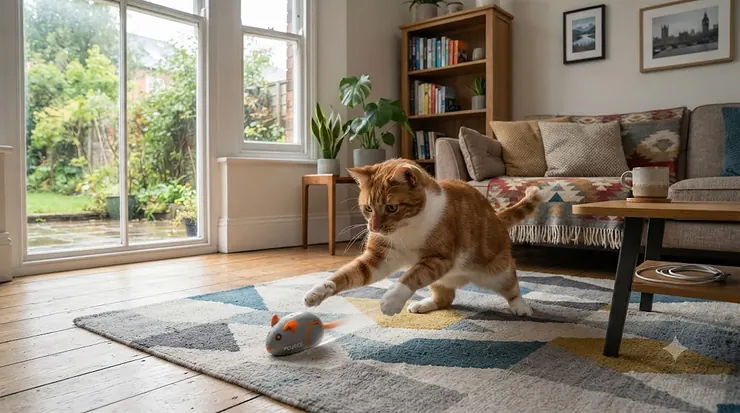
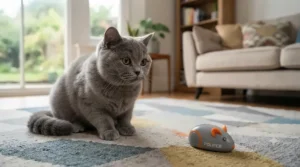
A self-moving cat toy for bored cats is any battery-powered or rechargeable toy that moves, spins, flaps or pops up on its own, without a human on the other end of the string, so a cat can hunt, pounce and burn energy solo. If that sentence made you picture your own cat glaring at you from the windowsill at 7am, you’re exactly who this guide is for.
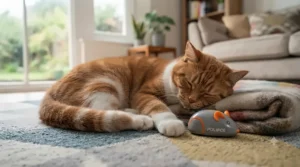
Here’s the thing nobody tells you when you bring a cat home: they’re not lazy, they’re under-stimulated. A wild cat spends hours a day stalking, chasing and “killing” prey. An indoor cat gets a bowl of biscuits and, if they’re lucky, ten minutes of wand-toy time before you collapse on the sofa. “Daily exercise keeps cats happy and healthy, reducing their chance of developing conditions such as diabetes, obesity and arthritis, and preventing the boredom that comes from not being able to express natural behaviours.
This is where automatic and self-propelled cat toys earn their keep. They’re not a replacement for you — nothing replaces you, and your cat will absolutely still headbutt your laptop at 9pm demanding attention — but they fill the gaps. The hour before you get home from work. The 2am zoomies. The long stretch of a Tuesday afternoon when everyone in the house is either asleep or at school.
Below, we’ve dug into seven real products sold in the UK, covering rolling balls, pop-up feather domes, concealed-motion wands and motion-sensor domes, at prices ranging from pocket-money to “actually quite a treat.” Every product mention includes genuine analysis — what the mechanism means for your specific cat, not just a spec sheet — so you can pick the right toy the first time, rather than adding to the pile of abandoned squeaky mice under the sofa.
Quick Comparison Table
| Toy | Mechanism | Price Level | Best For |
|---|---|---|---|
| SmartyKat Hot Pursuit | Concealed wand under fabric | £ | Budget buyers wanting classic hidden-prey action |
| PetFusion Ambush | Feather pops from 6 holes | ££ | Cats who like a strong “whack-a-mole” hunt |
| Catit Senses 2.0 Ball Dome | Motion-activated tilting ball | ££ | Solo play while you’re out |
| GoldenSun 2-in-1 | Laser + pop-up feather | £££ | Tech-loving owners wanting variety |
| Potaroma Moving Ball | Rolling ball with feather tail | £ | Kittens and first-timers |
| Speedy Tail 2.0 | Smart rechargeable rolling ball | ££ | Multi-mode play on carpet or hard floor |
| Migipaws MigiMouse | 360° rolling, realistic mouse | ££ | Cats obsessed with prey-shaped toys |
Looking at the spread above, the cheapest route into self-moving play is the Potaroma Moving Ball or the SmartyKat Hot Pursuit, both of which sit comfortably under £20 and deliver a genuinely different play style. If your cat is more of a “watch and pounce from a distance” type rather than a chaser, the Catit Senses 2.0 Ball Dome or PetFusion Ambush will suit their personality better than a rolling ball ever could. For households wanting one toy that does several jobs at once, the GoldenSun 2-in-1 justifies its higher price with genuinely useful extra modes rather than gimmicks.
💬 Just one click — help others make better buying decisions too!😊
Top 7 Self-Moving Cat Toys for Bored Cats: Expert Analysis
1. SmartyKat Hot Pursuit — best budget concealed-motion toy
The SmartyKat Hot Pursuit works on a simple but effective idea: a faux-fur “tail” darts and zips around underneath a rustling fabric cover, unpredictably changing direction the way a mouse would when it thinks it’s being watched. Two speed settings and a lights-and-motion combo mean you can dial the chaos up or down depending on whether your cat is a laid-back stalker or an over-caffeinated sprinter.
Spec-wise, it’s battery-operated (not rechargeable), runs on multiple speeds, and the wand and batteries are both user-replaceable, so a broken motor doesn’t automatically mean the bin. Based on the mechanism alone, this is one of the more convincing “hidden prey” simulations on the market — the rustling fabric does a lot of psychological heavy lifting that a plain rolling ball can’t match.
This is squarely a toy for cats with strong hunting instincts rather than couch potatoes; if your cat has never shown interest in feather wands, this probably won’t convert them overnight. Reviewers consistently note that cats “ask” for the toy once they’ve learned the button, and that the motor noise — while not silent — rarely bothers the cat itself, only the humans in the room. A recurring complaint is that particularly aggressive players can eventually pull the fabric cover loose or wear the motor out faster than gentler cats would.
Pros:
- ✅ Genuinely unpredictable, prey-like darting motion
- ✅ Two speeds cover both timid and high-energy cats
- ✅ Replaceable batteries and wand extend its lifespan
Cons:
- ❌ Motor noise is noticeable, especially in a quiet room
- ❌ Fabric cover can wear or tear under rough play
At around £10-£20, this sits firmly in impulse-buy territory, and the value case is straightforward: it’s one of the cheapest genuinely automatic toys you’ll find, making it a sensible first experiment before spending more on something fancier.
2. PetFusion Ambush — best pop-up hunting simulation
Where the SmartyKat hides its motion under fabric, the PetFusion Ambush takes the opposite approach: a colourful feather “pops” out from one of six holes around the toy’s edge in a randomised pattern, with LED lighting so it works day or night. Two speed settings let you tune the pace, and anti-skid feet stop it sliding around on hardwood or tile.
The six-hole layout matters more than it sounds. Rather than one predictable point of motion, your cat has to actually scan and react to wherever the feather appears next, which is a closer match to the “sudden ambush” instinct cats evolved for than a single bobbing toy. An 8-minute auto-shutoff protects the four AA batteries from being drained by an empty room, and a spare feather is included for when the first one inevitably meets its end.
Who is this for? Cats that enjoy batting and pouncing more than full-body chasing — since the PetFusion Ambush stays in one spot, it suits smaller flats or cats that prefer a “home base” to play from. Aggregated review sentiment is mixed but leans positive: many owners report their cats becoming genuinely obsessed, while a smaller but consistent group flags the motor as louder than expected, which can put off noise-sensitive cats before they even give it a chance.
Pros:
- ✅ Six-hole randomised popping keeps play unpredictable
- ✅ LED lighting extends usable play into the evening
- ✅ Auto shut-off after 8 minutes protects battery life
Cons:
- ❌ Motor is noticeably louder than fabric-covered alternatives
- ❌ Fixed footprint means it doesn’t suit cats who like to chase across a room
Typically priced in the low-to-mid £20s, the PetFusion Ambush sits in the middle of our line-up — not the cheapest, but the six-way randomisation and lighting genuinely add play value over a single-point toy.
3. Catit Senses 2.0 Ball Dome — best for unsupervised, motion-activated play
The Catit Senses 2.0 Ball Dome is built for exactly the scenario in our keyword: cats left alone and bored. It’s designed to help develop hunting instincts while giving cats something to play with solo, which matters because it means you can leave the house without worrying about the boredom being taken out on your carpet. A ball sits inside a dome with peek-through holes; when your cat approaches, the inner swivelling plate senses motion and sets the ball moving, sparking the cat’s hunting instinct, and there are two play modes — sensor-activated or continuous — with the option to open the ball and add catnip or a bell for extra incentive.
The genuinely clever part is the power management: it uses around 70% less battery than comparable battery-operated toys, because the plate only needs a small tilt to set the ball rolling on its own, and the whole unit goes to sleep automatically once play stops. That’s the kind of detail a spec sheet buries but actually determines how often you’re hunting for AA batteries.
This is the pick for households where the cat is genuinely alone for stretches of the day — the motion-sensor design means it doesn’t run constantly and annoy neighbours or drain power for no reason. Independent reviewers rate it well for solo play and safety, noting cats can play with it unsupervised, though larger or heavier cats occasionally knock the dome over during enthusiastic sessions.
Pros:
- ✅ Motion sensor means it only runs when your cat is present
- ✅ Roughly 70% more energy-efficient than typical battery toys
- ✅ Paw-safe design with mechanics hidden from claws
Cons:
- ❌ Larger or heavier cats can tip the dome during rough play
- ❌ Requires 2x AA batteries, sold separately
Priced in the mid-teens to low £20s, it’s excellent value against toys that burn through batteries just idling — the sleep function alone can pay for itself in reduced battery purchases over a year.
4. GoldenSun 2-in-1 Automatic Cat Toy — best multi-mode premium pick
The GoldenSun 2-in-1 stacks two mechanisms into one unit: an automatic laser chase, where a red dot and star pattern moves in a 360° random trajectory, plus an interactive whack-a-mole mode where feathers pop from eight hidden holes. It’s built from ABS material with a smooth, hole-less ball track designed to protect paws and stop claws catching.
What actually justifies the higher price here isn’t the novelty of two modes, it’s the smart scheduling. The toy runs automatically for 10 minutes every 3 hours and can be reactivated early by touch or voice, with a built-in night mode that switches it off automatically so it doesn’t interrupt anyone’s sleep. Charging is via USB-C, taking around two hours for roughly 3-4 days of standby power — a genuinely modern spec sheet compared with AA-battery rivals.
This is the toy for owners who want one purchase to cover multiple play styles rather than buying three separate toys — laser-chasers and pounce-and-swat cats both get something to do. The trade-off is straightforward: more electronics means more that can eventually wear out, and a toy this feature-rich costs roughly double the entry-level picks on this list. GoldenSun backs it with an 18-month warranty, which is longer than most competitors offer and worth factoring into the value calculation.
Pros:
- ✅ Two genuinely different play mechanisms in one toy
- ✅ USB-C rechargeable with multi-day standby
- ✅ Night mode and 18-month warranty add real value
Cons:
- ❌ Noticeably pricier than single-mode alternatives
- ❌ More moving parts means more that can eventually fail
Sitting around £30-£40, this is the premium choice on our list — worth it if your cat genuinely plays with both lasers and pop-up toys, less so if you already know they only care about one.
5. Potaroma Moving Ball with Feather Tail — best budget rolling ball
The Potaroma Moving Ball is the simplest mechanism on this list: a rechargeable ball with an attached feather tail that rolls itself around the floor, chirping or squeaking depending on the model, to keep a cat’s attention through movement and sound rather than pop-ups or lasers.
What most buyers overlook about rolling-ball toys generally is that floor type matters enormously — a ball that glides beautifully on hardwood can stall completely on thick carpet, so it’s worth checking your own flooring before assuming performance will match the listing photos. Potaroma’s version leans on obstacle-sensing to avoid getting wedged under furniture, which in practice means less time retrieving it from behind the sofa and more actual play time for your cat.
This is the toy to start with if you’re not sure your cat will take to automatic toys at all — it’s inexpensive enough that a lukewarm reaction doesn’t sting, and the rolling-plus-feather combination appeals to kittens especially, who are drawn to fast, erratic movement more than static pop-up toys. Aggregated feedback across similar rolling-ball toys tends to flag two recurring themes: cats losing interest faster than with pop-up or wand-style toys, and the rechargeable battery needing more frequent top-ups than premium rivals with larger cells.
Pros:
- ✅ Low price makes it a low-risk first automatic toy
- ✅ Feather tail adds visual and tactile appeal for kittens
- ✅ Obstacle-avoidance reduces toy retrieval trips
Cons:
- ❌ Smaller battery than premium rolling balls, more frequent charging
- ❌ Some cats lose interest faster than with pop-up toys
At roughly £10-£15, it’s one of the cheapest genuinely self-moving toys around, and a sensible litmus test before spending more.
6. Speedy Tail 2.0 — best smart rechargeable rolling ball
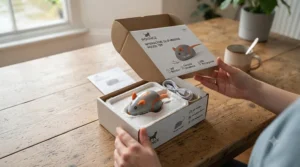
The Speedy Tail 2.0 upgrades the basic rolling-ball formula with genuine smart features: a “Normal” mode that runs continuously for five minutes once activated, and a “Smart” mode that stays in standby until it detects motion, then wakes immediately for spontaneous play. Two adjustable speeds are shown through light indicators, and the whole thing runs on a rechargeable battery charged via USB, with a compact 7.5cm diameter designed to suit the size and grip of domestic cats’ paws.
Here’s what the spec sheet won’t tell you outright: the “Smart” standby mode is the real value driver, because it means the ball isn’t rolling itself into a wall for hours while nobody’s watching — it waits for your cat, then responds, which mimics real prey behaviour (freeze, then flee) far more convincingly than a ball that just spins constantly.
This suits cats who play in short, intense bursts rather than long sessions, and multi-cat households where you want a toy that reactivates on demand rather than running on a fixed timer that might miss the window when a particular cat wanders past. Owners consistently mention the quiet operation as a genuine advantage over cheaper rolling balls, particularly for households where the toy needs to run near a sleeping area.
Pros:
- ✅ Smart standby mode wakes on cat contact, not a timer
- ✅ Two speeds with clear light indicators
- ✅ Compact, lightweight build suited to paw size
Cons:
- ❌ Five-minute active window may feel short for high-energy cats
- ❌ Smooth coating can show scuffs from claws over time
Priced in the £20-£30 range, it sits mid-table — a fair jump from the Potaroma ball, but the smart-standby feature is a genuine functional upgrade, not just marketing polish.
7. Migipaws MigiMouse — best realistic prey-shaped toy
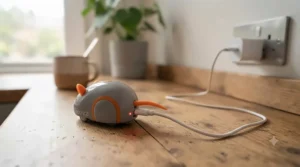
The Migipaws MigiMouse trades the ball-and-dome format for something closer to actual prey: a plush mouse-shaped toy with a mesh tail that rolls and spins 360°, using motion-sensor activation and a realistic squeak to draw a cat’s attention.
The realism is the whole pitch here. Where a spinning ball is an abstract shape, a mouse-shaped toy taps directly into a cat’s innate prey-recognition, and the plush construction means cats can also carry it around and “kill” it the way they would a real catch — something hard plastic balls simply can’t offer. Rechargeable via USB, it avoids the ongoing cost of disposable batteries that similarly-shaped budget mouse toys often rely on.
This is the pick for cats who are more interested in soft, catchable toys than smooth rolling balls — particularly older or more sedentary cats who enjoy batting and carrying a toy rather than chasing it around a room. A recurring theme in aggregated review sentiment is that the plush cover, while appealing to cats, needs occasional spot-cleaning after enthusiastic “kills,” and that the motor’s realistic squeak — a selling point for most — occasionally overstimulates particularly excitable or younger cats.
Pros:
- ✅ Prey-shaped design plays to natural hunting instincts
- ✅ Plush build allows carrying and “catching,” not just chasing
- ✅ USB rechargeable, avoiding disposable battery costs
Cons:
- ❌ Plush cover needs regular spot-cleaning
- ❌ Realistic squeak can overstimulate some younger cats
Generally priced in the £15-£25 range, it’s competitively positioned against other mid-tier automatic toys, with the prey-realism factor being the main reason to choose it over a plainer rolling ball.
Setting Up Your Self-Moving Cat Toy: The First 30 Days
Buying the toy is the easy part — getting your cat to actually use it independently takes a bit of technique. Start by introducing any new automatic toy while you’re in the room, ideally during your cat’s naturally active window (early morning or early evening, when wild hunting instincts peak). Let the toy run for a short session with you nearby rather than switching it on and walking away; a sudden buzzing, moving object with nobody familiar around can spook a nervous cat before they’ve had a chance to get curious.
A common first-30-days mistake is leaving a new toy running constantly from day one. Most cats need repeated short exposures — five to ten minutes, a few times a day — to build genuine interest, rather than one long session that overwhelms or bores them. If your cat ignores the toy completely at first, try adding a scent lure: a pinch of catnip near a ball-style toy, or a smear on a plush mouse, often bridges the gap between “unfamiliar object” and “worth investigating.”
Maintenance-wise, rechargeable toys should be topped up before the battery drops to empty rather than run completely flat repeatedly, which extends the working life of the cell. Wipe down plastic domes and balls with a damp cloth weekly, and check fabric covers or plush exteriors for loose threads your cat could ingest — a five-second inspection before each session is enough to catch problems early. Finally, rotate: even the best automatic toy loses its magic if it’s out permanently. Putting it away between sessions and bringing it back out a day or two later consistently gets a stronger reaction than leaving it on the floor as background furniture.
Real-World Scenarios: Matching the Toy to Your Cat and Your Life
The full-time worker with one indoor cat. If you’re out of the house for eight-plus hours a day and your cat is home alone, motion-activated toys that don’t need to run constantly are the better fit — think the Catit Senses 2.0 Ball Dome, which only activates when your cat actually walks past, or the GoldenSun 2-in-1 with its scheduled 10-minutes-every-3-hours pattern. Both avoid draining a battery on an empty room, meaning the toy still has power left for when your cat actually wants to play in the evening.
The multi-cat household. With two or more cats sharing space, toys that reset quickly and don’t require “taking turns” tend to work best. A PetFusion Ambush with its six randomised pop-up points gives more than one cat something to focus on simultaneously without direct competition over a single moving part, reducing the risk of squabbles over one rolling ball.
The nervous or senior cat. Loud motors and sudden bursts of movement can do more harm than good with an anxious or older cat. The Migipaws MigiMouse, with its softer, more prey-realistic movement and lower intensity, or a slow-speed setting on the SmartyKat Hot Pursuit, are gentler starting points than anything with lights, lasers, and multiple simultaneous mechanisms.
How to Choose a Self-Moving Cat Toy for Bored Cats
- Match the mechanism to your cat’s play style. Chasers need rolling balls or wand-style toys; ambush-hunters do better with pop-up or dome-style toys that stay in one spot.
- Check your flooring. Rolling balls perform very differently on hardwood versus thick carpet — always check compatibility before buying if your home is mostly carpeted.
- Prioritise rechargeable over disposable batteries if it’ll run daily. The ongoing cost of AA batteries adds up fast on a toy used every day, while USB rechargeable models pay for themselves within months.
- Look for auto-shutoff or motion-sensor features for unsupervised use. A toy that runs constantly wastes power and can become background noise your cat tunes out entirely.
- Consider noise level if your home is quiet or shared. Motorised wand toys are typically louder than smooth rolling balls — factor this in if you work from home or have thin walls.
- Read aggregated review themes, not star ratings alone. A 4-star average can hide a recurring durability issue that only shows up after a few weeks of real use.
- Buy one toy before committing to a full rotation. Cats are individuals — the “best” toy on paper can be ignored entirely by a specific cat, so test before you stock up.
Common Mistakes When Buying Automatic Cat Toys
The biggest mistake is assuming every cat wants the same kind of motion. Owners often buy the flashiest, most feature-packed toy on the shelf, only to find their cat is far more interested in a plain rolling ball than an LED-lit, multi-mode gadget — expensive doesn’t automatically mean more engaging from a cat’s perspective.
A second common error is ignoring flooring compatibility, particularly with rolling-ball toys, which can stall or barely move on thick carpet despite working perfectly in a showroom video filmed on hardwood. A third is underestimating noise: a motor that sounds fine in a five-second product video can be genuinely grating running for ten minutes in your actual living room, especially with concealed-motion or whack-a-mole mechanisms. Finally, many buyers skip checking for small, chewable parts — feathers, string attachments, and loose plush pieces are all worth inspecting before leaving a toy with an unsupervised cat, and are a genuine safety consideration, not just a durability one.
Self-Moving Cat Toys vs Traditional Wand Toys
The honest answer is that these two categories solve different problems, and most households benefit from both rather than picking one. Traditional wand toys — the ones you hold and move yourself — let you control pacing precisely, mimic prey behaviour far more convincingly than any motor can, and build the human-cat bond through shared play. iCatCare’s guidance on playing with your cat consistently points to interactive, owner-led sessions as the gold standard for engaging a cat’s full hunting sequence, from stalk through to catch.
Self-moving toys can’t fully replicate that nuance, but they solve a problem wand toys genuinely can’t: availability when you’re not there. A cat alone for eight hours gets zero benefit from a wand toy sitting in a drawer, but a motion-activated ball dome or a scheduled pop-up toy still gives them something to do at 2pm on a Tuesday. The practical answer for most bored cats is a mix — automatic toys for solo hours, and dedicated wand-toy sessions when you’re home, ideally at the times cats are naturally most active. Neither fully replaces the other; they cover different parts of the day.
Self-Moving Cat Toys for Cats With Separation Anxiety
Not every bored cat is simply under-stimulated — some genuinely struggle with being left alone. CCats can experience separation-related issues and loneliness when their owner isn’t home, which can lead to unwanted behaviours, and play is one way to help prevent this and keep a cat happy at home.. According to Cats Protection’s Nicky Trevorrow, a Clinical Animal Behaviourist, more pet owners are noticing separation-related behaviours now that routines have shifted back toward time away from home.
For a cat showing signs of stress when left alone — excessive vocalising, over-grooming, or toileting outside the litter tray — a self-moving toy is a supportive tool, not a fix on its own. Motion-activated toys that only run when the cat is nearby, like the Catit Senses 2.0 Ball Dome, tend to suit anxious cats better than constantly-running toys, since they respond to the cat’s own initiative rather than adding unpredictable noise to an already stressful environment. Pairing a toy with a consistent routine — leaving it in the same spot, at the same time each day — can help build a small, reliable ritual that makes time alone feel more predictable. If anxiety signs persist despite enrichment, a vet or behaviourist consultation is the right next step rather than trying to toy-shop your way out of a genuine behavioural issue.
Safety, Regulations and Battery Compliance for UK Buyers
All toys legally sold in the UK fall under the Toys (Safety) Regulations 2011, which require either a CE mark showing the product meets EU safety requirements, or a UKCA mark showing it meets UK safety requirements — both must be easily seen, easy to read, and hard to remove.. Since the current rules allow a “fast-track” approach where steps taken toward CE marking also count toward UKCA marking, and UK product safety law remains aligned with the EU standard, most reputable automatic cat toys sold on Amazon UK will display one or both marks on the packaging. While pet toys specifically fall outside the scope built for children’s products, reputable manufacturers of electronic pet toys typically follow equivalent electrical safety and battery standards voluntarily, given the shared supply chains.
Practically, for automatic cat toys this means checking for a visible CE or UKCA mark on the packaging, avoiding toys with exposed wiring or loose small parts (particularly with kittens or cats that chew), and disposing of old batteries responsibly through a battery recycling point rather than general waste. Rechargeable toys should be charged on a flat, stable surface and never left charging unattended overnight, the same commonsense practice as with any small lithium-battery device in the home.
Long-Term Cost & Maintenance
The upfront price tag is only part of the real cost of an automatic cat toy. Battery-powered toys like the SmartyKat Hot Pursuit or PetFusion Ambush have a genuinely lower purchase price, but daily use can mean replacing AA batteries every few weeks, which adds up over a year of regular play far more than the sticker price suggests. Rechargeable options — the Catit Senses 2.0 Ball Dome (battery-powered but highly efficient), the GoldenSun 2-in-1, Speedy Tail 2.0, and Migipaws MigiMouse — trade a slightly higher upfront cost for near-zero ongoing spend, since a USB charge costs a fraction of a penny compared with a pack of alkaline batteries.
Durability is the other half of the value equation. Toys with replaceable parts — a spare feather, a replaceable wand — extend the usable life of the whole unit well beyond toys where a single broken component means the bin. Cleaning matters too: plush toys like the Migipaws MigiMouse need periodic spot-cleaning to stay hygienic and appealing, while hard plastic domes and balls can simply be wiped down, making them marginally lower-maintenance over the long run. Factoring both battery cost and expected lifespan, the rechargeable mid-range options on this list tend to work out cheaper per year of use than the very cheapest battery-powered toys, even though they cost more to buy initially.
Frequently Asked Questions
❓ Do self-moving cat toys actually work for bored cats?
❓ Are automatic cat toys safe to leave unsupervised?
❓ How long should you let a cat play with an automatic toy?
❓ Can automatic toys help with cat separation anxiety?
❓ What's the difference between motion-activated and timed cat toys?
Conclusion
Boredom in indoor cats isn’t a personality flaw — it’s a mismatch between a hunting animal’s instincts and four walls with nothing to chase. Self-moving cat toys won’t solve everything, and they’re not a substitute for daily interactive play with you, but they fill a genuine gap: the hours you’re at work, asleep, or simply can’t be the mouse.
Across the seven toys covered here, there’s no single “best” pick — only the best match for your specific cat and home. Budget-conscious owners and first-timers get real value from the SmartyKat Hot Pursuit or Potaroma Moving Ball, both proving that automatic play doesn’t require a big spend. Cats who thrive on independence suit the motion-sensing Catit Senses 2.0 Ball Dome, while households wanting maximum variety in one purchase should look to the GoldenSun 2-in-1. Whichever you choose, the goal is the same: turning a bored, restless cat into one that’s genuinely, happily tired out by the time you walk back through the door.
Recommended for You
- App-Controlled Cat Toy For iPhone: 7 Best Picks (2026)
- Remote Control Cat Toy for Multiple Cats: 7 Best Picks (2026)
- Robotic Cat Toy vs Remote Control Cat Toy: 7 Best Picks (2026)
Disclaimer: This article contains affiliate links. As an Amazon Associate, I earn from qualifying purchases. If you purchase products through these links, we may earn a small commission at no additional cost to you.
✨ Found this helpful? Share it with your friends! 💬🤗
