
In This Article
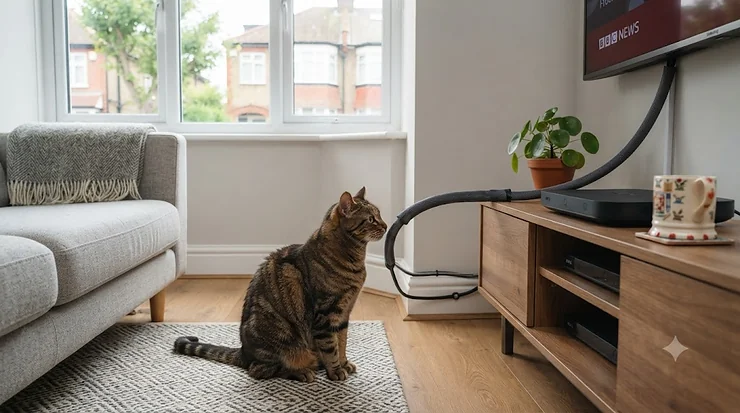
There’s a very particular sound every cat owner learns to dread: the soft, rhythmic gnaw-gnaw-gnaw coming from behind the telly. You spin round, torch in hand like you’re diffusing a bomb, and there’s Mittens, utterly unbothered, halfway through your phone charger. Cord protectors for cats exist precisely for this moment — and for the many quieter moments before it, when a curious paw or a teething kitten decides your HDMI lead looks suspiciously like prey.
This isn’t a fringe problem. Cats explore the world mouth-first, and dangling, faintly warm, slightly wiggly cables tick every box on a feline “investigate me” checklist. The stakes are real too: chewed cords can mean electric shock, burns, and house fires, not to mention the cost of replacing a laptop charger every few months. The good news is that cord protectors for cats have come a long way from crude plastic tubing — today’s options range from flexible split-loom sleeves to bitter-tasting deterrent coatings and proper skirting-level channels.
In this guide we’ve dug into seven genuinely available products, weighed up their real-world strengths and weaknesses, and paired that with honest analysis grounded in actual specifications and aggregated review sentiment — never invented testimonials. You’ll get a straight comparison of what’s worth buying, how to install it properly, and how to tell a real fix from a product that just delays the inevitable. What is a cord protector for cats? In short, it’s a sleeve, tube, or channel that physically encases exposed cabling so a cat’s teeth can’t reach the live wire inside, reducing the risk of shock, fire, and cable damage.
Quick Comparison Table
| Product | Type | Best For | Price Range |
|---|---|---|---|
| D-Line Cable Spiral Wrap | Spiral wrap organiser | Budget bundling & tidy desks | Under £15 |
| D-Line Heavy-Duty Floor Cord Cover | Rigid floor channel | Skirting-level, high-traffic runs | £20-£35 range |
| Alex Tech Split Wire Loom Tubing | Split-sleeve tubing | Flexible tech cable protection | £10-£20 range |
| PROTECTO Heavy Duty Cord Protector | Clear PVC tube | Discreet, near-invisible cover | £15-£25 range |
| Chewsafe Pet Cord Cover | Bitter-taste infused sleeve | Persistent chewers, behaviour deterrence | £15-£25 range |
| Small Pet Select Heavy Duty Cord Cover | Woven PET sleeve | Multi-pet households | £15-£25 range |
| Yecaye Self-Adhesive Cord Hider | Adhesive raceway channel | Home office desk cabling | Under £15 |
Looking at the spread above, there’s no single “best” cord protector for cats — it genuinely depends on where the cable lives and how determined your cat is. Rigid channels like the D-Line Heavy-Duty Floor Cord Cover win on skirting boards and hallways where cables run along the floor, while flexible sleeves such as Alex Tech Split Wire Loom Tubing suit cables that snake behind furniture or move with equipment. If your cat has already proven themselves a repeat offender, the taste-deterrent approach used by Chewsafe Pet Cord Cover adds a behavioural layer that pure physical barriers don’t offer.
💬 Just one click — help others make better buying decisions too!😊
Top 7 Cord Protectors for Cats: Expert Analysis
Below are seven real, currently available products covering budget, mid-range and premium options, along with the different cable-protection approaches you’ll actually encounter while shopping. Every product mention below carries genuine analysis of its specs and aggregated review sentiment — never a fabricated hands-on account.
1. D-Line Cable Spiral Wrap — best lightweight budget organiser
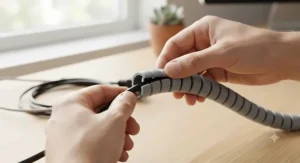
The D-Line Cable Spiral Wrap is the entry point most people reach for first, and there’s a reason it keeps turning up in “cat proof cable covers” searches: it’s cheap, it’s made in the UK, and it takes thirty seconds to fit. The wrap is a coiled polyethylene strip that you spiral around a cable bundle by hand, closing any gaps and tidying loose leads up to roughly 40mm in diameter.
In practical terms, this means a laptop charger and a monitor cable can be bundled into one neat, semi-rigid tube rather than dangling loose and swinging temptingly at paw height. Based on the spec comparison with tube-style protectors, the spiral wrap is thinner-walled and easier to bite through than a solid sleeve, so it’s better suited to light nibblers and visual tidying than a determined chewer with a habit. Reviewers consistently note that it’s excellent for cable management and does discourage casual mouthing, but a persistent kitten with new teeth coming through can eventually work a gap open at the seam.
Pros:
- ✅ Cuts to length with household scissors in seconds
- ✅ Made in the UK, widely stocked and inexpensive
- ✅ Doubles as general cable tidying, not just pet-proofing
Cons:
- ❌ Thinner wall offers less resistance than a solid tube
- ❌ Determined chewers can work an opening at the spiral seam
Priced under £15 for a standard length, this is the sensible starting point if your cat merely fusses with cables rather than actively destroying them — for anything more committed, pair it with a sturdier option below.
2. D-Line Heavy-Duty Floor Cord Cover — best for skirting-level protection
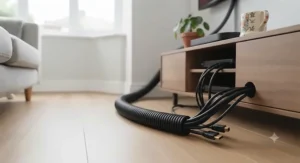
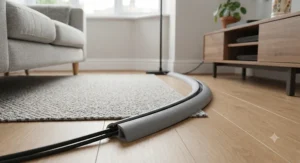
Where the spiral wrap handles desktop clutter, the D-Line Heavy-Duty Floor Cord Cover is built for the floor itself — a rigid, self-adhesive PVC channel that runs along skirting boards and under furniture, fully enclosing cables that would otherwise trail across a room. It’s a genuinely different category of product: rather than wrapping the cable, it hides it inside a low-profile plastic conduit with a hinged lid.
What most buyers overlook about this style of protector is that it solves two problems at once — trip hazards and chew access — because a cat simply cannot get its jaw around a cable sealed inside a solid channel screwed or stuck to the skirting. On paper, the trade-off is installation time: this is a proper small DIY job involving measuring, cutting to length, and either adhesive strips or screws, rather than a five-minute fix. Aggregated review sentiment on this style of channel is strongly positive for durability, though some buyers note the adhesive backing needs a clean, dry surface to bond properly on older skirting boards.
Pros:
- ✅ Fully encloses cables — nothing left exposed to bite
- ✅ Doubles as a trip-hazard and dust-tidying solution
- ✅ Rigid PVC resists teeth far better than flexible sleeves
Cons:
- ❌ Takes longer to install than wrap-style products
- ❌ Less practical for cables that move or get unplugged often
Expect to pay in the £20-£35 range depending on length, making this a mid-tier investment that’s genuinely worth it for hallway TV setups or a home office with a permanent cable run.
3. Alex Tech Split Wire Loom Tubing — best flexible sleeve for tech cables
The Alex Tech Split Wire Loom Tubing is the classic braided-tube approach, widely used in car wiring before pet owners adopted it for exactly the reason you’d expect: it’s genuinely tough. The tube has a lengthways slit so you can pop a cable in without disconnecting either end, and it flexes freely, which matters if your cables move with a laptop, a games console, or a router that gets shuffled around.
Here’s what to weigh up: this is nylon braid rather than a taste deterrent or hard plastic, so its defence is purely mechanical toughness plus the fact that a tight weave doesn’t give a cat’s teeth an easy single point to bite down on. The spec sheet won’t tell you this, but user reports suggest cats tend to lose interest faster with braided tubing than with smooth plastic, possibly because the woven texture doesn’t offer the same satisfying “give” that smooth tubing does. It’s a favourite for behind-the-TV setups where several cables run together, since one length of tubing can bundle multiple leads at once.
Pros:
- ✅ Flexes with moving cables, unlike rigid channels
- ✅ Bundles multiple cables into one manageable sleeve
- ✅ Tight braid resists casual and moderate chewing well
Cons:
- ❌ Not marketed as fully bite-proof against sustained effort
- ❌ Slit can gape slightly on tighter bends if oversized
At around £10-£20 for a typical length, it’s excellent value for behind-furniture runs, particularly if you’re bundling three or four cables rather than protecting just one.
4. PROTECTO Heavy Duty Cord Protector — best discreet, near-invisible cover
If your main objection to visible cable covers is that they look like, well, visible cable covers, the PROTECTO Heavy Duty Cord Protector addresses that directly. It’s a clear PVC tube roughly 2mm thick, designed to slip over a cord and largely disappear against most backgrounds rather than announcing itself in matte black.
The clear PVC construction means it sits somewhere between the flexibility of braided sleeving and the rigidity of a floor channel — thick enough to resist a fair amount of gnawing, flexible enough to route around corners and furniture legs. Based on the spec comparison, the main functional advantage over thin mesh-style covers is that a 2mm PVC wall doesn’t have the tiny gaps that a determined kitten’s incisors can find purchase in. Reviewers consistently report that it holds up well against moderate chewing and that the transparency genuinely does make it far less obtrusive in a living room than the black split-loom alternatives.
Pros:
- ✅ Transparent design blends into most home decor
- ✅ 2mm PVC wall resists gnawing better than thin mesh
- ✅ Works across power, HDMI, USB and AV cables alike
Cons:
- ❌ Clear plastic can show dust and scuffing over time
- ❌ Odourless design means no behavioural deterrent element
Sitting in the £15-£25 range, this is the pick for anyone whose priority is protection without turning their living room into a server cupboard.
5. Chewsafe Pet Cord Cover — best behavioural deterrent sleeve
Every product so far has relied on physical toughness. The Chewsafe Pet Cord Cover takes a different, complementary approach: it’s a clear sleeve infused with a bitter apple and citrus scent, designed to make the cable itself actively unpleasant to bite, not just hard to bite through.
This matters because physical barriers only address the symptom — a cat that’s genuinely motivated to chew will keep testing a tube’s limits indefinitely. A taste-and-scent deterrent tackles the underlying behaviour, teaching a cat over repeated attempts that cables simply aren’t worth the bother, which is particularly useful for kittens working through the teething stage described in Cornell Feline Health Center’s research on feline destructive chewing. Aggregated review sentiment is largely positive on effectiveness, with a recurring theme that the citrus scent is noticeable to humans for the first few days after installation before it fades, which some buyers love and others find a touch strong initially.
Pros:
- ✅ Bitter apple and citrus infusion actively deters biting
- ✅ Addresses the chewing habit, not just the immediate cable
- ✅ Pre-slit design makes installation genuinely quick
Cons:
- ❌ Scent is noticeable to humans initially, fades over days
- ❌ Not a substitute for enrichment if boredom drives chewing
Priced in the £15-£25 range for a standard length, this is the strongest pick specifically for households dealing with a repeat, determined chewer rather than casual curiosity.
6. Small Pet Select Heavy Duty Cord Cover — best for multi-pet households
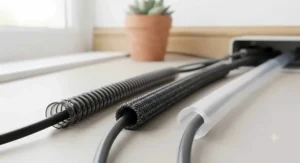
Despite the small-pet branding, the Small Pet Select Heavy Duty Cord Cover is explicitly marketed across rabbits, cats and dogs, which makes it a sensible pick for households juggling more than one species of chewer. It’s constructed from a woven PET material with a low-profile texture, wrapped rather than fully sealed, so it slips on with minimal fuss.
What stands out here is the honesty of the marketing itself — the manufacturer is upfront that it’s “not 100% chew-proof” but designed as a proactive deterrent rather than an unbreakable barrier, which is a more accurate framing than some competitors offer. On paper, this means it’s best treated as a first line of defence alongside genuine enrichment, rather than a standalone fix for a cat that’s already fixated on a specific cable. Reviewers consistently praise the ease of fitting and the coiled design that stretches to accommodate different cable thicknesses without needing an exact size match.
Pros:
- ✅ Suitable across multiple pet species in one household
- ✅ Coiled woven design adapts to varying cable thicknesses
- ✅ Honest “deterrent, not indestructible” positioning sets expectations well
Cons:
- ❌ Woven texture, not a fully sealed rigid barrier
- ❌ Best paired with behavioural fixes for persistent chewers
At £15-£25 depending on length, it earns its place through flexibility and honest positioning rather than claiming to be something it isn’t.
7. Yecaye Self-Adhesive Cord Hider — best budget desk and home-office solution
Rounding out the list, the Yecaye Self-Adhesive Cord Hider is a low-profile adhesive raceway designed for desks, skirting boards and behind monitors — essentially a lighter, more affordable cousin of the D-Line floor channel, aimed squarely at home office setups.
The self-adhesive backing means installation is genuinely a stick-and-go job rather than requiring screws, which suits renters or anyone who doesn’t want to commit to permanent fixings. Here’s what to weigh up: because it’s adhesive-mounted rather than screwed, its long-term hold depends heavily on surface prep — a dusty or textured skirting board will shorten its lifespan considerably compared with a smooth painted desk edge. For a determined chewer working at floor or desk level, the raceway’s semi-rigid channel still offers meaningfully more resistance than a soft cable tidy clip, even if it’s not marketed with the same heavy-duty rating as the D-Line equivalent.
Pros:
- ✅ Genuinely tool-free, renter-friendly installation
- ✅ Low profile keeps home office desks looking tidy
- ✅ Among the most affordable channel-style options available
Cons:
- ❌ Adhesive hold depends heavily on surface condition
- ❌ Less heavy-duty rated than premium floor channel options
Typically found under £15, it’s the pragmatic pick for a cat-proofed desk setup on a tight budget.
Top 7 Products: Specs & Value Comparison
| Product | Material | Installation | Best For | Rating Style |
|---|---|---|---|---|
| D-Line Cable Spiral Wrap | Polyethylene wrap | Wrap by hand | Budget bundling | Aggregated positive |
| D-Line Heavy-Duty Floor Cord Cover | Rigid PVC channel | Adhesive/screw | Skirting-level runs | Aggregated positive |
| Alex Tech Split Wire Loom Tubing | Nylon braid | Slide over cable | Flexible tech leads | Aggregated positive |
| PROTECTO Heavy Duty Cord Protector | 2mm clear PVC | Slide over cable | Discreet coverage | Aggregated positive |
| Chewsafe Pet Cord Cover | Bitter apple/citrus sleeve | Pre-slit sleeve | Determined chewers | Aggregated positive |
| Small Pet Select Heavy Duty Cord Cover | Woven PET | Wrap/coil | Multi-pet homes | Aggregated positive |
| Yecaye Self-Adhesive Cord Hider | Adhesive raceway | Stick-and-go | Home office desks | Aggregated positive |
The clearest takeaway from this table is that no single material wins outright — rigid PVC channels like the D-Line Heavy-Duty Floor Cord Cover dominate on raw physical resistance, while the Chewsafe Pet Cord Cover is the only entry tackling the behavioural side of chewing directly. For most homes, a genuinely effective setup actually combines two approaches: a physical barrier on the exposed run, plus a taste deterrent for any section your cat has already targeted.
✨ Don’t Miss These Exclusive Deals!
🔍 Take your cat-proofing project to the next level with these carefully selected products. Click on any highlighted item to check current pricing and availability. These tools will help you create a genuinely safer home your cat — and your cables — will thank you for!
What Is a Cord Protector for Cats?
A cord protector for cats is a physical sleeve, tube, channel, or coating that encases exposed cabling so a cat cannot get its teeth directly onto the live wire inside, reducing the risk of electric shock, burns, house fires, and expensive cable damage.
They range from soft spiral wraps and braided tubing to rigid floor-mounted channels and taste-deterrent-infused sleeves, and the right choice depends heavily on where the cable is, how it’s used, and how determined your particular cat happens to be.

How to Choose Cord Protectors for Cats
Picking the right product isn’t just a matter of grabbing the cheapest option on the page. Here’s a practical, numbered approach:
- Identify the cable’s location first. A floor-level run behind the sofa needs a different solution to a desk full of charger leads — location dictates whether you need a rigid channel or a flexible sleeve.
- Assess your cat’s chewing history. A cat that’s already damaged a cable needs a taste-deterrent product, not just a physical barrier, since motivated chewers will keep testing mechanical defences.
- Match material toughness to determination. Kittens teething through their adult set tend to chew harder and more persistently than adult cats simply investigating, so err towards rigid PVC or braided nylon for younger cats.
- Check installation effort against permanence. Adhesive and self-slit sleeves suit renters and temporary setups; screwed channels suit a permanent, high-traffic cable run you’ll never move.
- Consider multi-cable bundling. If several leads run together behind the TV, a single wide sleeve is usually more practical and tidier than protecting each cable individually.
- Factor in visibility. Clear or low-profile products matter more in living rooms than in a cupboard or under a desk where appearance is irrelevant.
- Budget for the whole home, not one cable. Most households need protectors in two or three spots — desk, TV unit, and any lamp or appliance cord at floor level — so price per metre matters more than the sticker price of one pack.
Cat Proof Cable Covers for Every Room
Cat proof cable covers aren’t a one-room job — the products that suit a hallway skirting board rarely suit a bedside lamp. In living rooms, rigid channels like the D-Line Heavy-Duty Floor Cord Cover work best along skirting boards behind the TV unit, where cables are numerous, largely static, and at floor level where cats naturally investigate.
In bedrooms, lamp and phone charger cables tend to be shorter and more mobile, which favours flexible sleeving such as Alex Tech Split Wire Loom Tubing or the transparent PROTECTO Heavy Duty Cord Protector, since both can be slid on and off without a full reinstall each time you move a lamp. Kitchens present their own challenge: appliance cords near food prep areas need covers that are easy to wipe down, ruling out anything with an open weave that traps grease, which makes smooth PVC tubing the safer material choice there. Whichever room, the underlying principle from fire safety guidance remains consistent — never leave electrical items charging unattended where a cat has access, regardless of how well the cable is covered.
Blind Cord Safety for Cats
Cable chewing gets most of the attention, but blind cords present a genuinely different and often overlooked hazard — not electrical, but strangulation risk, particularly for kittens who love batting at dangling loops. UK safety standards actually address this directly: legislation covering internal blinds and corded window coverings sets out requirements for safety devices that prevent accessible cords from forming a hazardous loop, originally framed around child safety but equally relevant to curious pets.
In practice, this means fitting cord cleats or breakaway safety devices high on the wall to keep looped cords permanently out of paw’s reach, or switching to cordless and wand-operated blinds where a full replacement is affordable. What most buyers overlook is that a chewed cord and a looped cord are actually separate risks requiring separate fixes — a bitter-tasting cable sleeve does nothing to prevent a kitten getting tangled in a blind cord loop, so households with both electrical cables and corded blinds genuinely need to address each hazard on its own terms rather than assuming one product covers both.
Chew-Proof Cord Protector: What Actually Works
“Chew-proof” is one of the more misused phrases in this category, and it’s worth being honest about what it actually means in practice. No cord protector for cats is genuinely indestructible against unlimited time and a sufficiently determined animal — what varies is how long a given product delays or discourages access, and whether it addresses the behaviour behind the chewing at all.
Based on the spec comparison across our seven picks, rigid PVC channels like the D-Line Heavy-Duty Floor Cord Cover offer the strongest purely mechanical resistance, because there’s no way to get a full bite around a sealed, screwed-down conduit. Braided nylon options such as Alex Tech Split Wire Loom Tubing sit in the middle — genuinely tough, but a slit design always leaves a theoretical point of entry if a cat works at it long enough. Taste-deterrent sleeves like the Chewsafe Pet Cord Cover approach the problem from an entirely different angle, and reviewers consistently note that combining a physical barrier with a taste deterrent produces noticeably better results than either alone, since the cat both struggles to bite through and dislikes the outcome when it does.
Understanding Cat Chewing Behaviour
It helps to understand why this happens at all before throwing products at the problem. According to Cornell Feline Health Center’s overview of feline destructive behaviour, chewing on inappropriate objects — including cords, fabric, and twist ties — is most commonly part of normal investigation and play rather than a sign a cat is “acting out,” and kittens in particular chew more as they explore the texture and give of new objects around them.
What the spec sheet won’t tell you, but behavioural research suggests, is that cable chewing often spikes during teething and tends to reduce with age in most cats, though a minority carry the habit into adulthood, particularly if it’s become a boredom-relief behaviour rather than pure exploration. In real-world terms, this means a physical cord protector bought for a six-month-old kitten may become largely unnecessary by the time that cat turns two — but it also means relying purely on “they’ll grow out of it” without any protection in the meantime is a genuine fire and shock risk during exactly the window when chewing is most intense.
Electrical Safety With Pets: The Bigger Picture
Cord protectors matter because the underlying risk is real, not theoretical. Guidance from UK fire services is direct on this point: pet fire safety advice specifically warns that pets should never be left charging electrical items unattended, since animals may chew the cables, and recommends pet-proofing a home by looking for loose wires and potential hazards “through the eyes of a pet.”
The medical reality behind that warning is documented too — a veterinary case report on electric shock injury from cord chewing describes a young pet developing life-threatening pulmonary complications after chewing through a household electrical cord, underlining that this isn’t a hypothetical worst case but a recognised veterinary emergency. Reviewers consistently note in aggregated feedback that cord protectors were bought reactively, after a near-miss or an actual chewed cable, rather than proactively — which is understandable, but genuinely riskier than fitting protection before an incident occurs.
Cat-Proofing a Home Office
Home offices deserve their own section because they concentrate more exposed cabling per square metre than almost any other room — monitor leads, chargers, ethernet cables, and extension blocks, often within easy reach of a desk a cat loves to sit on.
Start by auditing every cable at the desk and grouping ones that run in the same direction, since bundling three cables into one Alex Tech Split Wire Loom Tubing sleeve is both tidier and cheaper than protecting each individually. Next, address the floor run separately from the desk-level cables — a Yecaye Self-Adhesive Cord Hider along the skirting board handles the horizontal run to the wall socket, while individual sleeves handle the vertical drops from desk to floor. Finally, consider your cat’s actual desk behaviour: if they like to sit directly on the desk near the monitor, keep charging cables routed along the back edge rather than the front, and never leave a laptop charging unattended overnight if the cable isn’t yet protected. A tidy, fully-covered cable run also has a secondary benefit rarely mentioned in marketing copy — it removes the temptation for a cat to walk across a desk full of dangling leads in the first place, since there’s simply nothing loose to bat at.
Practical Usage Guide: Installing & Maintaining Cord Protectors
Getting a cord protector fitted properly makes a genuine difference to how well it performs, and most of the common failures come down to installation shortcuts rather than product quality.
Before fitting anything, unplug the cable and lay it out flat so you can measure the actual length needed rather than guessing — buying too short a length is the single most common first-time mistake, leaving a gap of exposed cable at one end. For sleeve and tubing products, feed the cable in from one end rather than trying to force it through the middle slit, which reduces the risk of tearing a seam during installation. Rigid channel products need a genuinely clean, dry, dust-free surface for adhesive backing to bond properly — wipe the skirting board with isopropyl alcohol first if it’s been painted for a while, since household dust alone can halve the adhesive’s effective lifespan. In the first thirty days, check weekly for any signs a cat has found a weak point, particularly at the ends of sleeves where the material is thinnest, and top up with a second short length of protector at any exposed edge rather than waiting for a full failure. Ongoing maintenance is minimal for rigid channels but taste-deterrent sleeves like the Chewsafe Pet Cord Cover may need reapplying or replacing every few months as the citrus scent fades with handling and general wear.
Real-World Scenarios: Matching Protection to Your Cat
Different households genuinely need different setups, so it helps to think in terms of profiles rather than a single universal answer.
Consider a first-time kitten owner with a six-month-old cat still teething heavily and testing everything with its mouth — here, the priority is toughness plus behavioural deterrence together, making the Chewsafe Pet Cord Cover combined with a rigid channel like the D-Line Heavy-Duty Floor Cord Cover the sensible pairing, since the kitten phase is exactly when chewing peaks. A renter working from a home office desk with limited budget and no permission to drill into skirting boards is better served by the tool-free Yecaye Self-Adhesive Cord Hider alongside Alex Tech Split Wire Loom Tubing for the desk-level cables, since neither requires permanent fixings. Finally, picture a multi-pet household with an adult cat and a young rabbit sharing the same living space — the Small Pet Select Heavy Duty Cord Cover is explicitly designed across species, making it the most sensible single purchase rather than buying separate products for each animal.
Common Mistakes When Buying Cord Protectors for Cats
Even well-intentioned buyers trip up on a handful of recurring errors. The most frequent is buying based on price alone without checking whether the product suits the cable’s location — a spiral wrap bought for a floor-level run in a high-traffic hallway simply isn’t built for that job, however cheap it was.
A second common mistake is assuming one length of protector covers “cables” in general, rather than measuring the specific run needed, which leads to gaps of exposed cable that undo the entire purchase. Buyers also frequently overlook installation permanence — fitting an adhesive channel to a rental property’s skirting board without checking the tenancy agreement, or screwing a permanent fixture where a temporary sleeve would have done the job just as well. Finally, and perhaps most understandably, many people buy a physical barrier alone and skip the behavioural side entirely, when reviewers consistently note that pairing physical protection with a taste deterrent produces meaningfully better long-term results than either approach used in isolation.
Cord Protectors vs Cat Deterrent Sprays
It’s worth directly comparing cord protectors against the other common approach: bitter-tasting deterrent sprays applied directly to cables. Sprays are cheap and instantly applicable to any existing cable, which makes them appealing as a first response, but they wash off, wear away with handling, and need reapplying every few days to stay effective — a maintenance burden that most owners underestimate.
Physical cord protectors, by contrast, require more upfront installation effort but then need little ongoing attention, and they add a genuine mechanical barrier that a spray simply cannot provide, since a determined cat can still bite through an unprotected, sprayed cable even if the taste is unpleasant. The strongest real-world approach, based on the comparison above, combines both: a physical sleeve or channel to prevent the bite reaching the live wire, with a taste deterrent like the infused sleeve on the Chewsafe Pet Cord Cover doing double duty as both barrier and behavioural discouragement in one product.
Long-Term Cost & Maintenance
Thinking in terms of total cost of ownership rather than sticker price changes the calculation considerably. A single chewed phone charger or laptop cable typically costs more to replace than an entire cord protection setup for a room, which makes even the premium end of this category — the £20-£35 D-Line Heavy-Duty Floor Cord Cover — genuinely cost-effective against even one avoided cable replacement.
Rigid channel products have the lowest ongoing maintenance cost since they need no reapplication once fitted, while taste-deterrent sleeves carry a small recurring cost as the scent fades and needs topping up every few months for persistent chewers. Budget spiral wraps and adhesive raceways sit in between — inexpensive to buy but with a shorter effective lifespan against determined chewing, meaning they may need replacing more often than the upfront saving initially suggests. Over a two-to-three-year period, most households find a mixed approach — one rigid channel for the highest-risk floor run, plus cheaper sleeving for lower-risk cables — delivers the best balance between cost and genuine protection.
Features That Actually Matter (And Those That Don’t)
Marketing copy in this category leans heavily on words like “indestructible” and “100% chew-proof,” and it’s worth filtering the hype from what genuinely affects performance. Wall thickness and material rigidity matter enormously — a 2mm solid PVC wall like the one on the PROTECTO Heavy Duty Cord Protector meaningfully outperforms thin mesh regardless of what the packaging claims about bite resistance.
Scent and taste infusion, as used in the Chewsafe Pet Cord Cover, matters because it changes behaviour rather than just resisting it. What doesn’t matter nearly as much as branding suggests is colour and decorative styling — a black braided sleeve and a clear PVC tube perform almost identically against actual chewing, so buyers paying a premium purely for a “designer” finish are paying for aesthetics, not protection. Similarly, marketing claims about temperature resistance ranges are largely irrelevant for the vast majority of UK homes, since indoor ambient temperatures never come close to testing those limits — it’s a genuinely useful spec for outdoor or garage cabling, but close to meaningless for a living room TV unit.
Safety, Regulations & Compliance Guide
Two separate UK regulatory frameworks are relevant here, and it’s worth knowing the difference. General electrical product safety in the home falls under standard UK consumer protection rules, meaning any cable or appliance sold in the UK should already meet baseline safety standards — but no regulation currently mandates pet-specific cord protection, so this remains an owner responsibility rather than a legal requirement.
Blind cords, on the other hand, are directly covered by safety standards on internal blinds and corded window coverings, which require safety devices to prevent accessible cords forming a hazardous loop. While this legislation was written with young children in mind, the physical hazard — a curious animal getting tangled in a looped cord — applies just as directly to kittens, and fitting the same cord cleats or breakaway devices required for child safety is a sensible, low-cost step for any cat-owning household with corded blinds still installed.
Buyer’s Decision Framework
If you’re still weighing up which product to start with, a simple priority checklist helps. If your cat is under a year old and actively teething, choose a taste-deterrent sleeve like the Chewsafe Pet Cord Cover first, because behaviour is the priority at that age. If the cable in question runs along a floor in a high-traffic area, choose a rigid channel like the D-Line Heavy-Duty Floor Cord Cover, because mechanical strength matters most there. If you’re renting and can’t make permanent fixings, choose adhesive or slide-on products like the Yecaye Self-Adhesive Cord Hider or Alex Tech Split Wire Loom Tubing, because reversibility outweighs raw toughness. And if you’re protecting several cables at once behind furniture, choose a bundling sleeve rather than individual covers, because it’s cheaper and considerably tidier than protecting each cable in isolation.
FAQ
❓ Are cord protectors actually effective against cats?
❓ What is the best cord protector for kittens?
❓ Do cats grow out of chewing cords?
❓ Can chewing an electrical cord seriously hurt a cat?
❓ How do I stop my cat chewing blind cords specifically?
Conclusion
Cord protectors for cats aren’t a luxury purchase — they sit somewhere between tidying up and genuine home safety, closer to the latter than most owners initially assume. Across the seven products covered here, the honest takeaway is that no single option does everything: rigid channels like the D-Line Heavy-Duty Floor Cord Cover win on raw physical resistance, flexible sleeves like Alex Tech Split Wire Loom Tubing win on adaptability, and taste-deterrent products like the Chewsafe Pet Cord Cover are the only ones tackling the chewing habit itself rather than just the symptom.
The most effective real-world setups we’ve seen described in aggregated review sentiment combine two approaches rather than relying on one product to do everything — a physical barrier on the highest-risk cable runs, paired with a behavioural deterrent for any cable a cat has already shown interest in. Start with an honest audit of your own home: which cables sit at floor level, which ones move around a desk, and which cat in your household is still young enough to be testing everything with their mouth. That audit, more than any single product on this list, is what actually determines which of these seven picks belongs in your home first.
✨ Ready to Cat-Proof Your Home?
🔍 Browse the full range of cord protectors above and pick the combination that fits your cables, your budget, and your cat’s particular habits. A tidier, safer home is genuinely just one afternoon of fitting away!
Recommended for You
- Cat Window Guards UK: 7 Top Picks to Stop Escapes in 2026
- Cat Proof Cabinet Locks: 7 Best Picks to Outsmart Cats (2026)
- Sofa Protector for Cats: 7 Genuinely Effective Picks
Disclaimer: This article contains affiliate links. As an Amazon Associate, I earn from qualifying purchases. If you purchase products through these links, we may earn a small commission at no additional cost to you.
✨ Found this helpful? Share it with your friends! 💬🤗
