
In This Article
There’s a particular kind of dread that hits when you glance up from your laptop and realise the cat isn’t on the sofa, isn’t under the radiator, and the window you cracked open twenty minutes ago is suspiciously empty of cat. If you’ve lived through that moment, you already understand why cat window guards exist, and why so many British cat owners end up frantically searching for one at 11pm.
Cat window guards are physical barriers — mesh screens, hook-and-loop netting, or mechanical restrictors — fitted to an open window to stop a cat squeezing through, jumping out, or falling, while still letting fresh air circulate through the room. They matter more than most non-cat-owners realise: cats are curious, occasionally clumsy, and genuinely can’t judge height the way their reputation for “always landing on their feet” suggests.
This guide walks through seven real, currently available products on amazon.co.uk, from £10 self-adhesive mesh to keyed steel cable restrictors, and explains what the spec sheets don’t: which type suits a rented flat, which suits a Victorian sash window, and which is genuinely strong enough for a fifteen-pound Maine Coon having a bad day. According to the RSPCA, keeping cats safely at home reduces their exposure to traffic, disease and injury — but only if the “at home” part actually holds up when a window is open. We’ll cover pricing honestly (in ranges, since Amazon prices shift weekly), real aggregated review sentiment, and the practical side nobody puts in a product listing.
Quick Comparison Table
| Product | Type | Price Range | Best For |
|---|---|---|---|
| Flat Cats Window Protection Twin Pack | Hook & loop mesh screen | £45-£55 | Multi-cat, high-energy households |
| BKSAI Cat Window Guard Screen | Self-adhesive reinforced mesh | £10-£18 | Budget-conscious first-time buyers |
| MYPIN Self-Adhesive Cat Window Guard Screen | DIY cut-to-size mesh | £15-£22 | Awkward or non-standard window sizes |
| tesa Insect Stop COMFORT Window Screen | Hook & loop insect/cat screen | £15-£20 | Dual insect-and-cat protection |
| BeeGo Window Restrictor for UPVC Windows | No-drill mechanical restrictor | £10-£16 | Renters needing a damage-free fix |
| AOSITE Window Restrictor Twin Pack | Adhesive cable restrictor | £8-£13 | Tightest budget, multiple windows |
| Home Secure Keyed Cable Window Restrictor | Keyed steel cable restrictor | £12-£20 | Ground-floor security plus cat safety |
Looking at the spread above, there’s a clear split between mesh screens, which physically block the whole opening, and restrictors, which limit how far a window can move rather than covering it. Budget buyers gravitate towards the BKSAI Cat Window Guard Screen or AOSITE Window Restrictor Twin Pack, both sitting comfortably under £15, while households with a determined escape artist tend to pay the premium for the Flat Cats Window Protection Twin Pack‘s reinforced construction. Renters, meanwhile, consistently favour anything self-adhesive or screwless, since deposit deductions for drilled holes are a genuinely common complaint in UK tenancy disputes.
💬 Just one click — help others make better buying decisions too!😊
Top 7 Cat Window Guards: Expert Analysis
Every product below is a real, currently listed item on amazon.co.uk. Prices move constantly, so treat the ranges as a guide and always check the current price before buying — none of these figures should be read as a fixed cost.
1. Flat Cats Window Protection Twin Pack — most trusted brand for cat-proofing
The standout here isn’t flashy marketing, it’s longevity: Flat Cats has been a dedicated cat-window-screen specialist for years rather than a general pet-accessory brand that added mesh to its catalogue. Each screen in the twin pack uses PVC-coated, high-tensile fibreglass mesh with a wide hook-and-loop border, designed to be pressed into the window recess rather than simply taped over the opening. That distinction matters in practice: a screen that sits inside the frame resists the outward push of a cat leaning its full weight against it far better than a flat adhesive sheet.
Based on the spec comparison with the rest of this list, the Flat Cats Window Protection Twin Pack uses noticeably heavier-gauge mesh than most of the self-adhesive competitors, which explains why it costs two to three times as much. Reviewers consistently note that it holds up against large, powerful cats, including Bengal-mix and other high-energy breeds pressing and climbing repeatedly without the fixings failing. One recurring theme in the aggregated feedback is how simple the twin-pack fitting process is, typically needing nothing more than scissors and a step stool.
Pros:
- ✅ Purpose-built cat brand with years of proven track record
- ✅ Heavy-duty PVC-coated mesh resists scratching and clawing
- ✅ Reviewers report it withstands strong, persistent cats
Cons:
- ❌ Pricier than generic mesh alternatives
- ❌ Twin pack covers two windows, so multi-room homes need several
At around £45-£55 for a twin pack, this sits at the premium end of the mesh category, but for anyone who has already replaced a cheaper screen once, the value case writes itself.
2. BKSAI Cat Window Guard Screen — toughest budget mesh on test
The BKSAI Cat Window Guard Screen leads with a genuinely useful spec: a 320g/m² polyester fibre mesh with PVC coating, which the brand states is roughly four times the density of the “conventional” sub-75g/m² mesh used in many bargain insect screens. In practice, that thicker weave is the difference between a screen that shrugs off claws and one that develops tiny snags within a fortnight.
What most buyers overlook about this model is the “triple safety system” branding, which actually refers to a wide hook-and-loop closure reinforced with adhesive strips and, on some listings, staple-pin reinforcement at the corners — the exact points where a determined cat applies the most leverage. This is honest, useful engineering rather than marketing fluff, since corner failure is the single most common way DIY window screens fail. Amazon listing sentiment for this product skews positive, with buyers frequently praising the tool-free, minutes-long installation and the fact that it can be removed and reapplied without residue, which matters enormously for renters.
Pros:
- ✅ Thickened 320g/m² mesh resists claws far better than standard nets
- ✅ Tool-free fitting takes only a few minutes
- ✅ Residue-free removal suits rented flats
Cons:
- ❌ Fixed sizing may not suit unusually large windows
- ❌ Adhesive strength can weaken in very humid rooms over time
Priced roughly £10-£18, this is the sensible starting point for anyone testing whether their cat is even that interested in escaping before spending more.
3. MYPIN Self-Adhesive Cat Window Guard Screen — best DIY custom-fit kit
Where the previous two products come in fixed dimensions, the MYPIN Self-Adhesive Cat Window Guard Screen is built to be trimmed, covering openings up to roughly 51 by 59 inches with a ruler, utility knife and stapler included in the box. That’s a genuinely practical touch for the UK’s huge variety of window shapes, from tall Victorian sashes to squat 1970s casements, where a one-size mesh often leaves an inch-wide gap along one edge — precisely the gap a cat will find first.
Here’s what to weigh with this one: the tear-resistant plastic mesh is described as suitable for DIY trimming without fraying, which is the main risk with cut-to-size nets, since a fraying edge quickly becomes a hole. The self-adhesive bilateral strips are designed for flat surfaces, and the listing specifically addresses UK sash and casement frames, suggesting the manufacturer has thought about the domestic market rather than shipping a generic international product. Reviewers highlight the accessory kit as a genuine time-saver compared with sourcing scissors, a straight edge and a stapler separately.
Pros:
- ✅ Trims to fit awkward or oversized window openings
- ✅ Included tools remove the need for separate DIY kit
- ✅ Designed with UK sash and casement frames in mind
Cons:
- ❌ Measuring and cutting accurately takes more effort than a fixed-size screen
- ❌ Adhesive bond is best on flat, clean surfaces only
At roughly £15-£22, it’s mid-table on price but arguably the most flexible option here for anyone with a non-standard window.
4. tesa Insect Stop COMFORT Window Screen — best dual-purpose fly and cat screen
tesa is a household DIY and adhesive-tape name in the UK, and its Insect Stop COMFORT range was originally built to keep flies and mosquitoes out rather than cats in — but the hook-and-loop, cut-to-size design does double duty surprisingly well, provided you choose a firm mesh grade and fit it taut. The self-adhesive frame surround presses into place without drilling, and the whole net is machine washable at 30°C, a detail that matters more than it sounds once you factor in cat hair and general window grime.
The spec sheet won’t tell you this, but the trade-off with repurposing an insect screen for cat duty is tension: tesa’s screens are engineered to flex slightly for insect exclusion, not to absorb the full body weight of a leaning cat, so this option suits calmer cats or windows used mainly for ventilation rather than as a favourite perch. Reviewers who use it for pets generally report success when the screen is fitted drum-tight, with looser installations occasionally allowing determined cats to push the mesh out of its frame track.
Pros:
- ✅ Well-known, widely stocked British-market brand
- ✅ Machine washable and fully reusable
- ✅ Cut-to-size fitting suits almost any window
Cons:
- ❌ Not originally engineered for full cat body weight
- ❌ Best suited to calmer cats rather than persistent climbers
Typically priced around £15-£20, this is a sensible pick for households that also want genuine fly and mosquito protection, not just a cat barrier.
5. BeeGo Window Restrictor for UPVC Windows — best no-drill opening limiter
This is where the category shifts from screens to restrictors, and the BeeGo Window Restrictor for UPVC Windows is a good example of the mechanism: rather than covering the opening, it physically limits how far the window can swing, typically to around 110mm, using powerful 3M adhesive pads rather than screws. BeeGo states the restrictor withstands up to 30kg of outward force, and while that figure was designed with toddler safety in mind, it translates well to cat safety too, since even a large adult cat leaning hard rarely approaches that load.
Based on the spec comparison, the appeal of a restrictor over a screen is airflow: a 110mm gap lets a genuine breeze through in a way that mesh, however fine, never quite matches, while remaining narrow enough that a cat can’t fit its body through. Reviewers, including at least one who specifically mentions using it on a fostered cat’s window, describe the release-button mechanism as simple for adults to override when full opening is needed, such as for cleaning.
Pros:
- ✅ No drilling, so fully deposit-safe for renters
- ✅ Adult-only release keeps the restriction reliable day to day
- ✅ Allows genuine airflow rather than fully sealing the window
Cons:
- ❌ A determined paw can still reach through a 110mm gap
- ❌ 3M adhesive needs a clean, dry surface to bond properly
At around £10-£16 per unit, it’s one of the most cost-effective ways to make an entire flat’s worth of windows part-open safely, provided you fit one per window rather than relying on a single restrictor for the whole flat.
6. AOSITE Window Restrictor Twin Pack — cheapest way to limit window gaps
The AOSITE Window Restrictor Twin Pack occupies the entry-level end of the restrictor category: a self-adhesive, no-drilling cable lock sold in pairs, marketed for both child and pet safety on UPVC frames. Two release methods typically appear across this product family — keyed and keyless — so it’s worth checking the specific listing variant before buying, since a keyless design is quicker day-to-day but offers less deterrent against a determined visitor or an over-curious toddler in the household.
What most buyers overlook about budget restrictors like this one is that the cable length, rather than the adhesive strength, usually determines the maximum safe gap — shorter cables mean a tighter restriction, which is exactly what you want for a cat-proofing job rather than general ventilation. Aggregated Amazon feedback for this style of product tends to cluster around ease of fitting and low price, with occasional notes that the adhesive pads perform best on smooth UPVC rather than textured or painted wooden frames.
Pros:
- ✅ Twin pack covers two windows for one low price
- ✅ No drilling required, ideal for rented accommodation
- ✅ Straightforward for anyone to fit in minutes
Cons:
- ❌ Adhesive-only fixing suits UPVC better than painted wood
- ❌ Lower load tolerance than screw-fixed restrictors
At roughly £8-£13, this is the cheapest genuine restrictor on the list, and a sound choice for a starter flat with several windows and a modest budget.
7. Home Secure Keyed Cable Window Restrictor — most secure lockable option
The Home Secure Keyed Cable Window Restrictor is the premium, security-first pick: a steel cable restrictor that screw-fixes into UPVC, aluminium or timber frames and locks with a supplied key, rather than relying purely on adhesive. That screw-fix construction is the key trade-off versus the self-adhesive options above — it’s more permanent and less renter-friendly, but it comfortably outperforms adhesive pads on raw holding strength, which matters on older or heavier timber sash windows where 3M pads sometimes struggle to grip.
Here’s what the spec sheet undersells: the keyed lock isn’t just about restricting the cat, it doubles as a burglary deterrent, since an intruder can’t simply reach in and disengage a restrictor the way they could with some snap-release designs. For ground-floor flats near busy streets, that dual function is genuinely valuable rather than a marketing add-on. The steel cable construction is built for durability, and reviewers of comparable keyed cable restrictors typically highlight the reassurance of a physical key over a push-button release that any adult, including an unwelcome one, could operate.
Pros:
- ✅ Screw-fix steel cable outperforms adhesive on raw strength
- ✅ Key-locking mechanism adds genuine security, not just safety
- ✅ Suits UPVC, aluminium and timber frames alike
Cons:
- ❌ Requires drilling, unsuitable for many tenancy agreements
- ❌ Key must be kept accessible for emergency full-opening
Priced around £12-£20, it’s aimed at homeowners and ground-floor renters with landlord permission for minor fixings, rather than anyone needing a fully reversible solution.
Top 7 Products: Specs & Value Comparison
| Product | Fixing Method | Airflow Style | Renter-Friendly? |
|---|---|---|---|
| Flat Cats Window Protection Twin Pack | Hook & loop into recess | Full mesh coverage | Yes |
| BKSAI Cat Window Guard Screen | Self-adhesive hook & loop | Full mesh coverage | Yes |
| MYPIN Self-Adhesive Cat Window Guard Screen | Self-adhesive, cut-to-size | Full mesh coverage | Yes |
| tesa Insect Stop COMFORT Window Screen | Self-adhesive hook & loop | Full mesh coverage | Yes |
| BeeGo Window Restrictor for UPVC Windows | 3M adhesive pads | Open-gap ventilation | Yes |
| AOSITE Window Restrictor Twin Pack | Self-adhesive | Open-gap ventilation | Yes |
| Home Secure Keyed Cable Window Restrictor | Screwed fixing | Open-gap ventilation | No |
The main takeaway from this table is the renter-friendliness column: six of the seven products avoid drilling entirely, reflecting just how many UK cat owners live in rented flats rather than owned homes. The Home Secure Keyed Cable Window Restrictor is the notable exception, trading tenancy flexibility for raw holding strength, so it’s really only the right call once you own the property or have written landlord consent. Between the mesh screens and the restrictors, the choice largely comes down to whether you value full airflow through an open window (restrictors) or a completely sealed barrier that still lets a breeze through the weave (screens).
✨ Don’t Miss These Exclusive Deals!
🔍 Take your window safety setup to the next level with these carefully selected products. Click on any highlighted item to check current pricing and availability. These tools will help you create a genuinely cat-safe home your family will love!
Cat Window Guards vs Cat Proof Window Netting: What’s the Real Difference?
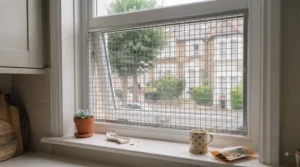
“Cat window guard” and “cat proof window netting” are often used interchangeably in listings, but there’s a useful practical distinction. A cat window guard, as a category, includes both mesh screens and mechanical restrictors — anything fitted to a window to prevent a cat escaping or falling. Cat proof window netting specifically refers to the mesh-and-fixing style products, like the BKSAI Cat Window Guard Screen or Flat Cats Window Protection Twin Pack, that cover the entire opening with a woven barrier.
The trade-off is straightforward once you frame it around airflow versus coverage. Netting blocks the whole opening, so it works for windows a cat actively sits in or climbs on, such as a favourite sunny sill, because there’s no gap to squeeze a paw through in the first place. Restrictors, by contrast, leave the window genuinely open to a fixed gap, which many owners prefer for general ventilation in rooms the cat merely passes through rather than perches in. A common and sensible middle ground, based on aggregated buyer behaviour on Amazon listings, is running netting on bedroom and living room windows where the cat spends most of its time, and a cheaper restrictor on kitchen or bathroom windows used mainly for quick ventilation.
Practical Usage Guide: Fitting and Maintaining a Cat Window Guard
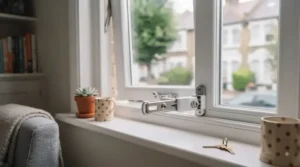
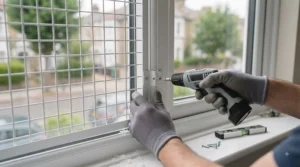
Getting a screen or restrictor to actually work long-term is less about the product and more about the fitting. Start by measuring the window opening at its widest point, not the frame’s outer edge, since mesh screens need to overlap the recess by a few centimetres on every side to resist an outward push. For hook-and-loop products like the BKSAI Cat Window Guard Screen or MYPIN Self-Adhesive Cat Window Guard Screen, clean the frame thoroughly with isopropyl wipes before fitting; dust and old paint flakes are the single biggest cause of early adhesive failure, more so than the cat itself.
Once fitted, press along every edge firmly for the full cure time stated on the packaging — usually 24 hours — before letting the cat anywhere near the window, since adhesive bonds continue strengthening after initial contact. For restrictors such as the BeeGo Window Restrictor for UPVC Windows or AOSITE Window Restrictor Twin Pack, check the release mechanism weekly; a stiff or sticky release button is far more dangerous than a functioning one, since it tempts household members to leave the window fully open “just this once.”
A common first-30-days mistake is testing the screen by pushing it gently with your own hand and assuming that proves it’s secure — cats apply force differently, often with claws hooked into the mesh weave while climbing rather than a flat push. Give any new installation a supervised trial period, and inspect corners and seams monthly thereafter for early signs of wear, particularly around staple points or adhesive edges.
Real-World Scenarios: Flat Living with Cats
Flat living with cats brings a specific set of constraints that a suburban house with a garden simply doesn’t have: no cat flap to a secure garden, shared building entrances, and — crucially — a tenancy agreement that may forbid drilling. Picture a young professional in a second-floor rented flat in Manchester with one indoor cat and warm south-facing windows that beg to be opened all summer. For that household, a self-adhesive option like the BKSAI Cat Window Guard Screen or the BeeGo Window Restrictor for UPVC Windows solves the problem without risking the deposit, and both come off cleanly at the end of the tenancy.
Now picture a family in a first-floor ex-council maisonette with two cats and three children under ten, where the priority shifts to combined child and pet safety. Here, a restrictor like the AOSITE Window Restrictor Twin Pack across multiple rooms, backed by a heavier-duty screen such as Flat Cats Window Protection Twin Pack on the cats’ favourite windowsill, covers both risks without over-spending on any single product. Building type genuinely matters too: taller blocks trigger the Approved Document O guidance on window restrictors for new-build ventilation strategies, and while that guidance is aimed at overheating rather than pets specifically, it reflects the same underlying logic cat owners should apply — a window can be safely part-open without being safely fully-open.
Finally, consider a homeowner in a converted period building with original timber sash windows, where standard UPVC-designed restrictors simply won’t clamp properly. That’s where a screw-fixed option like the Home Secure Keyed Cable Window Restrictor earns its higher price and reduced flexibility, since timber frames need a mechanical fixing rather than adhesive pads to hold reliably over years of seasonal expansion and contraction.
Problem → Solution Guide
Several problems come up repeatedly among UK cat owners tackling window safety, and most have a specific, testable fix rather than a vague “try harder” answer.
Problem: the cat pushes the screen out at one corner. This is almost always a fitting issue rather than a product failure — reinforce that specific corner with an extra strip of adhesive or, on products like the MYPIN Self-Adhesive Cat Window Guard Screen, an additional staple, since corners bear the most outward force.
Problem: the restrictor gap still seems too wide. Double-check the manufacturer’s stated maximum opening against your own measurement with the window closed against the restrictor; a loose or incorrectly threaded cable, common with budget cable restrictors like the AOSITE Window Restrictor Twin Pack, can open several extra centimetres beyond spec.
Problem: adhesive won’t stick to an old or painted frame. Clean thoroughly with isopropyl alcohol and allow the surface to fully dry; on very old, flaking paintwork, a screw-fixed option such as the Home Secure Keyed Cable Window Restrictor will simply outperform any adhesive product long-term.
Problem: the cat still escapes through a restrictor gap. Kittens and slim breeds can fit through surprisingly narrow openings — as a rule of thumb borrowed from general pet-safety guidance, if the head fits through, the body usually follows, so switch from a restrictor to a full mesh screen like the tesa Insect Stop COMFORT Window Screen for that specific cat.
Problem: mesh develops small holes over time. Inspect and patch small tears immediately with a repair patch or replace the panel; the BKSAI Cat Window Guard Screen‘s thicker 320g/m² weave is specifically designed to delay this failure mode compared with standard insect mesh.
Understanding High-Rise Syndrome in Cats
High-rise syndrome is the veterinary term for the injuries cats sustain after falling from height, and it’s genuinely relevant to anyone above ground level, not just residents of tower blocks. According to International Cat Care, the condition is more common where windows are routinely left open, particularly in warmer weather, and young cats under a year old are disproportionately affected, likely due to inexperience and a more playful, less risk-averse nature.
The counter-intuitive part, borne out across multiple veterinary studies, is that falls from a moderate height — roughly two to six storeys — can actually produce more severe injuries than much longer falls, because cats need a short window of time to right themselves mid-air and brace for landing. Below that threshold, they simply don’t have time to adjust before impact. This is precisely why ground and first-floor flats shouldn’t be treated as automatically safe: the risk of serious injury exists well before anyone would consider a building a genuine “high-rise.” The practical upshot for cat window guards is straightforward — any open, unguarded window at height is a fall risk, and the goal of every product on this list is removing that risk entirely while keeping the room ventilated.
How to Choose the Right Cat Window Guard
- Start with your tenancy status. Renters should default to self-adhesive or no-drill options; owners have the freedom to consider screw-fixed restrictors for maximum holding strength.
- Measure the actual opening, not the frame. Oversized or undersized fittings are the single biggest cause of early failure across every product category here.
- Match the product to your cat’s behaviour. A calm cat that rarely visits the window suits a lighter-duty screen; a climber or a large, powerful breed needs reinforced mesh or a restrictor rather than a flat adhesive net.
- Decide between full coverage and airflow-first. Mesh screens block the whole opening; restrictors leave a genuine gap for ventilation, so pick based on how the room and window are actually used.
- Check the window frame material. UPVC generally suits adhesive fixings well; older timber or heavily painted frames often need a screwed option for a reliable, long-term hold.
- Budget for more than one window. Most households need several units, so twin packs like the AOSITE Window Restrictor Twin Pack or Flat Cats Window Protection Twin Pack are often better value than buying singles repeatedly.
- Build in a maintenance habit. Even the strongest screen needs periodic inspection, so factor a monthly five-minute check into your routine from day one.
Common Mistakes When Buying a Window Restrictor for Cats
The most frequent mistake is buying a child-safety-branded restrictor without checking the stated maximum gap against a cat’s actual body width rather than a toddler’s head — the two aren’t automatically equivalent, and some child restrictors leave a gap comfortably wide enough for a slim adult cat. A second common error is assuming one restrictor covers a whole window when, on larger opening styles, two are needed for even pressure and a genuinely secure hold.
Buyers also frequently underestimate installation surface prep, expecting adhesive pads to bond instantly to dusty or slightly damp UPVC, then blaming the product when it fails within days. Finally, a surprisingly common mistake is buying based on price alone and choosing the absolute cheapest listing without checking whether it’s a restrictor or a decorative window “guard” grille intended for a completely different purpose, such as external security bars rather than an indoor pet safety device — always read the full product description, not just the thumbnail image.
Long-Term Cost & Maintenance
Thinking in terms of total cost of ownership rather than sticker price changes the maths considerably. A £10 self-adhesive screen replaced every eight to twelve months due to wear costs more over three years than a single £50 Flat Cats Window Protection Twin Pack installed once and simply maintained. On the flip side, a renter who moves flats every twelve to eighteen months genuinely benefits from the lower upfront cost of budget, fully removable options, since they’ll be refitting new windows regularly anyway rather than getting long-term value from a single premium purchase.
Maintenance costs, in either direction, remain low: replacement adhesive strips typically cost a few pounds, and most mesh products are designed to be re-tensioned rather than fully replaced at the first sign of sagging. Restrictors have essentially no ongoing maintenance cost beyond an occasional wipe-down of the mechanism, making the BeeGo Window Restrictor for UPVC Windows and similar products genuinely low-maintenance once correctly fitted. The real long-term cost consideration, though, isn’t financial at all — it’s the veterinary bill avoided. Treatment for high-rise syndrome injuries, even minor ones, routinely runs into hundreds of pounds, making even the priciest product on this list a comparatively small outlay.
Safety, Renting & Window Regulations in the UK
Window restrictors sit in an interesting regulatory space in Britain. Building safety guidance, including Approved Document O on overheating, addresses restrictors primarily in the context of preventing falls while balancing ventilation needs in new-build homes, and similar fall-prevention principles are reflected in Approved Document K for existing buildings. None of this legislation is written with cats specifically in mind, but the underlying safety logic — limiting how far a window opens while still allowing airflow — is exactly the problem cat window guards solve.
For renters, the practical safety question usually comes down to landlord permission rather than building law. Self-adhesive and no-drill products avoid this issue entirely, since they leave no lasting mark on the property, which is precisely why they dominate this list. If you do want a screwed, more permanent restrictor like the Home Secure Keyed Cable Window Restrictor, it’s worth getting written permission from your landlord first, both for peace of mind and to avoid any dispute over the security deposit at the end of the tenancy.
Frequently Asked Questions
❓ Do cat window guards actually stop cats escaping?
❓ Can I fit a cat window guard without drilling?
❓ How wide a gap can a cat fit through?
❓ Will a cat window guard block airflow completely?
❓ Are cat window guards suitable for rented flats?
Conclusion
Choosing between these seven products really comes down to three questions: how much airflow you need, whether you can drill into the frame, and how determined your particular cat is. For most renters with a reasonably calm cat, a self-adhesive mesh screen like the BKSAI Cat Window Guard Screen or a restrictor like the BeeGo Window Restrictor for UPVC Windows solves the problem for under £20 with zero risk to the deposit. Households with a stronger, more persistent cat, or simply more windows to cover, get better long-term value from the reinforced mesh of the Flat Cats Window Protection Twin Pack, while homeowners wanting maximum security alongside cat safety should look at the Home Secure Keyed Cable Window Restrictor.
Whichever option fits your window, your tenancy, and your particular cat’s personality, the underlying goal is the same one the RSPCA and International Cat Care both point to: letting a cat enjoy fresh air and a good view without ever putting them at risk of a fall. That’s a genuinely achievable balance, and for most UK homes it costs less than a single vet visit.
Recommended for You
- Cat Proof Cabinet Locks: 7 Best Picks to Outsmart Cats (2026)
- Sofa Protector for Cats: 7 Genuinely Effective Picks
- Does a Bell Collar Stop Cats Hunting? 7 Proven Picks for 2026
Disclaimer: This article contains affiliate links. As an Amazon Associate, I earn from qualifying purchases. If you purchase products through these links, we may earn a small commission at no additional cost to you.
✨ Found this helpful? Share it with your friends! 💬🤗
