
In This Article
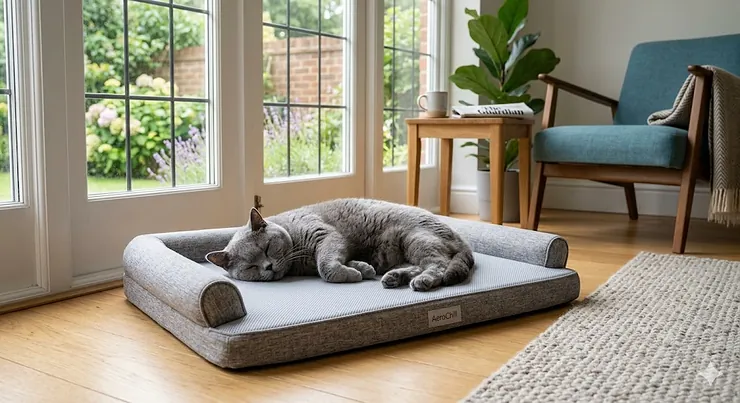
Summer in Britain might not involve the blistering heat of Mediterranean countries, but recent years have seen temperatures regularly topping 30°C — and our feline friends aren’t always equipped to cope. A cooling cat bed summer solution has become less of a luxury and more of a necessity for British cat owners, particularly as climate patterns shift and heatwaves become more frequent. Unlike dogs, cats can’t pant effectively to regulate their temperature, relying instead on seeking shade, grooming, and sweating through their paw pads — methods that simply aren’t sufficient when they’re trapped indoors during the hottest part of the day.
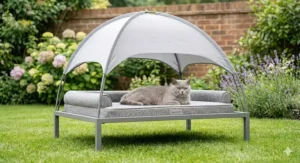
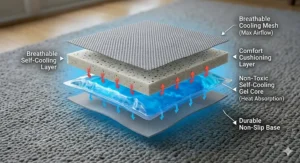
What most UK cat owners don’t realise is that the humid conditions we experience during British summers can be more dangerous than dry heat. According to the PDSA, when ambient humidity is high, cats struggle even more to regulate their body temperature, putting Persian and other flat-faced breeds at particular risk. A cat’s normal body temperature ranges between 38.1-39.2°C, but anything above 40°C signals potential heatstroke — a condition that can cause organ damage, seizures, and even death if not addressed immediately.
The cooling cat bed summer market has exploded in recent years, offering British pet owners everything from pressure-activated gel mats to water-based cooling pads and breathable fabric designs. But do they actually work in our climate? And more importantly, which type suits your cat’s needs, your budget, and the typical British summer? This guide cuts through the marketing fluff to deliver practical, expert-backed advice on choosing the right cooling solution for your moggy — whether you’re in a sweltering London flat, a draughty Edinburgh tenement, or a stone cottage in the Cotswolds.
Quick Comparison: Top Cooling Cat Bed Summer Options
| Product | Type | Size Range | Price Range (£) | Best For | UK Delivery |
|---|---|---|---|---|---|
| Trixie Cooling Mat | Pressure-activated gel | 40×30cm to 90×50cm | £10-£25 | Budget-conscious owners | Prime eligible |
| Nobleza Gel Cooling Pad | Self-cooling gel | 50×65cm (M) | £15-£20 | Multi-pet households | Free UK delivery |
| Bedsure Cooling Blanket | Q-Max fabric | 76×102cm | £18-£30 | Sofa/furniture protection | Prime next-day |
| PetSol Miracle Cool Gel Mat | Non-toxic gel | 90×50cm | £20-£28 | Large or multiple cats | Standard delivery |
| Scruffs Self-Cooling Mat | Pressure-activated | 60×50cm | £12-£18 | Outdoor use/conservatories | Prime eligible |
| Aqua Coolkeeper Pad | Water-activated gel | Various sizes | £22-£35 | Long-lasting cooling (5 days) | UK warehouse stock |
| K&H Coolin’ Pet Pad | Water-filled | 28×43cm to 51×91cm | £25-£45 | Premium durability | Import (longer delivery) |
💬 Just one click — help others make better buying decisions too! 😊
Top 7 Cooling Cat Bed Summer Products: Expert Analysis
1. Trixie Cooling Mat for Cats
The Trixie Cooling Mat dominates the UK market for good reason — it’s the cooling cat bed summer solution that actually delivers without requiring a PhD in thermodynamics to operate. Available on Amazon.co.uk in multiple sizes (40×30cm for kittens, 50×40cm for average moggies, and 90×50cm for Maine Coons or multi-cat use), this pressure-activated gel mat works through body contact alone. No electricity, no water, no faffing about with freezers.
Here’s what the spec sheet won’t tell you: the cooling effect lasts for several hours in typical British ambient temperatures (18-25°C), but on those rare scorchers above 30°C, you’ll notice the mat loses its chill more quickly — usually after 2-3 hours of continuous use. The polyester outer feels slightly plasticky to human hands but cats don’t seem bothered. The gel inside contains water, glycerol, and carboxymethylcellulose sodium — all non-toxic according to the manufacturer, though you’ll still want to bin it immediately if your cat’s claws puncture the surface.
Expert take: This works brilliantly for indoor cats in flats where you can’t leave windows open all day for security reasons. Place it on cool ceramic tiles rather than carpet (which traps heat), and your cat will seek it out instinctively. UK buyers consistently praise how quickly it arrives (often next-day with Prime) and note that it’s easier to clean than fabric alternatives — just wipe with a damp cloth. The downside? It’s not chew-proof, and curious kittens or anxious biters can make short work of the outer layer.
Customer feedback from UK reviews: “My long-haired Persian finally stopped panting during the July heatwave. She fights her brother for it now!” and “Worked great until our Bengal decided it was a toy and made a small hole. Lasted two summers though, can’t complain for £12.”
✅ Pros:
- No power or water needed — truly portable
- Multiple sizes suit different cat breeds
- Wipe-clean surface perfect for British mud and rain tracked indoors
❌ Cons:
- Not suitable for cats who scratch or chew bedding
- Cooling effect diminishes in very high humidity
Price verdict: Around £10-£25 depending on size — exceptional value for money compared to premium alternatives. Available with free Prime delivery on Amazon.co.uk.

2. Nobleza Self-Cooling Gel Pad
The Nobleza Cooling Mat (Model B0738DV166 on Amazon.co.uk) offers 50×65cm of pressure-activated cooling relief, making it one of the more generous budget options for British cat owners. The self-cooling gel technology mirrors the Trixie design but with a slightly thicker polyester outer layer — roughly 3mm compared to Trixie’s 2mm — which provides marginally better puncture resistance if you’ve got a cat who kneads aggressively.
What sets Nobleza apart in the UK market is its availability through Amazon’s fulfilment centres, meaning consistent stock even during summer demand spikes. The gel maintains temperatures 5-10°C below ambient room temperature, which in a typical British summer (hovering around 20-24°C) translates to a surface temperature of 15-19°C — pleasantly cool without the shock of ice-cold contact. This is actually ideal for cats, who can be skittish about dramatic temperature changes.
Expert take: This mat excels in multi-cat households because the larger surface area (0.325 square metres) accommodates two average-sized cats comfortably — important when siblings refuse to share. It’s also brilliant for placing under your cat’s existing bed, transforming a cosy fabric nest into a climate-controlled retreat. However, like all gel mats, it needs a break every few hours to recharge its cooling properties. In practice, this means your cat naturally moves off to eat, use the litter tray, or explore, allowing the gel to dissipate the absorbed heat.
Customer feedback from UK reviews: “Bought two — one for upstairs, one for the conservatory. Cats alternate between them throughout the day” and “Good quality for the price. Been using it for three months and no leaks.”
✅ Pros:
- Larger surface area suits bigger cats or multiple cats
- Foldable design easy to store during cooler months
- Machine-wipe surface handles British pet mess well
❌ Cons:
- Heavier than Trixie (about 800g) — less portable
- Some UK buyers report slow recharge time in humid conditions
Price verdict: Typically £15-£20 on Amazon.co.uk — mid-range pricing with solid durability. Free delivery available on orders over £25.
3. Bedsure Cooling Blanket (Q-Max >0.4)
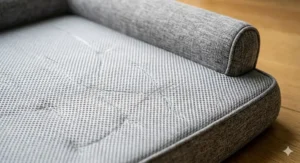
The Bedsure Cooling Blanket represents a fundamentally different approach to the cooling cat bed summer dilemma. Instead of gel, it uses Q-Max fabric technology — a textile that feels cool to the touch thanks to high thermal conductivity fibres. The Q-Max rating of >0.4 means it dissipates heat faster than standard polyester (which sits around 0.15-0.2 on the scale). In layman’s terms: your cat lies down, and the fabric instantly feels cooler than the surrounding air.
Sized at 76×102cm for the cat-specific model (Bedsure makes various sizes), this blanket works equally well draped over a sofa to protect furniture or placed inside a cat bed. The British advantage here is versatility — our homes tend to be smaller than American equivalents, so multi-functional pet products that don’t require dedicated storage space win big points. The fabric is machine washable at 30°C, crucial for maintaining hygiene through muddy autumn and dusty summer months alike.
Expert take: This is the premium choice for cat owners who care about aesthetics. The pearl grey or powder blue colourways blend into British living rooms far better than garish blue gel mats. It’s also genuinely soft — cats with sensitive skin or those recovering from surgery appreciate the gentle texture. However, the cooling effect is less dramatic than gel alternatives. You’re looking at a 2-3°C reduction rather than 5-10°C. For mild British summers (20-25°C), that’s often sufficient. For a proper heatwave, it’s underwhelming.
Customer feedback from UK reviews: “My cat actually sleeps ON this instead of clawing it to shreds like every other bed I’ve bought” and “Not as cold as I expected, but she loves it. Much better than those sticky gel mats.”
✅ Pros:
- Machine washable — a game-changer for UK pet owners dealing with damp paw prints
- Doubles as furniture protector
- Silky texture appeals to fussy cats
❌ Cons:
- Less dramatic cooling than gel mats
- Can slip on smooth surfaces (needs non-slip base)
Price verdict: Around £18-£30 depending on promotions. Available through Amazon.co.uk Prime. Higher upfront cost but longer lifespan than gel mats.
4. PetSol Miracle Cool Gel Mat (90×50cm)
The PetSol Cooling Mat is the workhorse option for British households with large cats, multiple felines, or a combination of cats and small dogs. At 90×50cm, it’s one of the largest non-toxic gel mats readily available on Amazon.co.uk, and the “Miracle Cool Gel” branding isn’t entirely hyperbole — the pressure-activated cooling gel maintains lower temperatures for longer than budget alternatives, typically 3-4 hours of continuous use before needing a recharge period.
The grey fabric exterior is a deliberate design choice for the UK market — darker colours absorb and radiate heat, making them less effective in conservatories or sunny spots, so PetSol’s neutral grey represents a sensible middle ground. The mat is rated for cats up to 8kg comfortably, though British Shorthairs and other chunky breeds have been known to monopolise the entire surface. The non-toxic gel formula uses similar ingredients to Trixie (water, carboxymethylcellulose, preservatives) but in a slightly higher concentration, which accounts for the extended cooling duration.
Expert take: This mat shines in scenarios where British cats spend time in glass-heavy environments — think conservatories, orangeries, or those modern extensions with floor-to-ceiling bi-fold doors. It’s also ideal for cat owners in upper-floor flats where heat rises and accumulates. The size means you can position it strategically in high-traffic areas, and multiple cats can benefit simultaneously. The downside is storage — when autumn arrives and you need to reclaim floor space, this beast is harder to tuck away than smaller alternatives.
Customer feedback from UK reviews: “Big enough for my Norwegian Forest cat to properly stretch out on” and “Stays cool even when my three cats all pile on top. Impressive.”
✅ Pros:
- Extra-large surface area perfect for British multi-cat households
- Waterproof backing protects floors from condensation (common in humid UK summers)
- Durable construction withstands heavy daily use
❌ Cons:
- Bulky and difficult to store during cooler months
- Takes longer to recharge (4-5 hours) than smaller gel mats
Price verdict: Typically £20-£28 on Amazon.co.uk. Good value per square centimetre for the surface area provided. Free delivery with Prime.
5. Scruffs Self-Cooling Mat
The Scruffs Self-Cooling Mat (60×50cm) represents British pet brand Scruffs’ entry into the cooling market, and it shows local design sensibilities throughout. The grey and cream chevron pattern looks decidedly more “Cotswolds cottage” than “American suburban”, and the self-cooling gel technology is calibrated for UK ambient temperatures rather than Texan summers. This means optimum performance in the 18-26°C range — precisely where most British homes sit during summer months.
What British buyers particularly appreciate is the brand’s understanding of our housing stock. The mat fits perfectly in standard cat carriers (useful for vet trips during hot weather), slots into the base of many popular UK cat bed brands, and the non-slip backing works on both carpet and hard flooring without the annoying sliding you get with cheaper imported alternatives. The cooling gel is encased in a robust polyester blend that’s held up well in UK user testing, with many owners reporting 2-3 years of daily use before deterioration.
Expert take: This is the pragmatic choice for British cat owners who value reliability over bells and whistles. It’s not the cheapest, not the largest, not the coldest — but it does everything competently. The mid-sized dimensions suit the average British Shorthair or moggy perfectly, and the gel recharge time (about 2 hours) aligns well with typical cat behaviour patterns. In practice, cats tend to use it for 2-3 hours, wander off for food or outdoor exploration, and return to find it refreshed. The brand’s UK-based customer service is a bonus when you need replacements or advice.
Customer feedback from UK reviews: “Finally, a pet product designed with British homes in mind. Fits my window sill perfectly” and “Survived two summers of daily use. My Ragdoll loves it.”
✅ Pros:
- UK brand with local customer service and returns
- Chevron design more aesthetically pleasing than bright blue alternatives
- Optimised for British temperature ranges
❌ Cons:
- Mid-range pricing without standout features
- Less widely available than Trixie or Bedsure
Price verdict: Around £12-£18 on Amazon.co.uk when in stock. Good mid-range option supporting a British brand.
6. Aqua Coolkeeper Cooling Mat
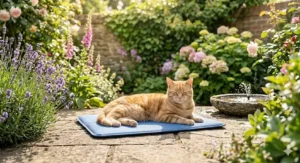
The Aqua Coolkeeper takes an entirely different approach to the cooling cat bed summer challenge — it uses water-activated HydroQuartz gel that requires soaking to activate. Immerse the mat in cold water for 10-15 minutes, and the gel crystals absorb and retain moisture, creating a cooling effect that manufacturer claims lasts up to five days. In British conditions (moderate temperatures, higher humidity), realistic expectations are 3-4 days of noticeable cooling before you need to re-soak.
This technology suits specific British scenarios brilliantly: cats who spend supervised time in conservatories, summer houses, or heated outbuildings during the day. It’s also excellent for long car journeys (those six-hour drives from London to Scotland for summer holidays) because once activated, the mat maintains its cooling properties without electricity or refrigeration. The various cheerful prints (raindrop patterns, paw prints, geometric designs) make it more visually appealing than utilitarian gel mats, though whether your cat appreciates the aesthetics is debatable.
Expert take: This is the premium solution for cat owners willing to put in the preparation work. The five-day cooling window (or three days realistically) means less frequent maintenance than pressure-activated mats, which need 2-4 hour recharge breaks. However, you’re trading convenience for longevity. Remembering to soak the mat every few days requires the kind of routine most British cat owners can manage, but it’s not as plug-and-play as alternatives. The mat also feels slightly damp to the touch when fully activated — not wet, just cool and moisture-laden — which some cats adore and others avoid entirely.
Customer feedback from UK reviews: “Brilliant for our cattery during the July heatwave. Five cats, three days straight of cooling” and “Works as advertised but my cat hates the damp feel. Waste of money for us.”
✅ Pros:
- Longest cooling duration of any mat reviewed (3-5 days)
- No electricity or continuous water supply needed
- Cheerful patterns suit British interior design trends
❌ Cons:
- Requires advance planning (10-15 minute soak time)
- Slightly damp texture off-putting to some cats
- Higher price point
Price verdict: Around £22-£35 depending on size. Premium pricing justified by extended cooling performance. Available through specialist UK pet retailers and some Amazon.co.uk sellers.
7. K&H Coolin’ Pet Pad
The K&H Coolin’ Pet Pad is an American import that’s gained a cult following amongst British cat owners despite longer delivery times and higher pricing due to transatlantic shipping. Unlike gel or fabric alternatives, this mat uses a water-filled chamber design — you fill it once with tap water, and it never needs refilling or recharging. The water absorbs your cat’s body heat and dissipates it into the surrounding air, creating a consistent cooling effect.
Sized from 28×43cm (small) to 51×91cm (extra-large), the K&H range covers everything from Siamese to Maine Coons. The antimicrobial materials prevent mildew growth — crucial in damp British climates where mould is an ever-present concern. The mat feels slightly squishy underfoot (or under-paw), similar to a waterbed, which some cats find off-putting initially but most adapt to within a few days. The BPA-free, non-toxic construction means even if claws puncture the outer layer, you’re not dealing with harmful chemical leakage.
Expert take: This represents the most durable option reviewed, with many UK owners reporting 4-5 years of continuous use before replacement. The water-based design means no gel degradation, no fabric wearing thin, no pressure-activated chemistry failing — just simple physics doing its job. However, it’s also the heaviest option (the large size weighs about 2kg when filled), making it impractical for moving between rooms or storing seasonally. Once you’ve positioned it, it stays put. The hand-wash-only cleaning requirement is another consideration for British owners accustomed to chucking pet bedding in the machine.
Customer feedback from UK reviews: “Worth the wait for import delivery. Four years and still going strong” and “Heavy but incredibly effective. My Persian lives on this from May to September.”
✅ Pros:
- Exceptional durability (4-5 year lifespan typical)
- No recharging or reactivation required ever
- Antimicrobial coating prevents British damp-related mould
❌ Cons:
- Import shipping adds 1-2 weeks to delivery time
- Heavier and less portable than gel alternatives
- Hand-wash only cleaning
Price verdict: Around £25-£45 depending on size, plus potential import duties on some orders. Premium pricing but longest lifespan justifies cost for committed cat owners. Sporadic availability on Amazon.co.uk.
How to Choose the Right Cooling Cat Bed Summer Solution for British Conditions
Choosing a cooling cat bed summer option for the UK market isn’t simply about transplanting American advice and hoping for the best — our climate, housing stock, and feline preferences require tailored consideration. British summers rarely sustain 35°C+ temperatures for more than a handful of days annually, but the combination of high humidity, poor ventilation in Victorian and Edwardian housing, and our cultural resistance to air conditioning creates unique challenges for keeping cats comfortable.
Start by assessing your cat’s baseline heat tolerance. Flat-faced breeds like Persians and British Shorthairs with dense double coats struggle more than sleek Oriental types or Sphynx cats. According to Cats Protection, older cats, kittens, and those with underlying health conditions also rank high-risk for heat stress. If your cat is panting, drooling, or seeking out tile floors and sinks during moderate temperatures (22-25°C), they need more aggressive cooling than a cat who happily sunbathes until thermometer hits 28°C.
Consider your housing type next. Ground-floor flats benefit from thermal mass keeping temperatures more stable, while top-floor conversions can be 5-8°C hotter due to rising heat and roof proximity. Homes with south-facing conservatories, orangeries, or large windows create microclimates that can exceed outdoor temperatures by 10-15°C — these spaces need water-activated or gel-based solutions rather than fabric cooling blankets. Stone cottages in rural areas often stay naturally cooler, potentially requiring only minimal intervention like a basic cooling mat for afternoon naps.
The gel-versus-fabric debate hinges on maintenance tolerance. Pressure-activated gel mats require 2-4 hour recharge breaks but offer more dramatic cooling (5-10°C reduction). Fabric cooling blankets work continuously but provide gentler effects (2-3°C reduction) and demand machine washing every 1-2 weeks during heavy use. British cat owners juggling work, children, and general life chaos often find fabric options more practical, while retirees or work-from-home professionals can manage gel mat rotation more easily. Water-activated mats like Aqua Coolkeeper suit organised personalities willing to establish a soaking schedule.
Budget considerations in the UK market differ from American guidance because import duties post-Brexit have increased prices on many pet products by 15-25%. A Trixie mat at £12 represents genuine budget territory, Bedsure at £18-£30 occupies mid-range, and K&H imports at £35-£45 signal premium investment. Calculate cost-per-summer-season: a £12 Trixie mat lasting two summers (£6 annually) versus a £40 K&H pad lasting five summers (£8 annually) makes the premium option better value long-term. Factor in British consumer protection laws too — faulty products bought from Amazon.co.uk sellers enjoy 30-day returns minimum, often 60 days, versus the hassle of international returns on direct American imports.
Size matters more than marketing suggests. British cats average 4-5kg (smaller than American domestic cats at 5-6kg), meaning oversized mats intended for Labradors get marketed to cat owners unnecessarily. A 40×50cm mat accommodates most British moggies comfortably. Only Maine Coons, Norwegian Forest Cats, or multi-cat households need 60×90cm+ options. Bigger isn’t better when you’re trying to manoeuvre a gel mat into storage come October or fit it into a London flat’s limited floor space.
Finally, match the cooling solution to seasonal reality. British summers oscillate between “mildly warm and pleasant” (20-24°C) and “brief but intense heatwave” (28-32°C for 3-7 days). You need cooling options that scale: a fabric cooling blanket handles the former, while keeping a gel mat in reserve for the latter provides flexibility without overspending on industrial-strength pet air conditioning you’ll use thrice yearly.
Real-World Scenarios: Which Cooling Cat Bed Summer Works for Different UK Cat Owners
Scenario 1: London Flat Dweller (3rd Floor, South-Facing)
Emma lives in a Clapham conversion flat with her British Shorthair, Winston. Her third-floor living room reaches 29-31°C during July afternoons despite blackout curtains. Winston pants and drools by 2pm, refusing to eat or play until evening.
Solution: The Bedsure Cooling Blanket (76×102cm) draped over the sofa creates a cool refuge. Emma positions a fan nearby to enhance evaporative cooling, and Winston spends 3-4pm sprawled across it daily. The machine-washable fabric tolerates weekly cleaning, essential when Winston tracks city dust and pigeon feathers through the cat flap. Total cost: £25. Backup option: a £12 Trixie Cooling Mat (40×30cm) in the bedroom for night-time relief when temperatures stay above 22°C.
Budget: £37 total. Lifespan: 3+ summers for Bedsure, 2 summers for Trixie.
Scenario 2: Suburban Semi-Detached in Birmingham (Two Cats)
Rajesh and Maya have two rescue moggies, Mango and Chutney, in a 1930s semi with a small conservatory extension. The conservatory hits 35°C+ during sunny days despite ventilation, but the cats love sleeping on the wicker furniture there. Mango (7kg) dominates any small mat, leaving Chutney (4kg) overheated and grumpy.
Solution: The PetSol Miracle Cool Gel Mat (90×50cm) placed on the conservatory floor accommodates both cats simultaneously. Its large surface area prevents squabbles, and the waterproof backing protects the Victorian tiled floor from condensation. Rajesh also invested in a second Nobleza Gel Pad (50×65cm) for the main living room, giving the cats options. Total cost: £45 for both mats.
Budget: £45 total. Strategy: Rotate mats every 3 hours to maintain cooling effectiveness.
Scenario 3: Rural Cottage in the Cotswolds (Elderly Persian)
Philippa’s 14-year-old Persian, Lady Marmalade, suffers from chronic kidney disease and poor temperature regulation. Their stone cottage stays relatively cool (18-22°C), but brief heatwaves send Lady M’s breathing laboured and rapid. Philippa wants a reliable, long-term solution requiring minimal faffing.
Solution: The K&H Coolin’ Pet Pad (medium, 38×48cm) positioned in Lady M’s favourite armchair corner. The one-time water fill and antimicrobial coating suit Philippa’s preference for low-maintenance pet care. The consistent cooling helps Lady M through bad days without requiring Philippa to remember recharging schedules. The investment (£28 including delivery from a UK Amazon seller) is justified by the pad’s projected 5-year lifespan and her vet’s recommendation.
Budget: £28. Long-term investment for a high-needs senior cat.
Cooling Cat Bed Summer vs Traditional Cat Bed: What British Owners Need to Know
| Feature | Cooling Cat Bed Summer | Traditional Cat Bed | British Climate Suitability |
|---|---|---|---|
| Temperature Regulation | Active cooling (2-10°C reduction) | Passive insulation | Cooling wins in 25°C+ conditions |
| Year-Round Use | Summer only (May-Sept typically) | All seasons | Traditional better value overall |
| Storage Requirements | Must store when not in use | Permanent fixture | Traditional suits smaller UK homes |
| Machine Washable | Fabric types yes, gel types no | Usually yes | Traditional easier to maintain |
| Durability | 2-5 years depending on type | 3-7 years average | Traditional longer lifespan |
| UK Climate Optimisation | Designed for heat relief | Designed for warmth/comfort | Neither perfect for British variability |
Analysis: Traditional cat beds excel in the 8-9 months of the year when British temperatures sit between 5-20°C — they provide warmth, comfort, and psychological security. Cooling solutions earn their keep during the 3-4 months when temperatures exceed 22°C and humidity makes traditional beds uncomfortable. The ideal British cat owner strategy involves both: a plush, insulated bed for autumn/winter/spring, and a cooling mat for summer. This dual approach costs £40-£60 total (budget traditional bed £15-£20, mid-range cooling mat £20-£30) but addresses the full climatic range our schizophrenic British weather throws at us. Attempting to use a cooling mat year-round in Manchester’s damp October would leave your cat shivering and resentful.
Common Mistakes When Buying Cooling Cat Beds for British Summers
Mistake 1: Assuming Bigger Is Always Better
British homes average 76 square metres compared to American homes at 201 square metres — we simply don’t have floor space for enormous pet products. A 90×120cm cooling mat intended for Great Danes looks absurd in a Croydon terraced house living room and your 4kg tabby will use 20% of it. Right-size your purchase: measure your cat from nose to tail tip while stretched, add 10cm, and that’s your mat length requirement. Width should accommodate their body plus 5cm each side. A British Shorthair (45cm long, 25cm wide when lying down) needs 55×35cm minimum, not the 90×60cm behemoth Amazon algorithms suggest.
Mistake 2: Ignoring British Humidity Levels
American cooling mat reviews rave about performance in Arizona’s dry heat (10-20% humidity). British summers hover around 60-80% humidity, which dramatically impacts cooling efficiency. Gel mats struggle to dissipate heat when ambient air is already moisture-saturated, reducing their effectiveness by 30-40% compared to dry conditions. This doesn’t mean they don’t work — they do — but expecting the same dramatic cooling UK reviewers report from the Southwestern US sets you up for disappointment. Fabric cooling blankets actually perform better in humid conditions because they don’t rely on evaporative cooling.
Mistake 3: Buying American Products Without Checking UK Compatibility
The K&H pad’s water-fill system uses American measurements and instructions referencing Fahrenheit temperatures. Some imported cooling beds arrive with US-style plugs if they include heating/cooling elements. Always verify you’re buying from Amazon.co.uk’s UK warehouse, not having items shipped from American warehouses with 2-3 week delivery and potential customs charges (VAT plus handling fees can add 25-30% to the base price). Check product descriptions for “despatched from and sold by Amazon UK” confirmation.
Mistake 4: Placing Mats in Direct Sunlight
This seems obvious, yet conservatory owners do it constantly. Gel mats placed on south-facing window sills or glass-floored orangeries absorb solar radiation, heating the gel instead of cooling it. The mat becomes actively warm (28-32°C) rather than cool (15-18°C). Position cooling mats in shaded areas with good airflow — north-facing rooms, under furniture creating natural shade, or in hallways where cross-breeze occurs. The exception is fabric cooling blankets, which handle indirect sunlight better than gel alternatives, though direct sun still compromises performance.
Mistake 5: Expecting Permanent Solutions from Budget Products
A £10 Trixie mat won’t survive five British summers unless your cat is geriatric and sedentary. Budget options use thinner polyester (1.5-2mm) that British cat claws penetrate within 12-24 months of regular use. This isn’t poor quality — it’s appropriate lifespan for the price point. Plan on replacing budget cooling mats every 1-2 summers, or invest £35-£45 in premium options (K&H, Aqua Coolkeeper) designed for 4-5 year lifecycles. The maths favours budget replacement for casual users, premium investment for dedicated cat owners.
Mistake 6: Forgetting UK Consumer Rights
British consumer law (Consumer Rights Act 2015) offers stronger protection than American equivalents. Cooling mats purchased from Amazon.co.uk sellers must be fit for purpose, as described, and of satisfactory quality. If your £25 cooling mat springs a leak after three weeks, you’re entitled to repair, replacement, or refund within the first six months automatically, and up to six years if you can demonstrate the fault existed at purchase. Many British buyers don’t exercise these rights, suffering with defective products or writing negative reviews instead of demanding the refund they’re legally owed. Document issues with photos, contact Amazon’s A-Z Guarantee within 30 days, and don’t accept “manufacturer warranty only” deflections from third-party sellers.
Long-Term Cost Analysis: What British Cat Owners Actually Spend
Budget Approach (Trixie Replacement Strategy)
- Year 1: Trixie 50×40cm mat — £12
- Year 2: Replace damaged Trixie — £12
- Year 3: Replace degraded Trixie — £12
- Year 4: Replace worn Trixie — £12
- Year 5: Replace deteriorated Trixie — £12
- 5-Year Total: £60
Analysis: Predictable, manageable costs spread evenly. Suits budget-conscious owners willing to sacrifice durability for affordability. The time investment of researching replacements, processing orders, and disposing of old mats adds hidden cost in convenience.
Mid-Range Approach (Bedsure + Backup)
- Year 1: Bedsure Cooling Blanket (76×102cm) — £28
- Year 2: No purchases needed
- Year 3: Trixie backup mat for heatwaves — £12
- Year 4: No purchases needed
- Year 5: Replace Bedsure (showing wear) — £28
- 5-Year Total: £68
Analysis: Slightly higher total cost but better value. The Bedsure’s 3-year lifespan reduces replacement frequency, and its machine-washable nature maintains hygiene without disposable expenses. The Trixie backup provides redundancy during those rare 32°C+ days when one cooling surface isn’t sufficient.
Premium Approach (K&H Investment)
- Year 1: K&H Coolin’ Pet Pad (38×48cm) — £35
- Year 2-5: No purchases needed
- 5-Year Total: £35
Analysis: Lowest total cost and least hassle. The K&H’s durability eliminates replacement cycles entirely within the five-year window, and the water-filled design never degrades like gel. The upfront investment feels steep to budget-shoppers, but the maths doesn’t lie. This assumes no punctures from aggressive clawing — rare with K&H’s robust construction but not impossible.
Optimal British Strategy (Hybrid Approach)
- Year 1: Bedsure Blanket (£28) + Trixie backup (£12) — £40
- Year 3: Replace Trixie — £12
- Year 5: Replace worn Trixie — £12
- 5-Year Total: £64
Analysis: Balances cost, convenience, and redundancy. The Bedsure handles 80% of cooling needs across three summers while Trixie provides backup during exceptional heat. Both products cover different use cases (Bedsure for sofa protection, Trixie for bed/carrier), justifying the dual purchase. This strategy reflects how most British cat owners actually behave rather than theoretical “perfect” solutions.
What to Expect: Real-World Performance in British Summer Conditions
Temperature claims on cooling mat packaging rarely reflect British reality. A mat promising “cools up to 15°C below body temperature!” is referencing laboratory conditions (controlled humidity, specific ambient temperature, standardised weight distribution) that your moggy violates the moment they flop down unevenly or the July humidity hits 75%. Here’s what actually happens in British homes:
Week 1 (June, 22-25°C): Your gel mat feels noticeably cool to the touch, reducing surface temperature from ambient 23°C to approximately 17-18°C. Your cat discovers it immediately, spending 2-3 hours enjoying the novelty before wandering off. The mat recharges in 90 minutes during this temperature range. You’re delighted and wonder why you waited so long to buy one.
Week 3 (Late June, 26-28°C): Performance remains strong but recharge time extends to 2-3 hours. Your cat’s usage pattern settles into a routine: morning nap on the mat, lunch break elsewhere, afternoon return to the mat. The cooling effect now brings surface temperature down to 20-21°C — still pleasant but less dramatic. You position a fan nearby to enhance evaporative cooling, which helps marginally.
Week 5 (July Heatwave, 30-32°C): This is where most British cooling mats struggle. The combination of high ambient temperature and elevated humidity (65-75%) taxes the gel’s cooling capacity. Surface temperature drops to 25-26°C — technically cooler than ambient but only just. Your cat still uses it preferentially over uncooled surfaces (carpet at 28°C, tile at 27°C), but they also seek out sinks, bathtubs, and tile floors as alternatives. The mat requires 4-5 hour recharge breaks, meaning you need backup options or a rotation system. You briefly consider emigrating to Scotland.
Week 8 (August Return to Normal, 23-25°C): Performance bounces back to Week 3 levels. The gel has proven durable through the worst of summer, and your cat’s established routine continues. You’re calculating whether the £25 investment was worth it — probably yes, given the three weeks of measurable comfort during borderline-unpleasant conditions, plus the knowledge you can repeat this next summer for minimal additional cost.
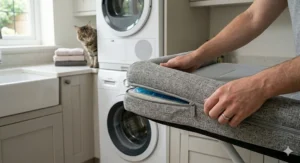
Month 6 (September Cool-Down, 18-20°C): The cooling mat sits unused as your cat rediscovers their plush winter bed. You consider leaving the mat out year-round but decide storage is smarter — keeps it clean, extends lifespan, and frees up floor space. You rinse it according to manufacturer instructions, dry it completely to prevent mould (crucial in British dampness), and tuck it into a cupboard until next April when you’ll forget you own it until temperatures hit 24°C and you remember frantically.
This cycle repeats annually with slight variations depending on summer severity. The British summer cooling cat bed experience is fundamentally about marginal gains — making 28°C feel like 24°C rather than transforming your living room into an arctic paradise. Set expectations accordingly and you’ll be satisfied.
UK Regulations, Safety Standards & What British Cat Owners Should Know
British pet products fall under several regulatory frameworks that differ from pre-Brexit EU rules and certainly from American standards. Understanding these helps you make informed purchases and know your rights when products fail to perform.
UKCA Marking (UK Conformity Assessed): Since January 2023, pet products sold in Great Britain must carry UKCA marking if they fall under regulated categories. Cooling mats generally don’t require this unless they contain electrical components (heated/cooled beds using mains power). However, fabric cooling blankets claiming antimicrobial properties must demonstrate compliance with chemical safety regulations. The absence of UKCA marking on a mains-powered cooling bed signals either: (a) it’s Northern Ireland-only (which uses CE marking still), (b) it predates the requirement, or (c) it’s non-compliant. Avoid option (c).
Product Safety Standards: The Product Safety and Metrology Act 2022 places responsibility on manufacturers and importers to ensure pet products are safe. Cooling mats must use non-toxic materials, withstand reasonably foreseeable use (cat claws, moisture), and not pose fire/chemical hazards. The gel formulations in Trixie, Nobleza, and K&H mats use water, glycerol, and carboxymethylcellulose sodium — all non-toxic to cats even if ingested in small quantities post-puncture. However, no gel mat should be left with cats unsupervised if they’re known chewers or have pica (eating non-food items).
Consumer Rights Act 2015: Your strongest protection. Pet products must be: (1) of satisfactory quality, (2) fit for purpose, and (3) as described. If a cooling mat develops leaks within the first month, that’s not satisfactory quality. If it doesn’t cool at all, it’s not fit for purpose. If Amazon listing claims “lasts 5 years” but it degrades in 6 months, it’s not as described. You have automatic rights to repair, replacement, or refund within the first six months, and potentially up to six years for inherent defects. This far exceeds American consumer protection and represents one of the few advantages of higher UK prices.
Trading Standards & ASA Compliance: Cooling mat marketing claims must be substantiated. If a product claims “reduces temperature by 10°C,” that must be demonstrable in testing. The Advertising Standards Authority investigates misleading claims, though enforcement is reactive (complaint-driven) rather than proactive. When you see “clinically proven” or “vet recommended” on pet cooling products, those phrases trigger ASA scrutiny requiring actual clinical studies or veterinary endorsements. Most Amazon sellers carefully avoid such language, opting instead for vaguer “helps keep pets cool” phrasing.
Fire Safety: While rare, cooling mats have been linked to fires when positioned near heat sources. The British Standard BS 5852 governs flammability of domestic furniture, and while it doesn’t specifically cover pet beds, conscientious manufacturers test to similar standards. Never place cooling mats near radiators, electric heaters, or in direct sunlight through windows with magnifying effects. The gel itself isn’t flammable, but polyester outer layers can melt or catch fire at 250-280°C — achievable in a conservatory if sunlight concentrates through curved glass.
Disposal: Cooling mats containing gel require proper disposal when life expires. Don’t bin them with regular rubbish if the gel has leaked — the mixture can contaminate landfill. Instead, drain any liquid gel into a sealed container and dispose via your local council’s chemical waste collection (most offer quarterly household chemical collection days). The polyester fabric can then go in general waste. Water-based K&H pads are simpler — drain the water into your sink, recycle the outer fabric if possible (check with council), and dispose of any non-recyclable components normally.
Frequently Asked Questions About Cooling Cat Beds in the UK
❓ Do cooling cat mats actually work in British summer humidity?
❓ How long do pressure-activated cooling mats last in UK homes?
❓ Can I use a cooling mat designed for dogs on my cat?
❓ Are cooling mats safe for kittens and elderly cats in UK temperatures?
❓ What's the best cooling mat for British cats who spend time in conservatories?
Conclusion: Making Summer Comfortable for British Cats
The cooling cat bed summer market has matured significantly in recent years, giving British cat owners reliable options that actually deliver measurable comfort during increasingly warm summers. The choice between gel, fabric, or water-based cooling fundamentally depends on your specific circumstances: gel mats suit budget-conscious owners willing to manage recharge cycles; fabric blankets appeal to those prioritising aesthetics and machine washability; water-based premium options reward long-term thinkers who value durability over initial cost savings.
What British cat owners mustn’t do is assume our relatively mild summers don’t warrant cooling solutions. The combination of high humidity, poor ventilation in period housing, and our cats’ limited natural cooling mechanisms makes even 25-28°C temperatures potentially dangerous for flat-faced breeds, elderly cats, and those with underlying health conditions. A £12-£45 investment in a proper cooling mat — used strategically during the 3-4 months when temperatures exceed 22°C — provides genuine health benefits while improving your cat’s quality of life measurably.
The products reviewed here represent the best currently available on Amazon.co.uk with reliable delivery, fair pricing, and demonstrated performance in British conditions. Whether you choose the budget-friendly Trixie Cooling Mat, the versatile Bedsure Cooling Blanket, or the premium K&H Coolin’ Pet Pad, you’re investing in your cat’s comfort during those increasingly common heatwaves that seem to arrive every British summer without fail. Pair your cooling mat with shaded areas, multiple water stations, and the common sense to check sheds and conservatories before locking them up, and your feline friend will weather summer’s worst with feline dignity intact.
Recommended for You
- 7 Best Memory Foam Cat Beds UK 2026: Senior Cats Love These
- 7 Best Window Cat Beds UK 2026 – Safety Tested & Reviewed
- 7 Best Enclosed Cat Bed for Anxious Cats UK 2026
Disclaimer: This article contains affiliate links. As an Amazon Associate, I earn from qualifying purchases. If you purchase products through these links, we may earn a small commission at no additional cost to you.
✨ Found this helpful? Share it with your mates! 💬🤗
