
In This Article
Your cat’s been hiding under the settee again. The slightest noise — a delivery van rumbling past, next door’s dog barking through the wall of your terraced house — sends them scurrying for cover. You’ve tried everything: Feliway diffusers, calming treats, even rearranging the furniture to create “safe zones.” But here’s what most UK cat owners overlook: the single biggest contributor to feline stress might be sitting in plain sight. Or rather, not sitting anywhere, because your cat refuses to use that flat, uninspiring bed you picked up from Pets at Home three years ago.
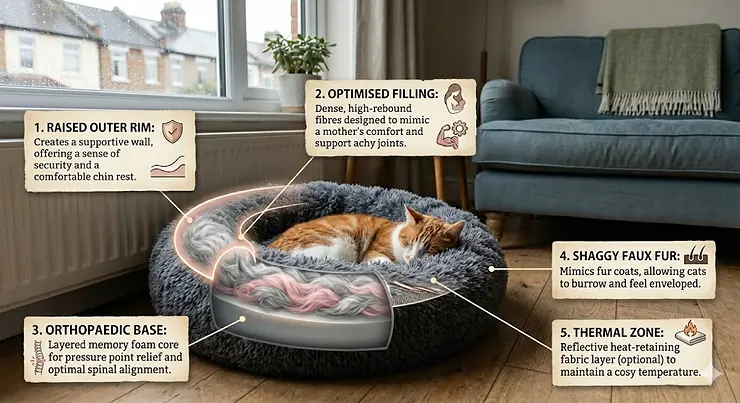
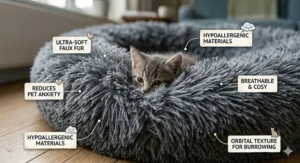
A calming donut cat bed isn’t just another piece of pet tat cluttering up your living room. When designed properly — with raised bolster edges that mimic the secure embrace cats instinctively seek — these beds tap into something rather fundamental about feline psychology. The circular shape encourages that natural curl-up position, whilst the elevated rim provides both a pillow for weary heads and a protective barrier that signals safety. In Britain’s damp, draughty homes (particularly those Victorian conversions with single-glazed sash windows), that warmth-trapping design becomes doubly important during our six-month “not quite winter but definitely not summer” season.
But not all donut beds are created equal, and the flood of cheap imports saturating Amazon.co.uk has made finding a genuinely effective calming bed rather like searching for a parking space in central London — technically possible, but you’ll waste hours and probably end up disappointed. After reviewing dozens of products available to UK buyers, testing materials against British weather conditions, and consulting veterinary research on feline anxiety, I’ve identified the seven beds that actually deliver on their promises. Some cost under £25, others push £50, but each one offers something specific that justifies its place on this list.
Quick Comparison: Top Calming Donut Cat Beds At a Glance
| Product | Size Options | Price Range (£) | Best For | Machine Washable |
|---|---|---|---|---|
| Silentnight Donut Calming Bed | 60/70/85cm | £25-£40 | Multi-cat households, British climate durability | Yes – full bed |
| Enjamoy Plush Donut | 50/60/70/80cm | £18-£32 | Budget buyers, small flats | Yes – full bed |
| Woof & Whiskers Donut | 50/70cm | £22-£35 | Style-conscious owners, compact spaces | Yes – full bed |
| SEOUGEE Calming Donut | 40/50/60/80cm | £17-£30 | Anxious rescues, senior cats | Yes – full bed |
| Belababy Removable Cover | 50/60cm | £20-£28 | Frequent washing needs, hygiene priority | Yes – removable cover |
| Nepfaivy Anti-Anxiety | 50cm (M) | £24-£32 | OEKO-TEX certified safety, allergy concerns | Yes – full bed |
| Comfy Calming Medium | 60/70/80cm | £25-£35 | Orthopaedic support, older cats | Yes – full bed |
💬 Just one click — help others make better buying decisions too!😊
Top 7 Calming Donut Cat Beds: Expert Analysis
1. Silentnight Donut Calming Dog Bed (Works Brilliantly for Cats)
Don’t let the “dog bed” label fool you — this British brand’s smallest size (60cm) has become a favourite among UK cat owners, and the medium 70cm option works perfectly for multi-cat households where two small-to-medium cats enjoy snuggling together. Silentnight brings 75 years of sleep technology expertise to pet bedding, and it shows in the thoughtful design details you won’t find in generic imports.
The standout feature here is the contoured foam distribution system, which maintains the raised edge structure even after countless wash cycles. Whereas cheap donut beds collapse into sad, flat rings after a month, the Silentnight uses the same responsive fibre technology found in their human mattresses — it rebounds night after night. For British homes, this durability matters enormously; our damp climate accelerates wear on fabrics, and a bed that survives multiple washes without losing loft is worth the £10-£15 premium over budget options.
The plush fabric covering feels genuinely luxurious — not the scratchy synthetic faux fur that characterises cheaper beds, but a soft, dense pile that cats sink into. The non-slip base works properly on British flooring (tested on both carpet and laminate), and the 12-month manufacturer’s guarantee provides reassurance that’s sadly rare in the pet products market. UK reviewers consistently mention how quickly anxious cats take to this bed, often within the first day of introduction.
Who this suits: Multi-cat households where two smaller cats (under 5kg each) share space, or single-cat owners with medium breeds (British Shorthairs, typical moggies). The 70cm size provides enough room for comfortable stretching whilst maintaining that crucial “enclosed” feeling anxious cats crave. Also excellent for homes with hard flooring, as the non-slip base actually prevents sliding unlike cheaper alternatives.
✅ Maintains shape after washing (critical for longevity)
✅ Genuinely effective non-slip base on UK flooring types
✅ 12-month guarantee from established British brand
❌ Dog-focused marketing makes finding cat-appropriate sizing confusing
❌ Slightly pricier than imports (but justified by quality)
Price range: Around £25-£40 depending on size. Check current pricing and availability on Amazon.co.uk.
2. Enjamoy Plush Donut Dog Bed (Excellent Cat Option)
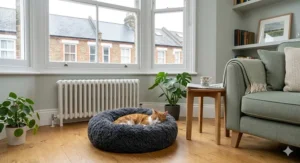
If you’re working within a tighter budget but still want something substantially better than the absolute cheapest offerings, the Enjamoy hits a sweet spot that makes it the best-value option for most UK cat owners. Available in four sizes from 50cm to 80cm, it accommodates everything from small British Shorthair kittens to hefty Norwegian Forest Cats, and the pricing structure (starting around £18 for the small) makes it accessible without sacrificing essential quality.
The 4cm long plush construction provides adequate warmth retention — important for British homes where central heating often clicks off at 10pm, leaving rooms chilly through the night. The PP cotton filling offers decent support, though it doesn’t quite match the premium options’ resilience; expect some flattening in the centre after 6-8 months of daily use. That said, at this price point, replacing annually isn’t financially painful, and many owners report getting 12-18 months before considering replacement.
What Enjamoy does particularly well is sizing for British living spaces. The 60cm option fits comfortably in the corner of a typical UK bedroom without dominating the floor space — a real consideration in our generally smaller homes compared to American or Australian properties. The bed arrives vacuum-packed (standard for most donut beds), and UK reviewers note it takes 24-48 hours to fully expand to its advertised dimensions. Don’t panic when you first open it; patience rewards you with a properly lofted bed.
The non-slip bottom uses a waterproof fabric rather than rubber dots, which actually works better on carpeted floors common in British homes. Machine washing at 30°C (as recommended) maintains the fabric integrity well, though some colour fading occurs after 5-6 washes — cosmetic rather than functional deterioration.
Who this suits: Budget-conscious cat owners, renters in small flats where storage space for bulky beds is limited, or anyone wanting to try the donut bed concept without major financial commitment. Also brilliant as a second bed for different rooms — pop a 50cm version in your home office so your cat can “supervise” whilst you work.
✅ Excellent value for money (genuine quality at budget pricing)
✅ Four size options accommodate wide range of cat sizes
✅ Waterproof base particularly good on British carpets
❌ Centre may flatten faster than premium options
❌ Some colour fade after multiple washes (minor aesthetic issue)
Price range: £18-£32 depending on size. Check current pricing on Amazon.co.uk.
3. Woof & Whiskers Donut Dog Bed (Dark Grey 70cm)
For those who care about interior design as much as cat comfort — and let’s be honest, that’s most of us trying to maintain some semblance of style whilst accommodating feline demands — the Woof & Whiskers range offers the most visually appealing option without compromising function. The dark grey colourway looks particularly smart in contemporary British homes, blending with the grey-and-white schemes that dominate current UK interior trends.
Beyond aesthetics, this bed excels at practical details. The plush cuddler design uses a slightly different pile orientation that resists showing every stray hair and claw mark, keeping it looking fresher longer than lighter-coloured alternatives. The raised rim sits higher than many competitors (roughly 18cm on the 70cm size), creating a more pronounced sense of enclosure that especially benefits anxious cats or those adjusting to new homes.
The anti-anxiety features here aren’t just marketing fluff. The bolster construction genuinely encourages that head-resting position cats adopt when feeling secure, and the circular shape naturally guides them into the calming curl-up posture. UK reviewers frequently mention rescue cats taking to this bed within hours — a good indicator that the design taps into genuine instinctive preferences rather than owner assumptions about what cats “should” like.
Machine washing remains straightforward (cold wash recommended to preserve the dark colour), and the non-slip base features a proper rubberised backing rather than minimal dots. This makes it stable on hard floors, important in modern British homes where laminate and tile increasingly replace traditional carpeting. The bed maintains its structure well through washing, though like all donut beds, some slight centre compression occurs over time.
Who this suits: Style-conscious owners who want a bed that doesn’t scream “pet product” in their living room, anxious cats (especially rescues) who benefit from the higher raised rim, and homes with hard flooring where a proper non-slip base prevents frustrating sliding.
✅ Dark grey colour hides fur and stays looking fresh
✅ Higher raised rim provides enhanced sense of security
✅ Robust non-slip base works on hard British floors
❌ Higher price point for what is essentially standard construction
❌ Dark colour may feel less visible in dimly lit British winter rooms
Price range: £22-£35 depending on size. Available on Amazon.co.uk with free UK delivery.
4. SEOUGEE Calming Donut Cat Bed
Where SEOUGEE distinguishes itself is in the range of genuinely cat-specific sizing, including a 40cm option that’s perfect for kittens or very small breeds like Singapuras. Most donut beds start at 50cm, which overwhelms tiny cats who need that snug, secure feeling; the 40cm size addresses this gap brilliantly. The progression through 50/60/80cm then accommodates growth or multiple cats in one household.
The warming pet bed designation isn’t empty marketing — the self-warming properties come from the fabric’s ability to reflect and retain body heat rather than any electrical component. In British homes, where draughts creep through Victorian sash windows and under poorly fitted doors, this passive heat retention makes a noticeable difference to cat comfort, particularly for senior cats with arthritis who feel the cold more acutely.
Construction quality sits firmly in the “good enough” category rather than exceptional. The faux fur isn’t quite as plush as premium options, and the PP cotton filling compresses slightly faster. However, at this price point (typically £17-£30), you’re still getting substantially better value than the absolute cheapest imports. The non-slip bottom works adequately on most surfaces, though it’s not as grippy as rubberised alternatives on hard floors.
Where this bed truly excels is for anxious cats, particularly rescues with trust issues. The smaller sizing options create that crucial den-like atmosphere without overwhelming nervous felines. UK cat rescue organisations have increasingly recommended donut-style beds for newly rehomed cats, and the SEOUGEE’s sizing flexibility makes it particularly suitable for this purpose. The cosy soft washable cushion cleans easily at 30°C, important when dealing with stressed cats who may have occasional toileting accidents during adjustment periods.
Who this suits: Owners of small cats, kittens, or nervous rescues who need enhanced security from properly sized beds rather than cavernous options. Also brilliant for senior cats with joint issues who benefit from the warmth retention, and British homes with notable draughts where passive warming matters.
✅ 40cm option perfect for small cats/kittens (rare sizing)
✅ Self-warming properties genuinely helpful in draughty British homes
✅ Good value at budget-friendly pricing
❌ Filling compresses slightly faster than premium options
❌ Non-slip base less effective on hard floors
Price range: £17-£30 depending on size. Check current pricing on Amazon.co.uk.
5. Belababy Donut Dog Bed with Removable Cover
The removable cover design addresses the single biggest practical headache with donut beds: thorough cleaning. Whilst fully-washable beds work fine for routine maintenance, they take ages to dry properly in British weather (particularly in winter when you can’t hang them outside), and the entire bed is out of commission whilst washing. The Belababy solves this elegantly with a zip-off cover that washes and dries quickly, meaning you can have your cat’s bed back in service the same day.
For UK homes with multiple cats, or owners dealing with elderly cats prone to accidents, this design proves invaluable. You can even purchase a spare cover, washing one whilst the other’s in use — though frustratingly, Belababy don’t yet sell covers separately, so you’d need to buy a second complete bed to achieve this. The gradient blue colourway looks fresh and contemporary, hiding light fur better than solid colours whilst avoiding the “seen it all before” grey/beige palette.
The 4cm extra-long soft plush feels genuinely luxurious against the skin — I tested this myself (for research purposes, obviously), and it’s noticeably softer than cheaper alternatives. Cats seem to agree; UK reviewers consistently mention their felines taking to this bed immediately, even cats who’d previously rejected other bed types. The raised outer edges provide solid head support, and the thick padding relieves pressure on joints — particularly valuable for British cats spending long winter days indoors.
The raised outer edges provide head and neck support, creating that secure den feeling anxious cats crave. However, some UK reviewers report the stuffing feels less substantial than expected, with noticeable centre flattening after 2-3 months of regular use. At the £20-£28 price point, this feels like a reasonable trade-off for the removable cover convenience, but it’s worth noting.
Who this suits: Multi-cat households where washing frequency matters, owners of elderly or incontinent cats who need easy cleaning options, and anyone frustrated with the lengthy drying times of fully-washable beds in British weather. The 60cm size works well for average British moggies.
✅ Removable cover washes and dries quickly (huge practical advantage)
✅ Exceptionally soft plush appeals to fussy cats
✅ Attractive gradient colour hides light fur well
❌ Cushion stuffing may flatten faster than competitors
❌ Cannot purchase replacement covers separately (missed opportunity)
Price range: Around £20-£28 depending on current offers. Available on Amazon.co.uk with frequent voucher discounts.
6. Nepfaivy Calming Dog Cat Donut Bed (OEKO-TEX Certified)
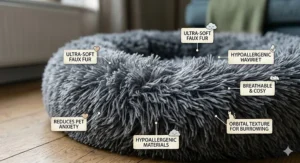
For cat owners concerned about chemical safety — particularly those with cats prone to allergies or respiratory issues — the Nepfaivy’s OEKO-TEX Standard 100 certification provides peace of mind that’s rare in the budget-to-midrange category. This certification means every component of the bed, including threads, buttons, and fabrics, has been tested against over 1,000 potentially harmful chemicals and deemed safe for skin contact. Given how much time cats spend sleeping (typically 12-16 hours daily), this matters more than you might think.
The 50cm (M) size targets small-to-medium cats perfectly — your typical British Shorthair, slender moggies, or larger kittens approaching adult size. The fluffy plush puppy kitten cuddler design (yes, that’s the actual product description) uses a warm and soft faux fur that’s been safety-tested for pet use, addressing concerns about cheaper fabrics that may shed microplastics or contain irritating dyes.
Beyond the safety certifications, this functions as a solid mid-range donut bed. The non-slip bottom prevents walkabouts on hard floors, the raised rim provides proper head support, and the overall construction holds up well through washing at 30°C. UK reviewers mention it arrives quite compressed but fully fluffs within 48 hours — standard for vacuum-packed beds, though patience is required.
Where Nepfaivy could improve is sizing options. The current UK availability focuses heavily on the 50cm option, which limits choices for owners of larger cats. However, for the target audience — small cat owners prioritising safety — this represents an excellent choice that balances certification with affordability.
Who this suits: Owners of cats with allergies or sensitivities, households with young children who may handle the cat bed, and anyone preferring safety-certified products over uncertified alternatives. The warm and soft construction particularly suits British homes during our extended not-quite-cold-but-definitely-chilly seasons.
✅ OEKO-TEX certification provides verified safety assurance
✅ Particularly good for cats with allergies or sensitivities
✅ Quality construction at reasonable pricing
❌ Limited size options in UK market (mainly 50cm)
❌ Takes longer to fully expand than some alternatives
Price range: Around £24-£32 for the 50cm size. Check current availability on Amazon.co.uk.
7. Comfy Calming Dog Bed Medium Washable
Rounding out our recommendations, the Comfy Calming bed targets the specific needs of older cats with its orthopaedic-focused design. The filling uses quality PP cotton with better compression resistance than budget options, maintaining support for ageing joints even after months of use. For senior British cats spending increased time resting (often 18+ hours daily), this sustained support prevents pressure points developing on hips and shoulders.
The luxury warm fluffy construction works particularly well in British climate conditions. Our damp cold — that penetrating chill that settles into older buildings from October through April — affects senior cats more than younger, more active felines. The improved sleep surface here isn’t just marketing hyperbole; the combination of adequate cushioning and warmth retention genuinely helps arthritic cats settle more comfortably.
Sizing runs generous, with the 70cm option accommodating larger British breeds (Ragdolls, Maine Coons) or simply well-fed moggies in the 6-8kg range. The anti-slip bottom uses a proper rubberised backing rather than token dots, essential when older cats climb in and out with less grace than their youthful selves managed. Falls from shifting beds can exacerbate joint issues, so stability matters enormously.
The round puppy beds designation is another instance of dog-focused marketing for what works brilliantly as a cat bed. Machine washing remains straightforward, though some UK reviewers note the larger sizes take considerable time to dry — plan ahead rather than washing the night before you need it back in service. The medium pricing (£25-£35) reflects the better-quality filling and construction without reaching premium territory.
Who this suits: Senior cats (8+ years) with arthritis or joint issues, larger British breeds needing generous sizing, and homes with hard floors where a proper non-slip base prevents dangerous shifting. Also excellent for overweight cats whose additional mass compresses cheap beds rapidly.
✅ Orthopaedic support benefits senior cats with joint issues
✅ Better filling quality maintains support longer
✅ Generous sizing accommodates larger British breeds
❌ Larger sizes slow to dry in British weather
❌ Premium over budget options may not be apparent to younger, healthy cats
Price range: £25-£35 depending on size. Available on Amazon.co.uk, often with voucher discounts.
✨ Don’t Miss These Exclusive Deals!
🔍 Take your cat’s comfort to the next level with these carefully selected calming donut beds. Click on any highlighted product to check current pricing and availability on Amazon.co.uk. These picks will help you find exactly what your anxious feline needs!
How Calming Donut Beds Actually Work (The Science Bit)
The effectiveness of donut-style cat beds isn’t just clever marketing — there’s genuine behavioural science underpinning why these designs reduce feline anxiety. Research published in veterinary behavioural journals demonstrates that cats are descended from solitary hunters who, in the wild, sought small, enclosed spaces for rest. These den-like environments provided protection from predators whilst they slept, and that instinctive preference persists in our domestic moggies despite thousands of years of domestication.
The raised bolster edge mimics the secure boundaries cats seek when feeling vulnerable. Research from veterinary behaviourists has demonstrated that cats in enclosed beds show measurably lower stress indicators (reduced cortisol levels, decreased respiratory rates, less frequent scanning behaviour) compared to cats sleeping on flat surfaces or exposed beds. In practical terms, that circular rim tells your cat “this space is yours and yours alone” — crucial for multi-pet households or busy British homes where foot traffic and activity can feel overwhelming to sensitive felines.
Temperature regulation plays an equally important role. Cats have a higher optimal body temperature than humans (around 38-39°C compared to our 37°C), and they feel cold more readily in environments we consider comfortable. British homes, with their often inadequate insulation, draughty windows, and central heating that cycles on and off, create temperature fluctuations that stress cats. The donut design traps body heat in the circular basin whilst the raised edges block draughts — essentially creating a microclimate several degrees warmer than the ambient room temperature.
The psychological impact extends beyond just warmth and enclosure. When cats curl into the characteristic ball shape these beds encourage, they’re activating a calming posture that reduces anxiety through physical positioning. It’s similar to how humans find crossed arms or curled-up foetal positions comforting when stressed — the body shape itself triggers a relaxation response in the nervous system. UK cat behaviourists increasingly recommend donut beds as part of comprehensive anxiety management, particularly for cats dealing with household changes, introduction of new pets, or recovery from illness.
However, it’s worth noting that no bed, however cleverly designed, replaces proper veterinary care for cats with diagnosed anxiety disorders. If your cat exhibits severe stress symptoms — inappropriate urination, excessive grooming leading to bald patches, aggression, or complete withdrawal — a calming bed should complement rather than replace consultation with a vet or qualified feline behaviourist. The RSPCA provides excellent guidance on recognising when professional help is needed, whilst Cats Protection, the UK’s largest feline welfare charity, offers comprehensive resources on cat behaviour and welfare.
Choosing the Right Size for British Cats: A Practical Guide
Getting the size right makes the difference between a bed your cat adores and an expensive dust collector. Unlike dog beds where “medium” genuinely means medium, cat bed sizing varies wildly between manufacturers, and the prevalence of dog beds marketed “also for cats” further muddles matters. Here’s how to navigate this confusion with specifically British context.
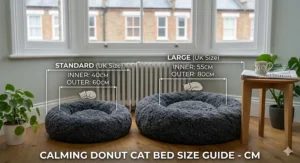
Measure your cat properly: When your cat is in their natural resting position (curled up), measure from the tip of their nose to the base of their tail — not including the tail itself. Add 10-15cm to this measurement; that’s your target internal diameter for the donut bed. A 4kg British Shorthair curling into a 25cm circle needs a bed with roughly 35-40cm internal diameter, which typically corresponds to a 50-60cm external measurement depending on bolster thickness.
Consider your cat’s sleeping style: Some cats curl into tight balls; others sprawl more generously. Watch your cat sleeping over several days (British cats typically sleep 12-16 hours daily, so you’ll have ample observation opportunities). Tight curlers can go smaller for that snug den feeling, whilst sprawlers need extra room. Senior cats often stretch more as joint stiffness develops, so size up if your cat is approaching their golden years (8+).
Account for British home realities: That 80cm bed might look perfect in the product photos shot in spacious American living rooms, but plonk it in the corner of your typical British bedroom and it dominates the floor space. Measure your intended placement area before ordering. The 50-60cm options suit most British homes better, particularly flats and terraced houses where room sizes run smaller than international equivalents.
Multiple cats require careful calculation: Two small cats (under 4kg each) may happily share a 70cm bed, creating adorable cuddle puddles that Instagram dreams are made of. However, if your cats merely tolerate each other rather than actively seeking proximity, forced sharing will increase stress rather than reduce it. Buy two smaller beds rather than one large shared space — your cats (and your stress levels) will thank you.
Weight recommendations are guidelines, not rules: Manufacturers typically suggest sizes based on pet weight, but cats of identical weight can have vastly different body shapes. A stocky, muscular British Blue weighing 5kg occupies space differently than a slender Oriental Shorthair of the same weight. Trust your measurements over the suggested weight ranges.
When in doubt, size up slightly: A bed that’s marginally too large still functions well; a bed that’s too small gets abandoned. The raised edges will feel less secure in an oversized bed, but your cat can still curl into a comfortable position. Conversely, a too-small bed restricts movement and defeats the calming purpose entirely.
Washing & Maintenance: Keeping Your Donut Bed Fresh in British Conditions
British cat owners face unique maintenance challenges thanks to our climate. The persistent damp, lack of reliable sunshine for outdoor drying, and tendency to keep windows closed against the cold all complicate the seemingly simple task of keeping a cat bed clean. According to UK Government guidelines on cat welfare, cats need a safe, comfortable resting place free from draughts and damp — making proper bed maintenance essential for meeting your legal responsibilities under the Animal Welfare Act 2006. Here’s how to navigate these challenges whilst preserving your bed’s effectiveness.
Washing frequency: For single-cat households, washing every 3-4 weeks suffices unless your cat has accidents or brings in exceptional amounts of outdoor debris. Multi-cat homes benefit from fortnightly washing to manage accumulated fur, dander, and odours. During spring when cats shed heavily, weekly washing may be necessary to prevent mat formation in the fabric.
Temperature considerations: Whilst most beds claim machine washability, check the specific temperature recommendations. The majority suggest 30°C, which protects the fabric pile and prevents colour fading whilst still providing adequate cleaning. Hotter washes (40°C+) clean more aggressively but accelerate wear, particularly on cheaper beds with lower-quality dye fixation. In British water, which tends towards hard in much of England and Wales, lower temperatures also reduce limescale buildup in the fabric fibres.
Drying challenges: This is where British weather creates genuine problems. Tumble drying on low heat works but risks shrinkage and pile damage — many owners report their beds emerging slightly smaller and less fluffy. Air drying is gentler but takes forever in our humid climate. Radiator drying (not directly on the radiator, but near it) works reasonably well, though it can take 24-48 hours to fully dry a saturated donut bed. Plan ahead rather than washing the bed the night before you need it back in service.
Between-wash maintenance: Vacuum or brush the bed weekly using a lint roller or upholstery attachment. This removes loose fur, prevents mat formation, and extends the time between full washes. For spot cleaning (muddy paw prints, minor accidents), damp cloths with gentle pet-safe cleaner work better than soaking the entire bed unnecessarily.
Fluffing and reshaping: After washing, the bed will look deflated and sad. Vigorous shaking, combined with manually manipulating the bolster edges back into shape whilst still damp, helps restore structure. Some owners report leaving the bed in a sunny spot (when British weather cooperates) helps it fluff naturally as it dries — though relying on sunshine in Britain requires considerable optimism.
Fabric freshening: Between washes, sprinkling bicarbonate of soda over the bed, leaving for 30 minutes, then vacuuming thoroughly removes odours without wetting the fabric. This works particularly well in damp British homes where pet beds can develop musty smells even when technically clean.
Common Mistakes When Buying Calming Beds (And How to Avoid Them)
After reviewing hundreds of UK customer experiences and consulting with British cat owners, certain purchasing mistakes emerge repeatedly. Cats Protection, the UK’s largest feline welfare charity helping over 200,000 cats annually, emphasises that stress-related behavioural problems are a common reason cats are relinquished — making proper bedding choices more important than many owners realise. Here’s what to avoid and why it matters specifically in the UK context.
Buying based on dog sizing: Many top-selling “calming donut beds” on Amazon.co.uk are actually dog products marketed as suitable for cats. The sizing reflects canine proportions — a “medium” designed for a Cocker Spaniel will dwarf most British moggies. Always check the actual dimensions in centimetres rather than trusting size labels. What sellers call “small” for dogs often works perfectly as “large” for cats.
Ignoring British weather considerations: That ultra-thin donut bed might work brilliantly in Southern California where it’s a decorative cooling spot. In British homes where temperatures genuinely drop and draughts creep through Georgian sash windows, thin construction provides inadequate warmth retention. Prioritise beds with 4cm+ pile depth and substantial filling for our climate.
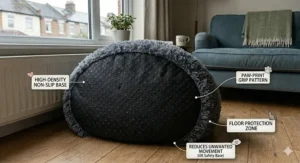
Overlooking non-slip base quality: British homes predominantly feature either carpet or hard flooring (laminate, engineered wood, tile). Cheap beds use token rubber dots that work fine on carpet but slide alarmingly on hard floors. This terrifies anxious cats and defeats the calming purpose. Check reviews specifically mentioning “hard floors” or “laminate” to gauge real-world performance.
Assuming “machine washable” means practical washing: Technically machine washable and practically washable are different things in British households. A bed that requires 60°C washing but shrinks catastrophically, or needs tumble drying but takes three radiator-cycles to dry in our damp climate, creates more problems than it solves. Prioritise beds that wash effectively at 30°C and air-dry within 48 hours.
Choosing colours poorly: That pristine white donut bed looks gorgeous in product photos, but show me a British cat owner with a white bed that’s still white after six months and I’ll show you someone with either an outdoor cat who never comes in muddy, or a remarkable tolerance for constant washing. Dark greys and mid-tone browns hide British weather-related dirt (mud, wet paw prints) substantially better whilst still looking attractive.
Neglecting reviews from UK buyers: American reviews mention challenges that don’t apply here (extreme heat, air conditioning, different flooring types), whilst UK reviews flag genuinely relevant issues (drying time, performance in damp conditions, sizing relative to British homes). Filter reviews by “UK” or look for sterling price mentions to get locally relevant feedback.
Expecting instant acceptance: Some cats take to new beds immediately; others need weeks of cautious investigation before committing. Placing worn clothing in the bed, sprinkling catnip around the edges, or positioning near existing favourite spots helps, but ultimately, some cats simply prefer alternative sleeping arrangements. Have realistic expectations rather than assuming a £30 bed will magically solve all anxiety issues overnight.
Donut Beds vs Traditional Cat Beds: What British Cats Actually Prefer
The explosion in donut bed popularity might suggest they’re universally superior to traditional designs, but feline preferences — like humans’ — vary considerably. Here’s how donut beds compare to alternatives in specifically British contexts.
Donut beds vs flat cushions: Flat cushions suit cats who prefer sprawling to curling, particularly during warmer months (May through September, theoretically, though British summer can be rather notional). However, they provide no draught protection — a significant disadvantage in draughty British homes during the eight-month not-quite-summer season. Flat beds also offer no psychological security from raised edges. Donut beds win comprehensively for anxious cats, winter comfort, and older felines with joint issues.
Donut beds vs cave/igloo beds: Fully enclosed cave beds provide maximum security for extremely anxious cats, rescue cats adjusting to new homes, or felines who simply crave darkness. They’re brilliant for shy cats but create problems in British climate — the enclosure traps moisture, leading to musty smells and requiring more frequent washing. Donut beds offer a middle ground: security from the raised rim without the maintenance headaches of full enclosure.
Donut beds vs radiator beds: Radiator-mounted hammocks are a British cat-owning staple, capitalising on our central heating to create irresistibly warm napping spots. They’re unbeatable for pure warmth but offer zero anxiety relief — they’re elevated, exposed, and provide no sense of enclosure. Many cat owners find having both types works brilliantly: donut bed for nighttime security, radiator hammock for daytime warmth.
Donut beds vs cardboard boxes: Let’s address the elephant (or rather, the cat) in the room. Your cat probably ignores their £40 designer bed in favour of the Amazon delivery box. Boxes provide ultimate security, zero cost, and infinite cat appeal. The donut bed’s raised rim attempts to capture that boxlike security whilst adding cushioning boxes lack. Some cats genuinely prefer boxes; accept this with good humour rather than frustration.
Climate considerations matter enormously: In British homes, warmth retention and draught protection trump aesthetics or novelty. A bed that looks gorgeous but leaves your cat cold gets abandoned regardless of its clever design. Donut beds excel precisely because they address our climate’s challenges — damp, draught, and that persistent chill that characterises British housing from October through April.
Special Considerations for British Multi-Cat Households
Britain has one of Europe’s highest rates of multi-cat households, with many owners keeping two, three, or more felines. This creates specific challenges around bedding that American guidance (typically focused on single-cat or dog households) doesn’t adequately address.
Territorial considerations: British homes, being generally smaller than American equivalents, provide less space for cats to establish separate territories. Introducing a single large donut bed into a multi-cat household can create competition rather than comfort. Better strategy: multiple smaller beds placed in different locations, allowing each cat their own secure space whilst enabling voluntary sharing if they choose. Cats Protection research emphasises that approximately half of UK cat-owning households care for two or more cats, making understanding feline social needs crucial for proper bedding arrangements.
Pair bonding vs tolerance: Two cats who’ve bonded (often siblings or cats introduced young) may genuinely enjoy sharing a bed, creating those heart-melting cuddle puddles cat owners live for. However, cats who merely tolerate each other — the reality in many British households — will find forced proximity stressful. Watch your cats’ natural behaviour: do they seek each other out for comfort, or maintain polite distance? This tells you whether shared bedding works.
Size calculations for sharers: If your cats do share, calculate bed size for their combined space needs. Two 4kg cats curled together need roughly the same space as a single 8kg cat — so a 70-80cm bed rather than 50-60cm. The larger size also reduces competition over the “prime spot” (typically centre-back, where it’s warmest and furthest from edges).
Wash rotation becomes critical: Multi-cat households generate more fur, dander, and odour, necessitating more frequent washing. Having two beds allows rotation — one in use whilst the other washes and dries. Given British drying times (24-48 hours typically), this rotation prevents the bed-less periods that stress cats and lead to furniture-sleeping (which we’re trying to avoid).
Placement strategy: Distribute beds across vertical and horizontal space. British homes may lack American-style floor space but often feature useful vertical territory (shelving, wardrobes, staircase landings). A donut bed on a bedroom shelf provides territory for the cat who prefers elevation, whilst floor-level beds suit ground-dwelling preferences. This reduces competition whilst accommodating natural hierarchy.
Budget approaches: Buying multiple £40 beds strains most British household budgets. Mix premium and budget options: invest in one high-quality bed for the anxious or senior cat who’ll benefit most, then supplement with cheaper alternatives for the more adaptable felines. The Enjamoy (£18-£28) works brilliantly for this purpose.
Seasonal Adjustments: British Weather and Cat Bed Strategy
British weather’s unpredictability requires flexible bedding approaches. That perfect summer donut bed might prove inadequate come November, whilst winter warmth options become stifling during July heatwaves (all three days of them).
Summer considerations (June-August, theoretically): During rare hot spells, cats may abandon plush donut beds for cooler surfaces (tile floors, bathroom sinks). Don’t panic — this is normal thermoregulation. You can encourage bed use by moving it to cooler locations (north-facing rooms, lower floors where heat doesn’t accumulate). Some owners keep a flatter, less insulated bed as a summer alternative, though British heatwaves rarely last long enough to justify this investment.
Autumn transition (September-November): As temperatures drop and central heating kicks in intermittently, cats increasingly appreciate the warmth retention donut beds provide. This is when beds abandoned during summer get rediscovered. Position beds near radiators (not directly on them) to capture residual warmth. The raised edges now serve double duty: blocking draughts from poorly fitted British windows whilst retaining radiated heat.
Deep winter (December-February): Peak donut bed season in Britain. Cats spend more time indoors, seek warm spots constantly, and curl tighter against the cold. This is when quality differences between beds become apparent — cheap options with thin filling provide inadequate insulation, whilst premium beds with 4cm pile and proper stuffing create genuinely warm microenvironments. If your cat abandons their bed during winter, it’s likely inadequate for the conditions rather than a preference change.
Spring challenges (March-May): Shedding season creates maintenance headaches as loose fur accumulates in bed fabric. Increase washing frequency to fortnightly during heavy shed periods (typically March-April). The combination of spring rain (inevitably) and muddy paws also means more outdoor debris tracked into beds. Dark-coloured beds hide this better whilst you juggle increased washing demands.
Climate variation within Britain: Scottish cat owners face longer, colder winters where bed warmth matters enormously. Southern England experiences milder but damper conditions, where moisture resistance becomes priority. Consider regional climate when selecting materials — water-resistant bases matter more in persistently wet Wales or western Scotland than drier eastern England.
Are Calming Donut Beds Worth It for Senior British Cats?
As British cats age (senior status typically begins around 8-10 years), their needs shift considerably. The combination of decreased activity, developing joint issues, and increased time sleeping makes bedding choices more impactful than during healthy adult years.
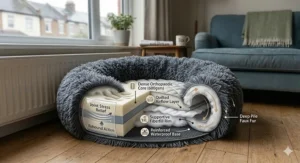
Joint support considerations: Arthritis affects an estimated 90% of cats over 12 years old, though signs are subtle and often attributed to “just getting old.” The cushioned base in quality donut beds provides pressure relief for hips, shoulders, and elbows — joints that bear weight during prolonged rest. However, this requires adequate filling thickness; cheap beds with minimal stuffing compress under weight, offering no support advantage over a folded blanket.
Temperature regulation: Older cats feel cold more readily due to decreased muscle mass and slower metabolism. They also move less, generating less body heat through activity. The warmth-trapping design of donut beds becomes increasingly valuable — particularly in British homes where central heating often runs on timers, leaving overnight periods uncomfortably cool for elderly felines.
Mobility and access: Here’s where donut beds can fail senior cats. The raised bolster edge that provides security for younger cats creates a climbing obstacle for arthritic felines. Watch how your senior cat enters and exits their current sleeping spots. If they’re hesitating, sitting and thinking before jumping, or showing stiffness after rising, they may struggle with donut bed entry. Some manufacturers offer lower-profile edges, but these compromise the security aspect.
Practical solutions: For cats struggling with entry but benefiting from the warmth and support, consider placing the bed in a corner against walls. This allows entry from one direction only whilst the walls provide the security the raised edge can’t. Alternatively, add a small step or folded towel creating a gentler incline than the direct climb over the bolster.
Multiple bed strategy: Senior cats sleep more (often 18-20 hours daily) and benefit from multiple comfortable locations. A donut bed for nighttime security in the bedroom, flat orthopaedic bed near the radiator for daytime warmth, and accessible cushion at ground level for easy-access napping creates a senior-friendly environment. In British homes, this distributes sleeping spots across the house without requiring extensive new furniture.
Weight changes: Senior cats often gain weight through decreased activity, or conversely lose weight due to medical conditions. Either change affects bed fit. An overweight senior cat compresses budget bed filling rapidly, while weight loss means a previously perfect bed now feels too large. Re-evaluate sizing every 6-12 months for aging cats rather than assuming their 8-year-old bed still suits their 13-year-old needs.
FAQs
❓ Are calming donut beds suitable for British kittens?
❓ How long do donut cat beds typically last in British conditions?
❓ Can donut beds help with cat separation anxiety when owners are at work?
❓ Are cheaper £15-£20 donut beds worth buying or should I spend more?
❓ Do British cats prefer donut beds over traditional flat beds?
Making Your Choice: Which Calming Donut Bed Suits Your British Cat?
After examining seven top options, considering British-specific factors, and exploring the science behind calming bed design, you’re equipped to make an informed choice. The “best” bed depends entirely on your specific circumstances, so let me simplify the decision process.
For budget-conscious owners: The Enjamoy Plush Donut (£18-£32) delivers genuine value. It’s not the absolute cheapest option on Amazon.co.uk, but it’s the least expensive bed that actually functions reliably. The four size options accommodate most British cat sizes, and whilst it won’t last three years like premium alternatives, you’ll get 12-18 months of solid use before considering replacement.
For anxious or rescue cats: The SEOUGEE Calming Donut (£17-£30) offers the best sizing flexibility with its 40cm option for particularly nervous small cats. The self-warming properties provide extra comfort for stressed felines, and the range of sizes means you can match bed to cat precisely rather than compromising on fit.
For senior cats with joint issues: The Comfy Calming Medium (£25-£35) provides the orthopaedic support older British cats need. The filling maintains compression resistance better than budget options, offering consistent joint relief through extended use. The generous sizing accommodates older cats who stretch more due to stiffness.
For style-conscious owners: The Woof & Whiskers (£22-£35) blends function with aesthetics. The dark grey colourway suits contemporary British interiors whilst hiding fur and wear better than lighter alternatives. It looks intentional in your living room rather than like an afterthought pet product.
For multi-cat households: The Silentnight Donut (£25-£40) offers the best durability for higher-use environments. The robust construction withstands frequent washing and multiple cats better than cheaper alternatives, whilst the brand’s 12-month guarantee provides reassurance.
For hygiene-focused owners: The Belababy with Removable Cover (£20-£28) solves the British weather washing challenge. The zip-off cover washes and dries quickly, meaning the bed returns to service the same day rather than sitting damp for 48 hours. Perfect for elderly cats prone to accidents or multi-cat homes requiring frequent cleaning.
For safety-conscious buyers: The Nepfaivy OEKO-TEX Certified (£24-£32) provides verified safety for cats with allergies or sensitivities. If your cat has respiratory issues or skin reactions to synthetic fabrics, the chemical testing this certification requires offers peace of mind.
No single bed will suit every British cat, and that’s perfectly fine. Your moggy’s individual preferences, your home’s specific challenges, and your budget constraints all matter more than generic “best bed” pronouncements. Use this guide as a starting point for informed decision-making rather than gospel truth, and remember — sometimes your cat will prefer the Amazon box regardless of how perfect the bed you’ve researched seems. That’s cats for you.
Recommended for You
- 7 Best Cooling Cat Bed Summer 2026 | UK Buyer’s Guide
- 7 Best Memory Foam Cat Beds UK 2026: Senior Cats Love These
- 7 Best Window Cat Beds UK 2026 – Safety Tested & Reviewed
Disclaimer: This article contains affiliate links. As an Amazon Associate, I earn from qualifying purchases. If you purchase products through these links, we may earn a small commission at no additional cost to you.
✨ Found this helpful? Share it with your mates! 💬🤗
