
In This Article
Your cat’s been hiding under the sofa again. Perhaps it’s the new washing machine’s spin cycle, or maybe just the postman’s daily arrival that sends them scurrying. Whatever the trigger, one thing’s certain: anxious cats crave spaces where they feel invisible, protected, and utterly secure. An enclosed cat bed for anxious cats does precisely that — it mimics the dark, snug hideaways cats instinctively seek when the world feels too loud, too bright, or simply too much.
The science backs this up rather nicely. Research shows that cats hide signs of stress to avoid becoming an easy target for predators, which means your feline’s anxiety might be more severe than their poker face lets on. Unlike open donut beds that suit confident loungers, enclosed cave beds provide the total privacy that nervous cats need to decompress. The difference isn’t trivial: whilst a confident tabby might happily snooze in the middle of your living room, an anxious cat needs walls, a roof, and preferably a single entrance they can monitor.
UK cat owners face particular challenges here. Our compact flats and terraced houses mean limited hiding spots, yet our unpredictable weather — with its relentless rain hammering windows and howling wind rattling letterboxes — creates plenty of triggers for sensitive cats. Add in the typical British multi-cat household (we’re a nation of cat hoarders, let’s be honest), and suddenly providing dedicated safe zones becomes essential rather than indulgent. According to Cats Protection, stress in cats can manifest as both emotional and physical unwellness, making proper environmental enrichment crucial for their long-term health.
This guide examines seven enclosed cat beds available on Amazon.co.uk, each tested against real-world UK conditions: machine washability (because British cats track in mud), compact dimensions (fitting into typical UK homes), and crucially, their effectiveness at providing genuine anxiety relief rather than just looking cute on Instagram. We’ve focused on beds that actually work for stressed cats, not simply cave-shaped cushions that collapse the moment a 5kg moggie steps inside.
Quick Comparison: Top Enclosed Cat Beds at a Glance
| Bed Type | Best For | Price Range | Key Feature | UK Availability |
|---|---|---|---|---|
| Bedsure Cat Cave Igloo | Multi-use flexibility | £18–£25 | Convertible 2-in-1 design | Amazon Prime eligible |
| Rosewood 40 Winks Cave | Maximum anxiety relief | £18–£28 | Medical-grade plush lining | Widely stocked UK |
| Hollypet 2-in-1 Foldable | Travel & new homes | £15–£22 | Ultra-portable, lightweight | Prime next-day |
| SBY Cat Igloo (Large) | Bigger breeds | £20–£30 | Spacious 42×46cm interior | UK warehouse stock |
| Bobby & Maisy Anti-Anxiety | Budget conscious | £12–£18 | Moisture-proof base | Fast UK delivery |
| ALLSOPETS Semi-Enclosed | Gradual transition | £16–£24 | Adjustable opening size | Multiple UK sellers |
| Ownpets 3-in-1 Convertible | Year-round use | £22–£32 | Dual-sided seasonal mat | Premium UK option |
💬 Just one click — help others make better buying decisions too! 😊
Top 7 Enclosed Cat Beds for Anxious Cats: Expert Analysis
1. Bedsure Cat Cave Igloo — The Convertible Champion
The Bedsure Cat Cave Igloo dominates Amazon UK’s bestseller lists because it solves a problem most cave beds ignore: cats are fickle. One day they want total darkness and womb-like enclosure; the next, they fancy a semi-open donut bed with a view. This 40×40×40cm flannel cave converts between both formats by simply folding down the hooded entrance, giving you two beds for the price of one.
What sets it apart is the structural engineering. Unlike cheaper igloos that sag within weeks, Bedsure uses resilient sponge filling that bounces back after compression. The non-slip bottom actually grips laminate flooring (crucial when your anxious cat bolts inside at speed), and the removable cushion pillow means you can wash the interior separately — rather important when stress-vomiting becomes a thing. The dangling toy ball is a nice touch for cats transitioning from anxiety, offering gentle enrichment without overwhelming timid personalities.
UK buyers consistently praise the size accuracy: it genuinely fits cats up to 5–6kg comfortably, though larger British Shorthairs might find it snug. The flannel exterior holds up well to our damp climate, resisting that musty smell cheaper fabrics develop in humid conditions. For around £18–£25, you’re getting Amazon Prime next-day delivery and build quality that justifies Bedsure’s reputation in the pet bedding market.
Pros:
✅ Convertible design adapts to changing moods
✅ Robust construction maintains shape long-term
✅ Machine washable components simplify UK home hygiene
Cons:
❌ Wipe-clean-only outer shell limits deep cleaning options
❌ Smaller side for Maine Coons and other large breeds
Price range: Around £18–£25 | This works brilliantly for households with multiple cats at different anxiety levels, as you can adjust the enclosure based on who’s using it.
2. Rosewood 40 Winks Round Cosy Plush Cat Cave — The Anxiety Specialist
When rescue cats or those adjusting to new homes need reassurance, the Rosewood 40 Winks delivers. Its oval hooded design creates darker internal spaces than the Bedsure, with plush fleece lining that feels noticeably more luxurious against anxious paws. This isn’t marketing fluff — the material quality difference is palpable, which matters when you’re trying to coax a traumatised rescue cat out from behind the fridge.
The construction emphasises stability over portability. At approximately 41×41×30cm, it sits low to the ground with a weighted base that won’t slide across tiles when a stressed cat dives inside mid-panic. The roof can fold flat to convert into an open bed, though most anxious cats prefer it fully enclosed. What’s clever is the entrance size: large enough for easy access but small enough to feel genuinely protective, striking a balance cheaper cave beds miss.
UK reviewers note the wipe-clean-only exterior is both blessing and curse. Yes, it stays looking smart longer than fully machine-washable options. But when your anxious cat stress-pees (it happens), you’re limited to surface cleaning rather than a proper 30-degree wash. The removable inner cushion is machine washable at least, which handles most day-to-day accidents. At around £18–£28, it sits in the mid-range but delivers premium-level anxiety relief that genuinely works for difficult cases.
Pros:
✅ Medical-grade plush creates superior comfort for stressed cats
✅ Low-profile stability prevents tipping during panicked entry
✅ Entrance sizing optimised for security without claustrophobia
Cons:
❌ Wipe-clean restriction complicates deep hygiene maintenance
❌ Bulkier footprint suits larger UK rooms better
Price range: Around £18–£28 | Particularly effective for cats with separation anxiety or those recently rehomed — the premium materials provide tangible comfort during adjustment periods.
3. Hollypet 2-in-1 Foldable Pet Bed — The Travel-Friendly Option
The Hollypet 2-in-1 targets a specific niche: cats whose anxiety worsens during transitions. Whether you’re visiting family over Christmas or moving house (both Top 10 feline stressors), this foldable cave bed collapses flat for transport, then pops back into shape at your destination. The familiar scent and structure provide continuity when everything else has changed — rather crucial for anxious cats who rely on environmental consistency.
At 40×40×40cm, it matches the Bedsure’s dimensions but weighs noticeably less, making it genuinely portable rather than theoretically movable. The crystal velvet exterior resists moisture better than standard plush, which matters in British holiday cottages with their inevitable damp patches. Inside, the removable dark grey cushion offers reversible sleeping surfaces, though the colour choice is clearly designed to hide the inevitable cat hair rather than photograph well for social media.
UK buyers appreciate the non-slip dots on the base — often omitted on budget cave beds — which prevent the whole structure sliding across wooden floors when your cat barrels inside seeking refuge from visiting toddlers. The 2-in-1 designation refers to its convertibility between cave and flat bed modes, though realistically, if you’re buying this for an anxious cat, you’ll keep it in enclosed mode permanently. Around £15–£22 makes it the budget-friendly choice that doesn’t sacrifice build quality, though don’t expect the premium materials of pricier options.
Pros:
✅ Genuinely portable design supports anxious cats during travel
✅ Crystal velvet resists moisture in damp UK conditions
✅ Budget-friendly without major quality compromises
Cons:
❌ Lighter weight means less stability for larger cats
❌ Material quality below premium options like Rosewood
Price range: Around £15–£22 | Ideal for cats whose anxiety spikes during travel or for UK renters who move frequently and need bedding that packs flat.
4. SBY Cat Igloo Bed (Large) — For Bigger British Breeds
British Shorthairs, Maine Coons, and other substantial cats face a frustrating problem: most “standard” cave beds treat them like they’re permanently kittens. The SBY Cat Igloo in Large (42×46×48cm) finally provides proper headroom and turning space for cats weighing up to 7.5kg, which means your chunky tabby can actually curl up comfortably rather than wedging themselves in with their bottom hanging out the entrance.
The size upgrade comes with structural improvements. The velvet surface provides better insulation against cold British floors than thinner fabrics, whilst the internal PP cotton padding offers genuine cushioning rather than token stuffing. The waterproof non-slip base is particularly well executed here — unlike cheaper alternatives where “waterproof” means “slightly damp-resistant,” this genuinely protects your carpets from stress-urination incidents whilst maintaining floor grip.
What UK buyers consistently note is the entrance positioning: slightly offset rather than dead centre, which creates a more natural cave-like feel whilst improving structural stability. The hanging ball toy attaches securely enough to withstand anxious batting but detaches easily if your cat finds it overstimulating. At around £20–£30, you’re paying a premium for the larger size, but for owners of hefty cats, it’s the difference between a bed they’ll actually use versus another expensive cat toy gathering dust.
Pros:
✅ Genuinely accommodates larger British breeds comfortably
✅ Superior waterproofing protects UK homes from accidents
✅ Offset entrance improves both stability and cave authenticity
Cons:
❌ Footprint too large for compact UK flats
❌ Higher price point reflects premium sizing
Price range: Around £20–£30 | Essential for British Shorthair, Norwegian Forest Cat, or Maine Coon owners whose cats have outgrown standard options.
5. Bobby & Maisy Anti-Anxiety Plush Bed — The Budget Champion
At around £12–£18, the Bobby & Maisy Anti-Anxiety bed proves you don’t need to spend premium money for effective anxiety relief — provided you understand its limitations. This 55cm diameter round bed with raised edges isn’t technically a full cave, but the 20cm height creates sufficient enclosure for mildly anxious cats without the claustrophobia some felines feel in true igloos.
The 4cm plush depth provides genuine cushioning, whilst the PP cotton padding maintains loft better than the wafer-thin filling in bargain-basement alternatives. What distinguishes this from other budget options is the moisture-proof bottom enhanced with silicon gel spotting — basic but effective for preventing slip on laminate floors common in UK homes. The bed’s design encourages the natural kneading behaviour many anxious cats use for self-soothing, with the plush fabric providing satisfying texture for paw massage.
UK reviewers note this works brilliantly as a first bed for newly adopted cats or as supplementary sleeping spots in multi-cat households, but it shouldn’t be your anxious cat’s only refuge. The sides compress with regular use faster than premium options, and the machine washability, whilst convenient, causes faster fabric pilling than wipe-clean alternatives. That said, at this price point, you can afford to replace it annually without guilt — arguably better than clinging to a £40 bed that’s lost its structure but feels too expensive to discard.
Pros:
✅ Exceptional value without catastrophic quality compromises
✅ Moisture-proof base handles British damp effectively
✅ Encourages natural anxiety-reducing kneading behaviours
Cons:
❌ Sides compress faster than premium constructions
❌ Partial rather than full enclosure limits severe anxiety relief
Price range: Around £12–£18 | Perfect as a starter bed for newly adopted cats or as affordable second/third beds in multiple-cat households.
6. ALLSOPETS Semi-Enclosed Tent Cave — The Transition Specialist
Some anxious cats find full igloos overwhelming initially, particularly if they’ve never had secure hiding spots before. The ALLSOPETS Semi-Enclosed addresses this with an adjustable cave structure that lets you gradually introduce enclosure. Start with the sides slightly open; as your cat’s confidence builds, reshape it into full cave mode. This flexibility makes it particularly effective for rehabilitation cases or cats transitioning from outdoor to indoor living.
The arctic fleece and PP cotton filling are genuinely eco-friendly (not greenwashing), which matters to environmentally conscious UK buyers. More importantly, they create a self-warming effect without electrical components — crucial in draughty British homes where heating costs have skyrocketed. The strong structure maintains its shape through repeated reshaping, unlike cheaper alternatives that lose their form after a few adjustments.
What UK users particularly appreciate is the complete machine washability. Whilst competitors limit washing to inner cushions, you can chuck the entire ALLSOPETS into a 30-degree cycle, which becomes essential when anxious cats experience stress-induced digestive issues. The patent number (referenced on product listings) indicates genuine design innovation rather than cheap knock-offs flooding the market. At around £16–£24, it sits comfortably mid-range whilst offering unique functionality that justifies the investment for specific anxiety cases.
Pros:
✅ Adjustable enclosure supports gradual anxiety management
✅ Complete machine washability simplifies UK hygiene standards
✅ Eco-friendly materials appeal to sustainable pet owners
Cons:
❌ Adjustment mechanism requires more user intervention than fixed designs
❌ Self-warming relies on British ambient temperatures being moderate
Price range: Around £16–£24 | Particularly valuable for behavioural rehabilitation programmes or cats adjusting from outdoor to indoor environments.
7. Ownpets 3-in-1 Convertible Cat Tent — The Year-Round Solution
British weather’s legendary unpredictability means your anxious cat needs winter warmth and summer cooling — ideally without buying separate beds. The Ownpets 3-in-1 delivers with its clever double-sided cushion: plush fabric for chilly months, ice silk for hot spells. The tent itself reshapes between igloo, sofa, and flat nest configurations, though anxious cats typically prefer the full enclosure setting regardless of season.
The high-density sponge maintains its original shape through frequent reconfiguration, which cheaper multi-mode beds struggle with. This structural integrity matters for anxious cats who need environmental consistency; a bed that slowly collapses creates new stressors rather than relieving existing ones. The 55cm diameter and 35cm internal space suit cats up to 5kg comfortably, though larger British breeds need the next size up.
UK reviewers consistently mention the seasonal cushion genuinely works — the ice silk side stays noticeably cooler during summer heatwaves, whilst the plush retains warmth during damp British winters. The moisture-proof bottom handles our wet climate well, and the silicon gel spotting prevents sliding on tiled kitchen floors where many anxious cats prefer to hide near their humans. At around £22–£32, it’s the premium option here, but the year-round versatility and superior construction justify the investment for households committed to managing feline anxiety long-term.
Pros:
✅ Seasonal cushion adapts to unpredictable British weather
✅ High-density sponge maintains structure through reconfigurations
✅ Three distinct modes suit changing anxiety levels
Cons:
❌ Premium pricing reflects advanced features
❌ Complexity may confuse some cats preferring simple consistency
Price range: Around £22–£32 | Best for UK households experiencing significant seasonal temperature swings or cats whose anxiety levels fluctuate throughout the year.
✨ Don’t Miss These Exclusive Deals!
🔍 Take your cat’s wellbeing to the next level with these carefully selected products. Click on any highlighted item to check current pricing and availability on Amazon.co.uk. These picks will help you find exactly what your anxious cat needs!
Understanding Cat Anxiety: Why Enclosed Beds Actually Work
The preference for enclosed spaces isn’t random feline quirks — it’s hardwired evolutionary behaviour. Wild cats seek out caves, hollow logs, and dense thickets when threatened, creating defensive positions where predators can only attack from one direction. Your domesticated British Shorthair retains this programming despite never encountering anything more threatening than the Ocado delivery driver.
Anxiety in cats frequently manifests through destructive behaviours and hiding, particularly when triggered by environmental changes. An enclosed cat bed essentially provides a portable panic room — a space your cat controls completely. They can monitor the single entrance whilst feeling protected from behind and above, reducing the hypervigilance that characterises chronic anxiety. This isn’t anthropomorphic nonsense; veterinary behaviourists consistently recommend enclosed spaces as primary environmental enrichment for anxious felines.
British homes present unique stressors. Our compact living spaces mean less natural territory, increasing resource competition in multi-cat households. The constant through-traffic in terraced houses creates unpredictable noise. Even well-meaning visitors trigger anxiety in cats who haven’t been properly socialised. According to Battersea Dogs & Cats Home, anxious cats may start avoiding certain areas or only use resources at quieter times, which can lead to chronic stress if not addressed.
The physiological impact runs deeper than mere discomfort. Chronic stress suppresses immune function, increases urinary tract problems (particularly common in British indoor cats), and can trigger stress-induced cystitis. An enclosed bed won’t cure severe anxiety alone, but it provides the foundation upon which other interventions build: pheromone diffusers work better when cats have secure bases, behaviour modification succeeds faster when cats can retreat to safety, and medication achieves better outcomes when environmental stressors are minimised.
What many UK cat owners miss is that enclosed beds must actually enclose. Those decorative cave beds that collapse flat the moment a cat steps inside? They’re aesthetically pleasing paperweights, not functional anxiety management tools. Proper enclosed beds maintain structural integrity even when your 6kg British Blue launches themselves inside at speed, which requires robust construction rather than decorative fluff.
How to Choose the Right Enclosed Cat Bed: UK Buyer’s Framework
Size Accuracy Matters More Than You Think
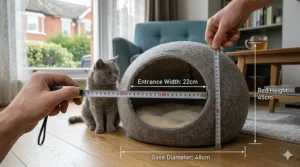
Measure your cat when they’re fully curled up sleeping — that’s your minimum internal dimension. Add 5–8cm for comfortable turning space. British cats average 4–5kg (smaller than American counterparts), but breeds like Maine Coons or Norwegian Forest Cats need large-sized cave beds despite being indoor pets. The mistake most UK buyers make is choosing beds based on their cat’s standing height rather than sleeping position, resulting in uncomfortable cramped quarters that defeat the anxiety-relief purpose.
Washability in British Conditions
Machine washable covers are practical must-haves for indoor cats, particularly in our damp climate where beds can develop musty odours within weeks. Fully machine-washable beds simplify hygiene but often sacrifice structural integrity. Removable cushion systems offer the best compromise: you can deep-clean the interior where most accidents occur whilst preserving the outer shell’s shape. Check specific washing instructions — some require 30-degree gentle cycles; others tolerate 40 degrees. Tumble-drying almost always damages filling, so factor in British air-drying times during winter months.
Material Quality vs Price
Budget beds under £15 typically use thin polyester filling that compresses flat within months. Mid-range options (£18–£28) employ PP cotton or high-density sponge that maintains loft longer. Premium beds above £30 add features like temperature-regulating fabrics or orthopaedic memory foam, which benefit senior cats but don’t meaningfully improve anxiety relief for otherwise healthy adults. For most UK households, the £18–£25 bracket offers optimal value: sufficient quality for long-term use without paying for unnecessary luxury features.
British Home Compatibility
Measure your available floor space before ordering. Cave beds occupy more room than they appear online — a 40cm diameter bed actually needs roughly 50cm clearance when you account for the cat’s entry/exit zone. Victorian terraces and modern flats often have limited floor space, making compact designs essential. Consider vertical options if floor space is tight: some radiator-mounted cave beds provide enclosure whilst utilising otherwise wasted wall space, though these suit confident climbers better than severely anxious cats.
Entrance Configuration
Single-entrance designs create stronger security feelings but can trigger claustrophobia in some cats. Dual-entrance caves offer flexibility but reduce the defensive advantage cats seek. Observe where your cat currently hides: if they prefer spots with single escape routes (under beds, behind sofas), choose single-entrance caves. If they favour through-routes (between bookcases, through tunnels), consider dual-access designs. Most UK-available caves use single entrances positioned off-centre for better structural stability.
Common Mistakes When Buying Enclosed Cat Beds (And How to Avoid Them)
Choosing Aesthetics Over Function
That Instagram-perfect cave bed in millennial pink might photograph beautifully, but if it collapses when your cat uses it, you’ve bought expensive home décor, not functional pet furniture. UK buyers particularly fall into this trap with woven seagrass or wicker cave beds that look stunning in minimalist Scandi interiors but offer terrible anxiety relief. Anxious cats need darkness, insulation, and structural stability — features rarely compatible with see-through woven designs or trendy but flimsy felt constructions.
Ignoring Your Cat’s Actual Size
Manufacturers classify “medium” wildly inconsistently. One brand’s medium fits 3–5kg cats; another’s accommodates 6–8kg animals. Always check internal dimensions in centimetres rather than trusting size labels. British cat owners frequently underestimate their pets’ size because we see them daily — that “medium” cat is actually a chunky 6kg beast who needs a large bed. When in doubt, size up; cats can curl smaller but can’t magically shrink to fit inadequate spaces.
Neglecting UK-Specific Requirements
Buying US-market cave beds without checking UK voltage (for heated options) or plug compatibility wastes money and creates safety hazards. Similarly, some materials popular in American pet products — like cedar chips or scented fabrics — violate UK pet safety standards or trigger respiratory issues in British homes with poorer ventilation than American houses. Stick to products explicitly sold through Amazon.co.uk with Prime eligibility, which generally ensures UK compliance.
Overlooking the Adjustment Period
Anxious cats don’t instantly adopt new beds — they need gradual introduction. UK buyers often return perfectly good cave beds after two days because their cat “won’t use it,” missing that acclimation requires weeks, not hours. Place the new bed in your cat’s existing favourite hiding spot. Add worn clothing with your scent inside. Sprinkle dried catnip near (not inside) the entrance. Feed treats progressively closer to the bed over several days. Patience trumps product quality when introducing anxious cats to new furniture.
Buying Multiple Cheap Beds Instead of One Quality Option
The temptation to buy three £12 beds instead of one £30 bed seems economical until all three collapse within months. Quality cave beds last years; budget alternatives need replacing seasonally. When you factor in the environmental cost of landfilled cheap beds plus the behavioural disruption of constantly changing sleeping areas (terrible for anxious cats), investing in one robust bed makes financial and ethical sense. UK households should calculate cost-per-year of ownership, not just purchase price.
Setting Up Your Enclosed Cat Bed for Maximum Anxiety Relief
Location, Location, Location
Anxious cats need quiet, darkened areas away from stimuli like noisy appliances or through-traffic routes. In typical British homes, this means corners of bedrooms or studies rather than living rooms. Avoid placing cave beds near windows where outdoor cats might trigger territorial anxiety, or near external doors where delivery drivers cause stress. Elevated positions work for some anxious cats (atop wardrobes or shelves), but severely stressed cats prefer ground-level hideaways they can bolt into quickly.
Creating Multi-Level Security
Anxious cats benefit from layered safe zones rather than single hideaways. Position your enclosed bed as the ultimate refuge with secondary hiding spots nearby: cardboard boxes, open wardrobes, or space under furniture. This creates a territory gradient where your cat can retreat progressively deeper based on threat level. A mildly startled cat might hide under the coffee table; a genuinely panicked one makes for the cave bed in the bedroom. This hierarchy reduces overuse of the primary hideaway, preventing the bed from becoming a prison where your cat spends 23 hours daily.
Temperature Considerations
British homes experience significant temperature variation. Winter draughts from sash windows can make cave beds uncomfortably cold; summer conservatories turn them into ovens. Position beds away from radiators (despite cats’ heat-seeking tendencies) to prevent overheating in winter. In summer, relocate beds to north-facing rooms or shaded corners. Some UK owners maintain seasonal bed locations, moving cave beds to warmer spots October–March and cooler positions April–September, though this works better for confident cats than anxious ones who need environmental consistency.
Scent Integration
Introduce new beds gradually using scent familiarisation. Place an unwashed item of your clothing (worn t-shirt, jumper) inside the bed for 24–48 hours before introducing your cat. The familiar scent makes the space less threatening. Some UK owners swear by transferring bedding from their cat’s current favourite spot into the new cave bed, though this can backfire if the cat dislikes sharing resources between locations. Synthetic pheromone products like Feliway can help, though they’re supplementary to proper environmental management, not standalone solutions.
Maintenance Routines
Anxious cats notice everything, including cleaning schedules. Establish consistent maintenance rather than sporadic deep-cleans that alter scent profiles dramatically. Spot-clean accidents immediately but reserve full washes for monthly intervals. When you do wash cave beds, air-dry them in spaces already saturated with household scents (living rooms, not outdoors) to minimise the jarring fresh-wash smell. Some UK owners keep two identical cave beds, rotating them through wash cycles so their cat always has access to a familiar-smelling refuge.
Enclosed Cat Beds vs Open Donut Beds: Which Anxious Cats Actually Need
When Enclosed Wins
Genuinely anxious cats — those hiding from visitors, startling at doorbells, or refusing to emerge during daylight — need full enclosure. The 360-degree protection addresses their core fear: vulnerability. Open donut beds, despite raised edges creating partial enclosure, leave cats exposed from above, triggering prey-instinct anxiety. UK rescue organisations consistently recommend cave beds for rehomed cats with unknown histories, as the enclosure provides security regardless of past trauma.
When Open Beds Suffice
Mildly nervous cats who simply prefer cosy spaces but don’t exhibit severe anxiety symptoms often thrive in donut beds. These cats emerge regularly, interact with family members willingly, and use open beds during daytime. The raised edges satisfy their preference for snug spaces without the sensory restriction some cats find claustrophobic in full caves. British Shorthairs, known for moderate temperaments, often prefer donut beds, whilst highly strung breeds like Siamese benefit from full enclosure.
The Hybrid Solution
Convertible 2-in-1 beds bridge both needs, letting cats choose their comfort level. Place them in enclosed mode initially; if your cat consistently pushes down the roof to create an open bed, they’re signalling preference for less enclosure. However, don’t interpret occasional open-mode use as preference — anxious cats sometimes test environmental safety by exposing themselves briefly before retreating to full enclosure. Monitor over weeks, not days, before concluding which mode suits your cat.
Multi-Cat Household Dynamics
UK homes averaging 2.3 cats per household face resource competition that amplifies anxiety. Multi-cat households deserve special mention because living with other cats is a major cause of stress. In these situations, enclosed beds aren’t optional luxuries — they’re essential territorial resources. Provide one cave bed per cat plus one extra, positioned in different rooms to prevent guarding behaviour. Anxious cats in multi-cat homes almost always choose enclosed options when given choice, using them as retreats from more confident housemates.
What Real UK Cat Owners Say: Anxiety Relief That Actually Works
The Rescue Cat Success Stories
UK cat rescue centres increasingly recommend cave beds as standard equipment for newly rehomed cats. Battersea, Cats Protection, and RSPCA staff report that cats previously hiding under furniture begin using dedicated cave beds instead, marking significant behavioural progress. One recurring theme from UK adopters: the transition from under-bed hiding to using an enclosed bed typically takes 2–4 weeks of patience, not the overnight miracles some Amazon reviews suggest.
Dealing with British Weather Triggers
Multiple UK reviewers mention weather-related anxiety improvement. Cats who previously panicked during thunderstorms or howling wind (particularly common in Scottish and northern English homes) show reduced stress responses when they have access to enclosed beds. The sound muffling provided by thick cave walls helps, but more importantly, having a predetermined safe retreat means cats don’t frantically search for hiding spots mid-storm, reducing overall panic intensity.
The Multi-Cat Household Reality
British households with multiple cats report mixed results. Enclosed beds definitely reduce territorial disputes by providing individual refuges, but they introduce new guarding opportunities — confident cats sometimes block entrances, preventing anxious cats from accessing beds. UK owners solve this by positioning cave beds in separate rooms and ensuring dominant cats have alternative preferred sleeping spots (window perches, radiator beds), reducing their interest in monopolising cave beds.
Long-Term Behavioural Changes
The most valuable UK reviewer insights come from long-term ownership (6+ months). Anxious cats don’t become social butterflies because you bought them a nice bed — that’s unrealistic marketing nonsense. What actually happens: they develop more predictable routines, spend less time hyper-vigilant, and recover faster from stressful events. One UK owner described it brilliantly: “She’s still anxious, but now she has a toolbox for managing it rather than just enduring it.”
UK Regulations and Safety Standards for Cat Beds
UKCA Marking and Post-Brexit Compliance
Since January 2023, pet products sold in Great Britain require UKCA marking indicating British safety compliance. However, enforcement remains inconsistent, particularly for soft furnishings like cat beds imported from China. Most Amazon.co.uk listings now display UKCA certification, but verify this before purchasing. The marking ensures materials meet UK flammability standards (crucial around radiators) and don’t contain restricted chemicals harmful to pets.
OEKO-TEX Standard 100 Certification
Several beds in our review carry OEKO-TEX certification, testing materials against over 1,000 harmful substances. This international standard exceeds basic UK requirements and particularly matters for anxious cats who overgroom stressed areas, potentially ingesting fabric fibres. The assessment process is independently conducted and updated annually, providing reliable safety assurance. Whilst not legally required in the UK, it’s the gold standard for pet bedding materials.
Trading Standards and Consumer Protection
UK buyers benefit from the Consumer Rights Act 2015, which requires products to be fit for purpose, match descriptions, and maintain satisfactory quality. If your enclosed cat bed collapses within normal use periods, you’re entitled to refund or replacement regardless of manufacturer’s limited warranty. Trading Standards enforce these protections, though Amazon.co.uk’s A-to-z Guarantee often provides faster resolution for marketplace purchases.
Fire Safety in British Homes
Unlike US regulations, UK fire safety standards emphasise slower ignition for soft furnishings, particularly important for cat beds positioned near radiators or electric heaters common in British homes. Check product listings for British Standard BS 5852 compliance if placing beds near heat sources. While not legally required for pet products, responsible manufacturers include this certification to prevent fire propagation risks.
Frequently Asked Questions
❓ Are enclosed cat beds suitable for kittens under six months?
❓ How often should I wash an enclosed cat bed in the UK?
❓ Can enclosed beds help with separation anxiety in British cats?
❓ Do enclosed cat beds work for outdoor cats transitioning indoors?
❓ Are there specific enclosed bed features for British climate considerations?
Conclusion: Finding Your Anxious Cat’s Perfect Sanctuary
Choosing an enclosed cat bed for anxious cats isn’t about finding the cheapest option or the Instagram-prettiest design — it’s about understanding your cat’s specific anxiety triggers and matching them to appropriate structural features. British cat owners face unique challenges: compact living spaces, unpredictable weather, and a culture that values practicality over pet pampering. The seven beds reviewed here span budget, mid-range, and premium options, but success depends less on price than on honest assessment of your cat’s needs.
For most UK households with genuinely anxious cats, the sweet spot lies between £18–£25: sufficient quality for long-term reliability without paying premiums for features that don’t meaningfully improve anxiety relief. The Bedsure Cat Cave Igloo offers exceptional value with its convertible design, whilst the Rosewood 40 Winks provides superior comfort for severe anxiety cases. Budget-conscious owners find the Bobby & Maisy performs admirably despite its lower price, though expect to replace it more frequently than premium alternatives.
Remember that enclosed beds are tools, not magic cures. They work best within comprehensive anxiety management: consistent routines, pheromone support, environmental enrichment, and sometimes behavioural therapy or medication. The bed provides the foundation — a secure base camp from which your cat can gradually expand their comfort zone. Set realistic expectations: your anxious rescue cat won’t transform into a social butterfly, but they will develop better coping mechanisms and experience measurably less chronic stress.
Finally, trust your cat’s behaviour over marketing claims. If they consistently avoid the bed after proper introduction (2–4 weeks minimum), it might not suit their specific anxiety profile. Some cats genuinely prefer open donut beds or cardboard boxes. The goal isn’t forcing them into cave beds because Internet experts say so — it’s observing what actually reduces their stress indicators and providing more of that. Your anxious British Shorthair hiding under the duvet might be telling you something important: sometimes, the best enclosed bed is the one they choose themselves.
Recommended for You
- 7 Best Radiator Cat Beds UK 2026 – Expert Reviews & Safety Tips
- 7 Best Self Warming Cat Bed vs Electric Options UK 2026
- 7 Best Orthopaedic Cat Beds for Senior Cats UK – 2026
Disclaimer: This article contains affiliate links. As an Amazon Associate, I earn from qualifying purchases. If you purchase products through these links, we may earn a small commission at no additional cost to you.
✨ Found this helpful? Share it with your mates! 💬🤗
