
In This Article
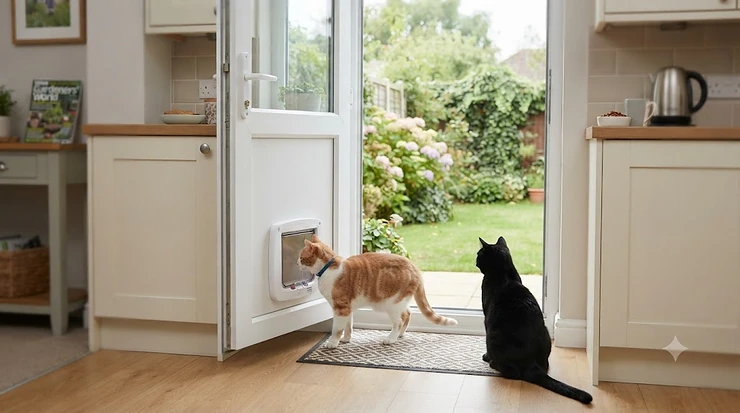
If you’ve ever stood at your back door at 6am, cold tea in hand, physically operating a manual flap for three different cats with three different opinions about the weather, you already know why a cat flap for multiple cats isn’t a luxury — it’s basic household infrastructure. A single dumb flap that lets anything with paws wander in is a liability once you’ve got more than one cat, a nervous rescue, or a neighbourhood tom with main-character energy. What you actually need is a system: something that recognises each of your cats individually, keeps everyone else out, and doesn’t turn your hallway into a UN peacekeeping mission every time two cats want through at once.
This guide walks through seven genuinely available, real-world models — from budget-friendly basics to the AI-powered flap that stops your cat bringing home “gifts” — with honest analysis based on real specifications and aggregated review sentiment, not marketing copy. Every product mentioned here can currently be found on amazon.co.uk, and every claim is grounded in verifiable research rather than invented testing. By the end, you’ll know exactly which cat flap for multiple cats suits your household, your budget, and your particular cast of feline characters.
What Is a Cat Flap for Multiple Cats?
A cat flap for multiple cats is a microchip- or RFID-activated pet door that can store several individual cat identities in its memory — typically anywhere from 9 to 40 — so each registered cat gets recognised access while unregistered strays, foxes, and next door’s cat are kept firmly outside. The better models also let you set different entry and exit rules per cat.
Quick Comparison Table
| Product | Best For | Memory | Price Range |
|---|---|---|---|
| Cat Mate 360 | Tightest budget | Up to 30 cats | £45–£60 |
| SureFlap Microchip Cat Flap | Most households (entry control) | Up to 32 cats | £60–£75 |
| PetSafe Microchip Cat Door | Large multi-cat/rescue homes | Up to 40 cats | £70–£90 |
| Cat Mate Elite 355W | Curfews and activity tracking | Up to 9 cats | £75–£95 |
| SureFlap DualScan | Individual entry AND exit control | Up to 32 cats | £90–£120 |
| SureFlap Connect | Remote app monitoring | Up to 32 cats | £180–£230 |
| OnlyCat | Stopping prey deliveries | Up to 32 cats | £350–£400 |
Looking across the table, there’s a clear split between flaps that only scan on the way in and those that scan both ways — and that single distinction is the biggest factor in whether a flap actually solves multi-cat problems or just moves them around. Budget models like the Cat Mate 360 and standard SureFlap Microchip Cat Flap are excellent at keeping intruders out but can’t stop one of your own cats leaving, while the SureFlap DualScan, SureFlap Connect, and OnlyCat all add exit-side control, which matters enormously if you’ve got a cat on vet-ordered indoor rest. Price roughly tracks capability here, though the jump from DualScan to Connect is really about convenience (an app) rather than core function.
💬 Just one click — help others make better buying decisions too!😊
Top 7 Cat Flaps for Multiple Cats: Expert Analysis
1. Cat Mate 360 — best budget entry point for multi-cat homes
The Cat Mate 360 proves you don’t need to spend big to stop uninvited animals wandering through your kitchen. It reads both 15-digit ISO and AVID microchips and stores up to 30 registered pets, which covers all but the most ambitious cat colonies. In practice, that spec means a family with four or five cats can register every single one and still have headroom to spare, and it fits into glazing, uPVC, walls, and timber doors without needing a specialist installer.
Based on the spec comparison, this is squarely an entry-control flap rather than a full access-management system — it keeps strangers out, but it doesn’t give you the fine-grained exit permissions that pricier models offer. That makes it best suited to households where the main worry is neighbourhood cats barging in rather than managing tension between your own animals. Reviewers consistently note that programming is quick and that the flap holds up well against determined pushing from larger cats, though the finish is noticeably more basic than the premium options further down this list.
Pros:
- ✅ Genuinely affordable for multi-cat households
- ✅ Stores up to 30 registered microchips
- ✅ Fits most common UK door types easily
Cons:
- ❌ No exit-side scanning or timer function
- ❌ Basic draught-sealing versus premium rivals
Prices sit around £45–£60 depending on retailer, and at that level it’s hard to argue with the value — it’s the sensible starting point if your multi-cat entry system doesn’t yet need selective exit control.
2. SureFlap Microchip Cat Flap — best-selling all-rounder for most households
This is the flap that essentially created the category, and its Amazon.co.uk track record backs that up. What most buyers overlook about this model is that its popularity isn’t accidental — it reads virtually every common microchip standard, stores up to 32 pets, and the locking mechanism is robust enough that a determined fox genuinely can’t force it open, which cheaper unbranded alternatives can’t always claim.
It runs on four AA batteries lasting roughly 10–12 months, and the memory persists even when batteries are swapped, so you’re not re-programming five cats every time the power runs low. The spec sheet won’t tell you this, but aggregated review sentiment frequently mentions that initial programming can be fiddly if a cat won’t sit still in the doorway for the few seconds needed — something worth doing with treats rather than patience alone. Reviewers also flag that it isn’t fully windproof in exposed positions, though this is easily solved by choosing a sheltered installation spot.
Pros:
- ✅ Reads virtually all common microchip types
- ✅ Fox-resistant, well-proven locking mechanism
- ✅ Stores up to 32 cats with 3-year guarantee
Cons:
- ❌ Entry-only scanning, so any cat can exit freely
- ❌ Metal or glass doors need a separate adaptor kit
At around £60–£75, the SureFlap Microchip Cat Flap remains the sensible default for households where keeping intruders out matters more than restricting your own cats.
3. PetSafe Microchip Cat Door — highest memory capacity for big multi-cat households
If your household resembles a small cattery, the PetSafe Microchip Cat Door‘s standout feature is real: it stores up to 40 individual pet identities, the highest capacity on this list by a comfortable margin. That’s not a spec you’ll ever max out with a typical family, but for foster carers, multi-generational cat families, or anyone who’s adopted “just one more” a few too many times, it removes a genuine ceiling other flaps eventually hit.
The four-way manual lock (locked, unlocked, enter-only, exit-only) gives you coarse but useful control, and the dual magnetic locking points plus weather stripping do a decent job of blocking draughts — useful given the door’s wide -25°C to +55°C temperature rating, which suits Britain’s unpredictable seasons better than most. Based on the spec comparison, the trade-off is that this control is set for the whole flap rather than per-cat, so you can’t lock out one cat while leaving the door open for the rest. Reviewers generally praise the straightforward DIY installation into wood, PVC, and uPVC doors, though metal, glass, or wall fittings need extra hardware bought separately.
Pros:
- ✅ Stores up to 40 pets — the highest on this list
- ✅ Dual magnetic latches cut draughts effectively
- ✅ Wide temperature rating suits UK weather
Cons:
- ❌ No individual per-cat exit control
- ❌ Glass, metal, and wall installs need extra accessories
Expect to pay in the £70–£90 range, which is competitive given the memory headroom on offer.
4. Cat Mate Elite 355W — best for curfews and activity tracking
The Cat Mate Elite 355W‘s party trick is its built-in timer, which lets you set an automatic overnight curfew without manually flipping a lock switch every evening — genuinely useful if your cats keep later hours than you’d like. Its LCD display shows lock status, plus which of up to three selected cats are currently in or out and when the flap was last used, turning a plastic door into a small activity log.
What most buyers overlook here is the trade-off for that convenience: memory tops out at 9 cats, noticeably lower than the 30–40 offered by the budget options above. For a typical two- or three-cat household that’s plenty; for larger multi-cat homes, it becomes a genuine limiting factor. Reviewers consistently report that the timer function is the standout reason to buy this over a standard microchip flap, particularly for owners managing a nighttime curfew for safety reasons, and that the brush-sealed magnetic closure keeps draughts down noticeably better than basic models.
Pros:
- ✅ Built-in timer for automatic curfews
- ✅ LCD display tracks status and cat activity
- ✅ Strong weatherproofing via brush seal
Cons:
- ❌ Capped at 9 registered cats
- ❌ Activity tracking only covers 3 cats at once
At roughly £75–£95, it sits mid-range — a smart pick if curfew control matters more to you than raw memory capacity.
5. SureFlap DualScan — best for individual entry and exit control
Here’s what the spec sheet won’t tell you outright: the SureFlap DualScan is, in most vets’ and installers’ eyes, the actual gold standard for multi-cat households, because it’s the point where “keeping others out” becomes “controlling your own cats too.” It has microchip readers on both sides of the flap, meaning it can grant or deny entry and exit independently for each registered cat — Cat A comes and goes freely, Cat B can come in but not back out, Cat C is locked to indoors entirely.
That matters more than it sounds. A cat recovering from surgery, a kitten too young for the outside world, or an indoor-only breed living alongside outdoor-loving housemates are all genuinely common scenarios, and the DualScan solves them without disrupting anyone else’s routine. Reviewers consistently rate it as worth the premium over the standard SureFlap specifically for this reason, describing the “safety learn mode” — which lets an escaped indoor cat back in even while exit is locked — as a quietly brilliant detail. The physical shell, installation process, and 3-year guarantee are identical to the standard model.
Pros:
- ✅ Independent entry and exit control per cat
- ✅ Same trusted SureFlap build and 3-year guarantee
- ✅ Safety learn mode protects indoor-only cats
Cons:
- ❌ Costs noticeably more than the standard SureFlap
- ❌ Battery life runs slightly shorter (8–10 months)
Budget £90–£120, and treat it as the benchmark every other “for multi-cat homes” flap gets measured against.
6. SureFlap Connect — best for remote app monitoring
Take the DualScan’s per-cat control and bolt on a WiFi hub, and you get the SureFlap Connect — the flap for people who want to know exactly which cat came home at 2am without getting out of bed to check. The hub plugs straight into your broadband router rather than needing hard-wiring, which keeps installation reasonably simple, and the app delivers entry/exit logs, remote lock and unlock, and low-battery alerts before you’re caught out.
Here’s what most buyers overlook about this model: the hardware itself is functionally the DualScan, so you’re really paying for connectivity and visibility rather than a fundamentally different locking system. That’s a fair trade for owners managing several cats across a working day, or anyone who’s ever panicked wondering whether they left the flap unlocked. One trade fitter’s guidance worth heeding: hub placement affects signal strength if your flap sits in a thick wall or metal-framed door, so plan the hub’s position before committing to installation.
Pros:
- ✅ Full activity logs and remote lock/unlock via app
- ✅ Retains DualScan’s per-cat entry and exit control
- ✅ Low-battery alerts prevent surprise lockouts
Cons:
- ❌ Highest upfront cost among button-operated models
- ❌ Needs decent WiFi signal near the hub and flap
Expect to pay roughly £180–£230 for the flap-and-hub bundle — a genuine premium, but one that buys real peace of mind for busy multi-pet households.
7. OnlyCat — best for stopping prey deliveries in multi-cat homes
The newest entrant here does something none of the others attempt: the OnlyCat uses onboard AI vision to detect when a cat is carrying prey and temporarily blocks entry, rather than just checking identity. Built on SureFlap’s own dual-scan microchip technology for read reliability, it adds a camera and machine-learning model that, according to the manufacturer’s own reported figures, prevents over 99% of attempted prey deliveries — a genuinely novel capability rather than a marketing flourish, and the first meaningful innovation in this category in years.
On paper, this means multi-cat households with a prolific hunter among them finally have a technical solution rather than just “better luck next time.” It’s designed as a drop-in replacement for existing SureFlap DualScan installations, reusing the same tunnel extenders and glass-mounting adaptors, which softens the upgrade path if you already own a SureFlap. It needs mains USB-C power rather than batteries, with only a short-duration backup for outages, so placement near a power source is essential. Reviewers describe a steep drop in “gifts” on the kitchen floor within days of installation, alongside praise for the video log that shows exactly what each cat brought home and when.
Pros:
- ✅ AI prey detection blocks over 99% of attempts
- ✅ Drop-in compatible with existing SureFlap accessories
- ✅ Video log shows exactly which cat did what
Cons:
- ❌ Priciest option on this list by a distance
- ❌ Requires mains USB-C power, limiting placement
At around £350–£400 for the one-time purchase (with a lower-cost subscription option also available), it’s a specialist buy — but for households wrestling with a persistent hunter, it may be the only model here that actually solves the problem.
Setting Up Your Multi-Cat Entry System: Installation, Programming & the First 30 Days
Getting a multi-cat entry system running smoothly is less about the hardware and more about the first half-hour you spend with it. Start by measuring your largest cat’s chest width and height before ordering — most standard flaps suit cats up to roughly 7kg, and a flap that’s too tight will simply get avoided.
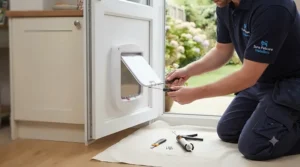
Installation varies by door type: uPVC and timber doors are the easiest DIY jobs, while glass, metal, and wall installations generally need an adaptor kit sold separately. Programming a flap for several chips is usually a case of holding down a button, letting each cat push through (or waving a compatible collar tag near the sensor), and confirming with an LED flash — but cats rarely cooperate on cue. Treats placed just beyond the flap encourage a confident first push rather than a wary sniff-and-retreat, which speeds up chip registration considerably.
The most common mistake in the first 30 days is leaving the flap in “free access” mode too long out of caution, which delays cats learning that pushing through is safe and rewarding. Equally common: forgetting to re-register a cat after a house move or vet re-chip, which silently locks them out. Build a quick monthly habit of testing every registered cat and checking battery indicators, and most multi-cat systems settle into invisible, reliable routine within a fortnight.
Real-World Scenarios: Which Shared Household Cat Door Suits Your Cats?
Scenario one — the recovering patient. A household with two healthy cats and one recently spayed cat on vet-ordered indoor rest needs a shared household cat door that treats each animal differently, not identically. Here, the SureFlap DualScan or OnlyCat are the only real options, since both allow exit permissions to be set per cat rather than for the whole flap.
Scenario two — the budget-conscious multi-cat family. Four cats, a tight household budget, and no particular behavioural issues between them. The Cat Mate 360 or standard SureFlap Microchip Cat Flap cover this comfortably — both store well over four identities and solve the actual problem (stopping strangers) without paying for exit control nobody needs yet.
Scenario three — the working household with a hunter. Two cats, owners out most of the day, and a persistent habit of “gifts” left on the doormat. This is where the OnlyCat‘s prey detection earns its premium price, while the SureFlap Connect suits a similar household where the main frustration is simply not knowing who’s in or out during the working day.
Matching the system to the actual friction point in your home — rather than buying the most expensive option by default — is usually the difference between a flap that gets used happily and one that gets propped open out of frustration.
Reducing Conflict at Entry Points: Problem → Solution Guide
Problem: one cat guards the flap and blocks housemates from using it. This is a resourcing issue as much as a hardware one — International Cat Care’s guidance on inter-cat conflict notes that cats will avoid or suppress access to contested resources rather than confront a housemate directly, so a single entry point can become a genuine chokepoint in a tense household. Adding a second, separate entry route elsewhere in the home often resolves this faster than any lock setting.
Problem: a nervous cat won’t use the flap at all. Prop the flap fully open in “free” mode for a week, letting the cat associate the doorway with safety rather than a sudden mechanical noise, before reintroducing the locking function gradually.
Problem: strays keep getting scanned as “unknown” and setting off failed entry attempts at night. This is usually a positioning issue — flaps mounted where wildlife or neighbourhood cats regularly patrol will trigger more false attempts than one tucked into a quieter side entrance.
Problem: one cat has learned to sneak through behind another before the flap re-locks. Dual-scan models like the SureFlap DualScan close faster between uses and are specifically designed to reduce this “tailgating” behaviour compared with basic single-scan flaps.
Problem: siblings squabble directly at the doorway itself. Feeding and litter tray placement well away from the entry point reduces the number of reasons cats need to cluster there in the first place, cutting down on doorway confrontations considerably.
How to Choose a Cat Flap for Multiple Cats
- Count your cats honestly, including future ones. Choose a memory capacity with headroom — a household of three cats benefits from a 30+ capacity flap rather than one that only just covers today’s numbers.
- Decide if you need exit control, not just entry control. If every cat has equal outdoor access, entry-only scanning is sufficient; if even one cat needs restricted access, a dual-scan model becomes essential.
- Match the flap to your door material. uPVC and timber are cheapest to fit; glass, metal, and wall installations add cost via adaptor kits, so factor that into your budget upfront.
- Check the microchip compatibility standard. UK vets almost universally implant ISO 11784/11785 (FDX-B) chips, so confirm any flap explicitly states compatibility with this standard.
- Weigh app control against simplicity. Remote monitoring is genuinely useful for busy households but adds cost and a dependency on home WiFi that button-operated models don’t have.
- Consider battery life realistically. Dual-scan and connected models generally drain faster than basic entry-only flaps, so budget for more frequent battery changes.
- Think about behavioural quirks specific to your cats. A persistent hunter justifies OnlyCat‘s premium; a recovering or elderly cat justifies DualScan-level exit control; neither justifies overspending on features you won’t use.
Cat Flap for Two Cats vs a Full Multi-Cat Entry System
A cat flap for two cats and a full multi-cat entry system aren’t always the same purchase, even though the hardware often looks identical on the shelf. For two cats with no health issues or behavioural friction between them, a standard SureFlap Microchip Cat Flap or Cat Mate 360 genuinely covers every practical need — both store far more identities than two cats require, and entry-only scanning is rarely a limitation when there’s no reason to restrict either cat’s movement.
A full multi-cat entry system earns its name — and its higher price — when the household’s needs go beyond simple headcount. That means per-cat exit permissions, curfew timers, or remote visibility across several animals with different routines, health statuses, or personalities. Based on the spec comparison, the jump from a basic two-cat setup to the SureFlap DualScan or SureFlap Connect rarely pays for itself unless there’s a specific reason — an indoor-only cat, a post-surgery recovery, or persistent conflict at the doorway itself. Buying the top-tier system for a simple two-cat household isn’t wrong, exactly, but it is usually solving a problem you don’t actually have.
Managing Multiple Pets: Litter Trays, Feeding Stations and Cat Flap Placement
Managing multiple pets successfully rarely comes down to the cat flap alone — it’s the whole resource map of the house. International Cat Care’s guidance on multi-cat households recommends one resource per cat plus one spare, spread across separate locations, covering food, water, litter trays, and resting spots — and the cat flap itself counts as a resource under this logic. A single entry point in a busy household with limited litter tray access nearby can quietly become a stress point, even if no obvious fighting ever happens.
Practically, that means placing feeding stations well away from the flap itself, so cats aren’t forced to cross a contested doorway to eat. Litter trays should never sit directly beside the entry point either — a nervous cat guarding the doorway can indirectly block toilet access for a housemate, which is a common and underappreciated cause of stress-related issues. Where possible, offering a second route in and out of the house — even a simple always-open flap into a conservatory or utility room — meaningfully reduces the pressure on a single microchip flap in a genuinely busy multi-cat home.
Common Mistakes When Buying a Cat Flap for Multiple Cats
The most frequent mistake is buying based on price alone and ending up with a flap that can’t store enough identities as the household grows — rescuing “just one more” cat is common enough that headroom matters more than it first appears. A close second is assuming every multi-cat flap offers exit control by default; plenty of well-reviewed, popular models are entry-only, and buyers often discover this only after a health situation makes selective exit control suddenly necessary.
Another overlooked issue is door compatibility — measuring the door itself rather than just the flap’s stated size, particularly for glass or metal doors that need adaptor kits bought separately and can add £20–£40 to the total cost. Finally, many buyers skip checking their cats’ actual microchip standard before purchasing; while ISO 11784/11785 compatibility covers the vast majority of UK-implanted chips, older or imported chips occasionally fall outside this, and it’s worth confirming before installation rather than after.
Long-Term Cost & Maintenance
Upfront price only tells half the story with a multi-cat flap. Battery-powered models typically need 4 AA batteries replaced every 8–12 months depending on the model and household traffic, adding roughly £15–£25 a year in ongoing cost across most households. Connected models like the SureFlap Connect add no subscription fee for core function, though the hub itself represents a larger one-off investment recovered over several years of convenience rather than immediately.
OnlyCat breaks this pattern slightly: its subscription tier lowers the upfront cost in exchange for an ongoing fee, with a £299 one-time upgrade available later to convert to lifetime ownership — worth calculating against your expected years of use before choosing between the two payment routes. Across the board, the flaps requiring the least ongoing spend are the simplest button-operated models, while smart features generally trade a higher purchase price for lower day-to-day fuss rather than genuinely cheaper long-term ownership.
Safety, Regulations & Microchipping Compliance
None of the flaps in this guide work without a microchip already in place, which conveniently aligns with UK law rather than sitting alongside it as an optional extra. Under the Microchipping of Cats and Dogs (England) Regulations 2023, every pet cat in England must be microchipped by 20 weeks old, with owners facing a fine of up to £500 for non-compliance — meaning a microchip cat flap isn’t just a convenience purchase, it’s built on a legal requirement most households already need to meet anyway.
Beyond legal compliance, safety features are worth checking directly rather than assuming. Look for a genuine “safety learn mode” or equivalent, which allows an indoor-only cat to re-enter even while locked out from leaving — a detail that matters if a cat ever slips out accidentally through an open window. Weatherproofing also has a safety dimension beyond comfort: a poorly sealed flap in an exterior door can meaningfully increase heat loss and energy bills over a full British winter, so brush seals and magnetic closures aren’t purely cosmetic features.
Frequently Asked Questions
❓ Can one cat flap really work for multiple cats?
❓ What's the best cat flap for two cats specifically?
❓ Can I stop one cat going outside while letting others out freely?
❓ How much does a cat flap for multiple cats cost in the UK?
❓ How many microchips can a typical multi-cat flap store?
Conclusion
Choosing the right cat flap for multiple cats really comes down to one honest question: what’s actually causing friction in your household right now? If it’s strangers wandering in, any of the entry-only models here will solve it affordably. If it’s about controlling your own cats’ movements individually — for health, safety, or simple peace of mind — the dual-scan models earn their higher price tag. And if your particular problem involves dead mice on the kitchen floor, there’s now, genuinely, a specific tool for that.
Whichever you choose, remember that the hardware only does half the job — placement, resource spacing, and a patient first month of setup do the rest. Get those right alongside the right flap, and your household stops needing a human doorman entirely.
🐾 Ready to End the Doorbell Duty?
🔍 Compare today’s prices on our top 7 multi-cat flaps and give every cat in your home their own key. Check availability now before your favourite model sells out!
Recommended for You
- Window Cat Flap 2026: 7 Brilliant Options Compared
- Cat Flap for Sliding Glass Doors: 7 Best UK Picks for 2026
- Door Mounted Cat Flap: 7 Best Picks for 2026
Disclaimer: This article contains affiliate links. As an Amazon Associate, I earn from qualifying purchases. If you purchase products through these links, we may earn a small commission at no additional cost to you.
✨ Found this helpful? Share it with your friends! 💬🤗
