
In This Article
There’s a particular kind of madness that sets in when you live in a flat with no back door, just a lovely big window and a cat who has decided, with total conviction, that the great outdoors is her birthright. If you’ve ever propped a window open on a warm evening “just for five minutes” and then spent the next hour anxiously listening for the thud of paws on next door’s shed roof, you already understand why a window cat flap exists. It solves a problem that door-based solutions simply can’t: what happens when your only viable exit is glazed, several feet off the ground, and worth several hundred pounds to modify incorrectly.
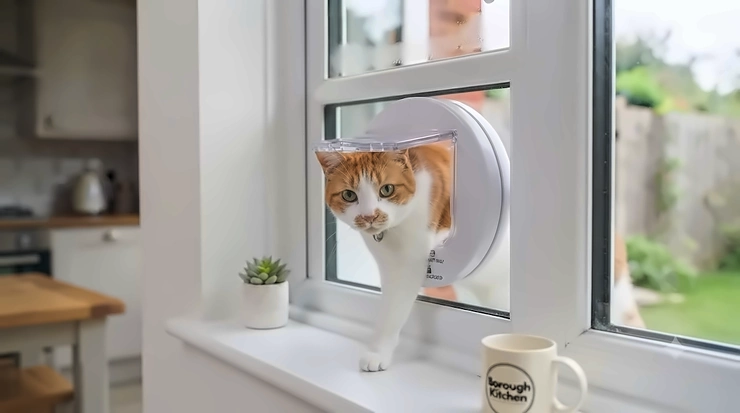
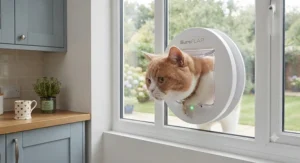
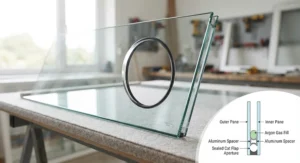
A window cat flap is a pet door fitted directly into a pane of window glass rather than into a door panel, wall, or wooden frame, giving cats independent access to the outside through a purpose-cut, sealed opening. Unlike a standard door-mounted flap, it usually requires professional glass cutting, a replacement sealed unit for double glazing, and careful thought about weatherproofing, since glass behaves very differently to timber or uPVC once you introduce a hole into it. That’s not a reason to avoid the idea, but it is a reason to research it properly before you call a glazier.
Below, we’ve dug into seven real, currently available products and services suited to window installations, from budget acrylic inserts to full microchip systems and professional glass-cutting services. The idea itself is far older than most people assume: the Oxford English Dictionary traces the phrase “cat flap” back to 1957, though according to Wikipedia’s history of the pet door, cat-sized openings in walls and doors go back centuries further — so this is a genuinely old problem with some genuinely modern solutions. We’ll cover pricing ranges, honest review sentiment, glass-cutting logistics, and the safety questions worth asking before anyone reaches for a diamond drill bit.
Quick Comparison Table
Before the deep dive, here’s a snapshot of how the seven options stack up on cost, cat suitability, and what each is genuinely best for. Treat this as a starting point rather than the final word — the detailed sections below explain the reasoning behind each entry.
| Product | Type | Price Range | Best For |
|---|---|---|---|
| Cat Mate 210W | Manual, 4-way lock | Under £30 | Budget window insert for small/medium cats |
| Cat Mate 357W | Manual, 4-way lock | £30-£50 range | Large cats and small dogs needing a bigger window insert |
| SureFlap Microchip Cat Flap | Microchip, glass adaptor | £50-£75 range | Single-cat homes wanting intruder-proof security |
| SureFlap DualScan | Microchip, in/out control | £90-£120 range | Multi-cat households needing individual permissions |
| PetPorte Smart Flap | Microchip, curfew timer | £120-£150 range | Owners wanting scheduled access without an app |
| PetSafe Big Cat Flap | Microchip, extra-large | £90-£130 range | Big cats and small dogs sharing one window |
| Pet Flaps UK glass-cutting service | Installation service | £185-£400 range | Anyone who doesn’t want to touch the glass themselves |
Looking at the spread, the story here isn’t really “which brand wins” — it’s “which combination of flap and glasswork suits your window.” A manual Cat Mate 210W paired with a competent local glazier can end up costing less overall than a premium microchip flap installed badly, while a household with three cats and one that needs to stay in overnight will find the extra spend on the SureFlap DualScan pays for itself in reduced stress alone. Budget buyers should also note that the flap price and the glass-cutting price are almost always separate line items, so the headline cost of the unit rarely reflects the true total.
💬 Just one click — help others make better buying decisions too!😊
Top 7 Window Cat Flaps: Expert Analysis
Every one of these products or services can genuinely be fitted into a window, whether that’s via a purpose-cut acrylic panel, a replacement sealed double-glazed unit, or a professional glass-cutting job. We’ve mixed manual and microchip options, budget and premium, and included the one type of business — the glass-cutting specialist — that most buying guides forget entirely.
1. Cat Mate 210W Glass Fitting Cat Flap — cheapest genuine window mounted cat flap
The 210W is the entry point into proper glass fitting kit, and its low price doesn’t mean it’s an afterthought — it’s specifically engineered as a window mounted cat flap rather than a door flap with a glass adaptor bolted on. It self-lines to 32mm thick, which comfortably covers most single glazing and thinner acrylic replacement panels, and the cut-out diameter sits around 223mm, a hole size most glaziers can quote for without blinking. Based on the spec comparison with pricier microchip units, what you’re really paying for here is simplicity: a four-way manual lock (open, closed, in-only, out-only) and a magnetic closure, nothing more. That’s precisely why it suits a specific type of buyer — someone with one well-behaved cat, no stray-cat problem in the neighbourhood, and a preference for a mechanism with fewer things to go wrong. Reviewers consistently note that the flap is quiet in operation and straightforward to fit once the glass hole exists, though several mention that toughened double glazing means ordering a new sealed unit rather than drilling the existing pane — an unavoidable reality of glass, not a flaw specific to this model.
Pros:
- ✅ Lowest-cost genuine glass and window fitting cat flap
- ✅ Four-way manual lock gives basic access control
- ✅ Slim 32mm self-lining suits thin panels and acrylic
Cons:
- ❌ No microchip recognition, so any cat can use it
- ❌ Toughened double glazing needs a new sealed unit, adding cost
At around under £30 for the unit itself, the Cat Mate 210W represents strong value for a first-time cat flap window insert, provided you budget separately and realistically for the glazier.
2. Cat Mate 357W Large Glass & Wall Fitting Cat Flap — roomiest window insert for big cats
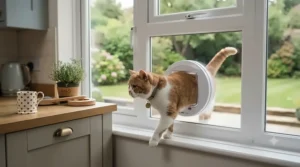
Where the 210W is aimed at average-sized cats, the 357W exists for the Maine Coons, the fluffy rescue toms, and the small dogs that occasionally share a cat flap out of sheer stubbornness. Its passage accommodates pets up to roughly 360mm at the shoulder, and the self-lining extends to 50mm thick, meaning it can handle chunkier acrylic replacement panels or slightly deeper glazing setups than its smaller sibling. What most buyers overlook about this model is that a bigger opening isn’t purely a size decision — it also changes the draught-proofing equation, since a larger brush seal and magnetic closure have more surface area to keep weathertight. Here’s what to weigh: if your only outdoor access point is a window, and your cat is on the larger side, downsizing to save a few pounds on the smaller flap often just means a cat wedging themselves through anyway, which stresses the seal and shortens the flap’s lifespan. Aggregated review sentiment on this range is positive regarding build quality and the double-point locking system, with the most common criticism being that the transparent flap can feel stiff in very cold weather until it’s bedded in.
Pros:
- ✅ Generous opening suits large cats and small dogs
- ✅ 50mm self-lining copes with thicker replacement panels
- ✅ Double-point four-way lock for stronger security
Cons:
- ❌ Larger cut-out means a pricier custom glass panel
- ❌ Bulkier profile is more visually noticeable on the window
Priced in the £30-£50 range, the Cat Mate 357W is the sensible mid-tier pick when “will my cat actually fit” is a genuine question rather than a formality.
3. SureFlap Microchip Cat Flap (with glass mounting adaptor) — smartest single-cat security upgrade
This is where things move from “keeps the weather out” to “keeps the neighbourhood cats out,” and for many owners that distinction is the entire point of upgrading. The SureFlap reads your cat’s existing implanted microchip rather than requiring a separate collar tag, storing up to 32 pet identities and unlocking only for registered chips. For a window installation specifically, the manufacturer supplies a dedicated glass mounting adaptor designed for a circular hole of roughly 212mm, and the official guidance is blunt about the glasswork: cutting glass is a skilled job and should be handled by a qualified glazier, not attempted as a DIY project. On paper this means slightly more setup faff than a manual flap, but the trade-off is real: reviewers consistently report a sharp drop in unwanted feline visitors once the microchip lock is active, and the low-battery indicator means you’re rarely caught out mid-week with a flap that’s stopped working. A genuinely useful detail buried in the manual is the safety learn mode, which lets an indoor cat that’s slipped out through an open window get back in even while the flap is set to locked overnight — a small feature with outsized peace-of-mind value.
Pros:
- ✅ Recognises existing microchips, no collar tag needed
- ✅ Stores up to 32 pet identities for shared homes
- ✅ Safety learn mode lets escapees back in when locked
Cons:
- ❌ Requires a separate glass mounting adaptor, sold apart
- ❌ Battery-only power means periodic AA changes
In the £50-£75 range for the flap alone, the SureFlap Microchip Cat Flap earns its reputation as the default recommendation for single-cat households wanting real security through a window.
4. SureFlap DualScan Microchip Cat Door — best for multi-cat households needing individual control
Multi-cat homes have a specific headache that single-cat products don’t solve: sometimes you want one cat allowed out and another kept firmly indoors, perhaps because of a vet appointment, a recovery period, or simply because one cat is a known escape artist and the other isn’t. The DualScan reads microchips on both entry and exit, which is the mechanical difference that makes individual permissions possible — you can set each registered cat to “in and out,” “in only,” or fully locked, and change it at any time. Reviewers consistently highlight this as the reason they upgraded from a standard microchip flap, particularly owners managing an indoor-only cat alongside outdoor-access siblings. Based on the spec comparison with the single-scan SureFlap, the DualScan needs the same 212mm-to-260mm circular glass hole and the same professional glazier involvement, so the installation complexity doesn’t increase — only the internal electronics do. What most buyers overlook is that this model genuinely reduces the low-level daily stress of shouting a cat’s name at 11pm to check who’s actually outside, since the app-free permission system does that job automatically.
Pros:
- ✅ Reads microchips on both entry and exit for real control
- ✅ Individual permissions per cat, changeable anytime
- ✅ Same glass hole size as the standard SureFlap model
Cons:
- ❌ Premium price compared with single-scan alternatives
- ❌ More cats registered means more monitoring to manage
At £90-£120 for the unit, the SureFlap DualScan is squarely aimed at households where “which cat is out there” is a genuinely common question.
5. PetPorte Smart Flap Microchip Cat Flap — quietest mechanism with scheduled curfews
The PetPorte range takes a slightly different engineering approach, and reviewers consistently single out noise level as the standout difference — several describe it as noticeably quieter in operation than rival microchip flaps, which matters more than it sounds if the flap sits near a bedroom or living space. Functionally, it offers four locking modes and microchip recognition, and the manufacturer’s own installation guidance for glass mirrors the SureFlap approach almost exactly: a 212mm circular hole cut by a professional glazier, with working with glass explicitly described as a skilled job best left to that professional. What most buyers overlook about the PetPorte compared with its rivals is the curfew-style scheduling, which lets you set fixed times for locking rather than relying purely on manual toggling — useful for owners with predictable routines who want the flap to essentially manage itself. The trade-off, based on aggregated review sentiment, is a slightly steeper price and reports that battery life runs a touch shorter than some competitors under heavy use, so budgeting for more frequent AA changes is sensible.
Pros:
- ✅ Genuinely quieter mechanism than most microchip rivals
- ✅ Scheduled curfew locking without needing an app
- ✅ Four distinct locking modes for flexible control
Cons:
- ❌ Sits at the higher end of the microchip price bracket
- ❌ Some reports of shorter battery life under heavy use
Typically found in the £120-£150 range, the PetPorte Smart Flap suits owners who want scheduling built in rather than managed manually every evening.
6. PetSafe Big Cat Flap — largest opening for big cats and small dogs sharing a window
Where the Cat Mate 357W offers a larger manual option, the PetSafe Big Cat Flap does the same job but with microchip recognition layered on top, aimed at the household where “our cat is basically a small dog” is a literal rather than affectionate description. It’s compatible with a dedicated glass installation adaptor that includes a circular cutting template, and the manufacturer is explicit that the cutout in glass must be handled by a professional glazier, with multi-pane or tempered units needing the hole cut during manufacture rather than afterwards. Here’s what to weigh: a bigger opening means a bigger, pricier custom glass panel, so this isn’t the flap to choose “just in case” for an average-sized cat — it earns its premium when the passage size is genuinely necessary. Reviewers consistently mention the sturdier frame construction compared with standard-sized microchip flaps, which makes sense given the larger surface area needs more structural rigidity to avoid flexing under a bigger animal’s weight.
Pros:
- ✅ Largest passage size for cats and small dogs alike
- ✅ Microchip recognition adds security over manual rivals
- ✅ Sturdier frame built for the bigger opening
Cons:
- ❌ Custom-cut glass panel costs more due to hole size
- ❌ Overkill and pricier than necessary for average cats
Sitting in the £90-£130 range for the flap, the PetSafe Big Cat Flap is a genuinely purpose-built choice rather than a generic upsell.
7. Pet Flaps UK glass-cutting and installation service — done-for-you cat flap glass cutting service
Every flap above shares one unavoidable requirement: something has to physically cut the hole in the glass, and that job sits outside most homeowners’ comfort zone (and outside most general handymen’s toolkits, too, since toughened glass cannot be drilled or cut on-site once manufactured). This is where a dedicated cat flap glass cutting service earns its place on this list as a genuine seventh option rather than an afterthought. Companies specialising in this work — Pet Flaps UK among the more established — handle the entire process: surveying the window, ordering a replacement sealed glass unit manufactured with the cut-out built in, and fitting the flap of your choice once the new pane arrives. Reviewers consistently describe the process as smoother than expected once they understood that toughened double glazing simply cannot be modified after the fact, meaning a wait of one to three weeks for the new unit is completely normal rather than a sign of a slow service. What most buyers overlook is that this route often works out more cost-effective than DIY-adjacent alternatives once you factor in a wasted attempt at cutting toughened glass, which typically shatters the entire pane and forces a replacement unit anyway.
Pros:
- ✅ Removes all risk of DIY glass-cutting mistakes
- ✅ Handles ordering and fitting the replacement sealed unit
- ✅ Typically includes workmanship guarantees
Cons:
- ❌ Slower than a straightforward door installation
- ❌ Adds a service fee on top of the flap’s own price
Based on current UK trade pricing, a full glass-cutting and fitting service for a window cat flap typically falls in the £185-£400 range depending on glazing type, according to Checkatrade’s cat flap installation cost guide — worth checking current price with a local installer before committing to any single flap choice above.
Practical Usage Guide: Getting Your Window Cat Flap Right From Day One
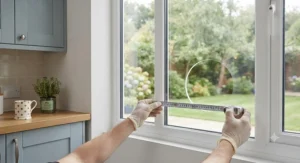
Buying the flap is genuinely the easy part. Setup starts with positioning: the bottom of the opening should sit roughly level with your cat’s belly when standing, not at a generic “average height,” since a flap positioned too high forces an awkward jump that nervous or older cats will simply avoid using. Before any glass is cut, measure your cat’s shoulder width and add a sensible margin — most manufacturers publish minimum passage dimensions, and it’s worth checking these against your actual cat rather than assuming “standard size” covers everyone. Once fitted, the first fortnight is about training, not troubleshooting: prop the flap open with tape for the first few days so your cat associates the opening with easy access rather than a barrier, then gradually let it swing freely. A common first-30-days mistake is switching straight to microchip-locked mode before the cat has learned to push the flap at all, which understandably looks like a malfunction but is actually a training gap. Maintenance is minimal but not zero — wipe the seal and hinge area every few months to stop grit building up, and check the magnetic closure each autumn, since a weak seal in winter is where most heat loss and draught complaints originate. If you’ve opted for the professional glass-cutting route, keep the installer’s paperwork; it typically covers both the workmanship and the glass unit itself, which matters if a seal fails within the warranty period.
Who Actually Needs a Window Cat Flap? Three Real-World Scenarios
The flat-dweller with no back door. If you’re on a raised ground floor or first floor with a single accessible window onto a balcony, patio, or flat roof, a window cat flap is often the only realistic option beyond walking your cat on a lead. Here, a manual model like the Cat Mate 210W paired with a professional glazier is usually enough, since security concerns are lower when the exit doesn’t lead directly onto open ground.
The multi-cat household with one indoor-only cat. If you’re managing three cats and one needs to stay in — perhaps recovering from surgery, or simply temperamentally unsuited to the outdoors — individual permission control stops being a luxury and becomes the actual point of the purchase. The SureFlap DualScan or a similarly equipped model earns its higher price here by solving a specific daily problem rather than a hypothetical one.
The renter or leaseholder facing hesitant landlords. Cutting a hole in a window is a permanent modification, and tenants should always secure written landlord permission before booking any glass work — this is separate from, and in addition to, any building regulations considerations. In this scenario, a reversible sealed unit swap (rather than cutting the existing pane) fitted by a specialist like a dedicated cat flap glass cutting service is usually the safer route, since the original glass can, in principle, be reordered and reinstated at the end of a tenancy.
Problem → Solution: Fixing Common Window Cat Flap Headaches
Problem: draughts around the flap in winter. This is almost always a seal issue rather than a design flaw. Check the magnetic closure hasn’t weakened and that the brush seal on models like the Cat Mate 357W hasn’t compressed or worn thin; replacement seal kits are usually available from the manufacturer directly.
Problem: the cat won’t use it. Nine times out of ten this traces back to positioning or training, not the flap itself. Revisit the propped-open training period described above, and check the opening height genuinely matches your cat’s belly line rather than a generic average.
Problem: other cats keep getting in. A manual flap simply can’t discriminate between cats. Upgrading to a microchip-reading model such as the SureFlap Microchip Cat Flap solves this directly, since aggregated review sentiment across the microchip category consistently shows a sharp drop in unwanted visitors once installed. The RSPCA’s guidance on keeping other cats out of your home covers wider steps worth pairing with a microchip flap, such as removing outdoor food sources that might be attracting visiting cats in the first place.
Problem: the glass cracked during a DIY cutting attempt. Toughened glass cannot be cut or drilled after manufacture — attempting it will cause the pane to shatter. The only fix at that point is ordering a replacement sealed unit through a specialist cat flap glass cutting service, which is precisely the scenario that service exists to prevent in the first place.
Problem: uncertainty over whether double glazing needs a full new pane. It does, in almost every case. Existing toughened or laminated double-glazed units cannot be modified on-site; a new sealed unit manufactured with the cut-out built in is the only compliant route.
How to Choose a Window Cat Flap
- Measure your cat’s shoulder width and belly height first. Every other decision follows from this, since an undersized flap gets avoided and an incorrectly positioned one gets ignored.
- Decide whether microchip security is worth the premium. If stray or neighbourhood cats are a known issue nearby, a microchip model like the SureFlap Microchip Cat Flap typically pays for itself in reduced stress and mess.
- Check your glazing type before falling in love with a flap. Single glazing, acrylic panels, and toughened double glazing all have different cutting and cost implications, so confirm this with a glazier before finalising your choice.
- Budget separately for the flap and the glasswork. Treating these as one combined cost, rather than two, avoids the nasty surprise of a cheap flap sitting alongside an expensive glass replacement quote.
- Consider household size and cat number. A single-cat home rarely needs the individual permission features of a SureFlap DualScan, while a multi-cat home often finds it essential.
- Get landlord or building consent sorted early if renting or leasehold. This step is frequently left until after a flap has already been purchased, which wastes both time and money if permission is refused.
- Ask any installer about warranty coverage on both the glass and the fitting. A cat flap glass cutting service worth using will typically guarantee both elements, not just the labour.
Window Cat Flap vs Door-Mounted Cat Flap
The obvious question many buyers ask is whether it’s simpler to just fit a cat flap in a door instead, and the honest answer is: it depends entirely on what access points your home actually has. A door-mounted cat flap is generally cheaper to install in wood or uPVC, since those materials can be cut on-site without the manufacturing lead time that toughened glass demands. However, a glass cat flap for windows becomes the only sensible option when your accessible exit genuinely is a window — a first-floor flat with a balcony, or a ground-floor room where the door leads somewhere unsuitable, such as a shared hallway. Cost-wise, glass installation typically runs higher than a straightforward wooden door fitting, largely because of the replacement sealed unit requirement for double glazing, whereas a uPVC panel swap can sometimes be cheaper than either. The security profile is broadly identical between the two once you’ve chosen a microchip model, since the electronics don’t change based on what they’re mounted in — the difference is almost entirely about installation complexity, lead time, and cost rather than the cat’s actual experience of using the flap.
Window Safety for Cats: What to Check Before You Cut Glass
Window safety for cats extends well beyond the cat flap itself, and it’s worth addressing directly because glazed openings carry genuine risks that door installations simply don’t. UK Building Regulations Approved Document K sets out “critical locations” for safety glazing, generally covering glass below 800mm from floor level and glazing near doors — toughened or laminated glass is required in these zones specifically because ordinary annealed glass can shatter into sharp, dangerous shards on impact, whereas safety glass breaks into small, blunt fragments. Any reputable cat flap glass cutting service should already be using appropriately rated glass for a replacement panel, but it’s a fair question to ask directly rather than assume. Beyond the glass itself, remember that a cat flap is an access point in both directions: the same opening that lets your cat out safely can also let them return with prey, which is a behavioural rather than structural consideration but worth planning for. The RSPCA’s advice on cat microchipping notes that a microchip-enabled flap can be programmed to recognise only your own cat’s chip, keeping out both unwelcome neighbourhood cats and other wildlife, which is as much a safety feature as a convenience one, since repeated territorial stand-offs at an unsecured flap are a genuine source of stress-related health issues in cats.
Ventilation and Pet Doors: Draught-Proofing Without Losing Airflow
There’s a persistent myth that any hole in a window automatically means a draughtier, colder home, and while there’s a grain of truth to it, well-specified ventilation and pet doors are designed specifically to minimise that trade-off. Brush seals and magnetic closures, present on every product in this guide, exist precisely to close the gap a plain flap would otherwise leave, and models with thicker self-lining — such as the Cat Mate 357W at 50mm — generally perform better in this respect than slimmer budget options. What most buyers overlook is that the glass adaptor kits used for window installations, such as the PetSafe adaptor compatible with several microchip models, include their own gasket specifically to maintain energy efficiency at the join between adaptor and glass. Practically speaking, if minimising heat loss matters to you — whether for comfort or energy bills — it’s worth asking any installer directly about the seal specification rather than assuming all flaps perform equally, since this is exactly the kind of detail that separates a genuinely weatherproof installation from one that merely looks the part.
Long-Term Cost & Maintenance of a Window Cat Flap
The upfront price tag on any of these seven options is only part of the real cost picture. Glazier fees for glass cat flap for windows installations typically sit in the £150-£400 range depending on glazing complexity, and that’s before factoring in the flap itself, meaning total first-year outlay can easily reach £200-£500 for a full microchip installation through professional glasswork. Ongoing costs are comparatively modest: manual flaps need occasional seal replacement, perhaps every two to three years depending on weather exposure, while microchip models add AA battery changes roughly every six to twelve months. Where the real long-term value shows up is in avoided costs rather than spend — a properly sealed, correctly specified window installation reduces heat loss compared with a badly fitted DIY alternative, and a microchip-secured flap avoids the ongoing nuisance (and occasional vet bills from territorial disputes) associated with unwanted feline visitors. Viewed as a five-year cost of ownership rather than a single purchase price, the premium models in this guide, such as the SureFlap DualScan or PetPorte Smart Flap, tend to close the gap with budget manual options once reduced maintenance and fewer behavioural problems are factored in.
Common Mistakes When Buying a Window Cat Flap
The single most frequent mistake is measuring the cat flap opening rather than the cat, leading to a passage that’s technically installed correctly but practically too small or too large for actual daily use. A close second is assuming existing double glazing can simply be drilled — it can’t, and attempting it typically destroys the pane entirely, turning a straightforward job into an emergency glass replacement. Many buyers also skip checking landlord or leasehold permission until after ordering a flap, only to discover the modification isn’t allowed, wasting both the purchase and any deposit paid to an installer. On the product side, a common error is choosing a manual flap purely on price when a known stray-cat problem in the area makes microchip security the more sensible long-term investment. Finally, some buyers underestimate installation lead time — a replacement sealed glass unit for a window mounted cat flap can take one to three weeks to manufacture, and planning a fitting date without accounting for that wait is a frequent source of frustration.
Features That Actually Matter (And Those That Don’t)
Cutting through the marketing noise, a handful of features genuinely affect day-to-day performance: microchip recognition (security), seal quality and self-lining thickness (draught-proofing), and correctly matched passage size (whether your cat actually uses it) are the three that consistently show up in real review sentiment as making a difference. Curfew scheduling, as offered on the PetPorte Smart Flap, is a genuine convenience for owners with predictable routines but isn’t essential for everyone. On the other hand, flap colour, minor styling differences between otherwise similar models, and marketing claims about “premium” materials without any accompanying spec change are largely cosmetic and shouldn’t sway a buying decision on their own. The spec sheet won’t tell you this, but reviewers note that battery life claims are often measured under ideal conditions, so real-world performance — particularly in a well-trafficked multi-cat household — tends to run somewhat shorter than the headline figure suggests.
Frequently Asked Questions
❓ Can any window have a cat flap fitted?
❓ How much does a window cat flap cost to install in the UK?
❓ Do window cat flaps let in more draughts than door versions?
❓ Is a microchip cat flap worth it for a window installation?
❓ Can I cut the glass myself to save on installation costs?
Conclusion
Choosing between these seven options really comes down to answering three honest questions: what’s your actual glazing type, how many cats need access, and how much are you willing to spend upfront versus over time. Budget-conscious owners with a single, well-behaved cat and no stray-cat problems nearby will likely find the Cat Mate 210W does everything genuinely necessary, provided the glasswork is handled properly. Households wrestling with unwanted feline visitors, or juggling different access needs across multiple cats, will get more lasting value from a microchip model like the SureFlap DualScan or PetPorte Smart Flap, even at a higher upfront cost. And regardless of which flap wins the debate at your kitchen table, don’t skip the seventh entry on this list — a proper cat flap glass cutting service, whether that’s Pet Flaps UK or an equally established local specialist, is what turns a good product choice into a safe, weatherproof, genuinely long-lasting installation. Whatever you land on, check current price and availability before committing, since both flap pricing and glazier quotes shift throughout the year.
✨ Don’t Miss These Exclusive Deals!
🔍 Take your window cat flap search to the next level with these carefully selected products. Click on any highlighted item to check current pricing and availability. These tools will help you create a genuinely safer, more comfortable home your cat will love!
Recommended for You
- Cat Flap for Sliding Glass Doors: 7 Best UK Picks for 2026
- Door Mounted Cat Flap: 7 Best Picks for 2026
- Top 7 Top Cat Flaps Under £50 in 2026: Budget Picks
Disclaimer: This article contains affiliate links. As an Amazon Associate, I earn from qualifying purchases. If you purchase products through these links, we may earn a small commission at no additional cost to you.
✨ Found this helpful? Share it with your friends! 💬🤗
