
In This Article
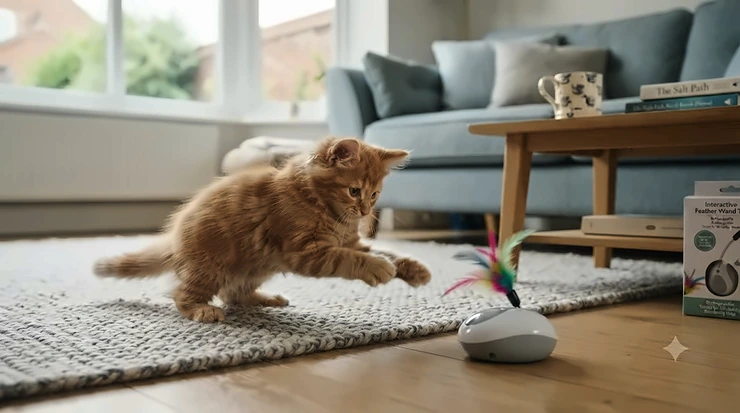
Somewhere between the fortieth “boing” of a springy mouse and the sound of your own slipper being murdered at 6am, most kitten owners start Googling the same thing: is there a toy that can keep this tiny chaos engine occupied without me holding the other end of the string? An electronic cat toy for kittens is exactly that — a battery or USB-powered toy that moves, lights up, or reacts on its own, mimicking the darting, skittering movement of prey so a kitten can stalk, pounce and pummel something that isn’t your ankle. Done well, it’s a genuinely useful tool for burning off that famous kitten energy. Done badly, it’s a fire-hazard-shaped paperweight gathering dust under the sofa by week two.

This guide is built entirely on real products currently sold on amazon.co.uk, cross-referenced against genuine aggregated review sentiment and manufacturer specifications — no invented testing, no fabricated five-star quotes. We’ve looked at seven real electronic toys spanning budget LED gadgets through to premium touch-activated designs, weighed them against what actually matters for a young, still-developing cat, and paired the picks with honest analysis on safety, supervision and value. If you’re choosing a kitten safe electronic toy for the first time, or trying to work out whether teething toys or electronic ones deserve the bigger slice of your budget, you’re in the right place.
Quick Comparison Table
| Toy | Mechanism | Price Range | Best For |
|---|---|---|---|
| JARUFEE Electric Kitten Toy | LED-lit erratic movement, USB charging | Under £10 | First-time buyers testing interest |
| DOLLGIFT Hide and Seek Toy | Feather pops in/out, squeaky mouse | £9–£13 range | Solo hunters who love surprises |
| TBTeek 2-in-1 Cat Toy | Remote control + rotating feather, dual light | £14–£18 range | Owners who want manual override |
| Migipaws MigiMouse | 360° rolling plush mouse, motion sensor | £18–£22 range | Realistic prey-chase play |
| YVE LIFE Laser Toy | Motion-activated randomised laser | £15–£20 range | High-energy, fast-moving kittens |
| GoldenSun 3-in-1 | Spinning balls, popping feather, butterfly | £25–£30 range | All-round unsupervised enrichment |
| Qraxond Touch-Activated Toy | Touch-triggered fluttering + hide and seek | £25–£30 range | Kittens who like to “switch it on” themselves |
Looking across the table, the spread isn’t really budget-vs-premium in the way you’d expect from, say, headphones — it’s more mechanism-vs-mechanism. The JARUFEE Electric Kitten Toy and DOLLGIFT Hide and Seek Toy are sensible low-stakes entry points if you’re not yet sure your particular kitten is even toy-motivated (some aren’t, and that’s fine). At the other end, the GoldenSun 3-in-1 and Qraxond Touch-Activated Toy justify their higher price with multiple play modes and touch/motion intelligence that keeps a kitten guessing for longer, which matters because novelty-fatigue with cats is real and fast.
💬 Just one click — help others make better buying decisions too!😊
Top 7 Electronic Cat Toys for Kittens: Expert Analysis
We’ve deliberately mixed budget, mid-range and premium options, plus a laser and a plush option, because kittens are individuals — a toy that sends one kitten into a hunting frenzy will get a bored blink from another. Here’s the honest breakdown.
1. JARUFEE Electric Kitten Toy — cheapest way to test if your kitten is toy-motivated
The standout here is simply the price of entry: this is the toy you buy when you genuinely don’t know yet whether your kitten will care. It’s an LED-lit, USB-rechargeable design marketed as an intelligent electric kitten toy for training and chasing practice, and at this price point it earns its place through sheer accessibility rather than sophistication.
Specs-wise, the LED element matters more than it sounds: young kittens are drawn to contrast and movement more than colour, so a lit-up moving tip gives even very small kittens something easy to lock onto in a dim room. USB charging (rather than disposable batteries) means no scrabbling around for AAAs at 9pm, and no loose battery compartment for a curious paw to pry open.
Based on the spec sheet, this is best suited to owners doing a first trial run, multi-cat households wanting a spare toy for the least-favoured corner of the living room, or anyone stocking a kitten starter kit on a tight budget. It’s not the toy you build your whole enrichment routine around.
Aggregated review sentiment sits around 4.5 out of 5 across roughly 195 ratings, which is a solid signal for a toy at this price point — reviewers generally rate it well, though as with any budget electronic toy, verified long-term durability data is thinner than for higher-volume competitors, so we’d flag that honestly rather than promise years of daily use.
Pros:
- ✅ Very low financial risk to try
- ✅ USB rechargeable, no disposable batteries
- ✅ LED movement grabs attention in low light
Cons:
- ❌ Fewer play modes than pricier rivals
- ❌ Smaller review base than category leaders
At around £7–£9 at the time of research, this is a fair-value trial toy rather than a long-term investment — buy it to find out what your kitten actually likes before spending more.
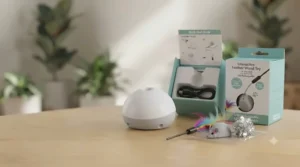
2. DOLLGIFT Hide and Seek Toy — feather pops in and out to trigger the ambush instinct
What makes this one stand out is the unpredictability of the “hide and seek” mechanism itself — the feather retracts and reappears rather than moving in one continuous, learnable pattern, which is closer to how real prey behaves than a toy that just spins in circles.
The toy pairs a moving feather with a squeaky mouse sound and is USB rechargeable. In practice, that combination targets two senses at once: the visual dart of the feather and the audio cue of the squeak, which together do a better job of holding attention than a silent, visual-only toy. For a young kitten still building hand-eye (or rather, paw-eye) coordination, that dual-sensory prompt genuinely helps.
Based on the spec comparison, this suits kittens who play solo for stretches while you’re working or asleep, since the toy is designed to run its own game without you dangling anything. It’s less suited to households with a nervous kitten, since the sudden pop-up motion and squeak can occasionally startle a shy cat rather than excite it.
Real aggregated review sentiment sits at roughly 4.4 out of 5 from around 329 ratings, a reasonably strong and sizeable sample for this category — reviewers commonly reference the surprise factor as the toy’s main appeal.
Pros:
- ✅ Combines visual movement with sound cues
- ✅ Genuinely unpredictable “pop” mechanism
- ✅ Solid review volume for its price point
Cons:
- ❌ Sudden pop and squeak can startle timid kittens
- ❌ Single mechanism means less variety than 3-in-1 toys
Priced in the £9–£13 range, it’s a strong step up from the absolute entry-level tier without moving into mid-range territory.
3. TBTeek 2-in-1 Cat Toy — remote control lets you referee playtime from the sofa
The standout feature is genuinely useful: remote control. Rather than only running on a fixed automatic cycle, you can manually trigger movement from across the room, which is a neat middle ground between fully hands-off electronic play and traditional wand-toy interaction.
It runs a rotating feather mechanism with dual light elements, and it’s rechargeable rather than battery-hungry. What that manual override actually buys you in practice is control over intensity — you can slow things down for a nervous first encounter, or ramp up the chase the moment your kitten’s ears prick and tail starts twitching, which a purely automatic toy can’t do.
Here’s what most buyers overlook about remote-controlled toys: the ability to intervene instantly is itself a safety feature, not just a fun one, because you can stop the mechanism the second a kitten’s paw or whisker gets too close to a moving part rather than waiting for an auto-shutoff timer.
With roughly 7,251 aggregated ratings and a 4.3 out of 5 average, this is by some distance the most reviewed product in our lineup, which gives its real-world reliability figures more statistical weight than most of the other entries here.
Pros:
- ✅ Remote control adds real-time supervision option
- ✅ Very large, reassuring review sample
- ✅ Dual light elements aid low-light engagement
Cons:
- ❌ Needs an adult nearby to operate the remote for full benefit
- ❌ Remote adds another small part to keep track of
Expect to pay in the £14–£18 range, which feels fair given the combination of manual and automatic modes.
4. Migipaws MigiMouse — the most lifelike prey simulation on this list
What sets this apart instantly is the realism: a plush mouse body with a long wiggling tail and built-in squeaker that rolls, spins, and mimics the stop-start behaviour of an actual mouse, rather than looking or sounding obviously mechanical.
The smart motion sensor is the spec that matters most here — it lets the toy detect obstacles and manoeuvre itself out of corners, so it keeps moving on both hard floors and carpet instead of getting stuck against a skirting board and sulking there for the rest of the afternoon. That’s a meaningful upgrade over toys that rely on a fixed, repeating path.
Based on aggregated review sentiment (around 4.1–4.2 out of 5 from roughly 2,000+ ratings), reviewers report it’s particularly effective for confined indoor cats and high-energy kittens, with the plush cover and erratic movement drawing strong initial interest — though some reviewers note the sound can be a little too loud or erratic for especially nervous cats, which is worth knowing before you buy for a timid rescue kitten.
What the spec sheet won’t tell you, but reviewers note, is that the plush cover — while great for realism — is also the toy’s weak point over time, since fabric takes more wear from teeth and claws than hard plastic housings do.
Pros:
- ✅ Genuinely lifelike movement and sound
- ✅ Motion sensor avoids getting stuck in corners
- ✅ Works on carpet and hard flooring alike
Cons:
- ❌ Plush cover wears faster than plastic-bodied toys
- ❌ Erratic noise may unsettle nervous kittens
In the £18–£22 range, it’s mid-tier pricing for what is arguably the most “cat-brain-hacking” design on this list.
5. YVE LIFE Laser Toy — unpredictable laser path for kittens who live at full speed
The standout advantage is in the motor, not the beam: rather than tracing the same tired circle, this toy uses motion-activated sensing to randomise the laser’s trajectory, which keeps a fast-adapting kitten brain from simply learning the pattern and losing interest.
It’s USB rechargeable and designed for hands-off, motion-triggered operation, meaning it starts working when your kitten approaches rather than running constantly and wasting charge on an empty room. In practice, that randomised path is what separates a laser toy a kitten stays obsessed with from one they dismiss within a week.
Here’s the honest caveat, and it’s an important one for a kitten-focused guide: laser toys should never fully replace physical toys, because a laser point can never actually be “caught,” and cats that only ever chase light with no tangible pay-off can develop frustration-driven behaviour over time. We’d recommend finishing every laser session with a real toy or treat the kitten can physically pounce on and hold, precisely so the hunting sequence gets to complete properly.
Verified individual customer review data for this specific listing was limited in our research, so rather than invent a star rating, we’ll say plainly: treat this as a promising spec sheet backed by category-wide laser-toy sentiment (fast engagement, occasional overstimulation risk) rather than a deeply reviewed bestseller.
Pros:
- ✅ Randomised path avoids pattern fatigue
- ✅ Motion-activated, so it’s not running constantly
- ✅ Great for high-energy indoor kittens
Cons:
- ❌ Should always be paired with a physical toy, never used alone
- ❌ Thinner verified review history than other picks here
Priced around £15–£20, it’s a mid-range buy best used as a supplement to, not a substitute for, catchable toys.
6. GoldenSun 3-in-1 Interactive Cat Toy — three play mechanisms in one rechargeable unit
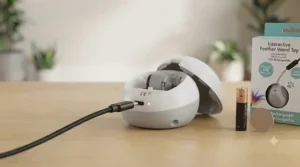
The headline strength is variety: spinning balls, a popping feather and a rotating butterfly are combined into a single toy, which multiple independent UK pet-product reviewers have separately named their top overall pick in this category for exactly that reason.
It runs on a 2000mAh USB-C rechargeable battery with an auto shut-off timer and three selectable play modes. That combination of variety and an automatic cut-off is the real value proposition here: switching mechanisms helps dodge the habituation problem where a kitten gets bored of one repetitive motion, while the timer means the toy isn’t grinding away (and draining its battery, or a nervous kitten’s patience) all day unsupervised.
Based on the spec comparison against the rest of this list, this is the closest thing to an “all-rounder” — it suits multi-cat households where different cats are drawn to different mechanisms, and owners who want one purchase to cover most bases rather than buying several single-mechanism toys separately.
Aggregated reviewer sentiment consistently highlights the variety as the toy’s biggest strength, with one buyer specifically noting their cat stayed engaged with it for a fortnight straight after losing interest in other electronic toys within a day — a genuinely useful signal against novelty fade, which is the single biggest complaint about this entire product category.
Pros:
- ✅ Three mechanisms fight novelty fatigue
- ✅ USB-C rechargeable, no disposable batteries
- ✅ Auto shut-off timer built in
Cons:
- ❌ Higher price than single-mechanism budget toys
- ❌ Larger footprint takes up more floor space
At roughly £25–£30, this sits at the upper end of mid-range, but the variety genuinely earns the premium over single-trick alternatives.
7. Qraxond Touch-Activated Hide and Seek Toy — kitten-triggered play with a fluttering feather
What makes this one distinctive is agency: rather than running on a fixed timer or constant automatic cycle, it’s touch-activated, meaning the kitten itself switches the game on by pawing or touching it, which taps into a cat’s preference for being the instigator of a chase rather than a passive responder.
It’s a newly upgraded, rechargeable design combining a hide-and-seek mechanism with a fluttering feather element. Touch-activation matters practically too: it tends to conserve battery life compared with toys that run continuously, and it means the toy stays dormant (and quiet) when no kitten is nearby, which is kinder on both battery and household nerves during nap time.
Based on the spec sheet and category norms, this is the pick for kittens who’ve already shown they enjoy “solving” a toy — batting, pawing and investigating before the reward of movement kicks in — rather than kittens who need instant, obvious motion to grab their attention from across the room.
With around 2,302 aggregated ratings and a 4.4 out of 5 average, this has both a large sample size and a strong score, giving real confidence in its real-world reliability at this price tier.
Pros:
- ✅ Touch-activation encourages independent investigation
- ✅ Conserves battery versus constantly-running toys
- ✅ Large, strong-scoring review base
Cons:
- ❌ Premium pricing versus simpler budget toys
- ❌ Less rewarding for kittens wanting instant motion
Expect to pay in the £25–£30 range, positioning it as a genuine premium pick rather than an impulse buy.
How to Choose an Electronic Cat Toy for Kittens
What is an electronic cat toy for kittens? It’s a battery or USB-powered toy that moves, lights up, vibrates or makes sound automatically or on activation, designed to trigger a kitten’s natural stalk-chase-pounce instinct without a human holding the other end — useful for enrichment, but never a full substitute for supervised, interactive play.
Choosing well comes down to matching mechanism to kitten, not just picking whatever has the most five-star reviews. Work through this in order:
- Match the toy to your kitten’s development stage. A very young kitten (under around 10-12 weeks) is still building coordination and may be overwhelmed by fast, erratic motion — a gentler LED or feather-pop mechanism works better than a full-speed laser.
- Check for kitten-safe design features first. Look for enclosed motors, no small detachable parts, chew-resistant cabling, and a housing your kitten can’t easily flip open with a determined paw.
- Decide how much supervision you can realistically give. If the toy will often run while you’re out of the room, motion-activated or auto-shut-off designs (like the GoldenSun 3-in-1 or Qraxond Touch-Activated Toy) are safer defaults than constantly-running ones.
- Think about noise sensitivity. A confident, bold kitten may love a squeaky, erratic toy like the DOLLGIFT Hide and Seek Toy; a nervous or newly-rehomed kitten often does better starting with a quieter, slower option.
- Weigh charging method against your routine. USB and USB-C rechargeable toys avoid the ongoing cost and battery-compartment risk of disposable batteries, but need remembering to charge — factor that into which toy you’ll actually keep using.
- Budget for more than one toy. Kittens habituate quickly; rotating two or three toys (rather than relying on a single “best” one) keeps engagement higher over months, not just the first week.
- Read aggregated review themes, not star ratings alone. A 4.2-star toy with consistent praise for durability can be a better bet than a 4.6-star toy with a thin review base and no long-term feedback.
According to International Cat Care, play mimics genuine hunting behaviour and is one of the best ways to give a kitten an outlet for natural predatory instincts while strengthening the bond with their owner — which is exactly the gap a well-chosen electronic toy is designed to fill.
Kitten Development and Play: What Electronic Toys Actually Teach Your Cat
Kitten development isn’t a straight line — it happens in fairly well-documented bursts, and play toys land differently depending on where your kitten sits on that timeline. Object play, the category electronic toys fall into, typically ramps up from around seven to eight weeks old, once a kitten has developed enough eye-paw coordination to track and grab a small moving object with any real accuracy. Before that stage, a kitten is still mostly play-wrestling littermates and working out its own back legs.
This matters enormously for toy choice. A kitten play toy that’s too fast or erratic for an eight-week-old can be genuinely bewildering rather than fun, while the same toy might be exactly right for a boisterous four-month-old who’s outgrown gentler options. What most buyers overlook is that “electronic” doesn’t automatically mean “advanced” — some of the simplest toys on this list, like the JARUFEE Electric Kitten Toy, are actually gentler starting points than flashier multi-mode toys, precisely because the movement is more predictable and less overwhelming.
There’s also a coordination-building angle worth taking seriously: toys that require a kitten to track, anticipate and time a pounce are doing real developmental work, not just burning calories. The Migipaws MigiMouse‘s stop-start movement and the Qraxond Touch-Activated Toy‘s “solve it yourself” mechanic both ask more of a kitten’s developing motor planning than a toy that just spins in a predictable circle — which is one reason we’d lean toward those two picks once a kitten is past the very earliest, wobbliest stage of object play.

Toys for Young Kittens vs Adult Cats: Key Differences
It’s tempting to assume any cat toy works for any cat, but toys for young kittens genuinely need different design priorities than toys aimed at fully-grown adults, and conflating the two is a common, honest mistake rather than a deliberate one.
Young kittens have smaller mouths, sharper but more fragile teeth, less bite inhibition, and considerably less body weight — which means smaller detachable parts pose a real choking risk that a twelve-pound adult cat simply isn’t going to bother with in the same way. Adult cats also tend to have settled preferences (some are die-hard feather fans, others only care about crinkly balls), whereas kittens are still discovering what they like, which is exactly why a lower-cost trial toy like the JARUFEE Electric Kitten Toy or DOLLGIFT Hide and Seek Toy makes more sense before investing in a premium pick for a kitten specifically.
Speed and unpredictability cut the other way, though. Many adult cats, especially older ones, actually prefer gentler, slower movement, while kittens — mid-way through their most intense object-play window — often want and need the fast, unpredictable motion of something like the YVE LIFE Laser Toy to stay engaged. A toy pitched at a sedate senior cat can bore a kitten within minutes, and a toy built for a hyperactive kitten can genuinely stress out an older, more sensitive cat. If you’re buying across a multi-cat household with a real age gap, it’s worth having at least one toy from each end of that spectrum rather than assuming one size fits all nine lives.
Teething Toys and Electronic Toys: Solving Two Problems at Once
Teething is its own separate challenge from general play, and it’s worth addressing directly because a lot of kitten owners assume their electronic toy will double as a teething solution — it generally won’t, and shouldn’t. According to PDSA, kittens lose their baby teeth as part of a completely normal process, and most don’t seem particularly bothered by it, though the accompanying urge to chew is very real and needs somewhere appropriate to go.
Electronic toys, almost without exception, aren’t designed to be chewed — their plastic housings, internal motors and charging ports make them a poor (and sometimes unsafe) outlet for a teething kitten’s determination to gnaw on something. This is precisely why we’d recommend pairing whichever electronic toy you choose with dedicated, soft, chew-safe teething toys (rubber, soft nylon, or freezer-friendly options) kept separately, rather than expecting one toy to cover both jobs.
Where the two genuinely complement each other is in timing and distraction. A teething kitten is often mouthier and more irritable, and a short, engaging session with something like the TBTeek 2-in-1 Cat Toy or GoldenSun 3-in-1 can burn off restless energy before you offer a chew toy for the actual gnawing — tired kittens chew calmer than wired ones. Just keep any electronic toy’s cabling, USB port and small components fully out of chewing range regardless of which toy you buy; teething kittens target cords with worrying enthusiasm.
Common Mistakes When Buying an Electronic Cat Toy for Kittens
Even careful owners fall into a handful of predictable traps here, almost always for understandable reasons rather than carelessness.
The biggest one is buying for the toy’s flashiest feature rather than the kitten’s actual temperament — a laser toy looks thrilling in a product video, but a genuinely nervous kitten may find the sudden, uncatchable red dot more stressful than stimulating. Reviewers across this category consistently note that toys purchased purely for novelty get abandoned faster than toys chosen to suit a specific cat’s known preferences.
A second common mistake is assuming “automatic” means “unsupervised is fine indefinitely.” Even the safest, most kitten-safe electronic toy on this list still benefits from supervised kitten play, at least until you’ve confirmed your particular cat doesn’t try to chew the housing, flip it over to reach the motor, or drag it somewhere it can get stuck.
Third, buyers often underestimate battery and charging admin. A brilliant toy that’s flat and uncharged in a drawer provides zero enrichment — USB-rechargeable options like the GoldenSun 3-in-1 and Qraxond Touch-Activated Toy are worth favouring specifically because they’re easier to top up on a routine (say, alongside charging your phone) than toys needing disposable batteries you might not have to hand.
Finally, plenty of owners buy just one toy and expect it to last the whole of kittenhood. Given how quickly kittens habituate to a single repeated motion, rotating two or three different mechanisms — a feather-pop, a rolling mouse, a laser — tends to deliver far better long-term engagement than one “best” toy used daily on repeat.
Electronic Toys vs Traditional Toys for Kittens
| Factor | Electronic Toys | Traditional Toys (wands, mice, balls) |
|---|---|---|
| Unsupervised play | Often designed for it (motion sensors, auto shut-off) | Generally needs a human holding one end |
| Cost over time | Higher upfront, no ongoing replacement | Lower upfront, but wear out and need replacing often |
| Unpredictability | High — motors create erratic, prey-like motion | Depends entirely on the human’s technique |
| Bonding value | Lower — kitten plays largely independently | Higher — direct interaction with owner |
| Charging/power needs | Requires batteries or regular charging | None |
The honest takeaway from this comparison is that electronic and traditional toys solve different problems rather than competing for the same job. Electronic options like the TBTeek 2-in-1 Cat Toy are brilliant for the hours you genuinely can’t be hands-on — working from home with back-to-back calls, or simply needing your kitten occupied while you cook dinner without them summiting the worktop. But nothing in an electronic toy’s spec sheet replaces the bonding value of a wand toy session where you’re actively reading your kitten’s body language and reacting to it. The strongest set-ups we’ve seen combine both: an electronic toy for solo stretches, and daily short wand-toy sessions for the relationship-building bit electronics simply can’t do.

Safety, Batteries and Supervised Kitten Play: What UK Owners Need to Know
Finding a genuinely kitten safe electronic toy comes down to a handful of concrete checks rather than vague reassurance, and it’s worth going through them properly before your kitten gets anywhere near a new toy.
First, check the housing. Kittens are determined, flexible, and surprisingly good at working small paws into gaps — a well-designed toy has a fully enclosed motor and battery compartment that a paw or claw genuinely can’t pry open. Second, inspect any detachable parts (feathers, mice, decorative elements) for how securely they’re attached; anything that can be pulled off and swallowed is a real risk, not a theoretical one, particularly with teething kittens who investigate everything mouth-first. Third, treat cables and charging ports as chew targets by default — route USB cables away from where the toy sits when not in use, and unplug toys fully once charged rather than leaving a live cable within reach.
Supervised kitten play is the single biggest safety upgrade you can apply for free, and it doesn’t need to mean hovering constantly. According to Cats Protection, play is important for developing a kitten’s balance and eye-paw coordination, and kittens need to be taught to play with appropriate toys rather than inappropriate objects — the same logic applies to a new electronic toy: introduce it under direct supervision for the first several sessions, watch specifically for chewing at the housing or cable, and only step back to unsupervised use once you’re confident your particular kitten treats it as a toy rather than a snack.
Motion-activated and auto-shut-off designs, like the Qraxond Touch-Activated Toy and GoldenSun 3-in-1, genuinely reduce risk versus toys that run continuously and unattended, simply because they’re not grinding away with nobody watching for hours at a stretch. That’s a real, practical reason to favour them if your household can’t offer close supervision every single session.
Practical Usage Guide: Setting Up Your Kitten’s First Electronic Toy
Getting the first introduction right shapes whether a toy becomes a firm favourite or gets nervously avoided forever, so it’s worth a bit of care.
Start with a full charge and a calm room — no other pets crowding in, no loud background noise, and ideally a moment when your kitten is already a little alert rather than freshly woken or mid-nap. Place the toy on the floor switched off first, let your kitten approach and sniff it entirely on their own terms, and only then turn it on at its lowest or gentlest setting if one’s available. Watch body language closely for the first few minutes: dilated pupils and a twitching tail usually mean excitement, while flattened ears or a bolt for the nearest hiding spot means it’s too much, too fast, and you should switch it off and try again later at a lower intensity.
For the first thirty days, keep sessions short — five to ten minutes, once or twice a day, rather than leaving any electronic toy running for hours. This does two jobs: it prevents the “novelty crash” where a kitten simply tunes a toy out from overexposure, and it lets you properly supervise early use while you’re still learning your kitten’s specific triggers and preferences. Check the toy’s housing and any cable after every few sessions for early signs of chew damage, and retire or repair anything showing wear before it becomes a genuine hazard rather than a cosmetic one.
A common early mistake is judging a toy a “failure” after one flat session — many kittens need two or three exposures to fully understand a new toy is safe and worth investing energy in, especially if they’re naturally cautious. Give a fair trial before writing anything off.
Real-World Scenarios: Matching Toys to Your Kitten’s Personality
The bold, food-and-fun-motivated kitten who charges at anything new, headfirst: this is the profile best matched to the YVE LIFE Laser Toy or DOLLGIFT Hide and Seek Toy, since fast, unpredictable movement and sudden squeaks tend to thrill rather than overwhelm a confident cat. Pair laser sessions with a physical toy at the end so the hunt gets a satisfying, catchable conclusion.
The cautious, recently-rehomed kitten still settling into a new home and prone to hiding under furniture at sudden noises: start here with the gentlest option on this list, the JARUFEE Electric Kitten Toy, introduced under close supervision on its lowest setting, well away from the safety of their hiding spot at first. Build up to louder or faster toys only once they’re confidently exploring the room unprompted.
The busy household with limited hands-on time, perhaps a full-time working owner or a family juggling children and a new kitten: the GoldenSun 3-in-1 or Qraxond Touch-Activated Toy earn their higher price tags here specifically because their auto shut-off and touch-activation features make them safer and more genuinely useful for the stretches when nobody’s available to supervise closely, without needing constant resetting or intervention.
Buyer’s Decision Framework
Use this as a quick priority checklist if you’re still torn between options:
- If your kitten is under twelve weeks old and easily startled, choose a gentle, predictable toy like the JARUFEE Electric Kitten Toy, because overwhelming a nervous, developing kitten can create lasting toy-avoidance.
- If your kitten is confident, fast, and easily bored, choose a multi-mode toy like the GoldenSun 3-in-1, because variety directly combats the novelty fatigue that ends most electronic toys’ usefulness within days.
- If you can’t supervise every session, choose a motion-activated or touch-activated design like the Qraxond Touch-Activated Toy, because it won’t run unattended for hours the way a continuously-cycling toy might.
- If your budget is genuinely tight, choose the JARUFEE Electric Kitten Toy or DOLLGIFT Hide and Seek Toy first, because a cheaper trial toy tells you what your specific kitten actually likes before you invest in a premium pick.
- If your kitten is also actively teething, prioritise pairing any electronic toy with dedicated chew-safe teething toys, because no toy on this list is designed to be safely chewed.
Long-Term Cost & Value: Is an Electronic Toy Worth It?
Cost-per-use is where electronic toys quietly earn their keep, even though the upfront price looks steeper than a 99p feather wand. A £7 toy like the JARUFEE Electric Kitten Toy used for even three months of regular short sessions works out to pennies per use, and USB-rechargeable designs across this whole list avoid the creeping cost of disposable batteries that traditional battery-powered toys often carry.
The premium end tells a more interesting value story than the price tag alone suggests. The GoldenSun 3-in-1 and Qraxond Touch-Activated Toy, at roughly £25–£30, cost three to four times more than the budget picks — but if their multi-mode or touch-activated design genuinely keeps a kitten engaged for months rather than the one to two weeks a single-mechanism budget toy often manages before boredom sets in, the effective cost-per-week of engagement can actually work out lower, not higher. That’s the calculation worth making rather than assuming “cheaper is always better value.”
Total cost of ownership should also factor in durability against teeth and claws — the Migipaws MigiMouse‘s plush cover, for example, is likely to need replacing sooner than a hard-plastic housing under equivalent daily chewing pressure, which is worth weighing if your household has a particularly determined chewer.
Frequently Asked Questions
❓ What is the best electronic cat toy for kittens?
❓ Are electronic cat toys safe for kittens?
❓ At what age can kittens start using electronic toys?
❓ Do vets recommend electronic cat toys for kittens?
❓ How do I stop my kitten chewing an electronic toy's charging cable?
Conclusion
Choosing an electronic cat toy for kittens isn’t really about finding one perfect product — it’s about matching mechanism, noise level and supervision needs to the specific, opinionated little animal currently using your ankles for target practice. Budget picks like the JARUFEE Electric Kitten Toy earn their place by letting you test the waters cheaply; mid-range options like the TBTeek 2-in-1 Cat Toy and Migipaws MigiMouse add realism and manual control; and premium picks like the GoldenSun 3-in-1 and Qraxond Touch-Activated Toy justify their price through genuine variety and safer, smarter automation. None of them, on their own, replace supervised play, dedicated teething toys, or the plain old wand-and-string sessions that build the bond electronics can’t. Start small, watch how your kitten actually responds, and build a rotation from there rather than betting everything on a single purchase.
Recommended for You
- Self-Moving Cat Toy For Bored Cats: 7 Top UK Picks (2026)
- App-Controlled Cat Toy For iPhone: 7 Best Picks (2026)
- Remote Control Cat Toy for Multiple Cats: 7 Best Picks (2026)
Disclaimer: This article contains affiliate links. As an Amazon Associate, I earn from qualifying purchases. If you purchase products through these links, we may earn a small commission at no additional cost to you.
✨ Found this helpful? Share it with your friends! 💬🤗
