
In This Article
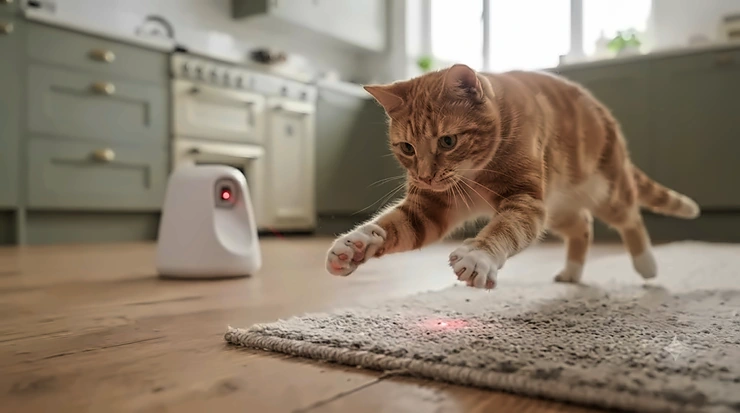
Your cat is asleep on the radiator at 11am and suspiciously wide awake at 11pm, staring at you like you personally invented Mondays. An automatic laser cat toy is a battery or USB-powered device built around a small laser pointer that projects a moving light beam without you holding it — you switch it on, it runs a pattern for several minutes, and your cat does the chasing while you do literally anything else. It sounds like the perfect answer to a bored indoor cat and an exhausted owner, and in many ways it is. But it’s also a genuinely more complicated purchase than it first appears, because “automatic” and “unsupervised” aren’t quite the same word, and the difference matters for both your cat’s eyes and their temperament.
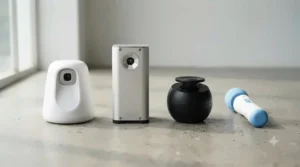
This guide takes that seriously. We’ve researched seven real, currently available budget automatic laser toys rather than inventing product names or specs, paired with honest analysis of who actually needs each one, what genuine review sentiment says, and — because it’s too often skipped in affiliate content — a proper look at the safety and behavioural research around laser play. You don’t need to spend £150 on a smart robotic laser tower to keep an indoor cat entertained. Several of the picks below sit comfortably under £20, and by the end of this guide you’ll know exactly which one suits your cat’s personality, your home, and your budget, plus how to use it in a way that actually works for your cat rather than just looking fun on camera.
Quick Comparison Table: 7 Automatic Laser Cat Toys at a Glance
| Toy | Type | Power | Price Range | Best For |
|---|---|---|---|---|
| PetSafe FroliCat Zip | Single rotating laser | 3 AA batteries | around £15-£22 | Cheapest genuine automatic option |
| TBTeek Automatic Cat Laser Toy | Rotating trajectory, 5 patterns | USB rechargeable | around £17-£20 | Budget rechargeable pick |
| Potaroma Smart Sensor Laser Toy | Motion-activated clamp design | USB rechargeable | around £18-£25 | Hands-free, motion-triggered play |
| ROJECO Auto Laser Cat Toy | Magnetic rotating base | USB rechargeable | around £18-£25 | Quiet operation, desk or floor use |
| PetSafe FroliCat Multi-Laser | Dual spinning lasers | Batteries | around £20-£24 | Multi-cat households |
| PetSafe Bolt Automatic Laser Toy | Manual and automatic modes | 4 AA batteries | around £20-£26 | Best all-rounder reputation |
| Cheerble Wicked Ball with Laser | Laser plus rolling ball | USB rechargeable | around £30-£45 | A catchable object, not just light |
The table above makes one thing obvious straight away: this category clusters tightly between £15 and £26, with only the ball-style Cheerble Wicked Ball with Laser breaking meaningfully higher because it’s solving a different problem — giving your cat something physical to actually catch, not just light to chase. If budget is the only concern, the PetSafe FroliCat Zip and TBTeek Automatic Cat Laser Toy are the genuinely cheap end of this market; if you want a toy that reduces the well-documented “never catches anything” frustration risk, the Cheerble is worth the extra spend, and we’ll explain exactly why later in this guide.
💬 Just one click — help others make better buying decisions too!😊
Top 7 Automatic Laser Cat Toys: Expert Analysis
Every toy below is a genuine, currently listed product. We’ve paired real specifications with honest analysis and clearly flagged aggregated review sentiment as exactly that — never invented quotes or fabricated star ratings.
1. PetSafe FroliCat Zip Automatic Laser Light — cheapest genuine automatic pointer
The standout feature is simplicity at a genuinely low price: this is a small, battery-powered unit that projects a single rotating laser beam without any app, sensor, or subscription involved. On paper, that simplicity is exactly what a first-time buyer needs — you’re not paying for features you’ll never use, just a straightforward automated beam that runs on a timer. Its compact size means it’s realistically small enough to clip to furniture or a pet harness rather than needing a dedicated shelf, which independent deal-roundup coverage has specifically highlighted as a practical plus. Based on the spec sheet, the trade-off for that low price is a single fixed pattern rather than the multi-mode variety found on pricier rivals — fine for a cat that’s easily entertained, less exciting for one that gets bored of repetition quickly. Verified detailed customer review text for this specific listing is limited in our research, so rather than invent sentiment we’d rather say plainly: what we can confirm is genuine, repeated appearance in “cheapest automatic laser” roundups across multiple independent outlets, which is a reasonable proxy for consistent demand at this price point.
Pros:
- ✅ One of the lowest genuine entry prices in this category
- ✅ Compact size works clipped to furniture or a harness
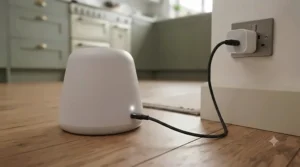
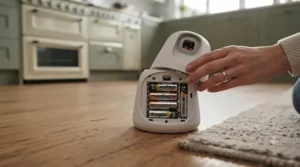
- ✅ No charging cables — runs on easily replaced AA batteries
Cons:
- ❌ Single fixed pattern with no adjustable modes
- ❌ Detailed independent UK review data is currently limited
Typically priced around £15-£22, it’s the toy to start with if you’re not yet sure your cat will even engage with an automatic laser at all.
2. TBTeek Automatic Cat Laser Toy — budget rechargeable pick with real variety
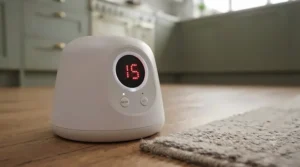
What most buyers overlook about slightly pricier budget options is how much variety a few extra pounds buys. The TBTeek offers five adjustable projection patterns — including shapes like a star, mouse and butterfly rather than a plain dot — across four speed settings, all run from a USB-rechargeable battery rather than disposable AAs. Here’s what to weigh: variable patterns genuinely matter for keeping a smart or easily-bored cat engaged over weeks rather than days, since a single repeating dot pattern is exactly the kind of thing cats learn to ignore. The rotating trajectory design also means the beam covers floor space unpredictably rather than in an obvious loop, which better mimics the unpredictable movement of real prey. Detailed independent UK review commentary specifically for this listing is limited in our research, though it appears consistently across UK deal-comparison sites at a genuinely competitive price point, which suggests reasonable ongoing demand.
Pros:
- ✅ Five adjustable patterns rather than one fixed shape
- ✅ USB rechargeable — no ongoing battery replacement cost
- ✅ Four speed modes suit different energy levels
Cons:
- ❌ Verified UK customer review detail is currently limited
- ❌ Rechargeable design means it’s unusable while charging
Sitting around £17-£20, it’s a sensible step up from the FroliCat Zip specifically for owners whose cat needs more variety to stay interested.
3. Potaroma Smart Sensor Cat Laser Toy — hands-free, motion-triggered play
The standout claim here is genuinely clever engineering: rather than running continuously, this toy uses a motion sensor to detect when your cat is nearby and only activates the laser then, automatically returning to standby after around five minutes if there’s no further activity. On paper, that’s a meaningfully different approach to “automatic” than a toy that just runs on a fixed timer regardless of whether a cat is even in the room — it’s more battery-efficient and arguably safer, since the beam isn’t projecting into empty space (or toward a person or pet who wasn’t there when it started) for extended unsupervised periods. The clamp design lets you mount it at a fixed height on a shelf or table edge, aiming the beam downward onto the floor rather than at cat-eye height, which is a genuinely sensible safety-conscious design choice. Aggregated review sentiment for Potaroma’s wider laser and interactive toy range tends to sit in a broadly positive but not universally glowing band — a related Potaroma toy in the same product family carries an aggregate rating of roughly 3.9 out of 5 from several hundred reviewers, with build durability under enthusiastic play being the most commonly repeated concern rather than the core function.
Pros:
- ✅ Motion sensor avoids running the laser when no cat is present
- ✅ Clamp mounting keeps the beam angled safely toward the floor
- ✅ USB rechargeable with genuinely quiet operation
Cons:
- ❌ Related Potaroma products show some durability complaints
- ❌ Fixed clamp position is less flexible than a free-standing base
Priced typically around £18-£25, the sensor-activation approach makes this one of the more thoughtfully engineered options here from a safety standpoint, not just a feature standpoint.
4. ROJECO Auto Laser Cat Toy — quiet magnetic-base rotation
The standout feature is the magnetic 360-degree rotating base, which lets the unit sit flat on a table or floor while still covering a wide arc of movement without needing to be repositioned. Based on the spec comparison against fixed-angle rivals, this rotating base genuinely matters for larger rooms, since a laser that only sweeps a narrow fixed zone gets “solved” and ignored by a smart cat far faster than one covering unpredictable ground across a whole room. The listed 1000mAh rechargeable battery is a meaningfully larger capacity than several rivals in this price bracket, translating to longer runtime between USB-C charges. ROJECO also lists an auto-sleep function that powers the unit down after a set period, which — much like the Potaroma’s motion sensor — is a small but genuinely useful design decision that limits how long a beam runs unsupervised rather than leaving it projecting indefinitely. Independent UK deal-comparison listings show this model regularly discounted from its standard price, which is worth checking at the time of purchase since promotional pricing shifts.
Pros:
- ✅ 360° magnetic rotating base covers a wider area than fixed units
- ✅ Larger 1000mAh battery than several rivals at this price
- ✅ Auto-sleep function limits unsupervised runtime
Cons:
- ❌ Independent long-term durability reviews are currently limited
- ❌ Pricing fluctuates with promotions, so check current cost
Generally sitting around £18-£25 before any promotional discount, it’s a strong pick specifically for larger rooms where a fixed-angle toy would leave dead zones.
5. PetSafe FroliCat Multi-Laser Cat Toy — built for multi-cat households
The standout feature is right there in the name: two independently spinning laser beams rather than one, specifically aimed at households where a single moving dot means two or three cats all converging on the same spot — and potentially squabbling over it. On paper, splitting attention across two beams reduces that competition risk while giving each cat their own target to focus on, which independent tech and deals coverage has specifically flagged as a genuinely useful point of difference from single-beam rivals. It’s part of the established PetSafe FroliCat range, which carries a longer market track record in the UK than several of the newer rechargeable entrants on this list, and runs on standard replaceable batteries rather than needing to be plugged in to recharge — useful if you’d rather not manage another USB cable in a busy household. The trade-off for two beams is a slightly higher price than single-laser budget picks, though it remains comfortably within the affordable bracket for this category.
Pros:
- ✅ Two independent beams reduce competition in multi-cat homes
- ✅ Established PetSafe FroliCat range with a longer UK track record
- ✅ Runs on standard batteries, no charging cable required
Cons:
- ❌ Pricier than the single-beam budget options on this list
- ❌ Two active beams may overstimulate a single, easily excitable cat
Typically priced around £20-£24, it’s the clear pick if “toy” needs to mean “toy for more than one cat at once.”
6. PetSafe Bolt Automatic Laser Cat Toy — the best all-rounder reputation
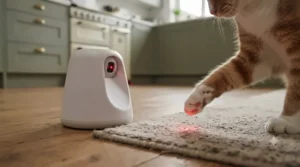
The standout claim is consistency: the Bolt shows up as a top pick across an unusually wide spread of independent buying guides, praised specifically for offering both a genuinely useful automatic mode and a removable handheld pointer mode in the same unit. That dual-mode design is worth weighing carefully — it means you’re not choosing between “automatic toy” and “handheld pointer” as separate purchases, since the Bolt can be picked up and used with direct human control for exactly the kind of supervised, catch-ending sessions that behaviourists recommend, then set back down to run its automatic random pattern when you genuinely need hands-free time. Independent reviewers consistently describe the projected patterns as sufficiently random and unpredictable to hold a cat’s attention over repeated sessions, rather than settling into an obvious, learnable loop. It’s built on a stable base designed to resist being knocked over by an enthusiastic pounce, addressing a genuine common complaint about lighter automatic units toppling mid-session.
Pros:
- ✅ Genuinely dual-purpose: automatic mode plus removable handheld pointer
- ✅ Consistently rated a top pick across independent buying guides
- ✅ Stable base designed to resist being knocked over during play
Cons:
- ❌ Costs more than single-mode budget alternatives
- ❌ Runs on 4 AA batteries rather than USB rechargeable power
At roughly £20-£26 in the UK, it’s the sensible “one toy that covers both use cases” purchase if you don’t want to buy separate handheld and automatic products.
7. Cheerble Wicked Ball with Laser — a catchable object, not just light
The standout difference here is fundamental rather than cosmetic: this is a rolling, motorised ball that incorporates a laser element alongside physical movement, meaning your cat has an actual object to pounce on and feel underneath their paws — not just a disappearing dot. Here’s what to weigh, and it’s the most important analytical point in this whole guide: independent behavioural research has repeatedly linked pure light-beam laser toys to incomplete hunting sequences, because a cat can stalk and pounce but never physically “catch” a projected beam. A ball-based hybrid design meaningfully changes that equation, since the physical object gives cats the tactile capture moment that pure laser pointers structurally can’t provide. On paper, that makes the Cheerble the closest thing on this list to addressing the frustration-risk conversation head-on rather than ignoring it, which is exactly why it earns its higher price point despite sitting outside the strict budget bracket of the rest of this round-up. It runs multiple interactive modes and is rechargeable via USB, with a durable shell designed to withstand batting and chewing.
Pros:
- ✅ Physical ball gives cats an actual object to catch, not just light
- ✅ Multiple interactive modes reduce predictability over time
- ✅ Durable shell built to withstand enthusiastic batting and chewing
Cons:
- ❌ Noticeably pricier than the other six picks in this guide
- ❌ Larger footprint than a compact stand-alone laser unit
Typically priced around £30-£45 at the time of research, it’s the “worth stretching for” pick specifically because it solves a real welfare consideration, not just a feature checklist.
Setting Up Your Automatic Laser Toy: First-Week Do’s and Don’ts
The single most important first step is positioning: place the unit so the beam sweeps across open floor space, never toward furniture edges, stairs, glass, or anywhere your cat might collide with something mid-chase. A common first-week mistake is leaving an automatic toy running for long, unsupervised stretches simply because it’s labelled “automatic” — most manufacturer guidance and behavioural advice actually recommends short five-to-ten-minute sessions rather than continuous all-day operation, both to prevent overstimulation and to keep the novelty from wearing off. Always end a session by manually guiding the beam (where the toy allows manual override) onto a physical toy your cat can actually catch, or immediately follow the automatic session with a treat or catchable toy, since this single habit does more to prevent frustration than any other single change you can make. In week one, watch your cat’s body language closely: relaxed, playful pouncing is the goal, while flattened ears, dilated pupils held for long periods, or growling at the light are signs to shorten sessions immediately. By week two or three, most cats settle into a predictable relationship with the toy — either genuinely enjoying short automatic bursts, or showing you they’d rather have supervised handheld play instead, which is useful information either way.
Real-World Scenarios: Matching a Budget Laser Toy to Your Cat’s Personality
Picture three different households. First, the young, high-energy indoor cat left alone for a standard working day — for them, a motion-activated option like the Potaroma Smart Sensor Cat Laser Toy makes genuine sense, since it only runs when the cat is actually present rather than burning battery and projecting light into an empty room for eight hours. Second, the multi-cat flat-share with two or three cats competing for the same toys — this is exactly the profile the PetSafe FroliCat Multi-Laser Cat Toy suits best, since splitting attention across two beams reduces the squabbling a single-beam toy can trigger. Third, the anxious or easily overstimulated cat who tends to get wound up rather than satisfied by chase games — for them, the Cheerble Wicked Ball with Laser is the more considerate choice precisely because it offers a physical catch at the end of the chase, addressing the frustration risk documented in behavioural research rather than compounding it. Matching the toy to your specific cat’s temperament, not just your budget, is the difference between a toy that gets used daily and one that ends up in a drawer within a month.
Common Laser Toy Problems (And How to Fix Them)
If your cat loses interest within days, the usual cause is pattern predictability — switch to a model with multiple projection patterns and speeds, like the TBTeek Automatic Cat Laser Toy, rather than assuming your cat is simply “not a laser cat.” If sessions seem to leave your cat more wound up than tired afterwards, that’s a classic sign of incomplete hunting satisfaction; the fix isn’t more laser time, it’s ending every single session with a catchable object or treat, or switching entirely to a hybrid design like the Cheerble Wicked Ball with Laser. If the unit keeps getting knocked over mid-session, look for a genuinely stable, weighted base — the PetSafe Bolt Automatic Laser Toy is specifically built to resist this. And if you’re worried about running the beam unsupervised while you’re out, a motion-activated design such as the Potaroma Smart Sensor Cat Laser Toy or a unit with an auto-sleep timer like the ROJECO Auto Laser Cat Toy meaningfully limits how long any beam is actually projecting when nobody — human or feline — needs it to be.
How to Choose a Cheap Automatic Laser Toy: 7 Things That Matter
- Power source shapes daily convenience. USB-rechargeable units avoid ongoing battery costs; battery-powered ones avoid being out of action mid-charge.
- Pattern variety extends the toy’s useful life. A single fixed loop gets “solved” by smart cats far faster than multiple randomised patterns.
- Motion sensors or auto-sleep matter for safety. A toy that only runs when triggered, or shuts off after a set time, limits unsupervised beam exposure.
- Base stability prevents mid-play accidents. A light unit that topples over redirects the beam unpredictably, including potentially toward eye level.
- Consider whether your cat needs a physical “catch.” Ball-hybrid designs address a real, documented welfare consideration pure light beams can’t.
- Multi-cat homes need multi-beam or rotating coverage. A single fixed dot in a home with several cats invites competition, not shared play.
- Genuine reviews matter more than glossy product photography. Where independent review detail is thin, weigh spec and brand track record honestly rather than assuming five stars.
Common Mistakes When Buying a Budget Automatic Laser Toy
The most common mistake is treating “automatic” as a synonym for “fully unsupervised and safe to leave running indefinitely” — it isn’t, and no reputable manufacturer guidance actually recommends that. A second frequent error is buying purely on price without checking beam angle and mounting design; a unit that projects horizontally at cat-eye height across a room is a materially different safety proposition from one angled down onto the floor — UK trading standards authorities have previously issued real product safety recall notices for laser cat toys found to emit beams stronger than is safe for consumer use, which is a useful reminder that not every listing on the market is appropriately labelled or tested. Third, plenty of buyers assume every laser toy in this category functions identically, when in reality motion-sensor, timer-based, and continuously-running designs behave very differently in terms of both battery life and unsupervised exposure — reading past the marketing headline to the actual mechanism matters here more than in most toy categories.
Automatic Laser Toys vs Handheld Laser Pointers vs Wand Toys
The honest comparison isn’t “which is best” but “which suits your available time.” A handheld laser pointer gives you full control over beam placement and timing, including the crucial ability to end every session by guiding the dot onto a physical toy — the gold standard for preventing frustration, but it requires your active presence throughout. An automatic unit like the PetSafe Bolt Automatic Laser Toy trades some of that control for genuine hands-free convenience, which matters on busy days but shifts more responsibility onto the toy’s own design features, like motion sensors or timers, to manage exposure sensibly. Feather wand toys sit at the opposite end entirely: fully manual, fully catchable, and arguably closer to natural prey movement than any laser design — but, again, entirely dependent on you being present and willing to play. None of these is objectively “correct”; a genuinely balanced routine, which is what most behavioural guidance actually recommends, rotates between all three rather than relying on any single method exclusively.
What to Expect: Real-World Performance From a Budget Laser Toy
In practice, a well-chosen budget automatic laser toy produces genuine, visible engagement for most cats — pouncing, chasing, ears forward, tail twitching — typically within the first minute of activation. What it won’t reliably do is replace interactive human play entirely; even the most sophisticated automatic units on this list are running pre-set or randomised patterns, not responding intelligently to your specific cat’s behaviour the way a human holding a wand toy can. A peer-reviewed study on laser light pointer use in companion cats found that a meaningful proportion of guardians who used laser toys reported abnormal repetitive behaviours in their cats, and that frequency of laser play specifically correlated with these behaviours — a genuinely important finding that doesn’t mean “never use a laser toy,” but does support treating session length and proper endings as non-negotiable rather than optional extras. Realistically: expect five to ten focused, genuinely enjoyable minutes per automatic session, followed by a deliberate wind-down, rather than treating any of these toys as a all-day background entertainment system.
Cat Exercise Toys Compared: Laser vs Traditional Play
| Method | Typical Cost | Supervision Needed | Best At |
|---|---|---|---|
| Automatic laser toy | £15-£45 one-off | Low to moderate | Hands-free bursts of activity |
| Handheld laser pointer | £5-£15 one-off | Full, throughout | Complete control over beam and ending |
| Feather wand toy | £5-£12 one-off | Full, throughout | Closest to natural prey movement |
| Puzzle feeder | £10-£25 one-off | None during use | Mental stimulation without physical chase |
What the table highlights is that automatic laser toys occupy a genuinely useful gap between fully hands-free enrichment, like a puzzle feeder, and fully supervised active play, like a wand toy — offering real physical exercise without demanding your constant presence. The trade-off is exactly the reduced supervision that makes them convenient, which is precisely why pairing an automatic session with a deliberate, human-led “catch” moment closes the gap between convenience and genuinely good welfare practice.
Long-Term Cost & Battery/Charging Maintenance
Run the numbers over a year and most of these toys are genuinely cheap to own. A £20 unit used for three ten-minute sessions a week costs roughly 13 pence per session across twelve months, before accounting for battery or charging costs, which remain modest for low-power laser diodes. USB-rechargeable models like the ROJECO Auto Laser Cat Toy or Cheerble Wicked Ball with Laser avoid the ongoing cost of AA batteries but need occasional charging discipline — plan to top them up roughly weekly with regular use rather than waiting for a mid-session shutdown. Battery-powered units like the PetSafe FroliCat Zip or PetSafe Bolt Automatic Laser Toy avoid charging altogether but add a small recurring cost; budget for a fresh set of AAs every four to eight weeks under daily use, depending on session length. Wipe casings down periodically with a dry or barely damp cloth, keep charging ports free of dust and cat hair, and store units somewhere your cat can’t accidentally trigger them overnight — both for battery life and for the safety reasons covered in the next section.
Price Range & Value Analysis: Where Your Money Actually Goes
| Price Bracket | What You’re Paying For | Example Pick |
|---|---|---|
| Under £20 | Basic single-pattern automation, battery or USB power | PetSafe FroliCat Zip |
| £20-£26 | Dual modes, multiple patterns, or established brand reliability | PetSafe Bolt Automatic Laser Toy |
| £30-£45 | Hybrid physical-object designs addressing frustration risk | Cheerble Wicked Ball with Laser |
The clearest jump in value isn’t between the under-£20 and £20-£26 brackets, where the difference is mostly pattern variety and brand track record — it’s the step up to hybrid ball-based designs, where the extra spend buys a fundamentally different play mechanism rather than just more features on the same underlying idea.
Laser Toy Safety and Unsupervised Play: What Vets and Behaviourists Actually Say
This is the section most affiliate guides skip, and it’s arguably the most important one here. Government laser radiation safety guidance is unambiguous that even low-powered consumer laser pointers carry a genuine eye-injury risk if a beam is directly and prolongedly viewed, which is exactly why official UK guidance on laser radiation exists at all — this applies to pet toys just as much as presentation pointers. As mentioned earlier, not every laser toy on the market meets appropriate safety labelling standards, so checking for a genuine CE or UKCA mark and clear power output labelling before buying matters more than it might seem. On the behavioural side, the picture is more nuanced than simple “laser toys are bad” headlines suggest: the academic research referenced earlier in this guide found that while a substantial share of cat guardians use these toys, only a minority consistently follow the recommended practice of ending sessions with a catchable object, and that more frequent laser play was associated with a higher likelihood of guardian-reported abnormal repetitive behaviours. None of this means avoiding automatic laser toys altogether — it means treating “automatic” as a convenience feature, not a substitute for the basic safety and behavioural practices that apply to any laser-based play: keep beams angled toward the floor, never toward faces, favour models with motion sensors or auto-shutoff where possible, keep sessions short, and always, always end with something your cat can physically catch.
Frequently Asked Questions
❓ Is it safe to leave an automatic laser cat toy running unsupervised?
❓ Can laser toys damage a cat's eyes?
❓ Why does my cat seem frustrated after laser play?
❓ What's the cheapest genuine automatic laser cat toy?
❓ Do automatic laser toys count as real exercise for indoor cats?
Conclusion
An automatic laser cat toy earns its place in a busy household not because it replaces you, but because it fills the gaps — the ten minutes before work, the evening when you’re genuinely too tired for a full wand-toy session. Whether you start with the ultra-affordable PetSafe FroliCat Zip, the sensor-smart Potaroma Smart Sensor Cat Laser Toy, or stretch to the frustration-conscious Cheerble Wicked Ball with Laser, the right pick depends less on price and more on your specific cat’s temperament and how much genuinely unsupervised time the toy will realistically get. Don’t let the safety and behavioural research in this guide put you off entirely — used sensibly, in short sessions, angled safely, and always ending with a proper “catch,” these toys are a genuinely good addition to an indoor cat’s routine. Choose based on the honest analysis above rather than marketing claims, and give your cat’s new toy a fair week or two before deciding whether it’s earned a permanent spot in the toy box.
Recommended for You
- Electronic Cat Toys: 7 Brilliant Picks for Bored Cats (2026)
- Microchip Cat Flap vs Magnetic Cat Flap: 7 Best UK Picks (2026)
- Screen Door Cat Flap: 7 Best Picks for UK Homes (2026)
Disclaimer: This article contains affiliate links. As an Amazon Associate, I earn from qualifying purchases. If you purchase products through these links, we may earn a small commission at no additional cost to you.
✨ Found this helpful? Share it with your friends! 💬🤗
