
In This Article
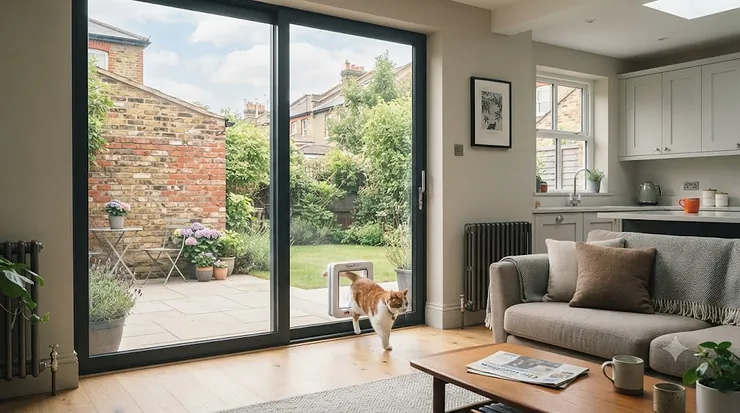
Sliding patio doors are brilliant right up until your cat decides 2am is the perfect time to demand access to the garden. Anyone who has stood, bleary-eyed, wedging a stiff aluminium door open six inches “just in case” knows the problem a cat flap for sliding glass doors is trying to solve. It sounds like it should be simple. It isn’t, quite. Standard cat flaps are designed for doors with some depth to them — a wooden panel, a chunky uPVC door — and sliding patio doors are the opposite: thin, tempered, and built to glide past a second pane with barely a whisper of clearance. Cut a hole in the wrong bit of glass and you’ve either ruined a very expensive sealed unit or built yourself a door that no longer slides.
The good news is that this is a solved problem, just not an obvious one. Manufacturers have spent the best part of two decades building slimline inserts, no-cut kits and purpose-made glass panels specifically for patio doors, and real UK buyers have been fitting them into rented flats, Victorian conservatories and brand-new bifold extensions for years. This guide walks through seven genuine, currently available products, explains where each one actually earns its keep, and digs into the sizing, draughtproofing and rental-permission questions that decide whether your installation is a Saturday-afternoon job or a call to a glazier. As the Energy Saving Trust notes in its draught-proofing advice, gaps around doors are a meaningful source of heat loss in UK homes, so getting the fit right matters for your bills as much as your cat’s dignity — more on that shortly.
Quick Comparison: Cat Flap Types for Sliding Glass Doors
Before diving into individual products, it helps to see the four broad routes people take to solve this problem, because “cat flap for sliding glass doors” actually covers several quite different pieces of kit.
| Solution Type | How It Fits | Typical Cost | Best For |
|---|---|---|---|
| No-cut insert panel | Slots into the existing door track, replacing the bottom of the glass run | £180-£220 range | Renters, no glazier needed |
| Permanent glass fitting flap | Fitted into a hole cut in a new or existing toughened panel | £25-£75 range | Homeowners with a fixed side panel |
| Microchip glass fitting flap | Circular flap plus glass/wall adaptor, wired to your cat’s chip | £75-£140 range | Multi-cat streets, intruder cats |
| DIY component flap | A basic flap built into a bespoke aluminium insert by a glazier | £15-£30 range (flap only) | Custom patio panel builds |
Looking at the table, the split really comes down to whether you’re prepared to cut glass at all. No-cut insert panels win on convenience and reversibility, permanent glass fittings win on price and a neater long-term finish, and microchip flaps trade a higher upfront cost for genuinely keeping the neighbourhood tomcat out of your kitchen. DIY component flaps only make sense once you’ve already committed to having a bespoke panel made, which is a bigger job than most people expect from a “quick cat flap install.”
💬 Just one click — help others make better buying decisions too!😊
Top 7 Cat Flaps for Sliding Glass Doors: Expert Analysis
1. PetSafe 2-Piece Sliding Glass Pet Door (Small) — best no-cut insert for renters
The clue is in the name: this thing assembles in two pieces and slots straight into your existing sliding door track, so there’s genuinely no cutting or drilling involved. The small size has a frame width of 21.6cm, a rise of 4.4cm and a flap opening of 13.3cm x 20.8cm, built for cats and small dogs up to 6.8kg. What that means in practice is you get an aluminium-framed panel with a section of tempered glass and a vinyl flap that simply replaces the lower run of your patio door glass. Based on the spec comparison with the permanent options further down this list, the trade-off is obvious: you pay more for a solution that needs zero commitment to your actual door.
This is squarely aimed at flat-dwellers and tenants — the panel comes out again when you move, taking every trace of “I fitted a cat flap without asking” with it. Reviewers consistently mention that the aluminium frame feels sturdier than the price suggests, though a recurring theme in feedback is that draught resistance is decent rather than exceptional compared with a properly sealed permanent flap, since it relies on weatherstripping around a removable frame rather than a bonded seal.
Pros:
- ✅ Zero cutting or drilling — fully reversible for tenancies
- ✅ Aluminium frame with tempered glass feels solidly built
- ✅ Includes two latch kits for added security
Cons:
- ❌ Pricier than a permanent glass flap of similar size
- ❌ Weatherstripping seal isn’t as tight as a bonded fitting
Expect to pay in the £180-£220 range at the time of research; check current price before ordering, as availability shifts by size. For a rental where permanence isn’t an option, this is solid value against the alternative of paying a locksmith to cut a new panel you can’t take with you.
2. PetSafe 2-Piece Sliding Glass Pet Door (Large) — biggest cats and small dogs covered
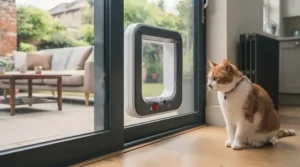
Same engineering as the small version above, scaled up considerably: a frame width of 34.3cm, a rise of 10.8cm, and a flap opening of 26.0cm x 41.6cm, rated for pets up to a hefty 45.4kg. What most buyers overlook about this model is that it isn’t really a “cat flap” in the narrow sense — it’s a genuine multi-pet door that happens to work brilliantly for large or elderly cats who struggle with a tight, low-clearance flap opening. The wider aperture means less crouching and squeezing, which matters if you’ve got an arthritic older cat or a household that also has a spaniel using the same door.
On paper, the size jump looks like it might compromise the door’s slide — but because this is still a no-cut insert replacing a section of track rather than a hole cut into existing glass, the sliding mechanism of the door itself is untouched; only the fixed or removable panel changes. Reviewers report that installation genuinely does take under an hour for someone reasonably competent with a tape measure, though a few note that very old or slightly warped patio door frames can need shimming to get a snug fit.
Pros:
- ✅ Handles cats and dogs up to 45.4kg in one unit
- ✅ Wide, low-effort opening — kinder to older or larger cats
- ✅ No cutting means the whole panel is removable later
Cons:
- ❌ A large aperture lets more draught and noise through than a small flap
- ❌ Bulkier panel is more visually obvious than a discreet glass insert
Prices for the large size typically sit in the £190-£220 range at the time of research, and it’s worth checking current pricing since PetSafe’s sliding door range varies by size band rather than a single fixed price point.
3. Cat Mate 210W Glass Fitting Cat Flap — best budget permanent glass insert
If the PetSafe inserts are the reversible option, the Cat Mate 210W is the other end of the spectrum: a genuine glass fitting flap designed to be built into a new toughened panel or cut into single glazing, with a cut-out diameter of 223mm and a flap opening of 145mm x 145mm. It self-lines to panels up to 30mm thick, which covers the vast majority of standard glazing and slimline patio door stiles. Here’s what to weigh: because toughened glass can’t be cut after manufacture, fitting this into existing double glazing means ordering a brand-new sealed unit from a glazier with the hole pre-cut — the flap itself doesn’t do any cutting.
Once fitted, though, this is about as neat and permanent a solution as you’ll get for the money. The circular transparent flap and brush-sealed magnetic closure are aimed at keeping the install genuinely draught-resistant rather than merely functional, and the 4-way lock (in/out, in only, out only, fully locked) gives you the kind of nighttime control a basic flap-in-a-hole doesn’t. Reviewers frequently mention how quiet the magnetic closure is in daily use, with the main complaint being that fitting requires a glazier for anything beyond single glazing.
Pros:
- ✅ Genuinely low-cost compared with no-cut insert kits
- ✅ 4-way lock gives full control over day/night access
- ✅ Brush seal plus magnetic closure keeps draughts down
Cons:
- ❌ Existing double glazing needs a brand-new sealed unit
- ❌ Not rated for large cats or small dogs
Expect a price in the £25-£40 range, making this one of the cheapest genuine glass door cat flap insert options on this list — the catch is you’re paying separately for the glazier’s labour and the new panel itself.
4. Cat Mate 357 Large Glass Fitting Cat Flap — extra headroom for big cats
Essentially the big sibling of the 210W above, built on the same self-lining, glass-friendly design principle but with a noticeably taller and wider opening intended for large cats and small dogs. The core engineering is identical: brush-sealed, magnetically closed, 4-way locking, and designed to be built into a new toughened panel rather than cut into existing double glazing. What most buyers overlook here is that “large” in cat flap terms usually just means Maine Coon-sized rather than genuinely dog-proportioned, so it’s worth measuring your specific cat’s shoulder width against the listed opening before assuming this is the right jump up from the standard 210.
Based on the spec comparison with the smaller model, the practical difference for most households is comfort rather than capability — a big cat can technically use the 210W, but they’ll be crouching and squeezing rather than walking through upright, which over years of daily use is the sort of thing that makes cats quietly start avoiding the flap altogether. Aggregated feedback on Cat Mate’s large glass flap tends to echo the standard model: solid, quiet, weatherproof, with occasional notes that professional fitting is worth the extra cost for a truly flush finish.
Pros:
- ✅ Comfortable opening for large or long-bodied cats
- ✅ Same reliable 4-way lock and magnetic seal as the standard model
- ✅ Clean, low-profile finish once professionally fitted
Cons:
- ❌ Larger cut-out means less flexibility on narrow door stiles
- ❌ Still requires a new sealed unit for existing double glazing
Price typically sits in the £35-£55 range, and it remains one of the more affordable ways to get a properly sized permanent flap into a patio panel, provided you’ve budgeted for the glazing work separately.
5. SureFlap Microchip Cat Flap with Glass & Wall Mounting Adaptor — keeps other cats out
This is the flap for anyone whose actual problem isn’t “how do I let my cat out” but “how do I stop next door’s enormous ginger tom from strolling in and eating my cat’s dinner.” The SureFlap Microchip Cat Flap scans your cat’s existing microchip (or a SureFlap RFID collar tag) and only unlocks for IDs you’ve programmed in, storing up to 32 pet identities, which matters more than it sounds for multi-cat households. Fitting it into a glass panel requires the separate glass and wall mounting adaptor, so budget for that as a second purchase rather than assuming it’s bundled — a detail more than one reviewer has been caught out by.
What the spec sheet won’t tell you, but user reports suggest, is that the selective-entry mechanism genuinely changes cat behaviour for the better in contested neighbourhoods; International Cat Care notes that a cat flap can otherwise be perceived by a cat as a weak point in their territory, and a microchip-locked flap closes that gap. On Amazon UK, the SureFlap Microchip Cat Flap carries well over 20,000 ratings averaging around 4.4 stars, a genuinely large and consistent review base for this category. Common praise centres on the one-button programming; the most frequent gripe is that it takes some cats — particularly nervous ones — a week or two to get comfortable with the scanning click before they’ll use it confidently.
Pros:
- ✅ Only opens for your cat’s own microchip, not the neighbours’ cats
- ✅ Stores up to 32 pet IDs for multi-cat homes
- ✅ Backed by a very large, consistently positive UK review base
Cons:
- ❌ Glass mounting adaptor is sold separately, adding to true cost
- ❌ Some cats need a settling-in period with the scanning mechanism
All told, budget for the flap plus adaptor together in the £100-£140 range at the time of research. For households dealing with intruder cats, that premium over a basic flap is arguably the whole point of the purchase.
6. PetSafe Magnetic 4-Way Locking Deluxe Cat Flap — lockable without a microchip
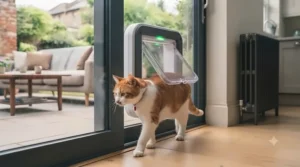
Sitting neatly between the ultra-budget Cat Mate 210W and the microchip-powered SureFlap Microchip Cat Flap, PetSafe’s Deluxe flap offers a 4-way locking system and a magnetic closure without asking you to register a microchip or buy a separate reader. Here’s what to weigh: it won’t stop a determined cat of the right size from pushing through, since it’s a mechanical lock rather than an identity check, but for households without a persistent intruder-cat problem, that’s usually not the deciding factor — cost and simplicity are.
Based on aggregated review sentiment, this model tends to sit comfortably in the “does exactly what it says” category rather than generating passionate praise or complaints, which is itself a useful signal for a piece of hardware you want to be boring and reliable. What most buyers overlook is that the magnetic closure genuinely does reduce draughts noticeably compared with a basic hinged flap with no seal, a small but real detail for anyone thinking about winter energy bills as much as cat access.
Pros:
- ✅ Full 4-way lock without any microchip or batteries needed
- ✅ Magnetic closure cuts draughts compared with basic hinged flaps
- ✅ Straightforward fitting into glass, UPVC or wood panels
Cons:
- ❌ No selective entry — any correctly sized cat can push through
- ❌ Woodgrain and white finishes limit design flexibility
Price generally falls in the £30-£50 range, making it a sensible mid-point pick for anyone who wants proper locking control without the ongoing cost or complexity of a microchip-reading system.
7. Amazon Basics Adjustable Plastic Pet Flap Door — cheapest building-block for DIY panels
This one doesn’t pretend to be a specialist patio door product — it’s a straightforward, budget plastic pet flap with a 4-way lock and a small-size entrance around 14.5cm x 14.2cm, sold as a general-purpose flap for cats and small dogs. Its relevance to sliding glass doors is specific: rather than fitting it directly into your existing patio glazing, it’s the kind of affordable component installers and glaziers use as the flap itself when building you a genuinely bespoke aluminium or uPVC insert panel sized to your exact door track.
Reviewers consistently note that, judged purely as a flap-on-a-panel, it does the basics competently for the price, with the usual caveats about budget plastic pet products: the frame flexes more than a premium metal-framed unit, and the magnetic-free locking mechanism feels less substantial in daily use. What most buyers overlook is that this is best thought of as a component cost rather than a complete solution — the real expense of a DIY panel build is the bespoke glazing and fitting labour, not the flap sat inside it.
Pros:
- ✅ Genuinely the cheapest flap option on this list
- ✅ 4-way lock included even at this budget
- ✅ Useful as a component for a custom-built patio insert
Cons:
- ❌ Not designed or marketed specifically for glass door fitting
- ❌ Build quality noticeably lighter than premium alternatives
Typically priced under £20, this is less a direct competitor to the other six products and more a budget-conscious building block for anyone commissioning a fully bespoke patio panel cat flap from a local glazier.
Fitting Your Cat Flap: A Practical Setup and First-30-Days Guide
Getting a cat flap installed is only half the job — the first month decides whether your cat actually uses it or whether you’re still holding the door open at 2am out of habit. Start by positioning the flap so its bottom edge sits roughly level with your cat’s stomach when standing; too high and nervous cats hesitate, too low and confident cats simply barge through without learning the mechanism properly. For no-cut insert panels like the PetSafe options, double-check the track alignment before final assembly — a millimetre or two of misalignment at the top can mean the sliding door won’t close flush months later.
For the first week, prop the flap open (most 4-way locks have an “always open” setting) and let your cat discover it under no pressure, ideally with a small treat trail leading through from both sides. Avoid forcing a cat through the flap physically — this is one of the fastest ways to create a lasting aversion. By week two, most cats are pushing through unassisted; if yours isn’t, check the flap tension hasn’t been fitted too stiff, which is a common first-timer’s mistake with magnetic closures. By day thirty, switch on selective locking (microchip or 4-way) if you plan to use it, since introducing restriction after the cat is already confident tends to go far more smoothly than locking it from day one.
🐾 Ready to Stop Holding the Door Open?
🔍 Browse the full lineup of glass fitting flaps and no-cut inserts above and pick the one that matches your door, your cat and your tenancy situation. Click through on any highlighted option to check current pricing and availability before you measure up!
Real-World Scenarios: Matching the Right Cat Flap to Your Household
If you’re renting a two-bedroom flat with a single indoor cat and a strict “no permanent alterations” clause, the PetSafe 2-Piece Sliding Glass Pet Door (Small) is very likely your best fit — it goes in without tools touching the actual door structure and comes straight back out at the end of the tenancy. Compare that with a homeowner in a Victorian terrace with a newly fitted patio door and a persistent problem with a neighbour’s cat helping itself to the food bowl: here, the SureFlap Microchip Cat Flap with its glass mounting adaptor solves the actual problem rather than just providing access, even though it costs considerably more upfront.
A third scenario: a family with an elderly, slightly arthritic cat and a medium dog sharing one exit point benefits most from the PetSafe 2-Piece Sliding Glass Pet Door (Large), simply because the wider, lower-effort opening reduces the daily strain of squeezing through a tight flap. And for someone commissioning a full custom patio panel rebuild as part of a wider extension project, the Amazon Basics Adjustable Plastic Pet Flap Door as a component paired with the Cat Mate 210W as a pre-made alternative gives a glazier two genuinely different price points to quote against.
Common Sliding Door Cat Flap Problems — and How to Fix Them
Problem: the sliding door won’t close flush after fitting a no-cut insert. This is almost always a track alignment issue rather than a faulty product — recheck the panel is seated evenly along the full rail before assuming the kit is defective.
Problem: the cat won’t use the flap at all. Nine times out of ten this comes down to positioning height or a too-stiff flap tension; lower the height slightly or manually flex a magnetic closure a few dozen times to loosen it before troubleshooting further.
Problem: draughts are noticeably worse after fitting. Check the weatherstripping on removable insert panels hasn’t compressed unevenly, and consider adding a supplementary brush seal along the top track — a cheap, five-minute fix that the Energy Saving Trust’s general draught-proofing advice applies just as well here as to any other gap around a door.
Problem: another cat keeps getting in. This is the single strongest argument for upgrading to a microchip flap; a mechanical 4-way lock genuinely cannot distinguish between your cat and a similarly sized intruder.
Problem: the flap has gone stiff or sticky after a year or two. A light, pet-safe silicone spray on the hinge points, applied every six months or so, resolves the vast majority of these cases without needing a replacement flap.
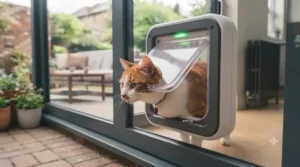
Patio Door Draught Seal: Buyer’s Decision Framework for Winter-Proofing
If you’re choosing purely on draught resistance, a permanent glass fitting flap with a brush seal and magnetic closure — like either Cat Mate model — will generally outperform a no-cut insert panel’s weatherstripping over a cold winter, because a bonded fitting has fewer gaps by design. If you’re a tenant who can’t fit a permanent panel, choose the no-cut insert anyway and budget five minutes for a supplementary self-adhesive draught strip around the frame edge each autumn. If you’re dealing with a genuinely draughty older patio door regardless of the cat flap itself, treat the flap as a secondary concern: fix the wider patio door draught seal first using standard foam or brush strips, since draught-proofing windows and doors more broadly is one of the cheapest ways to cut heat loss, according to the Energy Saving Trust. And if cost is genuinely no object, pair a microchip flap with a professionally fitted new toughened panel — this combination minimises both draughts and unwanted animal traffic in one job.
What Is a Cat Flap for Sliding Glass Doors?
A cat flap for sliding glass doors is a pet access panel specifically engineered for the slimline, tempered-glass construction of patio and bifold doors, either as a no-cut insert that replaces part of the existing track or as a flap built into a new or existing glass panel. Unlike standard cat flaps designed for thicker wooden or uPVC doors, these products account for the narrow clearance between sliding panels and the fact that toughened glass cannot be cut once manufactured.
How to Choose a Cat Flap for Sliding Glass Doors
- Confirm whether your glass is single or double glazed. Double glazing generally means a brand-new sealed unit is needed for any permanent flap, which changes your budget significantly.
- Measure your cat’s shoulder width and chest depth, not just their length. This decides whether a standard or large flap opening actually gives comfortable clearance.
- Decide whether you’re renting or own the property outright. This single factor probably narrows your shortlist faster than any spec sheet.
- Work out if intruder cats are a real problem in your area. If so, prioritise microchip selectivity over price from the outset.
- Check your sliding door’s fixed versus moving panel configuration. No-cut inserts typically fit into a fixed panel section, not the panel that actually slides.
- Get a glazier’s quote before committing to a permanent flap. Panel replacement costs vary enough regionally that it’s worth two or three quotes.
- Factor in draughtproofing from the outset. A flap chosen on price alone but fitted badly can undo a surprising amount of your home’s existing insulation.
Cat Flap Panel Sizing: Getting the Measurements Right
Cat flap panel sizing trips up more first-time buyers than any other part of this process, largely because “cat-sized” varies enormously between a slim Siamese and a broad-shouldered rescue moggy. The rule of thumb worth following: measure your cat standing normally, take the widest point across the shoulders, and add roughly 20-25% for comfortable clearance — cats need to feel they can move through without their whiskers brushing the sides, since whisker sensitivity genuinely affects their willingness to use a tight opening. For permanent glass fittings like the Cat Mate range, panel thickness matters just as much as flap opening: the self-lining depth (commonly up to 30mm) has to accommodate your actual door or panel thickness, and getting this wrong means either a loose, rattling fit or a flap that won’t sit flush at all. For no-cut insert kits, sizing works differently again — you’re matching the insert’s frame width and rise against your door’s existing track dimensions rather than your cat’s measurements, so always measure the aperture height and width of your specific sliding door before ordering, since patio door dimensions vary more between manufacturers than most buyers expect.
| Cat Body Type | Recommended Opening Width | Best Product Match |
|---|---|---|
| Small/slim (e.g. Siamese) | Around 145mm | Cat Mate 210W Glass Fitting Cat Flap |
| Average domestic shorthair | 145-180mm | PetSafe Magnetic 4-Way Locking Deluxe Cat Flap |
| Large/broad (e.g. Maine Coon) | 180mm+ | Cat Mate 357 Large Glass Fitting Cat Flap |
| Large cat plus small dog | Full multi-pet opening | PetSafe 2-Piece Sliding Glass Pet Door (Large) |
The table makes the pattern fairly clear: sizing decisions cascade from body type straight through to product choice far more reliably than price does. A too-small flap doesn’t just inconvenience a large cat — over months it can lead them to avoid the flap altogether and revert to scratching at the door, which rather defeats the point of buying one in the first place.
Sliding Door Cat Flap Kit vs Permanent Glass Panel Insert
The core decision most buyers face isn’t really about brand — it’s whether to choose a sliding door cat flap kit (a no-cut insert like the PetSafe range) or a permanent glass panel insert (like either Cat Mate model). A kit wins decisively on flexibility: no glazier, no altered glass, and full portability if you move house or simply change your mind. A permanent panel wins on cost and finish — once fitted, it looks like part of the original door design rather than an obvious add-on panel, and the upfront price is typically a fraction of a full insert kit before you even factor in the glazing cost.
Where this gets genuinely interesting is total cost of ownership over, say, a five-year tenancy versus five years of homeownership. A renter installing and later removing a no-cut kit across two different flats effectively reuses the same £200 purchase multiple times, which a permanent glass panel simply can’t offer. A homeowner, conversely, only pays the glazing cost once and then owns a fixture that adds practical value to the property indefinitely. Neither option is objectively “better” — they’re solving genuinely different ownership problems, and the right call depends far more on your housing situation than on the cat flap itself.
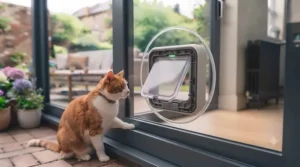
Rental-Friendly Cat Flaps: What Renters and Landlords Need to Know
Fitting anything permanent into a rented property’s glazing is, unsurprisingly, the kind of alteration that needs your landlord’s written permission — cutting a hole in a sealed double-glazed unit isn’t something most tenancy agreements will wave through without a conversation. This is exactly where rental-friendly cat flaps like the no-cut PetSafe insert panels earn their higher price tag: because nothing about the original door is permanently altered, many landlords are considerably more relaxed about approving them than a genuine glass-cutting job.
It’s worth knowing your rights here too. Under the rules that came into force for private tenancies in England from 1 May 2026, tenants can formally request permission to keep a pet, and landlords must respond within a set timeframe and can’t refuse without good reason, as Shelter England explains in its guidance for private renters. That doesn’t automatically extend to structural alterations like cutting glass, though — a landlord agreeing to a pet living in the property is a separate conversation from agreeing to permanently modify a patio door, so it’s sensible to raise both requests explicitly and in writing, keeping a written record either way. For anyone still negotiating that permission, a reversible no-cut kit is simply the lower-friction ask.
Long-Term Cost & Maintenance of Patio Panel Cat Flaps
Judged purely on upfront price, permanent glass fittings like the Cat Mate range look like the clear winner — but that comparison only holds if you already own the glazing outright and aren’t paying for a new sealed unit. Once glazier labour and a new toughened panel are factored in, a professionally fitted permanent flap can easily exceed the cost of a no-cut insert kit, particularly for double glazing where the whole unit needs replacing rather than a simple cut-and-fit job. Ongoing maintenance costs are modest either way: brush seals and magnetic closures typically need nothing beyond an occasional wipe-down and, once a year or so, a light silicone spray on moving parts to keep the action smooth.
Microchip flaps add a small recurring cost that’s easy to overlook — batteries. SureFlap’s microchip flap runs on four AA batteries with an estimated 12-month life under normal use, a modest but genuine ongoing expense compared with the fully mechanical Cat Mate or PetSafe alternatives. Over a five-year ownership period, that’s realistically four to five battery changes, still a fraction of the intruder-cat problem it’s solving for many households — and worth knowing given that, as International Cat Care explains, UK law has required pet cats in England to be microchipped since June 2024, meaning most cats already carry the chip a SureFlap needs without any extra vet visit.
Safety, Regulations and Microchipping for UK Cat Owners
Two separate regulatory threads matter here, and it’s easy to conflate them. The first concerns the glass itself: UK Building Regulations set out “critical locations” around doors — broadly, glazing within 300mm of a door edge and up to 1500mm high, and any glazing below 800mm from floor level — where safety glass such as toughened or laminated must be used, as Richmond upon Thames Council’s building control guidance sets out. Any new panel cut for a cat flap in that zone needs to meet this standard, which is exactly why toughened glass can’t simply be cut after the fact — a competent glazier will already be working to this rule as standard practice.
The second thread concerns your cat rather than your glazing: all pet cats in England must be microchipped by 20 weeks of age under UK law, with contact details kept current on an approved database (more on that below). This is worth knowing before choosing a microchip-reading flap like the SureFlap, since it means the vast majority of UK cats already carry a compatible chip — you’re very unlikely to need a separate collar tag purely for compatibility reasons, though one remains available as a backup option for cats whose owners prefer not to rely on the chip alone.
Features That Actually Matter (And Those That Don’t)
A properly sealed magnetic or brush closure genuinely matters, both for draughtproofing and for keeping the flap quiet enough not to wake a light sleeper at 3am. A 4-way lock genuinely matters if you want any control over overnight access at all. What matters considerably less, based on the spec comparison across this list, is flap colour or woodgrain finish — a purely cosmetic choice that adds nothing to function, and one manufacturers happily charge a small premium for regardless. Curfew timer functions on premium microchip flaps sound impressive but, in practice, only earn their keep for households with genuinely predictable schedules; for anyone with variable shift patterns, manual locking achieves much the same result without the added complexity of programming a timer correctly.
FAQ
❓ Can you fit a cat flap in a sliding glass door yourself?
❓ Do sliding door cat flaps let in a draught?
❓ What size cat flap do I need for a large cat?
❓ Can I get a cat flap in a sliding door if I'm renting?
❓ Do microchip cat flaps work with any microchip?
Conclusion
There’s no single “best” cat flap for sliding glass doors, and honestly, anyone claiming otherwise probably hasn’t tried fitting one into a rented flat versus a homeowner’s newly glazed extension. What the research consistently points to is that the right choice hinges on three practical questions: do you own or rent, how big is your cat, and is an intruder-cat problem actually part of what you’re solving. Renters and anyone wary of permanent alterations should lean toward a no-cut insert like the PetSafe sliding glass range; homeowners prioritising cost and a neat finish will likely prefer a permanent glass fitting from Cat Mate; and anyone dealing with unwelcome feline visitors should treat the SureFlap Microchip Cat Flap‘s extra cost as money well spent rather than an upsell. Whichever route you take, measure twice, check your glazing type before ordering, and factor draughtproofing into the decision from day one rather than as an afterthought once winter arrives.
Recommended for You
- Door Mounted Cat Flap: 7 Best Picks for 2026
- Top 7 Top Cat Flaps Under £50 in 2026: Budget Picks
- Microchip Cat Flap UK: 7 Best Picks Ranked for 2026
Disclaimer: This article contains affiliate links. As an Amazon Associate, I earn from qualifying purchases. If you purchase products through these links, we may earn a small commission at no additional cost to you.
✨ Found this helpful? Share it with your friends! 💬🤗
