
In This Article
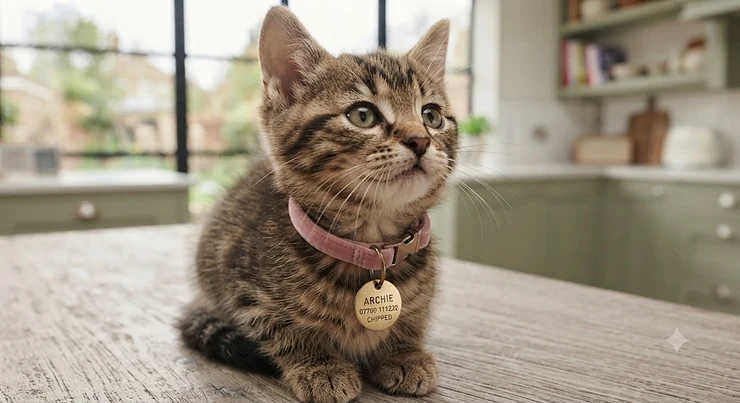
Somewhere between “she’ll never actually get out” and the 2am phone torch search of next door’s garden, most cat owners discover the same truth: cats treat fences as suggestions. A set of cat ID tags is the cheapest insurance policy you’ll ever buy for a creature who considers your garden wall a stepping stone to somewhere more interesting. Small, jangly, and often overlooked in favour of “I’ll sort a collar eventually,” these little discs of stainless steel or brass do a genuinely unglamorous but vital job: they tell whoever finds your wandering cat exactly who to call, without needing a vet’s microchip scanner or a trip to the practice.
What is a cat ID tag? It’s a small metal disc — usually stainless steel, brass or aluminium — engraved or stamped with your cat’s name and your contact details, fitted to a breakaway collar so anyone who finds your cat can ring you straight away, no scanner required.
This guide looks at seven real, currently available options on amazon.co.uk, from budget glitter discs to brass tags built to outlast the collar they’re riding on, plus one QR-code alternative that’s shaking things up a bit. We’ll cover engraving depth, weight, durability, and — because cat microchipping has been a legal requirement in England since 10 June 2024 under the Microchipping of Cats and Dogs (England) Regulations 2023 — how a tag fits into the wider picture of keeping your cat properly identified, not just legally compliant. Prices below are shown as ranges only, since Amazon prices shift regularly — always check the current price on the listing before buying.
Quick Comparison Table
| Product | Material | Best For | Price Range |
|---|---|---|---|
| EDSG Cat ID Tag | Stainless steel | Budget-friendly personalisation | Under £8 |
| The Stately Hound Cat Tag | 2mm stainless steel | Quiet, premium everyday wear | £10-£15 range |
| Anavia Slide On Silent Pet ID Tag | Stainless steel + fabric | Cats who hate jangling | £8-£12 range |
| GoTags Personalised Cat & Dog ID Tag | Stainless steel | Shape variety and gifting | £8-£14 range |
| Solid Brass Pet Tag | Solid brass | Long-term durability | £15-£25 range |
| LARRYROO Engraved Paw Tag & Collar | Stainless steel + nylon | All-in-one collar and tag combo | Under £10 |
| ilFindYou QR Code Cat Tag | Aluminium/composite | Tech-forward, no engraving needed | £8-£13 range |
Looking at the spread above, the EDSG Cat ID Tag and LARRYROO Engraved Paw Tag & Collar dominate the entry-level end for owners who just want something reliable on the collar this week. The Solid Brass Pet Tag sits at the top for buyers thinking in years rather than months, while the ilFindYou QR Code Cat Tag is the outlier — it swaps traditional engraving for a scannable code, which changes the whole value proposition. None of these seven is a bad choice; they’re simply built for different owners, which is exactly what we’ll unpack next.
💬 Just one click — help others make better buying decisions too!😊
Top 7 Cat ID Tags: Expert Analysis
Picking a winner among cat ID tags isn’t really about finding “the best” — it’s about matching the tag to your cat’s temperament, your budget, and how much you value quiet over flash. Here’s the honest breakdown of seven real options currently listed on Amazon UK, covering budget, mid-range and premium territory.
1. EDSG Cat ID Tag — cheapest reliable entry point
The EDSG Cat ID Tag turns up near the top of Amazon’s cat ID tag charts for good reason: it’s inexpensive, comes in a genuinely wide range of colours and glitter finishes, and does the core job without fuss. Made from stainless steel with deep engraving on one or both sides depending on the listing you choose, it holds a name and phone number legibly without the text wearing away after a few months of outdoor scrapes.
What’s worth knowing before you buy: the engraving depth on budget tags like this one varies between batches, so a tag that reads crisply out of the box can start looking a little shallow after eighteen months of collar friction against fur and undergrowth. That’s simply the trade-off of stainless steel at this price point rather than a defect — deeper engraving generally costs more because it takes longer to cut.
Based on the spec comparison with pricier alternatives, the EDSG Cat ID Tag makes most sense for owners who want a tag on the collar today, aren’t precious about a decade of use, and like having colour and shape options (bones, hearts, rounds) to match their cat’s personality. Amazon reviews for glitter and bling-finish tags like this one commonly mention that the sparkle finish can flake slightly with heavy wear, though the core stainless steel underneath holds up fine — worth noting if you want the tag to look pristine for years rather than months.
Pros:
- ✅ Genuinely low price for a personalised stainless steel tag
- ✅ Wide colour and shape choice for matching your cat’s style
- ✅ Deep enough engraving to stay legible for typical use
Cons:
- ❌ Glitter/bling finishes can show wear faster than plain steel
- ❌ Engraving depth can vary slightly between batches
At under £8, the EDSG Cat ID Tag is hard to argue with as a starting point — it delivers the basics of a personalised stainless steel cat tag without asking you to think too hard about it.
2. The Stately Hound Cat Tag — quietest premium option
If your cat’s collar sounds like a tiny wind chime every time she walks across the kitchen, The Stately Hound Cat Tag is aimed squarely at solving that. Built from 2mm-thick stainless steel and specifically engineered to sit flush and “quiet” against the collar, it’s noticeably heftier and better finished than most budget tags, while staying light enough for a cat’s neck at 20mm in the small size.
The thicker gauge steel is the standout spec here, and it matters more than it sounds: thinner tags flex and rattle against buckles and other hardware, which is exactly the noise that can spook a nervous cat into scratching at their own collar. A 2mm tag simply moves less, so there’s less to jangle in the first place. It’s also genuinely waterproof rather than merely “water resistant,” which matters for cats who treat every puddle and pond edge as a personal challenge.
What most buyers overlook about a tag like this is that “quiet” isn’t just a comfort feature for the cat — it’s a practical one for you too, since a cat who isn’t constantly pawing at a noisy collar is a cat who’s less likely to work the collar loose or damage the tag against something. Reviewers of similarly engineered “quiet” tags consistently note the noise reduction as the single biggest difference from cheaper alternatives, more than the price gap would suggest.
Pros:
- ✅ Noticeably quieter than standard hanging tags
- ✅ Thicker 2mm stainless steel resists bending and denting
- ✅ Fully waterproof for outdoor and multi-cat households
Cons:
- ❌ Sits at a higher price point than basic engraved discs
- ❌ Smaller size may need double-checking against your cat’s collar hardware
For an owner who’s tired of the 3am jingle-jangle across the landing, The Stately Hound Cat Tag is worth the extra spend in the £10-£15 range — this is where “premium” actually earns the word.
3. Anavia Slide On Silent Pet ID Tag — best for hating dangly tags
The Anavia Slide On Silent Pet ID Tag takes a completely different approach: instead of hanging off a ring, the tag threads directly onto the collar via a slim elastic fabric band, so there’s nothing swinging or clinking at all. For cats who chew at dangling tags, or who manage to somehow snag every loose object on every fence post in a three-street radius, this design removes the problem at the source.
Stainless steel construction keeps the engraved plate itself durable, while the elastic band is designed to be chew-resistant rather than something a bored cat can shred in an afternoon. In practice this means the identification stays put through exactly the kind of rough-and-tumble outdoor activity that shakes loose tags off split rings.
Honestly, this is a tag built for a specific problem rather than universal appeal — if your cat has never once tugged at her collar tag, you probably don’t need this. But for the subset of cats who do, the slide-on band genuinely solves what a standard ring-and-tag setup can’t. Aggregated feedback on slide-on and silent-style pet tags tends to praise the reduced noise, with the main caveat being that legibility on a slimmer engraved surface can be marginally smaller than a full-sized round disc.
Pros:
- ✅ Eliminates dangling and jangling entirely
- ✅ Chew-resistant band reduces loss from tag-fiddling cats
- ✅ Stainless steel plate keeps engraving durable
Cons:
- ❌ Smaller engraving surface than standard round tags
- ❌ Band may need periodic replacement as it wears
In the £8-£12 range, the Anavia Slide On Silent Pet ID Tag is a smart, slightly under-the-radar pick for anxious or fidgety cats — not the flashiest option here, but arguably the most thoughtfully engineered for a specific real-world problem.
4. GoTags Personalised Cat & Dog ID Tag — best shape and style variety
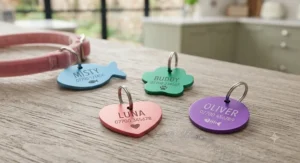
GoTags Personalised Cat & Dog ID Tag covers an unusually wide range of shapes — bow tie, star, heart, round, badge and bone among them — all engraved on both sides in stainless steel. For owners who want their cat’s tag to reflect a bit of personality (or match a theme, if you’re the sort who colour-coordinates pet accessories), this is one of the more flexible options on the market.
Double-sided engraving is the practical standout: it means you can fit both your cat’s name and your contact number without cramming everything onto one crowded face, which genuinely improves legibility for anyone who finds your cat and has to squint at a tiny disc in poor light. The shape variety isn’t just cosmetic either — a star or bow-tie shape sits slightly differently against fur than a round disc, which some owners find reduces snagging on long-haired breeds.
What the spec sheet won’t tell you, but shoppers who’ve bought multiple shapes from this range note, is that the smaller novelty shapes (like the bow tie) have proportionally less engraving space than the round or bone options, so if you’ve got a long name or want a full address, stick with the bigger shapes.
Pros:
- ✅ Wide range of genuinely different tag shapes
- ✅ Double-sided engraving fits more information legibly
- ✅ Solid stainless steel construction across the range
Cons:
- ❌ Novelty shapes offer less engraving space
- ❌ Style variety can make choosing genuinely time-consuming
Priced in the £8-£14 range depending on shape and size, GoTags Personalised Cat & Dog ID Tag earns its place here as the “something for everyone” option in this line-up.
5. Solid Brass Pet Tag — best long-term durability
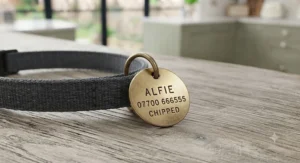
If you want to buy a tag once and genuinely forget about it, the Solid Brass Pet Tag is built for exactly that mindset. Made from solid brass rather than plated or coated steel, it takes deep-cut engraving that doesn’t wear, fade, or flake — brass simply ages into a warmer patina rather than degrading, which is a meaningfully different proposition to stainless steel over a five- or ten-year window.
The minimalist design strips away glitter, colour and novelty shapes in favour of a clean, legible plate, which sounds like a small thing until you’re the person squinting at a scratched-up budget tag in the rain trying to work out a phone number. Brass is also naturally more resistant to the kind of surface corrosion that can eventually dull cheaper metal tags, particularly for cats who spend a lot of time near salt air or damp gardens.
Based on the spec comparison with the other six products here, this is the closest thing to a “buy it for life” cat ID tag in this round-up — not because it’s flashy, but because the material itself is doing more of the durability work than any coating or finish could.
Pros:
- ✅ Solid brass resists fading and corrosion long-term
- ✅ Deep-cut engraving stays legible for years
- ✅ Timeless, minimal design that suits any collar
Cons:
- ❌ Noticeably pricier than stainless steel alternatives
- ❌ Fewer colour and novelty shape options available
At around £15-£25, the Solid Brass Pet Tag costs more upfront, but the cost-per-year of ownership genuinely competes with — and likely beats — cheaper tags you’ll end up replacing twice over the same period.
6. LARRYROO Engraved Paw Tag & Collar — best all-in-one starter set
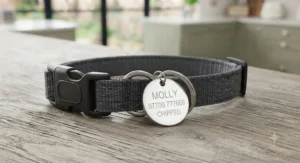
The LARRYROO Engraved Paw Tag & Collar is a slightly different proposition: rather than just a tag, it’s a breakaway safety collar with an optional engraved, glitter paw-shaped tag included, aimed at owners who need the whole setup sorted in one purchase rather than sourcing a collar and tag separately. It also offers a “Do Not Feed” messaging variant, which is a genuinely useful option for cats on medically restricted diets or who are prone to wandering into neighbours’ kitchens for a second dinner.
The breakaway safety clasp is the feature that matters most here, and it’s not just a nice-to-have — as we’ll cover in the safety section below, a quick-release mechanism is what stands between a snagged collar and a genuine emergency. Bundling it with the tag means new kitten owners in particular don’t accidentally end up with a beautifully engraved tag on an unsafe, non-breakaway collar.
For a first-time cat owner setting up a kitten’s collar from scratch, this bundled approach removes a decision point that’s easy to get wrong — and the paw shape and glitter finish, while clearly aimed at a younger or more playful aesthetic, don’t compromise the core stainless steel tag underneath.
Pros:
- ✅ Combines a breakaway collar and tag in one purchase
- ✅ “Do Not Feed” option is genuinely practical for some cats
- ✅ Simple for first-time owners setting up a new kitten
Cons:
- ❌ Paw-shaped tag has a smaller engraving area
- ❌ Glitter collar styling may not suit every taste
Under £10, the LARRYROO Engraved Paw Tag & Collar is a sensible one-stop pick for new kitten owners who’d rather not source a separate collar and tag on their first attempt.
7. ilFindYou QR Code Cat Tag — best tech-forward alternative
The ilFindYou QR Code Cat Tag ditches engraving altogether in favour of a scannable QR code linked to an online profile, which anyone who finds your cat can scan with a smartphone camera to see your contact details and, depending on the service, send you a location alert. It’s a genuinely different category from the other six tags here — lighter, since there’s no metal engraving plate involved, and updatable without buying a new tag if your phone number changes.
The core trade-off is dependency: a QR tag only works if the finder has a smartphone with signal and is willing to scan an unfamiliar code on a stray cat’s collar, which isn’t guaranteed in every situation the way a plainly printed phone number is. On the other hand, the ability to update your details instantly online — rather than re-engraving a physical tag every time you move house — is a real practical advantage that traditional tags simply can’t match.
What most buyers overlook about QR-based tags is that they work best as a companion to, not a replacement for, a traditional engraved tag or the legally required microchip — belt and braces, essentially, rather than a single point of failure. Feedback on QR-style pet tags generally highlights the ease of updating contact details as the standout feature, with occasional notes that older or less tech-confident finders may hesitate to scan an unfamiliar code.
Pros:
- ✅ Contact details updatable without buying a new tag
- ✅ Very lightweight with no metal engraving plate
- ✅ Can include location-alert features via the linked app
Cons:
- ❌ Relies on the finder having a smartphone and signal
- ❌ Less immediately obvious than a printed name and number
In the £8-£13 range, the ilFindYou QR Code Cat Tag is best thought of as a modern add-on for tech-comfortable households rather than a wholesale replacement for a classic metal disc.
Top 7 Products: Full Specification Comparison
| Product | Engraving | Weight Profile | Best For | Price Range |
|---|---|---|---|---|
| EDSG Cat ID Tag | Deep engraved, one/both sides | Standard | Budget personalisation | Under £8 |
| The Stately Hound Cat Tag | Deep engraved, 2mm steel | Slightly heavier, very quiet | Quiet everyday wear | £10-£15 range |
| Anavia Slide On Silent Pet ID Tag | Engraved plate on band | Lightweight | Chew-prone or fidgety cats | £8-£12 range |
| GoTags Personalised Cat & Dog ID Tag | Double-sided engraved | Standard, varies by shape | Style and shape variety | £8-£14 range |
| Solid Brass Pet Tag | Deep-cut brass | Standard | Long-term durability | £15-£25 range |
| LARRYROO Engraved Paw Tag & Collar | Engraved, smaller area | Lightweight | New kitten starter set | Under £10 |
| ilFindYou QR Code Cat Tag | No engraving, QR code | Very lightweight | Tech-forward households | £8-£13 range |
Read across this table and a pattern emerges: weight and engraving depth pull in opposite directions, since the metal that holds a deeper cut generally weighs a little more too. If your cat is small, skittish, or simply hates anything extra on her collar, the Anavia Slide On Silent Pet ID Tag or ilFindYou QR Code Cat Tag solve for comfort first. If longevity is the priority over grams, the Solid Brass Pet Tag and The Stately Hound Cat Tag are worth the slightly heavier feel on the collar.
✨ Don’t Miss These Exclusive Deals!
🔍 Take your cat’s safety kit to the next level with these carefully compared tags. Click through to check current pricing and availability on each one, and give your cat the best odds of a fast trip home if she ever slips out the cat flap uninvited.
Practical Usage Guide: Fitting and Maintaining Cat ID Tags
Buying the tag is the easy part. Getting it right on the collar — and keeping it legible for years rather than months — is where most owners drop the ball, usually without realising it.
Start with fit before you even think about engraving: a correctly fitted breakaway collar should let you slide two fingers comfortably between the collar and your cat’s neck, no tighter. Too loose and the tag swings wildly, accelerating wear on both the engraving and the split ring; too tight and you risk chafing, regardless of how good the tag itself is. Fit the collar first, then attach the tag, rather than the other way round — it’s a small ordering change that stops you overtightening to compensate for a heavy or dangling tag.
Split rings are the quiet failure point nobody talks about. Even the best engraved cat tag is useless if it’s dangling from a rusted, bent, or simply cheap split ring that pops open the first time it snags a branch. Check the ring every few months, and don’t hesitate to replace it with a slightly sturdier stainless steel version if the one that came with your tag feels flimsy — it’s a pound or two well spent.
For the first thirty days after fitting a new tag, watch for two things: whether your cat is constantly pawing at the collar (a sign it’s uncomfortable or the tag is too heavy for her frame), and whether the tag is staying legible under normal wear. A common early mistake is fitting a heavier premium tag, like the Solid Brass Pet Tag, onto a kitten who simply isn’t grown into the weight yet — better to start light with something like the Anavia Slide On Silent Pet ID Tag and upgrade once she’s fully grown.
Ongoing maintenance is minimal but not nothing: wipe the tag periodically to keep engraving grooves free of dirt, which genuinely helps legibility, and re-check the collar fit every few months since cats’ necks change shape slightly with weight and coat thickness across the seasons.
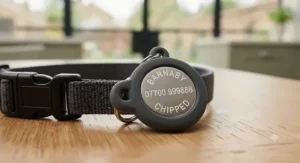
Real-World Scenarios: Matching the Tag to Your Cat
The nervous indoor-outdoor cat. If your cat startles at her own collar tag clinking against a food bowl, noise is the deciding factor, not price. The Anavia Slide On Silent Pet ID Tag or The Stately Hound Cat Tag both solve for quiet, just via different mechanisms — slide-on band versus thicker, flush-sitting steel. Either beats forcing a nervous cat to tolerate a standard dangling disc out of habit.
The new kitten owner on a tight budget. You need a breakaway collar and tag sorted quickly, without overthinking it, and you’re honestly not sure yet whether your kitten will even keep a collar on. The LARRYROO Engraved Paw Tag & Collar bundle removes the decision fatigue of sourcing two separate items, and at under £10, it’s a low-stakes way to find out whether your particular cat tolerates a collar at all before investing in something pricier.
The multi-cat household that moves house occasionally. If you’ve got three cats and a habit of relocating every few years, re-engraving physical tags every time gets tedious and adds up in cost. This is where the ilFindYou QR Code Cat Tag genuinely earns its keep — update the linked contact details online in minutes rather than buying seven new tags across a house move, while keeping a basic engraved tag as backup for the cats who spend the most time outdoors.
Problem → Solution: Common Cat ID Tag Issues
Problem: The tag falls off within weeks. This is almost always a split ring issue, not a tag issue. Solution: upgrade to a sturdier stainless steel split ring and check it monthly — most of the seven products above ship with an adequate but basic ring that benefits from an upgrade for outdoor cats.
Problem: The engraving has worn illegible after a year or two. Cheaper stamped or shallow-engraved tags are more prone to this. Solution: for cats who spend a lot of time outdoors rubbing against fences and undergrowth, step up to deep-engraved stainless steel like The Stately Hound Cat Tag, or solid brass for maximum longevity.
Problem: My cat won’t stop pawing at the collar. Usually weight or noise related. Solution: switch to a lighter, quieter option such as the Anavia Slide On Silent Pet ID Tag, and double-check the collar fit isn’t too tight — pawing is sometimes a comfort complaint rather than a tag complaint.
Problem: I keep changing my phone number and re-engraving is a hassle. Solution: the ilFindYou QR Code Cat Tag solves this specific problem directly, since details update online rather than requiring a new physical tag every time.
Problem: My cat’s collar snapped off completely and I never found it. This is actually the breakaway mechanism doing its job correctly, not a failure — but solution-wise, always keep a spare collar and tag ready so your cat isn’t going without identification for weeks while you order a replacement.
How to Choose the Right Cat ID Tag
- Confirm you’re choosing a breakaway collar first. The tag matters far less than the collar it’s attached to — a snap-open, quick-release collar should always come before you even think about engraving, since Cats Protection specifically recommends quick-release collars to prevent your cat getting stuck or injured.
- Decide how much text you actually need. A name and one phone number is usually enough — cramming an address on too gives a stranger who finds your cat information they don’t need in a moment of stress.
- Weigh durability against your cat’s lifestyle. An indoor-only cat can comfortably wear a lighter budget tag; an outdoor explorer benefits from deeper engraving or solid brass that resists years of undergrowth abrasion.
- Check the tag’s weight relative to your cat’s size. Kittens and small breeds do best with lightweight options rather than a premium heavy disc scaled for an adult cat.
- Think about noise tolerance. If your cat is easily startled, a slide-on or flush-fitting tag beats a standard dangling disc regardless of how good the engraving looks.
- Factor in how often your contact details change. Frequent movers may prefer a QR-based tag that updates online over repeated re-engraving costs.
- Remember the tag is a backup, not a replacement, for microchipping. It’s the fast, no-scanner-needed option for a neighbour who finds your cat in the garden — the microchip is the legal, permanent record underneath it.
Engraved Cat Tag vs Personalised Cat Name Tag: What’s the Difference?
In practice, these two terms overlap more than they diverge, but there’s a genuinely useful distinction for buyers comparing listings. An engraved cat tag specifically refers to how the text is applied — cut or etched into the metal surface, as seen on products like the EDSG Cat ID Tag and The Stately Hound Cat Tag. A personalised cat name tag is a broader category that simply means the tag is customised to your cat specifically, which could mean engraving, but could also mean a printed, stamped, or even QR-linked approach like the ilFindYou QR Code Cat Tag.
Why does the distinction matter for buyers? Engraving tends to last longer against wear because the text sits below the surface rather than on top of it, resisting scuffing better than printed or surface-level customisation. Personalisation as a broader concept, though, opens up options — like updatable QR codes — that engraving simply can’t offer. If longevity of the physical mark is your top priority, lean toward genuinely engraved products like the GoTags Personalised Cat & Dog ID Tag. If flexibility and easy updates matter more, a personalised-but-not-engraved option earns a look too.
Stainless Steel Cat Tag vs Other Materials: Durability Compared
| Material | Corrosion Resistance | Weight | Typical Lifespan |
|---|---|---|---|
| Stainless steel | Good | Moderate | 2-5 years typical outdoor use |
| Solid brass | Excellent | Moderate | 5-10+ years |
| Aluminium/composite | Fair | Very light | 1-3 years typical outdoor use |
Stainless steel sits in the sensible middle ground of this comparison, which is exactly why the majority of products in this round-up — including the EDSG Cat ID Tag, The Stately Hound Cat Tag, Anavia Slide On Silent Pet ID Tag, and GoTags Personalised Cat & Dog ID Tag — are built from it. It resists rust well enough for typical UK weather without the added cost and weight of solid brass. Where the Solid Brass Pet Tag pulls ahead is pure longevity under sustained outdoor exposure, while lighter aluminium-adjacent options like the ilFindYou QR Code Cat Tag trade some durability for genuinely reduced weight — a fair trade for a cat who barely tolerates anything on her collar at all.
A durable cat collar tag, in other words, isn’t automatically the heaviest or most expensive one — it’s the one whose material properties actually match how and where your specific cat spends her time.
Lightweight Cat ID Tag: Why Weight Matters More Than You’d Think
It’s tempting to assume a few extra grams on a collar tag is negligible, but for a kitten or small-breed cat, weight genuinely affects comfort and collar retention. A tag that feels trivial in your hand can pull a lightweight collar askew on a cat under three kilos, causing chafing at the collar’s leading edge or prompting exactly the kind of pawing-at-collar behaviour that eventually leads to a lost tag.
This is precisely where a lightweight cat ID tag like the Anavia Slide On Silent Pet ID Tag or ilFindYou QR Code Cat Tag earns its place over a heftier premium option. Neither compromises on the core job — legible identification — while both meaningfully reduce the load on a small cat’s neck. For adult, larger-breed cats, the weight difference between these and something like the Solid Brass Pet Tag is far less noticeable, which is why weight should factor into your decision proportionally to your cat’s actual size, not as a universal rule.
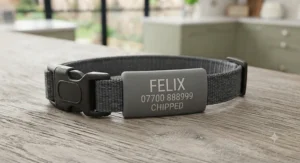
Custom Stamped Pet Tag vs Laser Engraved: Which Lasts Longer?
Stamping presses text into metal using physical force, while laser or deep-cut engraving removes material to form the lettering — and the difference shows up in longevity. A custom stamped pet tag can look identical to an engraved one on day one, but stamped lettering tends to be shallower on average, meaning it’s more vulnerable to gradual wear from friction against fur, other collar hardware, and general outdoor abrasion over a year or two.
Deep engraving, as used on products like The Stately Hound Cat Tag and the Solid Brass Pet Tag, cuts noticeably further into the metal surface, which is why these tend to stay legible for longer under identical conditions. That said, stamped tags aren’t a bad choice outright — they’re typically cheaper to produce, which is reflected in the lower price of budget options, and perfectly adequate for indoor cats who won’t be subjecting the tag to years of fence-and-hedge friction.
Metal Identification Tag for Cats: Safety, Regulations & Compliance
Here’s the bit that trips a lot of owners up: a metal identification tag for cats is genuinely useful, but it is not, on its own, a legal substitute for microchipping in England. Under the Microchipping of Cats and Dogs (England) Regulations 2023, all cat owners in England must ensure their cat is microchipped, with only feral, farm, unowned and community cats exempt. Owners found not to have complied face a fine of up to £500 after a 21-day grace period to get the chip done.
So where does a physical tag fit in? Think of it as the fast lane. A microchip needs a scanner, usually only found at vets, shelters, or with animal wardens — brilliant for confirming ownership formally, but not much help to a neighbour who’s just found your cat sitting on their bins at 6am. A tag with a name and number lets that neighbour ring you directly, no scanning equipment required, which is precisely why the RSPCA continues to recommend both a collar tag and a microchip working together rather than treating either as sufficient alone.
Safety-wise, the collar the tag hangs from matters just as much as the tag itself. Every collar you fit should be a breakaway, quick-release design — never a standard buckle collar that can’t release under pressure, since a cat caught on a branch or fence post with a non-breakaway collar is at genuine risk of injury or worse.
Common Mistakes When Buying Cat ID Tags
The most frequent mistake is buying a tag before checking the collar it’s going on is genuinely breakaway — an engraved tag on an unsafe collar solves the wrong problem entirely. A close second is over-cramming the engraving with a full address, which takes up space better used for a clear, large-print phone number that’s actually legible at arm’s length in poor light.
Another common slip is assuming a heavier, premium tag is automatically “better” without checking it against your specific cat’s size — a solid brass disc built for a large adult cat can genuinely irritate a kitten still growing into her collar. Finally, plenty of owners buy the tag and consider identification “sorted,” forgetting entirely that tags fall off and collars come loose — which is exactly why the microchip underneath remains the permanent backup a tag alone can’t replace.
Long-Term Cost & Maintenance
Run the numbers over five years and the picture shifts a little from what the sticker price suggests. A budget tag like the EDSG Cat ID Tag, replaced roughly every 18-24 months as engraving wears or a ring gives way, can end up costing a similar total to a single Solid Brass Pet Tag bought once and left alone. That’s not an argument against budget tags — plenty of owners are perfectly happy replacing an inexpensive disc every couple of years — but it’s worth factoring cost-per-year, not just cost-per-purchase, into the decision if longevity genuinely matters to you.
Split ring replacement is the other quiet ongoing cost: budget rings occasionally need swapping for a few pence each, a trivial expense that nonetheless prevents the far more annoying cost of losing an otherwise perfectly good tag in the garden. Beyond that, maintenance is close to zero — an occasional wipe to keep engraving legible is genuinely all these products ask of you.
Features That Actually Matter (And Those That Don’t)
Actually matters: engraving depth, breakaway collar compatibility, and tag weight relative to your cat’s size — these three genuinely affect whether the tag does its job for years rather than months.
Doesn’t matter nearly as much as marketing suggests: novelty shapes and glitter finishes are lovely if they suit your cat’s personality, but they don’t meaningfully change how well the tag performs its actual function, so don’t let shape variety alone tip a decision away from a tag with better core specs. Similarly, brand name recognition matters far less here than material and engraving quality — several of the lesser-known products in this round-up, like the Anavia Slide On Silent Pet ID Tag, outperform bigger-name alternatives on the specific problem they’re designed to solve.
FAQ
❓ Do cats legally need to wear an ID tag in the UK?
❓ What information should go on a cat ID tag?
❓ How much does a personalised cat ID tag cost in the UK?
❓ Are quick-release collars safe for cat ID tags?
❓ Does a cat ID tag replace microchipping?
Conclusion
Cat ID tags are one of those small purchases that punch well above their price tag when it actually matters — the difference between a stranger ringing you within the hour and a much longer, more anxious search. Across the seven options here, there’s genuinely no single “best” answer: the EDSG Cat ID Tag and LARRYROO Engraved Paw Tag & Collar cover budget-conscious and first-time owners well, The Stately Hound Cat Tag and Anavia Slide On Silent Pet ID Tag solve for noise and comfort, the Solid Brass Pet Tag rewards owners thinking long-term, and the ilFindYou QR Code Cat Tag offers a genuinely modern alternative for households who’d rather update details online than re-engrave metal.
Whichever you choose, pair it with a breakaway collar and keep your cat’s microchip details current — the tag gets your cat home fast, and the chip makes sure that identification never truly gets lost, even if the collar does.
Recommended for You
- Vest Harness for Cats: 7 Best Picks for UK Owners in 2026
- How To Walk A Cat On A Lead: 7 Best Harnesses (2026 UK)
- Cat Walking Harness: 7 Brilliant Picks Reviewed (2026)
Disclaimer: This article contains affiliate links. As an Amazon Associate, I earn from qualifying purchases. If you purchase products through these links, we may earn a small commission at no additional cost to you.
✨ Found this helpful? Share it with your friends! 💬🤗
