
In This Article
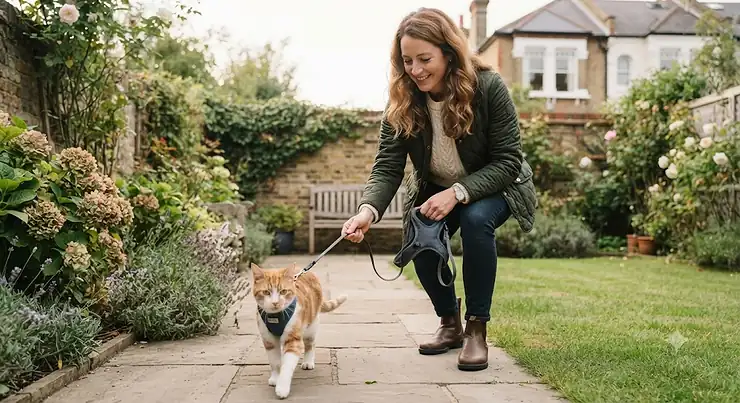
The first time my neighbour’s tabby trotted past my window on a lead like he owned the pavement, I laughed out loud. Cats don’t do walkies. Except, increasingly, they do — and the internet is full of confident, harness-clad moggies strolling round parks like tiny feline aristocrats. If you’re wondering how to walk a cat on a lead without ending up in a tangled heap of fabric and fury, you’re in exactly the right place.
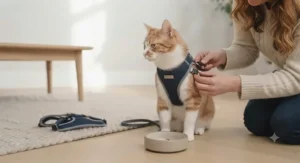
Here’s the honest truth up front: teaching a cat to walk on a lead is nothing like teaching a dog. Cats don’t naturally follow, they don’t chase approval the way dogs do, and a fair few will simply flop dramatically the moment the harness touches their fur. What is a cat harness, then, and why bother? It’s a body-worn restraint — usually a vest or figure-of-eight design — that distributes pressure across the chest and shoulders rather than the throat, letting a cat explore outdoors under supervision without the choking risk a collar carries.
This guide walks through seven real, UK-available harnesses spanning budget figure-of-eight sets right up to premium escape-resistant vests, alongside a proper step-by-step approach to training. Cats Protection’s own guidance is that most cats are generally happier exploring outdoors freely rather than on a harness and lead, so we’ll also cover when a lead genuinely helps — and when your energy is better spent elsewhere. Whether you’ve got a nervous rescue or a bold kitten raring to explore, you’ll find the right gear and the right technique below.
Quick Comparison Table
| Harness | Type | Best For | Price Range |
|---|---|---|---|
| Ancol Nylon Figure 8 Cat Harness & Lead Set | Figure-of-eight | Budget starters with a calm cat | under £10 |
| Trixie Adjustable Cat Harness with Lead | Soft mesh strap | Kittens and first-time trials | under £10 |
| Catit Nylon Adjustable Cat Harness and Leash Set | Slim strap | Cats who hate bulky vests | £8-£12 |
| Rabbitgoo Cat Harness and Lead Set | Vest, escape-resistant | Most owners wanting security | £10-£17 |
| PetSafe Come With Me Kitty Harness and Bungee Leash | Vest, bungee lead | Cats that bolt or lunge | £12-£20 |
| Kitty Holster Cat Harness | Cotton vest, velcro | Sensitive skin, vet visits | £15-£25 range |
| Hepper Cat Harness and Leash Set | H/X-shape vest | Adventure cats, daily walks | £20-£30 range |
Looking across the board, the split roughly mirrors what you’d expect: cheaper figure-of-eight designs from Ancol and Trixie work fine for a placid cat that barely notices the harness, but they rely on a single strap around the neck, which is exactly the pinch point a determined escape artist will find first. The vest-style options — Rabbitgoo, PetSafe, Kitty Holster and Hepper — spread pressure over a much wider area and are noticeably harder to back out of, which matters more than any other single factor once you’re actually outdoors. If your cat is nervous, twitchy, or has form for wriggling out of collars, spend the extra few pounds on a vest design; it’s the difference between a relaxed walk and a frantic search through next door’s hedge.
💬 Just one click — help others make better buying decisions too!😊
Top 7 Cat Harnesses: Expert Analysis
Every cat is a slightly different shape, temperament and level of patience, so there’s no single “best” harness — only the best harness for your particular cat. Below are seven genuinely available options across the price spectrum, chosen to cover figure-of-eight beginners’ sets, all-rounder vests, and premium escape-resistant designs.
1. Ancol Nylon Figure 8 Cat Harness & Lead Set — classic budget figure-of-eight starter
The Ancol Nylon Figure 8 Cat Harness & Lead Set is about as simple as cat harnesses get, and that simplicity is precisely its appeal for a first attempt. One continuous nylon strap loops around the neck and the other around the body, meeting at a central ring where the lead clips on, and the whole thing is genuinely quick to fit even on a squirming cat.
The design measures roughly 24-46cm around the chest depending on size, and comes with a reflective moon-and-stars pattern woven into the webbing for visibility on dusk walks. Because it’s a single continuous loop rather than a padded vest, it weighs next to nothing, which some cats barely register once it’s on — useful if your cat objects to anything heavier or bulkier touching their fur.
Based on the spec comparison with vest-style rivals further down this list, the figure-of-eight design’s obvious trade-off is security: if a cat panics and pulls backwards hard enough, the neck loop can tighten uncomfortably, and a determined escape artist has fewer barriers to wriggling free than with a wrap-around vest. This makes the Ancol a sensible pick for a calm, confident cat taking their very first tentative steps in the garden, not for a nervous cat you’re planning to walk somewhere unfamiliar.
Reviewers consistently report that the harness holds up well over time and that the release clip, while functional, can feel a little fiddly to operate one-handed. Several owners also note that once cats connect the harness with going outside, they stop fussing about being dressed in it.
Pros:
- ✅ Very lightweight, barely noticeable on smaller cats
- ✅ Quick to fit even on wriggly kittens
- ✅ Reflective stitching helps visibility at dusk
Cons:
- ❌ Single-loop design is easier to slip than a vest
- ❌ Release clip can be fiddly for some owners
At around under £10, the Ancol offers solid value as a low-risk way to test whether your cat tolerates a harness at all before spending more on a premium set.
2. Trixie Adjustable Cat Harness with Lead — soft mesh with elasticated give
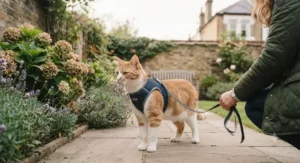
Trixie is one of the most recognisable names in UK pet accessories, and the Trixie Adjustable Cat Harness with Lead takes a slightly softer approach than a rigid nylon strap. It’s built from a breathable mesh and nylon blend with an elasticated section built into the lead itself, which flexes rather than yanking when a cat suddenly stops or changes direction.
Sizing runs from around 24-42cm at the chest with fully adjustable straps at both the chest and belly, and the padding along the strap edges reduces the risk of chafing behind the front legs — a genuinely common sore spot on cheaper harnesses. A supplementary snap buckle adds a second point of security beyond the main adjustment strap, giving a little more peace of mind than a pure figure-of-eight.
What most buyers overlook about this model is that the elasticated lead does double duty: it absorbs the shock of a sudden lunge (say, at a passing bird) without transmitting a hard jolt through the harness to the cat’s chest, which reduces the odds of a startled cat associating the walk itself with discomfort. That’s a small but meaningful detail for anyone leash training a cat for the first time, since a bad early experience can set training back weeks.
Aggregated review sentiment is mixed specifically on the velcro-style safety fastenings included on some colour variants — some owners find them reassuring, others report the fastening can loosen with heavy pulling, so a snug initial fit really does matter here.
Pros:
- ✅ Elasticated lead cushions sudden pulls
- ✅ Padded straps reduce chafing behind the legs
- ✅ Widely stocked with easy size exchanges
Cons:
- ❌ Velcro elements can loosen under strong pulling
- ❌ Not the most secure choice for a bold escape artist
Priced under £10, the Trixie sits comfortably alongside the Ancol as an entry point, but the extra padding and elasticated lead make it the gentler of the two for a genuinely first-time cat harness experience.
3. Catit Nylon Adjustable Cat Harness and Leash Set — lightest, least noticeable fit
Catit is a cat-specialist brand, and the Catit Nylon Adjustable Cat Harness and Leash Set is engineered to feel like almost nothing on a cat’s back. The slim nylon straps adjust at multiple points along the chest and neck, and the whole set is noticeably lower-bulk than any vest-style harness on this list.
The harness uses a “snag-proof” strap design, meaning the material is built so that if it catches on a branch or fence, the strap resists tightening further rather than cinching down — a small but sensible safety feature for anyone walking their cat somewhere with brambles or garden clutter. It’s finished with a small gold-plated bell, which, while mostly cosmetic, does give wildlife a fair warning if your cat likes to stalk the hedgerows.
On paper this means the Catit is best suited to petite adult cats and kittens who find anything heavier overwhelming or restrictive — the kind of cat that freezes the moment a vest touches their shoulders but tolerates a slim strap without complaint. The lightness is a genuine advantage for cat harness training tips aimed at anxious cats, since less physical sensation often means a faster, calmer introduction. The obvious trade-off, as with any slim-strap design, is that it offers less coverage and control than a vest if your cat does try to twist free.
Real owner feedback frequently praises how quickly cats stop noticing the harness once it’s on, though a handful of reviewers note that a truly determined cat can still back out of it if the fit isn’t snug.
Pros:
- ✅ Extremely light and low-profile fit
- ✅ Snag-proof strap resists sudden tightening
- ✅ Multiple adjustment points for a precise fit
Cons:
- ❌ Less overall coverage than a vest design
- ❌ Requires a very snug fit to prevent slipping
At roughly £8-£12, the Catit is fair value for owners specifically hunting for the least intrusive harness on the market, though security-focused buyers should look further down this list.
4. Rabbitgoo Cat Harness and Lead Set — best-selling escape-resistant vest
The Rabbitgoo Cat Harness and Lead Set is one of the most reviewed cat harnesses sold on Amazon UK, and it’s easy to see why: the vest-style construction wraps around the chest and back with two separate adjustment points, distributing pressure far more evenly than any strap-only design.
Available in four sizes from extra-small to large, the harness uses soft breathable mesh with reinforced stitching at every stress point, plus snap buckles rather than pure velcro for the main closure — a detail that matters once a cat starts leaning into the strap out of curiosity. The included lead runs to roughly 1.2-1.5 metres, long enough for a relaxed pace but short enough to maintain quick control near a road.
Here’s what the spec sheet won’t tell you, but user reports suggest: sizing runs a touch generous, and several owners recommend ordering one size down from their cat’s measured chest girth for a genuinely escape-resistant fit — a loose harness, however well-designed, is only as secure as its adjustment. Once correctly fitted, though, the two-point adjustable design makes it substantially harder for a cat to back out of than either the Ancol or Trixie above, which is exactly why it’s become the default recommendation for owners introducing outdoor walking to an indoor cat for the first time.
Aggregated review sentiment is strongly positive on comfort and reflective visibility for evening walks, with the main recurring complaint being sizing rather than build quality — a fixable issue with a tape measure and the size chart, not a design flaw.
Pros:
- ✅ Two adjustment points make backing out difficult
- ✅ Reflective strips aid visibility at dusk
- ✅ Reinforced stitching at every stress point
Cons:
- ❌ Sizing runs generous — measure carefully
- ❌ Bulkier feel than slim-strap alternatives
In the £10-£17 range, the Rabbitgoo delivers the best balance of security and value on this list, and it’s the harness I’d point most first-time owners toward.
5. PetSafe Come With Me Kitty Harness and Bungee Leash — shock-absorbing bungee lead
PetSafe has been making pet behaviour and containment products since 1991, and the PetSafe Come With Me Kitty Harness and Bungee Leash channels that experience into a genuinely clever lead design. Rather than a static strap, the lead itself is built from bungee cord that flexes and tightens gently across the shoulder straps whenever the cat pulls or bolts.
The harness uses a two-point fit that applies pressure to the shoulders rather than the throat, with quick-snap buckles and a colour-coded belly strap so you can tell at a glance which piece goes where — a small touch that makes putting it on considerably less fiddly than harnesses with unmarked straps. It’s sized for small, medium and large cats separately rather than using a single adjustable range, which tends to produce a more consistent fit than one-size vests.
What most buyers overlook about this model is what the bungee mechanism actually does in practice: when a cat suddenly darts sideways at a leaf or a passing dog, the stretch in the lead absorbs that jolt gradually rather than snapping the harness taut instantly, which is gentler on the cat’s shoulders and reduces the panic response that a sharp tug can trigger. That matters a great deal for step-by-step cat harness training, since a startling correction early on can undo weeks of patient habituation in a single walk.
Reviewers frequently mention that cats adapt to the bungee stretch faster than to a rigid lead, and that the harness resists escape attempts well provided the correct size is chosen — undersized fits being the most common complaint in aggregated feedback.
Pros:
- ✅ Bungee lead cushions sudden pulls or bolts
- ✅ Colour-coded straps speed up fitting
- ✅ Shoulder-focused pressure avoids the throat
Cons:
- ❌ Sized per cat weight, so measuring matters
- ❌ Bungee stretch feels unusual to some cats initially
Sitting in the £12-£20 range, the PetSafe earns its place for owners whose cats are prone to sudden lunges, where the shock-absorbing lead genuinely changes the walking experience.
6. Kitty Holster Cat Harness — plush cotton vest with velcro security
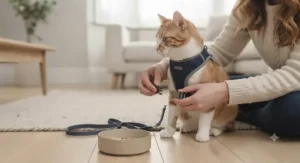
The Kitty Holster Cat Harness takes a completely different construction approach from every other product on this list: rather than nylon webbing, it’s made from breathable, washable cotton with an undyed lining designed to be gentle on sensitive skin, and it fastens with ultra-strong hook-and-loop closures instead of plastic buckles.
The wrap-around vest design hugs the chest and shoulders closely, and because there are no rigid buckles digging in, it’s often recommended for cats that react badly to the click and pressure of snap fasteners. It comes in a genuinely wide size range from extra-small through to extra-large, and each harness ships with a short leash-training pamphlet, which is a nice nod to how many buyers are attempting harness training for the very first time.
Based on the spec comparison with buckle-based vests, the trade-off here is philosophical rather than purely technical: velcro isn’t inherently weaker than a plastic buckle, but a sufficiently strong, sustained pull can peel hook-and-loop fastenings apart in a way a snap buckle simply won’t release under, so no design here is truly escape-proof, only escape-resistant. Reviewers who use it for calmer cats, vet visits and short garden sessions tend to rate the comfort very highly; those with especially strong, food-driven or lunging cats occasionally report the velcro loosening over a long pull.
Aggregated feedback consistently highlights how quickly nervous cats settle once wearing it, likely thanks to the soft cotton construction rather than crinkly nylon mesh, and the harness is machine-washable, which matters after a few muddy walks.
Pros:
- ✅ Soft cotton is gentle on sensitive skin
- ✅ No plastic buckles pressing into the body
- ✅ Includes a leash-training pamphlet for beginners
Cons:
- ❌ Velcro can loosen under sustained strong pulling
- ❌ Less breathable than mesh vests in hot weather
At a premium £15-£25 range, the Kitty Holster is best suited to nervous or sensitive-skinned cats where comfort outweighs the need for maximum pull resistance.
7. Hepper Cat Harness and Leash Set — premium H-shape built for adventure cats
The Hepper Cat Harness and Leash Set sits at the top of this list on both price and build quality, using a versatile H- or X-shaped configuration with durable stitched nylon and adjustable straps at four separate points rather than the usual two.
Every seam is reinforced, and the set includes a matching lead with a sturdy clip, plus a reflective strip woven into the main body strap for low-light visibility. The multi-point adjustment allows for a genuinely tailored fit across a wide range of body shapes, which matters because so much of a harness’s real-world security comes down to how snugly it sits rather than the material itself.
The spec sheet won’t tell you this, but reviewers note that the H/X-shape configuration is one of the hardest layouts for a cat to twist or wriggle out of, since there’s no single loop a cat can slip a shoulder through — pulling in any direction simply tightens against a different anchor point rather than loosening the whole assembly. That makes it a strong pick for confident, adventurous cats who walk regularly, rather than a cat taking its first few cautious steps in the garden. The set is also fully machine-washable, a practical bonus once a harness starts seeing regular outdoor use.
Aggregated review sentiment is very positive on build quality and security, with the main criticism in earlier product runs being limited colour choice rather than performance — a minor gripe compared with fit and safety.
Pros:
- ✅ Four-point adjustment resists twisting escapes
- ✅ Reinforced stitching built for regular use
- ✅ Includes matching lead with reflective strip
Cons:
- ❌ Highest price point on this list
- ❌ Limited colour options compared with budget brands
In the £20-£30 range, the Hepper is the pick for owners who walk their cat regularly and want the most secure, most durable option money can buy.
Transformation Content
Step-By-Step Cat Harness Training
Getting a cat comfortable enough to actually enjoy a lead takes patience measured in days and weeks, not minutes — so here’s a realistic step-by-step cat harness training approach that respects a cat’s pace rather than forcing it.
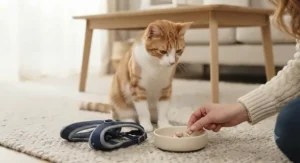
Days 1-3: Scent and sight only. Leave the harness out near the food bowl or favourite sleeping spot so your cat can sniff, walk over, and generally decide it’s not a threat. Don’t put it on yet.
Days 4-6: Brief wearing sessions indoors. Pop the harness on loosely for two or three minutes at a time, paired with a treat or a play session immediately afterwards, then take it straight back off. The goal here is purely positive association, not distance.
Days 7-10: Extend wearing time, attach the lead indoors. Once the harness itself is a non-event, clip the lead on and let it trail loosely while your cat potters around a familiar room, so they get used to the weight without any pulling from you.
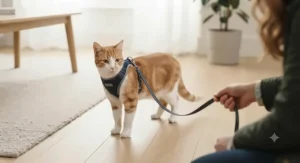
Days 11-14: First steps in a secure garden. Choose a quiet, enclosed outdoor space, keep sessions to five minutes, and let your cat lead the pace entirely — you’re accompanying them, not walking them like a dog. This is the point at which many indoor-only cats genuinely start enjoying the fresh air.
Common mistakes in this first fortnight include rushing the schedule, forcing a struggling cat to “just get used to it,” and choosing a busy or unfamiliar space too early. Among the most useful cat harness training tips from experienced owners: always let your cat retreat to a hiding spot if they freeze or flatten to the ground, since forcing continued movement at that point usually sets training back rather than forward.
Real-World Scenarios: Which Harness Suits Your Cat?
The nervous rescue cat. If your cat startles at loud noises, hides from visitors, and has never worn anything before, a soft, low-bulk option like the Trixie or Catit makes sense for the earliest sessions, since minimal sensation and gentle fastenings reduce the chance of an early bad experience. Sessions should stay indoors and under five minutes for the first fortnight.
The confident indoor cat wanting a taste of outdoors. For a bold, curious cat that already headbutts the front door hopefully every time it opens, introducing outdoor walking to an indoor cat works well with a secure vest like the Rabbitgoo, since the two-point adjustment gives you the confidence to explore slightly further from the door once the basics are solid.
The escape artist who’s slipped a collar before. If your cat has form for backing out of collars or loose harnesses, skip straight to a multi-point vest such as the Hepper or Kitty Holster, and double-check the fit against the sizing chart rather than guessing — a snug, correctly sized escape-resistant harness solves most “my cat got loose” stories at the source.
Problem → Solution: Fixing Common Harness Training Setbacks
Problem: your cat flops and refuses to move. This is one of the most common early reactions, and it isn’t stubbornness — it’s often a freeze response. Solution: sit down at their level, wait it out without pulling on the lead, and reward any voluntary movement, however small.
Problem: the harness keeps twisting round. Usually a sizing or fit issue. Solution: tighten the chest strap first so the D-ring sits centred on the back before attaching the lead, and re-check fit after any weight change.
Problem: your cat scratches at the harness constantly. Solution: shorten wearing sessions and check for pinching at the legs — models like the Trixie with padded edges tend to cause less irritation for sensitive cats.
Problem: your cat associates the harness with a stressful vet trip. Solution: reserve a completely separate harness for walks if possible, and rebuild positive association from scratch with short, reward-heavy indoor sessions.
How to Choose a Cat Harness for Lead Walking
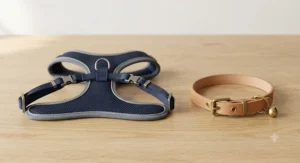
- Measure your cat’s chest girth first. Every harness on this list lists a size range, and a harness that’s even slightly too loose undermines any escape-resistant design feature it has.
- Match the design to your cat’s temperament. Confident, established outdoor cats tolerate vest-style multi-point harnesses well; nervous first-timers often do better starting with something lighter like the Catit or Trixie.
- Prioritise pressure distribution over price. A properly designed pet harness spreads pressure across the chest and shoulders rather than concentrating it at the neck, which is safer regardless of budget tier.
- Check the closure type. Snap buckles resist sustained pulling better than velcro alone, though velcro designs like the Kitty Holster avoid the discomfort some cats feel from plastic clips.
- Consider the lead separately from the harness. A bungee or elasticated lead, as used by PetSafe and Trixie, absorbs sudden pulls more gently than a completely rigid lead.
- Factor in visibility for evening walks. Reflective stitching, present on the Ancol, Rabbitgoo and Hepper, matters more than most buyers expect once autumn evenings draw in.
- Buy one size, try it indoors, then commit to a colour range. Returns on a badly fitting harness are far easier before your cat associates it with going outside.
Common Mistakes When Buying and Using a Cat Harness
The single most frequent mistake is buying a cat harness for first time use based purely on looks rather than chest measurement — a beautifully designed harness that’s a centimetre too loose is not a safe harness. A close second is skipping the indoor habituation phase entirely and heading straight outside on day one, which almost guarantees a stressed, harness-averse cat going forward.
Owners also commonly attach the lead to a collar instead of a harness “just for a quick trip to the car,” which risks serious neck injury if the cat panics and pulls. Finally, many people assume a harness that worked brilliantly for a friend’s cat will suit theirs identically — but body shape, coat thickness and temperament vary enormously between individual cats, so what fits a lean short-haired cat snugly may sit completely differently on a stockier, longer-coated one.
Cat Harness vs Cat Collar and Lead
| Factor | Harness | Collar and Lead |
|---|---|---|
| Neck safety | Pressure spread across chest/shoulders | High risk of choking if cat pulls |
| Escape resistance | Much harder to back out of (vest styles) | Very easy to slip over the head |
| Comfort for extended wear | Generally comfortable once fitted | Can rub and irritate skin |
| Suitability for lead walking | Recommended by vets and welfare charities | Not recommended for lead attachment |
A collar plays an important role in everyday identification, but as Cats Protection and other welfare organisations consistently point out, a lead should never be clipped directly onto it — a cat’s neck simply isn’t built to absorb that kind of sustained pressure the way a chest and shoulder harness is. Beyond safety, the practical difference shows up the moment a cat pulls backwards in surprise: a collar slips off almost instantly, while even a modest vest harness like the Catit or Ancol offers some resistance. For anyone serious about lead walking rather than occasional identification, the harness isn’t optional — it’s the entire foundation the activity rests on.
What to Expect: Real-World Performance of a Cat on a Lead
Specs and marketing photos rarely capture what an actual first walk looks like, so here’s the honest version. Most cats spend the first two or three outdoor sessions moving in short bursts — a few tentative steps, a long pause to sniff a leaf, then possibly flattening against the ground entirely if a car passes. This is completely normal and not a sign the harness or the cat is “wrong” for walking.
Confident cats, particularly those introduced young, often settle within a couple of weeks into a recognisable rhythm: exploring at their own pace, climbing low obstacles, and occasionally trying to lead you rather than the other way round. Nervous cats may take considerably longer, and some — this is worth saying plainly — never fully relax into it, in which case respecting that and returning to enrichment indoors is the kinder outcome. Reviewers across every harness on this list mention the same pattern: comfort and confidence build gradually, and rushing the timeline is the most common reason training stalls.
Cat Harnesses for Different Life Stages: Kittens, Adults and Senior Cats
Kittens generally adapt to harness wearing far more readily than adult cats, since they haven’t yet built up years of comfortable “collar-free” habit — lightweight options like the Trixie or Catit in their smallest sizes suit growing kittens well, though expect to size up more than once during their first year. Adult cats being introduced for the first time often need a longer, more patient habituation period, and a secure vest such as the Rabbitgoo gives more room for confidence to build without constant re-adjustment.
Senior cats bring their own considerations: reduced mobility, arthritis or simply a stronger preference for routine can make outdoor walks less appealing or physically comfortable than they once were. A softer, lower-friction option like the Kitty Holster‘s cotton construction avoids unnecessary rubbing on ageing joints and skin, and sessions should be shorter and less frequent than for a younger cat.
Long-Term Cost and Maintenance
A budget harness like the Ancol or Trixie, at under £10, will likely need replacing sooner if used for regular daily walks, since thinner nylon straps show wear faster under repeated stress than reinforced vest stitching. A mid-range vest such as the Rabbitgoo or PetSafe, in the £10-£20 range, tends to hold up well for a year or more of regular use provided it’s hand-washed rather than machine-washed on a hot cycle.
Premium options like the Kitty Holster and Hepper, priced in the £15-£30 range, are generally built with heavier stitching and better-quality hardware designed to survive years of regular outdoor use, which can work out cheaper per walk over time even though the upfront cost is higher. Maintenance across all seven products is straightforward: a quick rinse after muddy walks, occasional hand-washing with mild detergent, and periodic checks on stitching and buckle strength before longer walking seasons begin. It’s also worth using any outdoor season as a prompt to double-check your cat’s microchip details are up to date, since worn collar tags are easy to lose on an active walk.
Features That Actually Matter (And Those That Don’t)
Multi-point adjustment and pressure distribution genuinely matter — they’re the difference between a harness a cat can twist out of and one it can’t. Reflective stitching matters if you walk at dusk or dawn, and a bungee or elasticated lead matters for cats prone to sudden lunges. Machine-washability is a small but real quality-of-life feature once a harness starts seeing regular mud and grass.
What matters considerably less, despite marketing emphasis, is colour range and decorative patterning — a harness’s escape resistance has nothing to do with whether it comes in tiger print or plain black. “100% escape-proof” claims are also worth treating with scepticism; as multiple pet welfare resources note, no harness design is truly escape-proof, only more or less escape-resistant depending on fit and construction.
Safety, Regulations and Compliance Guide
There’s no UK law specifically governing cat harnesses or lead walking, but there is a legal requirement that directly affects any cat spending time outdoors: since 10 June 2024, it has been compulsory in England for keepers to have their cat microchipped by 20 weeks of age, with fines of up to £500 for non-compliance. It’s a sensible safety net alongside a secure harness in case the two ever part ways unexpectedly outdoors.
Welfare guidance is worth taking seriously here too. Cats Protection’s own advice is that many cats simply don’t like being restrained, and that getting them into a harness can be genuinely stressful for them, particularly for cats that haven’t been introduced gradually or that show clear signs of distress such as flattened ears, crouching, or attempts to bolt. If your cat consistently resists — not just during the first few sessions, but persistently over weeks — that’s a genuine signal to stop rather than push through, regardless of how well-fitted the harness itself is. A properly fitted vest-style harness that distributes pressure evenly, combined with a calm introduction and a quiet, low-traffic environment, remains the safest way to approach lead walking for cats who genuinely take to it.
Frequently Asked Questions
❓ What is the best harness to walk a cat on a lead?
❓ How do you get a cat used to walking on a lead?
❓ Can any cat be trained to walk on a lead?
❓ Is it cruel to walk a cat on a lead?
❓ How long does it take to leash train a cat?
Conclusion
Learning how to walk a cat on a lead isn’t about forcing a dog’s routine onto a very different animal — it’s about matching the right harness to your individual cat’s temperament and letting them set the pace, literally and figuratively. A budget figure-of-eight set like the Ancol or Trixie is a perfectly reasonable way to test the waters, while a secure vest like the Rabbitgoo, PetSafe or Hepper earns its higher price tag through genuinely better pressure distribution and escape resistance once you’re committed to regular walks.
Whichever harness you choose, the training process matters just as much as the gear: short sessions, plenty of patience, and a willingness to stop if your cat is telling you, clearly and repeatedly, that this isn’t for them. For the cats that do take to it, a well-fitted harness opens up a whole new world of garden sniffing, leaf-chasing and pavement supervising that indoor-only cats rarely get to experience. Take it slowly, measure carefully before you buy, and let your cat’s confidence — not a training schedule — set the timeline.
Recommended for You
- Cat Walking Harness: 7 Brilliant Picks Reviewed (2026)
- H-Harness vs Vest Harness Cat: 7 Best Picks Compared 2026
- Escape Proof Cat Harness UK: 7 Anti-Escape Picks for 2026
Disclaimer: This article contains affiliate links. As an Amazon Associate, I earn from qualifying purchases. If you purchase products through these links, we may earn a small commission at no additional cost to you.
✨ Found this helpful? Share it with your friends! 💬🤗
