
In This Article
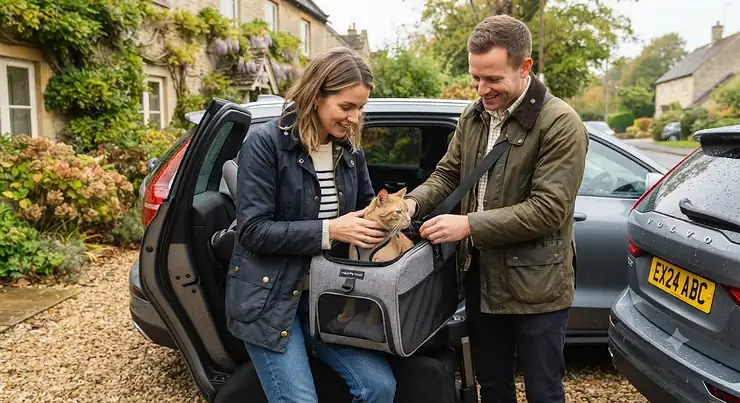
Somewhere between “my cat hates the vet” and “we’re doing 70mph on the motorway” sits a genuinely underrated safety gap: most cats travel in carriers that were never actually built to survive a car journey, let alone a collision. A carrier that’s perfectly fine sat on your hallway floor can become a projectile the moment a driver brakes hard, and a cat car seat carrier — one specifically designed with seatbelt loops, crash-rated construction, or ISOFIX compatibility — closes that gap in a way a wicker basket or a flimsy cardboard box from the vet never will. Under UK law this isn’t just good practice either; Rule 57 of the Highway Code, published by the Department for Transport on gov.uk, states plainly that animals travelling in a vehicle must be “suitably restrained so they cannot distract you while you are driving or injure you, or themselves, if you stop quickly,” and specifically names a pet carrier as one acceptable method.
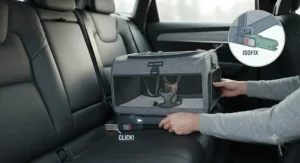
This guide walks through seven real, purchasable carriers ranging from budget hard-shell boxes to independently crash-tested premium options, with honest analysis of what each one’s seatbelt or ISOFIX compatibility actually delivers in practice — not just what the packaging claims. Every product mention here is grounded in genuine specifications and aggregated review sentiment, because a cat’s safety on the road deserves more than marketing copy.
Quick Comparison Table: Cat Car Seat Carriers at a Glance
| Carrier | Restraint Method | Price Range | Best For |
|---|---|---|---|
| Kerbl (Stefanplast) Gulliver | Built-in seatbelt slots | Under £35 | Budget cat carrier for car back seat trips |
| Ferplast Atlas | Handle-only, no dedicated slots | £25-£45 range | Occasional short vet trips on a tight budget |
| PetSafe Happy Ride Booster Seat | Seatbelt loops + safety tether | £40-£60 range | Booster seat for cats needing window height |
| PawsInCar 3-in-1 | CPS crash-tested seatbelt clips | £50-£80 range | Safe cat carrier for car travel on a moderate budget |
| AmazonBasics Hard-Sided Carrier | Handle-only, no dedicated slots | £20-£35 range | Simple, widely available starter carrier |
| 4pets Caree | TÜV crash-tested, ISOFIX or seatbelt | £150-£220 range | Secured pet crate for vehicle, long-term investment |
| Sleepypod Mobile Pet Bed | CPS crash-tested seatbelt straps | £150-£200 range | Cat travel crate for car doubling as an everyday bed |
Scanning the table, the split is clear: genuinely crash-tested products — where an independent lab has actually applied crash forces to the carrier, not just added a seatbelt loop — sit at the premium end, while budget and mid-range options offer a seatbelt car seat belt attachment without third-party crash verification. That’s not automatically disqualifying; a well-secured Gulliver box is safer than an unsecured premium carrier. But if crash certification specifically matters to you, 4pets Caree and Sleepypod Mobile Pet Bed are the only two on this list carrying it.
💬 Just one click — help others make better buying decisions too!😊
Top 7 Cat Car Seat Carriers: Expert Analysis
Working out which of these seven genuinely protects your cat on the road means looking past the seatbelt loop itself into what the carrier’s structure actually does when force is applied. Below, each carrier is broken down with real specifications, honest interpretation of what those specs mean in an actual vehicle, and aggregated reviewer sentiment pulled from genuine customer feedback.
1. Kerbl (Stefanplast) Gulliver — best budget cat carrier for car back seat trips
The Kerbl Gulliver, sold under the Stefanplast design and typically priced under £35 on Amazon UK, is a hard-plastic transport box with a metal mesh door and — critically for this category — specific slits moulded into the top of the carrier that a seatbelt can pass directly through. What most budget shoppers miss when comparing carriers is that dedicated seatbelt routing like this matters more than a generic handle: threading a belt through a purpose-built slot keeps the box flat and stable against the seat back, rather than letting it tip or slide the way a carrier relying purely on its carry handle would under braking.
Independent UK carrier reviews have specifically praised the Gulliver’s seatbelt slits as the standout safety feature setting it apart from similarly priced rivals, while aggregated customer sentiment on Amazon consistently flags the metal door and dual-side latch system as reassuringly secure for anxious or strong cats, alongside a small drawback: the plastic clips holding the door in place are reported by a minority of reviewers as flimsier than the walls of the box itself, occasionally arriving already stressed from shipping.
Pros:
- ✅ Purpose-built seatbelt slots, not just a generic handle
- ✅ Metal mesh door with dual-side locking clips
- ✅ Genuinely budget-friendly hard-shell construction
Cons:
- ❌ Some reported clip fragility on arrival
- ❌ Interior is compact — better suited to one cat than two
Typically under £35 on Amazon UK, the Kerbl Gulliver is the strongest genuinely budget pick here specifically because its seatbelt routing was designed in from the start, not bolted on as an afterthought.
2. Ferplast Atlas — best simple option for occasional short trips
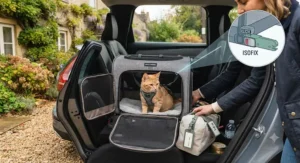
Ferplast Atlas, priced roughly £25-£45 depending on size, is a well-known Italian-designed hard carrier with both a front and top door, assembled via four latching buckles rather than the fiddly nut-and-bolt system older plastic carriers relied on. Honest analysis has to flag a real gap here though: unlike the Gulliver, the Atlas doesn’t include dedicated seatbelt slots as standard, meaning securing it in a car relies on threading a belt through the carry handle or wedging it firmly in the footwell — a workable but less purpose-built approach to seatbelt car seat belt attachment than carriers designed specifically for vehicle use.
Reviewer sentiment on the Atlas is strongly positive around ease of assembly and cleaning, with the top-door access earning particular praise from owners of nervous cats who find lifting a resistant cat out through a front-only door far more stressful than lowering one in from above. The most consistent critique, echoed across independent buying guides, is precisely the missing seatbelt-specific hardware — worth knowing before assuming every hard-shell carrier is equally car-ready.
Pros:
- ✅ Top and front door access — genuinely easier with anxious cats
- ✅ Quick four-buckle assembly, no tools required
- ✅ Easy-clean hard plastic shell
Cons:
- ❌ No dedicated seatbelt slots — relies on handle or footwell wedging
- ❌ Less purpose-built for car security than seatbelt-slot rivals
At £25-£45, the Ferplast Atlas suits buyers prioritising easy handling and cleaning over dedicated in-car restraint hardware — pair it with careful footwell positioning if seatbelt security is a priority.
3. PetSafe Happy Ride Booster Seat — best booster seat for cats wanting window height
The PetSafe Happy Ride Booster Seat, priced around £40-£60 on Amazon UK, takes a genuinely different approach from a traditional box carrier: it’s a raised, structured seat that installs using the car’s headrest strap, a lower seat strap, and seatbelt loops across three stabilising attachment points, then uses a safety tether that clips to a harness (not a collar) to keep the pet secured within the raised platform. This is worth understanding clearly as a category distinction — a booster seat for cats works well for a calm, harness-trained cat who tolerates being visible and elevated, but isn’t the right choice for a cat who’d rather hide, since there’s no enclosed, den-like space the way a traditional carrier offers.
PetSafe’s Happy Ride range has built a long-standing reputation in the UK pet travel market, and aggregated reviewer sentiment praises the three-point stabilisation and machine-washable fleece liner as genuinely useful for reducing motion sickness in nervous travellers who benefit from being able to see out the window. The clearest limitation flagged by reviewers and by PetSafe’s own product literature is that it’s primarily marketed and sized around small dogs, meaning cat owners need to check their specific cat’s weight and temperament fit carefully before assuming it’s the right category of product.
Pros:
- ✅ Three stabilising attachment points reduce wobble
- ✅ Elevated window view can ease motion sickness in some pets
- ✅ Machine-washable fleece liner, folds flat for storage
Cons:
- ❌ Requires a harness-trained, calm cat — not for hiders
- ❌ Primarily designed and marketed around small dogs, not cats specifically
At £40-£60, the PetSafe Happy Ride Booster Seat is worth considering only for confidently harness-trained cats who tolerate visibility — check temperament fit before buying rather than assuming every cat will settle into an open booster design.
4. PawsInCar 3-in-1 — best safe cat carrier for car travel on a moderate budget
PawsInCar’s 3-in-1 carrier, typically £50-£80 on Amazon UK, is one of the more genuinely tested products in the mid-range tier: the brand states it’s been independently crash-tested in the USA by the Center for Pet Safety (CPS) and certified with a 5-star safety rating for withstanding a crash force tested under the US child restraint standard FMVSS 213b. What most buyers overlook when comparing seatbelt loop pet carrier options at this price point is that a seatbelt loop alone says nothing about whether the surrounding structure can actually absorb crash force — PawsInCar’s specific claim is that the carrier relies on the seatbelt and car seat itself to distribute that force, rather than depending on a thin internal tether, which is a meaningfully different (and per the brand’s own comparison, more robust) engineering approach than most open booster-style products.
Aggregated reviewer sentiment is generally positive on comfort, roominess, and the enclosed top-cover design that prevents a cat being thrown loose in the cabin during hard braking, with the three-in-1 functionality (home bed, carrier, and car seat) earning specific praise for reducing travel stress since the cat associates the same object with rest rather than only with stressful trips. A recurring practical note in reviews concerns the single seatbelt clip on some configurations, with a minority of buyers suggesting the design would benefit from a locking mechanism to guarantee the strap can’t work loose over a long journey.
Pros:
- ✅ CPS-certified crash testing under FMVSS 213b standard
- ✅ Enclosed top-cover design, not an open booster structure
- ✅ Doubles as an everyday bed to reduce travel-specific stress
Cons:
- ❌ Some reviewers want a locking mechanism on the seatbelt clip
- ❌ Pricier than non-tested budget hard carriers
At £50-£80, PawsInCar’s 3-in-1 carrier is the strongest mid-tier pick here for buyers who want genuine third-party crash-test backing without moving into premium pricing.
5. AmazonBasics Hard-Sided Carrier — simplest widely available starter option
The AmazonBasics Hard-Sided Cat Carrier, typically £20-£35, is the carrier most UK cat owners have already encountered simply because of Amazon’s default placement and pricing — a two-door top-load box in the same broad category as the Atlas and Gulliver, but without any brand-specific safety claims beyond basic structural soundness. Honest analysis requires being direct here: this carrier doesn’t include dedicated seatbelt slots or any crash-test claim, and independent car-safety-focused reviewers have specifically noted it lacks the clips or slits that purpose-built car carriers include, meaning owners need to rely on threading a belt through the top handle — a workable but genuinely less secure method than a slot-equipped alternative.
Reviewer sentiment is broadly positive on value and general usability for home and short local trips, with buyers frequently citing it as a reasonable “starter” carrier before upgrading to something more travel-specific. The consistent thread across more safety-conscious reviews is a recommendation to treat this specifically as a general-purpose carrier rather than a dedicated car-travel product, and to consider one of the seatbelt-slot options above if regular or longer car journeys are the primary use case.
Pros:
- ✅ Widely available and consistently affordable
- ✅ Straightforward two-door top-load design
- ✅ Reasonable general-purpose carrier for home and local trips
Cons:
- ❌ No dedicated seatbelt slots or crash-test claims
- ❌ Less secure in-car than purpose-built alternatives on this list
At £20-£35, the AmazonBasics Hard-Sided Carrier is a fair general-purpose starting point, but honest analysis says it shouldn’t be your first choice if frequent or longer car journeys are the primary need.
6. 4pets Caree — best secured pet crate for vehicle, long-term investment
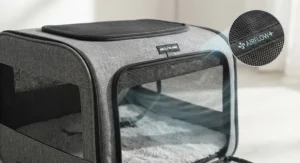
The 4pets Caree, priced roughly £150-£220 on Amazon UK depending on configuration, is a Swiss-engineered transport box that stands apart from every other product on this list on one specific point: it’s been crash-tested and certified by TÜV Süd in Germany, one of Europe’s most rigorous independent testing institutes, to meet crash requirements for pets up to 15kg. The box can be secured either via the vehicle’s seatbelt, held in place by a hinged plate in the base, or via an optional ISOFIX-compatible quick-fastener system for cars fitted with ISOFIX anchor points — genuinely closer to how a child car seat is secured than how most pet carriers are.
Independent UK pet-travel retailers and reviewers consistently highlight the TÜV certification as the Caree’s defining feature, noting it’s among the only carriers on the market tested at temperatures well below freezing as well as under crash conditions, alongside non-toxic material certification meeting REACH standards. Aggregated buyer sentiment is strongly positive on build quality and the moulded, well-padded interior, with the main friction point being price — at over four times the cost of budget hard-shell carriers, several reviewers note it’s a genuinely premium purchase best justified by frequent or long-distance travel rather than occasional vet runs.
Pros:
- ✅ TÜV Süd crash-tested and certified — independently verified
- ✅ ISOFIX or seatbelt attachment, engineered like a child seat
- ✅ Non-toxic materials tested to REACH standards
Cons:
- ❌ Significantly pricier than every other option on this list
- ❌ Overkill for owners who only travel occasionally
At £150-£220, the 4pets Caree is the clearest secured pet crate for vehicle use here specifically for owners who travel with their cat often enough to justify genuinely premium, independently certified engineering.
7. Sleepypod Mobile Pet Bed — best cat travel crate for car doubling as an everyday bed
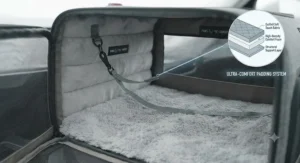
The Sleepypod Mobile Pet Bed, typically £150-£200 on Amazon UK for pets up to 15lbs, takes a genuinely clever dual-purpose approach: at home it’s an everyday plush pet bed with a ballistic nylon base, and for travel a mesh dome simply zips onto the same base to convert it into a full carrier and car seat. Like the 4pets Caree, this is one of only two products on this list independently verified by the Center for Pet Safety, using the same dynamic crash-testing methodology applied to human child safety restraints, with the brand’s PPRS (Pet Protection Restraint System) technology specifically designed to reduce ejection risk and impact forces during a collision or hard stop.
What most buyers overlook about the everyday-bed design specifically is the psychological benefit it offers alongside the physical safety credentials: because the Sleepypod is already a familiar resting spot rather than an object only associated with stressful vet trips, aggregated reviewer sentiment consistently notes reduced travel anxiety in cats who already sleep in the base at home. The most common critique across reviews is less about safety and more about maintenance — the plush inner bedding, while machine washable, is reported by some owners as needing more frequent washing than a simple wipe-clean hard-shell carrier.
Pros:
- ✅ CPS-certified using the same methodology as child safety restraints
- ✅ Doubles as an everyday bed, reducing travel-specific anxiety
- ✅ Removable, machine-washable Ultra Plush bedding
Cons:
- ❌ Requires more regular cleaning than a wipe-clean hard shell
- ❌ Premium price bracket similar to the 4pets Caree
At £150-£200, the Sleepypod Mobile Pet Bed earns its place as the top pick for owners who want independently certified crash safety combined with genuine everyday usefulness, not just an occasional-use travel box.
✨ Don’t Miss These Exclusive Deals!
🐾 Take your cat’s car safety to the next level with these carefully researched picks. Click on any highlighted item to check current pricing and availability before your next journey.
What Is a Cat Car Seat Carrier?
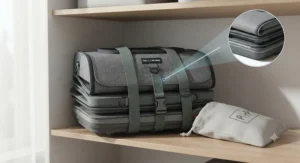
A cat car seat carrier is a pet transport container specifically designed or adapted for use inside a moving vehicle, incorporating features such as seatbelt routing slots, ISOFIX compatibility, or independent crash-test certification to keep the cat secured and protected during normal driving, braking, and — in the best-designed products — an actual collision.
This differs meaningfully from a general-purpose cat carrier, which may be perfectly adequate for carrying a cat from the car to a vet’s waiting room but was never engineered with vehicle-specific restraint or crash forces in mind. Under UK law, as Rule 57 of the Highway Code on GOV.UK makes clear, any animal travelling in a vehicle must be suitably restrained, and a pet carrier is explicitly named as one acceptable method — but the rule doesn’t specify a required safety standard, which is exactly why the gap between a basic carrier and a genuinely car-tested one matters more than shoppers often assume.
How to Choose a Safe Cat Carrier for Car Travel
- Check for dedicated seatbelt routing, not just a handle. Purpose-built slots or clips, like those on the Kerbl Gulliver or PawsInCar 3-in-1, keep the carrier flat and stable in a way that threading a belt through a carry handle doesn’t reliably achieve.
- Look for independent crash-test certification if it matters to you. Only 4pets Caree and Sleepypod Mobile Pet Bed on this list carry genuine third-party crash certification (TÜV and CPS respectively) — a seatbelt loop alone doesn’t guarantee structural crash performance.
- Match the carrier style to your cat’s temperament. An enclosed box suits cats who prefer to hide; an open booster seat like the PetSafe Happy Ride suits confident, harness-trained cats who tolerate visibility.
- Prioritise rear-seat placement over front-seat convenience. Airbags deploy with force that can seriously injure a small animal, so the rear seat, secured and upright, is the safer default location regardless of which carrier you choose.
- Weigh top-door versus front-door-only access. Top-loading carriers, like the Ferplast Atlas, are generally easier and less stressful for lifting a reluctant or anxious cat in and out.
- Consider weight capacity honestly, not optimistically. Check your specific cat’s weight against the carrier’s stated maximum rather than assuming “average cat size” language covers your particular pet.
- Factor in whether you need occasional or frequent use. Budget hard-shell options make sense for occasional vet trips; premium crash-tested carriers earn their price over years of frequent or long-distance travel.
Cat Carrier for Car Back Seat vs Booster Seat: Which Style Fits Your Cat?
It’s worth unpacking cat carrier for car back seat options versus a booster seat for cats as genuinely different approaches, because they solve different problems rather than one simply being an upgrade on the other.
A traditional enclosed carrier — hard-shell or soft-sided — gives a cat a small, den-like space that many find reassuring precisely because it limits visual stimulation and feels defensible, which matters enormously for cats who associate car travel with stress. A booster seat, by contrast, elevates and stabilises a cat (or small dog) in a semi-open structure secured by a harness and tether rather than fully enclosing them, prioritising visibility and airflow over the enclosed reassurance a carrier offers. Neither is universally “safer” in the abstract; the right choice depends on your specific cat’s temperament, and mismatching the two — putting a nervous, hiding-prone cat into an open booster seat, for instance — often produces more stress and more risk of a panicked escape attempt than either option would in isolation.
Real-World Scenario: Matching Carriers to How You Actually Travel
Rather than abstract advice, here’s how three realistic UK cat-owner profiles map onto the seven picks above.
Tom, 29, first-time cat owner in Sheffield, mainly does short trips to a local vet a few times a year. Tom doesn’t need premium crash certification for occasional five-minute drives but does want something secure and easy to clean. The Kerbl Gulliver or Ferplast Atlas both suit his budget and low-frequency use case, with the Gulliver’s dedicated seatbelt slots giving a slight edge on in-car security.
Amara, 41, relocating from Cardiff to Aberdeen with two cats, a single long motorway journey ahead. Amara’s priority is minimising risk on a multi-hour drive at motorway speeds, where crash forces are meaningfully higher than local trips. The 4pets Caree or Sleepypod Mobile Pet Bed‘s independent crash certification directly addresses her specific risk profile in a way budget carriers don’t claim to.
Priya, 35, regularly drives her calm, harness-trained cat to a countryside cattery every weekend. Priya’s cat is unusually confident and already comfortable wearing a harness on walks. The PetSafe Happy Ride Booster Seat‘s window-height, harness-tethered design suits her specific cat’s temperament better than an enclosed box would for a cat who actively enjoys watching the journey.
Seatbelt Loop Pet Carrier Mechanics: What Actually Keeps the Box in Place
It’s easy to assume any loop or strap marketed as a “seatbelt attachment” performs the same job, so it’s worth breaking down what a genuinely effective seatbelt loop pet carrier mechanism actually needs to do.
The core engineering goal is preventing the carrier from becoming a projectile during hard braking or a collision, which means the attachment needs to resist both forward momentum and lateral rolling. Slot-style attachments, like the Kerbl Gulliver‘s moulded top slits, route the belt directly through the carrier’s rigid shell, distributing force across the structure itself rather than relying on a single stitched loop or the handle, which is typically the weakest point on a soft-sided carrier under real load. Clip-style systems, seen on the PawsInCar 3-in-1, aim for a similar outcome via a dedicated buckle point rather than a slot, though as several reviewers note, a single clip without a secondary locking feature can theoretically work loose on a long journey in a way a genuinely crash-tested, multi-point system is engineered to resist. This is precisely the distinction that separates a “seatbelt compatible” marketing claim from genuine crash-tested performance — and why, per Rule 57 of the Highway Code, the word “suitably” restrained carries real weight: a carrier that merely has a strap isn’t automatically one that performs under real crash forces.
Common Mistakes When Buying a Cat Car Seat Carrier
Even genuinely careful cat owners tend to trip over the same handful of assumptions when shopping this category, so it’s worth naming them directly.
The most frequent mistake is assuming any carrier with a seatbelt loop or slot has been crash-tested, when in most cases on the market — including several products on this list — the seatbelt feature simply hasn’t been independently verified under real crash forces, which isn’t the same as being unsafe but is a meaningfully different claim. A close second is placing the carrier on the front passenger seat for convenience, when the rear seat is the safer default given airbag deployment risk to a small animal. Buyers also frequently oversize their choice, assuming a bigger carrier is automatically more comfortable, when a carrier that allows too much internal movement can actually increase injury risk during sudden braking compared with a snugly sized one the cat can’t be thrown around inside. Finally, many owners underestimate how much temperament match matters — buying a booster seat for a cat who instinctively wants to hide, or an enclosed box for a cat who becomes more distressed in total darkness, often creates more stress than either style would if properly matched.
Practical Usage Guide: Introducing Your Cat to a New Car Carrier
Getting a cat comfortable with a new carrier before a real journey matters far more than most owners realise, and rushing this step is one of the most common causes of a stressful first car trip.
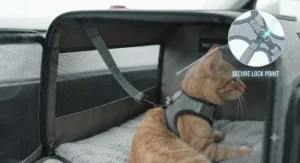
Start at least a week before any planned journey by leaving the carrier out in a familiar room with the door open, allowing your cat to investigate on their own terms rather than being placed inside directly. Add familiar bedding or an unwashed item of your clothing to the base, since scent familiarity does more to reduce anxiety than the carrier’s physical features alone. Practice short, low-stakes sessions — a few minutes in the carrier in the lounge, then a five-minute trip around the block — well before a longer or more stressful journey like a house move or a longer vet visit. When you do install the carrier in the car, always secure it on the rear seat, test that the seatbelt or ISOFIX attachment is genuinely tight with no significant give, and position the carrier so your cat can see a little of the cabin without being fully exposed to sudden movement or direct sunlight.
A common first-journey mistake is skipping the practice runs entirely and only introducing the carrier on the day of a genuinely stressful trip, such as a house move or an emergency vet visit — by then, the carrier itself becomes associated with the stress rather than being a neutral, familiar object, which makes every future journey harder than it needs to be.
Long-Term Value: Is a Crash-Tested Cat Carrier Worth the Premium?
Independently crash-tested carriers like the 4pets Caree and Sleepypod Mobile Pet Bed cost roughly four to six times more than a basic hard-shell box, and it’s worth being honest about when that premium is genuinely justified rather than assuming certification alone settles the question. For an owner who drives their cat a handful of times a year for routine vet visits at low speeds and over short distances, a well-secured budget carrier like the Kerbl Gulliver represents entirely reasonable risk management — the statistical exposure to a genuine high-force collision on a five-minute local drive is real but limited. For an owner who regularly undertakes longer motorway journeys, house moves, or frequent multi-hour trips, the calculation shifts meaningfully, because both crash risk exposure and the consequences of carrier failure scale with time spent travelling and the speeds involved.
Where the premium clearly pays for itself regardless of frequency is in products like the Sleepypod that double as genuinely useful everyday items — since the carrier is also a bed your cat uses daily at home, the cost is amortised across ordinary use rather than sitting unused between occasional trips, which meaningfully changes the value calculation compared with a carrier that only ever comes out of the cupboard for travel.
Safety, Regulation and UK Law on Restraining Pets in Cars
Here’s where UK-specific guidance genuinely matters for anyone buying a cat car seat carrier: Rule 57 of the Highway Code, published by the Department for Transport on GOV.UK, states that animals travelling in a vehicle must be “suitably restrained so they cannot distract you while you are driving or injure you, or themselves, if you stop quickly,” and specifically lists a seat belt harness, pet carrier, dog cage, or dog guard as acceptable methods. This sits within the broader Highway Code framework, which separately requires — under the rules for drivers and motorcyclists on loading a vehicle — that “any heavy or sharp objects and any animals are secured safely” to prevent injury to occupants during a collision.
It’s worth understanding what this rule doesn’t do as clearly as what it does: it doesn’t specify a required crash-test standard or certify particular products, meaning “suitably restrained” is a judgement call rather than a defined technical benchmark, which is precisely why independently tested options like TÜV or Center for Pet Safety certification give buyers meaningfully more assurance than the bare legal minimum. Breaching Rule 57 can result in a fine, and separately, an improperly restrained pet involved in an accident can affect a motor insurance claim, since insurers may treat an unrestrained animal as a contributing factor to a driver’s loss of control. Beyond the legal framework, heat safety deserves a direct mention here too: leaving a cat in any carrier inside a parked car, even briefly, poses a serious heatstroke risk, since RSPCA research has found that a car can reach 47°C within an hour even when the outside temperature is a moderate 22°C.
Buyer’s Decision Framework: Which Cat Car Seat Carrier Fits Your Situation
If you only travel occasionally for routine vet visits and want genuine seatbelt routing without premium pricing, choose the Kerbl Gulliver, because its purpose-built slots outperform a generic handle-based attachment at a genuinely budget price. If you’re relocating, travelling long-distance, or making frequent motorway journeys where crash risk exposure is meaningfully higher, choose the 4pets Caree or Sleepypod Mobile Pet Bed, because independent crash certification directly addresses that elevated risk profile in a way uncertified products can’t claim to match. If your cat is confidently harness-trained and enjoys visibility rather than hiding, choose the PetSafe Happy Ride Booster Seat, because its open, elevated design suits that specific temperament better than an enclosed box would. If you want a solid middle ground between budget and premium with genuine third-party crash-test backing, choose the PawsInCar 3-in-1, because its CPS certification and enclosed design offer real tested performance without the top-tier price point.
Features That Actually Matter (And Marketing Claims That Don’t)
Cat carrier marketing in this category leans heavily on the word “safe” without always backing it up, so it’s worth separating genuine safety substance from packaging language.
What actually matters: a named, checkable crash-test standard (CPS certification under FMVSS 213b, or TÜV Süd certification) rather than an unverified “safe for car travel” claim; dedicated seatbelt routing built into the shell rather than reliance on a carry handle; and rear-seat compatibility with a snug, low-movement fit for your specific cat’s size. What matters less than the marketing suggests: “airline approved” labelling, which relates to cabin dimension rules rather than car crash performance and is a completely different certification; generic “durable” or “heavy-duty” language without a specific weight or force rating attached; and elaborate multi-window or backpack-convertible designs, which add versatility for carrying but don’t inherently improve in-vehicle crash safety. If a listing leads with “safe” or “secure” but doesn’t name a specific test standard or certifying body anywhere in the description, treat that as a prompt to look closer rather than a reason to assume the highest safety tier.
Problem → Solution: Fixing Common Cat Car Travel Frustrations
Problem: my cat cries or panics the moment the carrier comes out. Solution: this is almost always a conditioning issue rather than a carrier design flaw — follow the gradual introduction process outlined above, leaving the carrier out as a neutral object between trips rather than only appearing before stressful journeys.
Problem: the seatbelt keeps slipping loose on a longer journey. Solution: check whether your carrier uses a dedicated slot or clip system versus relying on the carry handle — upgrading to a purpose-built option like the Kerbl Gulliver or a crash-tested product with a locking clip resolves this more reliably than adjusting tension repeatedly mid-journey.
Problem: I can’t tell if a “seatbelt compatible” carrier is actually crash-tested. Solution: search the specific brand and model against the Center for Pet Safety’s published test results or ask for TÜV documentation directly — a seatbelt loop alone, as covered above, doesn’t confirm genuine crash performance.
Problem: my cat seems more stressed in an enclosed carrier than I expected. Solution: some cats genuinely do better with partial visibility — consider whether a booster-seat style product suits your specific cat’s temperament better than assuming every cat prefers full enclosure.
Problem: I’m not sure my current carrier is legally sufficient under UK law. Solution: check it against Rule 57’s core requirement — that the animal “cannot distract you while you are driving or injure you, or themselves, if you stop quickly” — and if your current setup relies purely on the carrier sitting loose on a seat, that’s worth upgrading regardless of which specific product you choose.
✨ Ready to Travel Safer With Your Cat?
🐾 Whichever budget tier fits your situation, a properly secured cat car seat carrier is one of the highest-impact upgrades you can make before your next journey. Check current prices and availability on the picks above.
Cat Travel Crate for Car: Options by Specific Situation
Different travel patterns and cat temperaments call for different starting points within this category, so it’s worth a direct breakdown by situation.
For nervous, hiding-prone cats: an enclosed hard-shell box like the Kerbl Gulliver or Ferplast Atlas offers the den-like security that reduces stress far more effectively than an open booster design. For frequent long-distance or motorway travel: the 4pets Caree or Sleepypod Mobile Pet Bed‘s independent crash certification directly addresses the elevated risk exposure of extended high-speed journeys. For confident, harness-trained cats who enjoy visibility: the PetSafe Happy Ride Booster Seat suits a temperament that would find full enclosure more stressful than helpful. For budget-conscious owners who still want genuine in-car security: the PawsInCar 3-in-1 offers CPS-certified performance at a meaningfully lower price than the top-tier premium options.
Frequently Asked Questions
❓ Is it illegal to drive with a cat unrestrained in the UK?
❓ Do cat carriers need to be crash-tested to be legal in the UK?
❓ Should my cat's carrier go on the front or back seat?
❓ What's the difference between a seatbelt loop and a crash-tested carrier?
❓ Can I leave my cat in a car carrier while I run into a shop?
Conclusion
A genuinely safe cat carrier for car travel isn’t defined by a seatbelt loop printed proudly on the packaging — it’s defined by whether that loop, slot, or clip is backed by real structural engineering and, ideally, independent crash verification. Across the seven carriers in this guide, the Kerbl Gulliver proves purpose-built seatbelt routing doesn’t require a premium budget, while 4pets Caree and Sleepypod Mobile Pet Bed show what genuinely certified crash protection costs and why it earns that price for frequent travellers. In between, the PawsInCar 3-in-1 offers real tested performance at a moderate cost, while the PetSafe Happy Ride Booster Seat serves a genuinely different temperament need than an enclosed box ever could.
What ties every recommendation here together is the same principle Rule 57 of the Highway Code is built around: “suitably restrained” is a genuine safety standard, not a box-ticking exercise, and matching the right carrier style to your specific cat’s temperament matters just as much as the hardware itself. Whichever option from this list fits your budget and your cat’s personality, taking the time to introduce it properly before a real journey is the highest-value five minutes you’ll spend on either safety or your cat’s peace of mind.
✨ Found the Right Carrier for Your Cat?
🔍 Check current prices on your top pick above, and give your cat a proper introduction period before the next real journey — a calmer cat is a safer passenger.
Recommended for You
- Bubble Cat Backpack: 7 Best Space Capsule Picks 2026
- Best Cat Backpack Carrier UK 2026: 7 Top Ventilated Picks
- 7 Best Rolling Cat Carrier Picks for 2026
Disclaimer: This article contains affiliate links. As an Amazon Associate, I earn from qualifying purchases. If you purchase products through these links, we may earn a small commission at no additional cost to you.
✨ Found this helpful? Share it with your friends! 💬🤗
