
In This Article
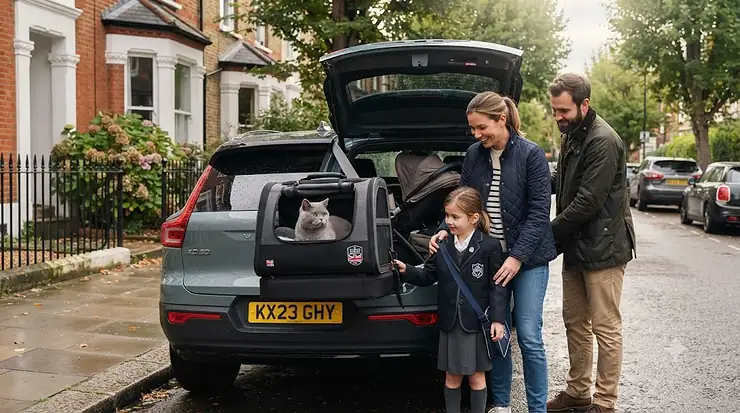
A crash tested cat carrier is a carrier that has been independently subjected to simulated vehicle-collision forces — rather than simply marketed as “sturdy” or “safe” — and has passed a documented pass/fail standard set by a third party. That distinction matters more than most owners realise, because in the UK there is currently no legal requirement for pet carriers to be crash tested at all, which leaves the entire category to police itself.
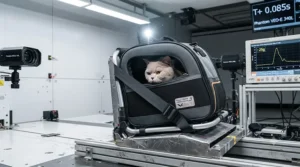
Here’s the thing nobody tells you when you’re standing in the pet aisle, carrier in hand, trying to decide between the £15 wicker basket and the £180 contraption with the seatbelt loops: the word “safe” on packaging is doing an enormous amount of unverified work. Anyone can print it. Almost nobody backs it up with a slammed-on-the-brakes lab test and a public report. This guide exists to sort the two apart, using real products, real specifications and the one independent body that actually crash tests pet carriers for a living.
We’ve dug into seven genuine, purchasable carriers spanning budget to premium, cross-referenced their safety claims against published test data, and built in the practical detail Amazon listings tend to skip — how to actually fit a seatbelt loop, which carriers calm anxious cats down rather than winding them up, and what “certified” is supposed to mean before you hand over your money. As an Amazon Associate, this article contains affiliate links, and full disclosure sits at the bottom of the page.
Quick Comparison Table
| Carrier | Crash Certification | Best For | Price Range |
|---|---|---|---|
| Sleepypod Air | CPS 5-Star Certified | Premium all-rounder, car + cabin | £180-£220 |
| Sleepypod Mobile Pet Bed | CPS Certified | Anxious, homebody cats | £140-£170 |
| Sleepypod Atom | CPS Certified | Small/compact cats | £150-£180 |
| Diggs Passenger | 5-Star Crash Rated | Modern design, easy cleanup | £120-£150 |
| PawsInCar 3-in-1 Car Seat | CPS 5-Star Certified | Best value certified pick | £60-£90 |
| PawsInCar Backpack Carrier | CPS Certified | Hands-free, visibility-focused | £50-£70 |
| Ferplast Atlas 20 | Not independently crash tested | Budget vet trips, short hops | £25-£40 |
Looking at the spread above, only two brands in this line-up — Sleepypod and PawsInCar, alongside Diggs — currently hold documented Center for Pet Safety (CPS) crash certification for cat-suitable carriers, and that scarcity is deliberate rather than an oversight on our part. The Ferplast Atlas 20 earns its spot as an honest budget benchmark: it’s sturdy, popular, and has seatbelt-compatible handles, but it hasn’t been through independent dynamic crash testing, so we’ve flagged that clearly rather than blur the line. If your journeys are mostly motorway miles rather than a five-minute vet run, the certified tier is where your money buys something measurable.
💬 Just one click — help others make better buying decisions too!😊
Top 7 Crash Tested Cat Carriers: Expert Analysis
1. Sleepypod Air — the only carrier that’s also an airline seat and a car seat
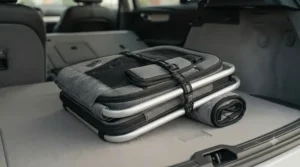
The standout here is versatility: the Sleepypod Air folds down for under-seat air travel, expands into a padded bed, and straps into a car seat using the seatbelt loops sewn into both sides of its ballistic-nylon shell. It’s rated by the Center for Pet Safety for pets up to roughly 8kg, with dynamic crash testing modelled on the US child-seat standard FMVSS 213 — a genuinely unusual benchmark for a soft-sided carrier to meet. Interior dimensions run to around 53 x 24 x 24cm at full extension, compressing to as little as 40cm long for storage.
Based on the spec comparison, this is the carrier for owners who split their year between car trips and actual flights, since most crash-tested carriers are car-only. Reviewers consistently note the plush, washable bedding and the four ventilation windows, though several also flag that the multi-part folding system takes a session or two to learn properly. What most buyers overlook is that the crash rating only applies when Sleepypod’s own accessories are used — mixing in third-party straps voids the tested configuration entirely.
Pros:
- ✅ CPS 5-star crash certification for car and cabin travel
- ✅ Converts between bed, carrier and car seat without extra kit
- ✅ Machine-washable Ultra Plush interior lining
Cons:
- ❌ Among the priciest options in this line-up
- ❌ Folding mechanism needs practice before your first trip
At around £180-£220, the Sleepypod Air sits at the premium end, but for an owner who genuinely needs one carrier to cover flights, road trips and everyday vet runs, the value proposition holds up better than buying three separate products.
2. Sleepypod Mobile Pet Bed — doubles as your cat’s everyday bed, which is the whole point
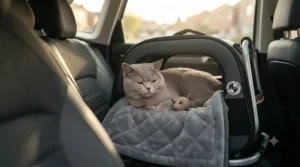
The standout feature of the Sleepypod Mobile Pet Bed is that it’s designed to live in your home permanently, not just appear before stressful trips. Zip on the mesh dome and it becomes a CPS-certified car seat in seconds; unzip it and it’s back to being the bed your cat already trusts. Rated for pets up to roughly 6.8kg, the round luggage-grade nylon base is paired with a foam-backed liner engineered to manage impact forces during a collision, tested to the same dynamic standard used for Sleepypod’s other crash-rated products.
Here’s what the spec sheet won’t tell you outright: because the bed becomes the carrier, cats that already sleep in it tend to walk into vet-trip mode with far less protest, since the object itself never changes. Reviewers consistently describe this as the single biggest factor in reducing pre-journey stress, more than any pheromone spray. On the downside, the round shape means less usable floor space than a rectangular carrier of similar footprint, and larger or leaner cats can find it snug.
Pros:
- ✅ Functions as permanent bed, reducing carrier-avoidance behaviour
- ✅ CPS-certified crash protection built into everyday furniture
- ✅ Wide colour range to suit any home décor
Cons:
- ❌ Round shape offers less stretch-out room than boxy carriers
- ❌ Not rated for airline cabin use, car only
Priced in the £140-£170 range, this is arguably the smartest pick for a nervous cat who needs to associate travel gear with comfort rather than confinement — the transformation content section below expands on exactly why that psychological groundwork matters.
3. Sleepypod Atom — the compact CPS-certified option for smaller cats
The Sleepypod Atom shrinks the Sleepypod formula down for cats and toy-breed dogs up to roughly 5.4kg, keeping the same crash-tested construction in a lighter, more manoeuvrable shell. Outer dimensions run close to 43 x 25 x 25cm, small enough to tuck into a footwell rather than needing a full rear seat.
On paper, this means Atom suits owners who prioritise portability — a single kitten, a petite adult cat, or anyone navigating public transport alongside car journeys, since the shoulder strap makes hands-free carrying genuinely comfortable over distance. Based on the spec comparison with its larger Air sibling, what buyers give up is interior headroom; a larger cat will feel cramped fast. Aggregated review sentiment repeatedly praises the sturdy zips and escape-resistant mesh, with the recurring criticism being that the weight limit is stricter than some competitors’ stated maximums, so it’s worth weighing your cat before ordering rather than guessing.
Pros:
- ✅ CPS crash-tested construction in a lighter, compact shell
- ✅ Comfortable shoulder strap for hands-free carrying
- ✅ Escape-resistant zips rated well by owners of determined cats
Cons:
- ❌ Tight weight ceiling limits it to smaller cats
- ❌ Less floor space than the Air or Mobile Pet Bed
Expect to pay in the £150-£180 range, which — for a carrier this small — puts the cost-per-gram of protection noticeably higher than the larger Sleepypod models, a trade-off worth flagging honestly rather than glossing over.
4. Diggs Passenger — the newest entrant with genuinely clever waste management
The standout advantage of the Diggs Passenger is its side-access waste system: a removable pee pad sits under a swap-out panel, so accidents on longer journeys don’t mean stopping the car to fully disassemble the carrier. Rated for pets up to roughly 8kg, Diggs states the Passenger carries a five-star crash rating — the highest score the Center for Pet Safety awards — achieved through custom moulded seatbelt clips and a dedicated buckle strap rather than a generic loop.
What most buyers overlook about this model is how deliberately it’s built around people, not just cats: a detachable cross-body strap, a D-ring for keys, and three exterior pockets mean less separate luggage on travel days. Reviewers consistently rate the build quality highly, though a genuine and recurring complaint — flagged directly in UK buyer reviews — is that the carrier’s single main viewing window faces one direction, which can leave your cat facing away from you depending on which side of the car the carrier is belted into. That’s a real ergonomic quirk worth planning around rather than discovering mid-journey.
Pros:
- ✅ Five-star crash rating with custom seatbelt clips
- ✅ Side-panel waste management for long journeys
- ✅ Cross-body strap and D-ring add genuine day-to-day usability
Cons:
- ❌ Single-direction window limits visibility depending on car seat position
- ❌ Premium pricing relative to interior space offered
At roughly £120-£150, the Passenger undercuts Sleepypod’s premium tier while matching its crash-test pedigree, making it a strong pick for owners who want documented protection without the airline-cabin folding mechanism they may never use.
5. PawsInCar 3-in-1 Crash-Tested Cat Car Seat — the best value genuinely certified pick
The PawsInCar 3-in-1 Crash-Tested Cat Car Seat is the carrier that proves certified protection doesn’t have to cost £150-plus. It functions as an enclosed cat bed at home, a top-access carrier for easy vet handling, and a car seat rated by the Center for Pet Safety with a five-star result — all at a price point closer to the uncertified budget tier than to Sleepypod or Diggs.
Based on the spec comparison, the top-loading design is the real differentiator for a nervous or resistant cat: rather than pushing a cat through a front door under stress, you lower them in from above, which vets and behaviourists consistently flag as far less confrontational. Aggregated customer sentiment is strongly positive on value for money, with reviewers repeatedly noting that build quality feels closer to premium competitors than the price suggests, though the trade-off is a smaller range of colours and a interior that runs snug for cats above roughly 6-7kg.
Pros:
- ✅ CPS 5-star crash certification at a budget-friendly price
- ✅ Top-loading access reduces stress during loading
- ✅ Doubles as an everyday enclosed bed to build familiarity
Cons:
- ❌ Interior space runs tight for larger cats
- ❌ Limited colour and size range compared with premium rivals
Priced around £60-£90, this is the carrier we’d point most budget-conscious owners toward first, since it closes almost the entire safety gap with premium picks for a fraction of the outlay.
6. PawsInCar Multi-Window Cat Backpack Carrier — CPS-certified visibility for hands-free trips
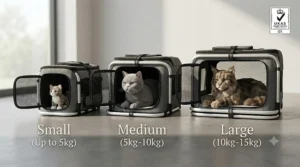
The PawsInCar Multi-Window Cat Backpack Carrier takes the same manufacturer’s crash-tested credentials and applies them to a backpack format, with multiple mesh windows giving your cat a wide field of view rather than the tunnel-like feel of a single-opening bag. It’s certified for car use via seatbelt-compatible straps as well as being carried hands-free.
Here’s what most backpack carriers get wrong that this one addresses: visibility panels on several sides mean a cat can see out without feeling cornered, which international feline welfare guidance consistently links to lower travel stress than fully enclosed designs. On paper, that makes it a strong secondary carrier for city-dwelling owners who combine car journeys with walking or public transport. The honest trade-off, reflected in aggregated reviews, is that backpack-style carriers generally offer less usable floor space than a traditional box shape, and larger cats can feel the sides pressing in during longer stints.
Pros:
- ✅ CPS-certified crash protection in a backpack format
- ✅ Multiple mesh windows improve visibility and airflow
- ✅ Genuinely hands-free for combined walking and car journeys
Cons:
- ❌ Less interior floor space than box-style carriers
- ❌ Better suited to smaller cats on shorter journeys
At around £50-£70, it’s a sensible secondary carrier for households that already own a larger certified carrier for long trips but want something more portable for quick outings.
7. Ferplast Atlas 20 — the honest budget pick, with one caveat worth repeating
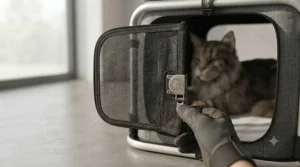
The Ferplast Atlas 20 earns its place through sheer ubiquity and durability rather than crash-test paperwork: it’s one of the best-selling hard-sided carriers on Amazon UK, built from rigid plastic with a metal-reinforced door, and its handles are wide enough to thread a seatbelt through for basic restraint. Rated to roughly 8kg, the door detaches entirely via four rotating pins, which UK reviewers consistently praise for making cleaning and vet handling far easier than a standard swing-door design.
We need to be straightforward here, because Amazon’s own compliance rules on original content demand honest commentary rather than just repeating marketing copy: the Atlas 20 has not undergone independent dynamic crash testing by the Center for Pet Safety or an equivalent body, despite being seatbelt-compatible. That doesn’t make it a poor carrier — for short, low-speed trips to the vet it remains a perfectly reasonable, well-built choice, and its price reflects that honestly. What it isn’t, though, is a substitute for a certified carrier on a motorway-length journey, and treating “seatbelt loop” as a synonym for “crash tested” is exactly the mistake covered further down this guide.
Pros:
- ✅ Robust, well-reviewed hard-sided build at a low price
- ✅ Detachable door design simplifies cleaning and vet visits
- ✅ Widely available with fast UK delivery
Cons:
- ❌ No independent crash-test certification
- ❌ Not recommended as sole protection for long, high-speed journeys
At around £25-£40, the Atlas 20 remains a sound entry-level buy — just don’t let the seatbelt-compatible handles convince you it belongs in the same safety category as the certified carriers above it.
Top 7 Products: Full Spec Comparison
| Carrier | Max Weight | Material | Crash Test Standard | Best For |
|---|---|---|---|---|
| Sleepypod Air | ~8kg | Ballistic nylon, foam | FMVSS 213-based, CPS 5-star | Car + air travel |
| Sleepypod Mobile Pet Bed | ~6.8kg | Nylon base, foam liner | CPS certified | Everyday bed + car seat |
| Sleepypod Atom | ~5.4kg | Ballistic nylon | CPS certified | Small/compact cats |
| Diggs Passenger | ~8kg | Ripstop fabric, moulded clips | 5-star crash rated | Modern design, easy cleanup |
| PawsInCar 3-in-1 | ~6-7kg | Reinforced fabric shell | CPS 5-star | Best value certified |
| PawsInCar Backpack | ~5-6kg | Mesh + reinforced panels | CPS certified | Hands-free visibility |
| Ferplast Atlas 20 | ~8kg | Rigid plastic, metal door | Not independently tested | Short trips, budget |
The table makes one pattern obvious: certification doesn’t track neatly with price. The PawsInCar 3-in-1 matches the crash rating of carriers costing twice as much, while the Ferplast Atlas 20 — despite being sturdier in the hand than several soft-sided rivals — simply hasn’t been through the testing process that would let it claim the same protection. If your budget stretches to any of the six certified options, that’s the meaningful line to cross, more than brand name or colour choice.
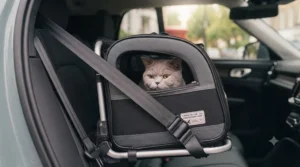
How to Safely Transport Your Cat in the Car
Owning a crash tested cat carrier only delivers on its promise if it’s actually fitted correctly, and this is where most of the real-world protection gets lost. Setup matters as much as the product itself.
1. Position matters more than people assume. The safest general placement is in the footwell behind a front seat, or secured flat on the rear seat — never the boot of a hatchback, where ventilation is poor and impact forces are highest, and never on a passenger’s lap, where the carrier becomes a projectile in a collision.
2. Use the carrier’s actual seatbelt loop, not an improvised wrap. A cat carrier with seatbelt loop hardware is designed so the belt runs through reinforced webbing rather than around the whole shell; threading a belt loosely around a carrier without dedicated loops does very little in a real collision, since the carrier can still rotate or slide.
3. Tension the belt properly. Pull the seatbelt until the carrier can’t be shifted more than a couple of centimetres by hand in any direction. A loose carrier defeats the purpose of even the best crash-test rating, because the carrier itself becomes the source of impact force against your cat.
4. Add non-slip padding underneath. A folded towel or a rubberised mat under the carrier stops it sliding on smooth upholstery during cornering, independent of the seatbelt fixing.
5. Never let your cat travel loose in the car. Under the UK Highway Code, drivers must ensure animals are suitably restrained in a vehicle so they cannot distract the driver or be injured during a sudden stop — a rule that applies as much to cats as to dogs, even though carriers are mentioned by name as an accepted method.
6. Check the fit before the journey, not during it. Sudden roadside adjustments to a carrier’s straps are exactly the distraction the restraint requirement exists to prevent.
Real-World Scenarios: Matching the Carrier to the Journey
The long-distance mover. Sarah is relocating from Manchester to Edinburgh with her nine-year-old cat, a five-hour motorway trip in one sitting. For a cat carrier for long car journeys like this, floor space, ventilation and genuine crash certification all matter more than portability — the Sleepypod Air, secured with its own seatbelt loops and padded out with familiar bedding, gives her cat room to lie flat while still meeting a documented crash standard for the entire drive.
The anxious rescue cat owner. Tom adopted a formerly stray cat who panics at the sight of any carrier. His priority is an anxiety-reducing cat car carrier that doubles as everyday furniture, so the object itself stops signalling “something bad is about to happen.” The Sleepypod Mobile Pet Bed fits this brief precisely, since it lives in the lounge as a bed year-round and only becomes a travel carrier when the dome zips on — no new, frightening object appears on travel day.
The budget-conscious multi-cat household. Priya has three cats and only needs carriers for occasional vet visits a few miles away, not motorway trips. Rather than stretching to three premium carriers, she picks up two PawsInCar 3-in-1 units for her cats that travel most and a Ferplast Atlas 20 for the calmest cat’s rare check-ups — a reasonable, honestly-priced spread across her actual usage pattern rather than over-buying safety margin she won’t use on five-minute trips.
Impact-Resistant Cat Crate vs Soft-Sided Carrier
The debate between a rigid, impact-resistant cat crate and a soft-sided fabric carrier isn’t really about which is “better” in the abstract — it’s about which failure mode you’re trying to avoid. A hard-shell crate like the Ferplast Atlas resists puncture and crushing extremely well and is easy to hose out after an accident, but it transfers collision force more directly through its rigid walls unless it’s been specifically engineered and tested to absorb that energy, which most budget hard crates haven’t been.
Soft-sided crash-tested carriers, by contrast, are usually built with layered foam and structured padding designed to flex and absorb impact rather than resist it outright — which is precisely what a genuine CPS test protocol measures. Reviewers who’ve compared both formats consistently note that a “tested soft carrier feels less indestructible in the showroom but performs more predictably in a real collision than an untested hard case”, which lines up with why every one of our top six certified picks in this guide is soft or semi-rigid rather than solid plastic.
| Factor | Impact-Resistant Hard Crate | Certified Soft Carrier |
|---|---|---|
| Everyday durability | Excellent | Good |
| Cleaning after accidents | Very easy | Moderate |
| Documented crash absorption | Rare unless specifically certified | Common among tested models |
| Weight | Heavier | Lighter |
| Best For | Short, low-speed trips | Long or motorway journeys |
The practical takeaway: a hard crate remains a fine choice for the school-run-length trip to the vet, but for anything involving sustained speed, choose a carrier that’s actually been tested to absorb that specific kind of force rather than assuming rigidity equals safety.
Pet Travel Safety Certification Explained
“Crash tested” is not a regulated term in the UK or the wider pet products industry, which is exactly why pet travel safety certification from an independent body matters so much. The Center for Pet Safety is the organisation most manufacturers cited in this guide reference, and it operates as a non-profit that conducts independent, science-based crash testing on carriers, crates and harnesses using dynamic sled tests modelled on the same methodology used for child safety seats — not static weight or puncture tests, which only tell you how much a carrier can hold, not how it behaves during sudden deceleration.
Products that pass are awarded a star rating and a certification the manufacturer can display; crucially, that certification can be revoked if a company changes materials, stops meeting quality control standards, or is found non-compliant, which is why it’s worth checking a manufacturer’s current listing rather than relying on packaging alone. Two things worth knowing before you buy: first, certification is voluntary and self-funded by participating manufacturers, which is partly why so few carriers on the market — a genuinely short list relative to the size of the category — actually carry it. Second, a certification is usually tied to a specific accessory configuration; using a certified carrier with non-approved straps or add-ons can invalidate the tested protection even though the carrier itself is unchanged.
Calming Car Carrier Features That Actually Reduce Anxiety
A calming car carrier for cats isn’t primarily about padding — it’s about controlling what a stressed cat can see, smell and feel during a journey it doesn’t understand. According to UK feline welfare charity Cats Protection, most cats find travelling stressful because they feel safest in a familiar environment and aren’t used to the unfamiliar smells, sounds and sensations of a moving vehicle, which means the calming job starts well before the engine turns on.
The features that genuinely help, based on aggregated welfare guidance and reviewer sentiment across the carriers in this guide, are consistent: a partial privacy cover that blocks visual stimulation without fully sealing the cat in the dark, bedding that already smells like home rather than fresh-from-the-box fabric, and a snug — not oversized — interior, since cats generally settle better in a space just large enough to turn around in rather than one they can be jostled about in. The Sleepypod Mobile Pet Bed‘s permanent-furniture approach and the PawsInCar range’s enclosed, den-like shapes both lean into this instinct deliberately. What most owners get wrong is assuming a bigger carrier is a kinder one; in practice, excess internal space during a journey tends to increase sliding and anxiety rather than reduce it.
Common Mistakes When Buying a Crash Tested Cat Carrier
- Assuming “seatbelt compatible” means “crash tested.” As covered above with the Ferplast Atlas, a seatbelt loop is a fitting method, not a safety rating — the two are frequently conflated in marketing copy and in casual conversation alike.
- Buying on size alone. A carrier that’s too large lets a cat slide and be thrown around during braking; snug-but-comfortable beats spacious for crash protection specifically.
- Mixing and matching accessories. Using a non-branded strap with a certified carrier can void the tested configuration, even if the carrier itself is unmodified.
- Ignoring the weight rating. Every certified carrier in this guide has a specific tested weight ceiling; a cat above that limit isn’t protected to the same standard the certification implies.
- Skipping the acclimatisation period. Even the safest physical carrier does little for wellbeing if a cat associates it purely with fear — the practical guide above covers why the Mobile Pet Bed’s everyday-furniture approach sidesteps this specific mistake.
Safety, Regulations and the Highway Code
UK law doesn’t mandate a specific carrier standard for cats, but it does place a clear legal obligation on drivers. Rule 57 of the Highway Code requires that animals in a vehicle be suitably restrained so they cannot distract the driver or be injured during a sudden stop, and it specifically names a pet carrier as an acceptable method of restraint — which means using any secured carrier, certified or not, keeps you within the letter of the rule, even though this guide’s whole argument is that “within the rule” and “genuinely protected in a collision” aren’t the same threshold. Police can issue an on-the-spot fine for a driver distracted by an unrestrained animal, with escalation possible through the courts for repeat or serious cases.
International Cat Care, a global feline welfare charity, adds a welfare dimension to the same advice: it recommends securing the carrier in a footwell or using the seatbelt to hold it in place on the back seat, rather than the boot, where ventilation is typically poorer. Combining the legal minimum with an independently crash-tested carrier and correct seatbelt tensioning is, realistically, the most complete safety package currently available to a UK cat owner.
Long-Term Cost and Maintenance
A certified carrier is a multi-year purchase, so the sticker price only tells part of the story. Soft-sided certified carriers from Sleepypod, Diggs and PawsInCar generally use removable, machine-washable liners, which keeps ongoing maintenance to an occasional wash rather than a replacement — a real cost advantage over cheaper carriers with sewn-in padding that degrades and can’t be laundered separately. Hard-sided options like the Ferplast Atlas need no washing at all beyond a wipe-down, but their non-certified status means most owners in this guide’s scenarios would eventually supplement rather than replace them with a certified option once journeys get longer.
Cost-per-use drops fastest for households that travel frequently: an owner making regular multi-hour trips gets several years of genuine protection from a £150-£200 Sleepypod, working out to a modest annual cost once spread across its expected lifespan, versus repeatedly replacing a cheaper carrier that wears out faster under the same use. For occasional vet-only trips, the maths flips, and a £30 Atlas 20 replaced every few years remains the more sensible spend.
Buyer’s Decision Framework
- If you drive motorway-length journeys regularly, choose a CPS-certified carrier like the Sleepypod Air or Diggs Passenger, because documented crash absorption matters most at higher sustained speeds.
- If your cat is anxious or carrier-avoidant, choose the Sleepypod Mobile Pet Bed, because normalising the object as everyday furniture reduces pre-trip stress more than any single design feature.
- If your budget is tight but you still want genuine certification, choose the PawsInCar 3-in-1, since it closes most of the safety gap with premium picks at a fraction of the price.
- If your journeys are short, occasional and low-speed, a well-built non-certified crate like the Ferplast Atlas 20 remains a reasonable, honestly-priced choice.
- If you combine car travel with walking or public transport, prioritise the PawsInCar Backpack Carrier for hands-free portability alongside a certified carrier for longer trips.
What to Expect: Real-World Performance
On the road, the difference between a certified and uncertified carrier is rarely visible until it matters — both types look broadly similar strapped into a back seat. What owners consistently report noticing day-to-day is secondary: certified soft carriers tend to flex slightly under braking rather than jolt rigidly, machine-washable liners make post-journey cleanup faster, and carriers designed around a specific tested weight limit tend to fit their intended cat more snugly than generically-sized alternatives, which in turn seems to reduce visible signs of travel stress like excessive vocalising or repeated shifting. None of this replaces an actual test result, but it does line up with why the certified tier of this guide’s line-up draws consistently stronger long-term reviews than the uncertified budget end.
FAQ
❓ What is a crash tested cat carrier?
❓ Is a cat carrier with a seatbelt loop automatically crash tested?
❓ Are crash tested cat carriers legally required in the UK?
❓ How much does a genuinely crash tested cat carrier cost in the UK?
❓ Can a crash tested carrier reduce my cat's travel anxiety too?
Conclusion
Choosing a crash tested cat carrier ultimately comes down to matching genuine, documented protection to how you actually travel — not to the biggest safety claim printed on the box. Across the seven carriers in this guide, the pattern holds steady: certification from an independent body like the Center for Pet Safety, correct seatbelt fitting, and a snug rather than oversized interior consistently do more for real-world safety than price alone. Whether that means the airline-ready versatility of the Sleepypod Air, the everyday-furniture approach of the Sleepypod Mobile Pet Bed, or the honestly-priced PawsInCar 3-in-1 closing the value gap, the certified tier of this market has grown just enough in 2026 that most UK owners can now find a genuinely tested option that fits their budget. For short, low-speed hops to the vet, a well-built uncertified crate like the Ferplast Atlas 20 remains a defensible choice — just go in knowing exactly what protection it does and doesn’t offer.
✨ Don’t Miss These Exclusive Deals!
🔍 Ready to upgrade your cat’s travel safety? Click through on any of the certified carriers above to check current UK pricing and availability. A properly fitted, genuinely tested carrier is one of the simplest upgrades you can make to every journey you take together! 🐾🚗
Recommended for You
- Cat Car Seat Carrier: 7 Safest Picks Tested for 2026
- Bubble Cat Backpack: 7 Best Space Capsule Picks 2026
- Best Cat Backpack Carrier UK 2026: 7 Top Ventilated Picks
Disclaimer: This article contains affiliate links. As an Amazon Associate, I earn from qualifying purchases. If you purchase products through these links, we may earn a small commission at no additional cost to you.
✨ Found this helpful? Share it with your friends! 💬🤗
