
In This Article
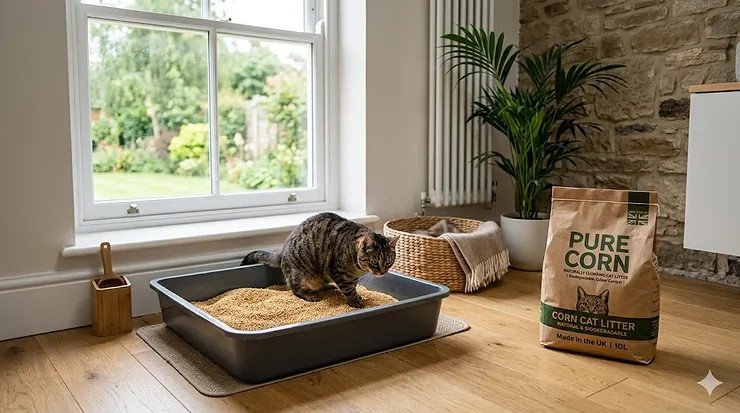
There’s a quiet revolution happening inside British litter trays. Slowly, steadily — and with the kind of understated determination that feels very British indeed — cat owners are ditching the grey, dusty bags of clay they’ve lugged home from the supermarket for decades. Corn cat litter is the alternative that’s genuinely earned its growing fanbase, and not just because it sounds wholesome.
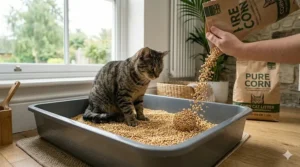
So what exactly is corn cat litter? In plain terms, it’s a clumping, plant-based cat litter made from whole-kernel corn or processed corn husks. The natural starch in corn creates tight, firm clumps when wet — no artificial binders needed — and the material is fully biodegradable, often flushable, and produces virtually no silica dust. That last point matters more than most product descriptions let on; according to PDSA, respiratory health is a significant concern for indoor cats, and dust-heavy clay litters are a known irritant.
With around 11 million cats living in UK homes, we collectively produce a staggering amount of litter waste each year — most of it clay-based, non-biodegradable, and quietly filling landfills for decades. Corn cat litter sidesteps that problem entirely.
But not all corn litters are created equal. Some clump brilliantly; some turn into a wet mess. Some last the week; others need daily topping up. In this guide, we’ve rounded up the seven best corn cat litters available right now on Amazon.co.uk, analysed them properly, and cut through the marketing noise so you can make the right choice for your cat, your flat, and your conscience.
Quick Comparison: Best Corn Cat Litters at a Glance
| Product | Type | Size Options | Price Range | Best For |
|---|---|---|---|---|
| by Amazon Clumping Corn Cat Litter | Pure corn, unscented | 10L, 25L | Under £15 / £20–£25 | Budget buyers, first-timers |
| Sanicat Recycled Corn Cob Litter | Recycled corn cob | 6L | Under £12 | Eco-conscious owners |
| Super Benek Fresh Grass Corn Litter | Pure corn, scented | 3×7L | £15–£22 | Multi-cat homes |
| Super Benek Sea Breeze Corn Litter | Pure corn, scented | 3×7L | £15–£22 | Odour-sensitive owners |
| World’s Best Cat Litter Comfort Care | Whole-kernel corn | 3.18kg–12.7kg | £15–£45 | Premium performance seekers |
| FUKUMARU Tofu & Corn Mixed Litter | Tofu + corn blend | 16L (4 packs) | £20–£30 | Cats new to natural litter |
| Ever Clean Naturally (Clay & Corn) | Clay + corn blend | 10L | £12–£18 | Transitioning from clay |
The table paints an interesting picture. The by Amazon own-brand option undercuts nearly everything on the market while using the same core ingredient as the premium World’s Best. That said, there’s a real performance gap between budget and premium here — most noticeable in clump firmness and odour longevity. For a single-cat household in a well-ventilated flat, the budget option is genuinely hard to fault. For three cats in a semi-detached in Leeds where every room flows into the next? World’s Best earns its price.
💬 Just one click — help others make better buying decisions too! 😊
✨ Don’t Miss These Exclusive Deals!
🔍 Take your cat’s litter experience to the next level with these carefully selected natural picks. Click any highlighted product name to check current pricing and availability on Amazon.co.uk — prices update regularly, so it’s always worth a look.
Top 7 Corn Cat Litters for UK Buyers: Expert Analysis
1. by Amazon Clumping Corn Cat Litter (Unscented, 10L / 25L)
Amazon’s own-brand entry into the corn litter market is arguably the best-kept secret in the category. Sold under the “by Amazon” banner (previously the Lifelong brand — same formula, new packaging), this unscented, GMO-free litter is made from 100% plant-based corn and clumps with genuine efficiency.
The 10L bag is a sensible starter size; the 25L is where the value really shows for committed buyers — it works out considerably cheaper per litre than most rivals. Clump integrity is solid, not spectacular; clumps hold together during scooping but won’t survive aggressive trowelling. Amazon recommends filling to 5–6 cm depth, which we’d second — skimping on depth causes clumps to stick to the tray base, which is exactly the kind of problem that turns pet owners back to clay.
What most UK buyers overlook about this model is the flushability claim. It’s marked as flushable, but the small print includes “depending on local waste disposal laws” — a sensible caveat given that Thames Water and several other UK water companies actively discourage flushing any litter, biodegradable or not. Best to bag and bin unless you’ve checked with your local water utility.
UK reviewers note minimal tracking and excellent odour control for the price. It’s unscented, which is a plus for cats with sensitive sniffers — and for owners who’d rather not live inside a pine forest.
✅ 100% plant-based, GMO-free
✅ Available in 10L and 25L on Amazon.co.uk (Prime-eligible)
✅ Excellent value per litre
❌ Clumps slightly softer than premium options
❌ No subscription discount as significant as some rivals
Price range: Under £15 (10L) / £20–£25 (25L). Solid value verdict — arguably the best starting point for anyone making the switch.
2. Sanicat Recycled Corn Cob Clumping Cat Litter (6L)
Sanicat brings over 60 years of litter-making experience to this product, and it shows. Made from 100% recycled corn cobs — the agricultural byproduct left over after the corn kernel is removed — this is arguably the most circular-economy option on this list. The corn cob texture produces a lighter, slightly coarser granule than whole-kernel corn litters, which some cats actually prefer.
Clumping performance is strong and odour control genuinely impressive for a natural product. The 6L capacity makes it feel like a premium sample more than a full bag, which is both its strength (easy to try, easy to store in a small flat kitchen cupboard) and its weakness (you’ll be reordering more frequently than with larger bags). For owners in compact London flats with limited storage — which, frankly, describes a significant slice of British cat ownership — this is a genuine advantage.
UK customers report that Sanicat holds up well when trays are cleaned every other day, which is a realistic maintenance rhythm for busy owners. The natural odour control doesn’t rely on artificial scents, which means sensitive cats tend to accept it readily.
✅ Made from recycled agricultural byproduct — genuinely circular
✅ Compact size suits small-home storage
✅ Natural odour control, no artificial fragrance
❌ 6L goes quickly — higher per-use cost for multi-cat homes
❌ Coarser texture not universally liked
Price range: Under £12. Subscribe & Save on Amazon.co.uk offers a worthwhile additional discount.
3. Super Benek 100% Natural Corn Cat Litter — Fresh Grass (3×7L)
Super Benek is a Polish brand that’s quietly become a cult favourite among UK cat owners who want World’s Best performance without the World’s Best price tag. The Fresh Grass variant is made from 100% corn and fresh grass — a slightly odd-sounding combination that, in practice, produces one of the best-performing natural litters available in the UK at this price point.
The multi-pack format (three 7-litre bags) is sensible for multi-cat households or owners who’ve committed to the switch. Clumping is fast and firm — “wee burgers,” as one delightfully candid UK reviewer described them, hold together cleanly. The fresh grass scent is subtle; most cats don’t seem bothered by it, though a small minority of sensitive individuals may take a week or two to adjust.
The spec sheet says flushable. In practice, UK owners report no issues over years of use — though the advice to break clumps up before flushing, and to check your local water authority guidelines, still applies. In a two-cat household, one 7L bag lasts roughly two weeks with daily scooping — better value than it first appears.
✅ Premium clumping performance at mid-range price
✅ Compostable and biodegradable
✅ Multi-pack format reduces per-litre cost
❌ Scent may not appeal to all cats
❌ Lighter granules can track slightly on smooth floors
Price range: £15–£22 for the 3×7L pack. One of the best value-for-performance options in the category.
4. Super Benek Sea Breeze Corn Cat Litter (3×7L)
The Sea Breeze variant from Super Benek shares the same core corn formula as the Fresh Grass version but swaps the natural grass scent for a more assertive ocean-breeze fragrance. Whether that’s an upgrade or a downgrade depends entirely on your cat — and your nose.
Odour neutralisation is, frankly, excellent. The Sea Breeze scent actively masks ammonia rather than simply absorbing moisture. For owners of large male cats — Maine Coons and Ragdolls being the usual suspects in this department — whose output can be, shall we say, assertive, this formula performs noticeably better than unscented alternatives. One long-time UK reviewer describes keeping a Maine Coon and trying “every litter there is” before settling here, which is a ringing endorsement from someone who has earned the right to an opinion.
The one genuine caveat: some cats are put off by artificial fragrances, particularly if they’ve only ever used unscented litter. If your cat is already suspicious of change — and many are, with the quiet outrage of a creature who owns the house and merely tolerates you — a gradual transition mixing old and new litter over a week or two usually resolves this.
✅ Outstanding odour control for strong-smelling cats
✅ Fast clumping, easy scooping
✅ Competitively priced per litre
❌ Artificial scent not suitable for all cats
❌ Some users report slight tracking on carpeted floors
Price range: £15–£22 for 3×7L. Best suited to homes where odour control is the primary concern.
5. World’s Best Cat Litter Comfort Care Unscented (3.18kg / 6.35kg / 12.7kg)
Let’s address the name immediately: it’s either brilliantly confident or mildly insufferable, depending on your tolerance for American marketing. In this case, the product largely justifies the swagger. World’s Best is made from whole-kernel corn — not ground husks, not corn cobs, but the entire kernel — which produces a distinctly finer, denser granule with superior moisture-trapping performance.
The clumps are tight, compact, and genuinely hold together under scooping pressure. Dust is almost entirely absent; this is one of the few litters that genuinely delivers on the “99% dust-free” claim. For multi-cat households — the 12.7kg bag is available on Amazon.co.uk and lasts considerably longer than its weight suggests, since corn is lighter than clay — the longevity is a real selling point that offsets the premium price.
It’s flushable and septic-safe, with a stronger track record of real-world UK use than most competitors. The main drawback, as reviewed by UK buyers and cats.com’s independent testing, is the price: at the top end of this category, it requires genuine commitment. It’s also worth noting that whole-kernel corn has a naturally noticeable scent straight from the bag — earthy, faintly sweet — which most cats accept immediately, though some owners find it unexpected on first use.
✅ Premium whole-kernel corn formula — tightest clumps in the category
✅ Virtually dust-free; excellent for cats (and owners) with respiratory sensitivities
✅ Genuinely flushable with strong safety record
❌ Most expensive option on this list
❌ Natural corn scent may surprise first-time users
Price range: £15–£45 depending on size. Worth every penny for serious cat owners who’ve tried everything else.
6. FUKUMARU Tofu & Corn Mixed Cat Litter (16L, 4 Packs)
FUKUMARU occupies an interesting niche: it’s not a pure corn litter but a blend of tofu (soybean curd) and corn pellets. The result is a softer-textured, pea-sized pellet that’s particularly gentle on paws — relevant for declawed cats, kittens, or senior cats with sensitive feet — while retaining the clumping and biodegradable benefits of corn.
The dust-free formulation is exemplary; the mixed pellet format also dramatically reduces tracking compared to finer corn granules, which is a genuine quality-of-life upgrade if your cat has ever distributed a trail of fine litter across your kitchen tiles at 6am. The 16L pack (four separate 4L bags) is practical for storage and for topping up trays without lugging a single enormous bag.
The corn-tofu blend clumps relatively quickly and the clumps are flushable — direct to toilet, the brand claims, though the usual caveats about UK water authority guidance apply here too. Odour control is competent without being exceptional, and the lack of scent is well-suited to cats making their first transition away from clay.
✅ Soft pellets ideal for sensitive or elderly cats
✅ Minimal tracking — a genuine advantage in carpeted homes
✅ Dust-free; excellent for asthmatic cats or owners
❌ Tofu pellets can disintegrate if tray becomes saturated
❌ Odour control merely adequate compared to pure corn options
Price range: £20–£30 for the 16L pack. Best positioned as a “transition” or specialist litter for cats with particular needs.
7. Ever Clean Naturally Clumping Cat Litter (Clay & Corn Blend, 10L)
Ever Clean’s “Naturally” variant sits at a slightly different angle from the rest of this list — it’s a hybrid of clay and corn rather than a pure plant-based formula. This makes it an interesting proposition: you get the clumping power of sodium bentonite clay combined with the lighter weight and reduced dust of corn, with 99.9% natural ingredients.
For cat owners who’ve tried pure corn litters and found the clumps slightly less firm than they’re used to from clay — a common feedback point — Ever Clean Naturally bridges that gap without forcing a complete philosophical commitment. Think of it as a sensible halfway house. The clumps are rock-solid, odour control is excellent, and the hybrid formula handles high-traffic trays (two or three cats, multiple uses daily) without requiring constant topping up.
The environmental credentials are more qualified than pure corn options — it’s not flushable, and the clay component means it won’t fully biodegrade — but it does significantly reduce the dust and chemical exposure of traditional clay litters. For the owner who wants better without necessarily going all-in on fully natural, this is the pragmatic choice.
✅ Superior clump firmness — closest to traditional clay performance
✅ 99.9% natural ingredients; much less dust than standard clay
✅ Handles multi-cat high-traffic use well
❌ Clay component means not fully biodegradable or flushable
❌ Heavier per litre than pure corn options
Price range: £12–£18 for 10L. The most logical stepping stone for clay litter users who aren’t quite ready to leap fully into the natural world.
How to Switch Your Cat to Corn Litter Without a Diplomatic Incident
Cats are creatures of habit. Swap their litter suddenly and you may find them expressing their displeasure in creative, targeted, and deeply inconvenient ways. The trick is a gradual transition that gives your cat time to investigate and accept the new material on their own terms.
Week one: Fill the tray with 75% existing litter and 25% corn litter. Don’t mix vigorously — let the textures coexist and let your cat sniff about. Most cats will accept this without comment. Some will sniff at length, look at you with magnificent disdain, and then use it anyway.
Week two: Move to a 50/50 mix. If your cat is using the tray normally, you’re winning.
Week three: 25% old litter, 75% corn. Watch for any avoidance behaviour — if your cat starts toileting elsewhere, slow the transition down rather than pushing forward.
Week four: Full corn litter. Maintain a depth of at least 5–6 cm; corn litter performs significantly better at depth than at a shallow pour.
A few practical UK-specific notes worth knowing: corn litter is lightweight, which is wonderful for carrying up the stairs to a first-floor bathroom in a Victorian terrace but means the bags are bulkier per kilogram than clay. Store bags in a dry cupboard — the damp British winter can introduce moisture even through sealed packaging. And regardless of what the packaging says about flushability, it’s always worth checking your water company’s guidance; Thames Water and several others specifically advise against flushing any litter, natural or otherwise.
Real-World Scenarios: Which Corn Litter Suits Your Situation?
The London flat dweller with one cat: Space is limited, smell management is critical (neighbours are close), and you’re probably already Subscribe-and-Saving everything to avoid carrying heavy bags up three flights. The by Amazon Corn Cat Litter in 10L is your answer — compact, Prime-eligible, unscented enough to keep neighbours happy, and genuinely good for the price. Top up fortnightly and you’re done.
The family in a four-bedroom semi in Manchester with two cats: Odour is the main battle, and you need a litter that handles volume. Super Benek Sea Breeze (3×7L) gives you the odour neutralisation you need, the bulk format that makes sense for two-cat use, and the environmental credentials your teenagers are probably quietly judging you for not having. The scent is assertive enough to mask serious cat business without turning the utility room into a beach resort.
The cat breeder or multi-cat household: If you have four or more cats and litter management has become a genuine daily chore, World’s Best Cat Litter in the 12.7kg size justifies its premium. The whole-kernel formula lasts longer per tray-fill than any other option here, clumps remain firm and discrete, and the dust-free performance protects both you and your cats from respiratory accumulation over the long term. The upfront cost stings; the monthly cost, once you account for how much less you’re using, is more reasonable than it first appears.
The owner of a Senior or sensitive cat: If your cat is elderly, declawed, or prone to paw sensitivity, FUKUMARU Tofu & Corn offers the softest underfoot feel in this category. It also tracks the least — relevant if your elderly cat moves slowly and drags litter further than a younger cat would.
Corn Cat Litter vs Clay vs Wheat: An Honest Comparison
| Type | Biodegradable | Dust Level | Clump Quality | Flushable | Cost (approx.) | Environmental Impact |
|---|---|---|---|---|---|---|
| Corn | ✅ Yes | Very low | Good–Excellent | Often yes* | Mid–High | Low |
| Clay (bentonite) | ❌ No | High | Excellent | No | Low | Very high (strip-mined) |
| Wheat | ✅ Yes | Low | Good | Often yes* | Mid | Low |
| Silica gel | ❌ No | Very low | N/A (absorbs) | No | High | Moderate |
| Wood pellets | ✅ Yes | Very low | Non-clumping | Sometimes | Low–Mid | Low |
*Subject to local UK water authority guidance
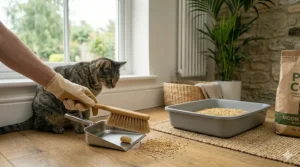
The table makes the environmental case for corn litter fairly clearly. According to research on UK cat litter waste, clay litter can take centuries to decompose in landfill — an uncomfortable thought when you consider that the UK’s roughly 11 million domestic cats are collectively producing a truly enormous volume of waste each year. Biodegradable alternatives like corn, wheat, and wood represent a meaningful switch, not merely a feel-good one.
Corn holds a specific advantage over wheat in clump quality and over wood in user convenience (wood pellets don’t clump at all, requiring full tray replacement rather than daily scooping). Vs silica gel, corn wins on biodegradability and safety if accidentally ingested. Where corn loses to clay is in raw clump hardness at the premium budget level — though World’s Best largely closes that gap.
The broader picture on sustainability is also worth noting: clay litter production involves strip mining that destroys topsoil and natural habitats, a process described in detail by Wikipedia’s overview of cat litter and covered in depth by environmental researchers. Corn, by contrast, is a renewable agricultural crop grown in rotation — and brands like Super Benek and Sanicat are using byproduct material that would otherwise be agricultural waste.
✨ Don’t Miss These Exclusive Deals!
🔍 Ready to make the switch to natural corn litter? Click any highlighted product above to check current pricing and availability on Amazon.co.uk. Prime members can expect next-day delivery on most of these picks.
How to Choose Corn Cat Litter in the UK: 6 Criteria That Actually Matter
It would be easy to walk into this decision armed only with a price comparison. That would be a mistake. Here’s the framework that actually produces good outcomes:
1. Single cat or multiple cats? This is the single most important filter. Single-cat owners can get away with smaller bags and lighter clumping formulas. Multiple cats demand denser clumping, better odour control, and larger pack formats. For two or more cats, go Super Benek Sea Breeze or World’s Best.
2. Flat or house — how’s your storage? UK flats, particularly in cities, have limited cupboard space. A 25L bag of corn litter (lighter than clay of equivalent volume, but still bulky) may cause real logistical problems. If you’re in a two-bedroom flat in Bristol with one airing cupboard, the Sanicat 6L or Amazon 10L in repeat Subscribe & Save orders is a more practical approach than bulk buying.
3. Is your cat fussy? Some cats — typically those who’ve used only clay litter, or particularly cautious breeds — will resist any change in litter texture or scent. Start with the unscented by Amazon option or Super Benek Fresh Grass, both of which have the lowest barrier to acceptance. Avoid scented options for the initial switch.
4. Are there respiratory concerns in your household? If you or your cat have asthma or dust-related sensitivities, corn litter as a category is already better than clay. Within the category, FUKUMARU Tofu & Corn and World’s Best stand out as the most genuinely dust-free formulas.
5. What’s your disposal plan? If you want to compost used litter (only solid matter, after removing cat faeces — DEFRA guidance on composting is worth checking), most corn litters qualify. If you want to flush, check with your water authority first. If you’re bagging and binning, the biodegradability still matters for the longevity of landfill impact.
6. What’s your actual budget per month? The by Amazon 25L at Subscribe & Save pricing works out very well per litre. World’s Best appears expensive per bag but, because whole-kernel corn lasts longer per use, the monthly cost compresses significantly over time. Don’t compare bag price — compare how long a bag actually lasts in your specific situation.
Features That Actually Matter (And Those That Don’t)
Matters enormously:
- Clump firmness. Loose clumps disintegrate during scooping, contaminating clean litter and causing tray odour to build faster. Test this by pressing a clump gently between fingers after scooping — it should hold together.
- Dust level. Not just for aesthetics. Silica dust from clay litter is a genuine respiratory concern for cats and humans alike, particularly in smaller UK homes where airflow is limited.
- Actual odour performance in warm conditions. Marketing claims are made in labs. The real test is a warm summer room in a terraced house with a south-facing aspect and not-brilliant ventilation.
Matters less than claimed:
- “Multi-layer odour protection.” Mostly marketing language for “we added a fragrance.” Natural odour neutralisation through absorption is more effective and less problematic for cats.
- Tracking claims. Every natural litter tracks to some degree. The material and granule size make a difference, but the shape of your litter tray and the presence of a tracking mat are bigger variables than the litter brand.
- Weight. “Lightweight” is a real benefit when carrying bags up stairs, but not a meaningful performance differentiator once the litter is in the tray.
Long-Term Cost & Value: What Corn Litter Really Costs UK Owners
The sticker price of corn litter — particularly premium options — can cause a sharp intake of breath at checkout. It’s worth doing the actual maths before writing it off.
A typical single-cat household goes through roughly 10–12 litres of clumping litter per month with daily scooping and full tray changes every three to four weeks. On those figures:
- by Amazon 10L (budget): Under £15/month. Extremely competitive.
- Super Benek 3×7L (mid-range): Roughly one 3-pack per six to eight weeks for a single cat, putting monthly cost in the £8–£12 range — excellent value.
- World’s Best (premium): The 6.35kg bag is recommended to last a single cat approximately six weeks with proper maintenance. Monthly equivalent cost is more reasonable than the per-bag price implies.
Factor in that corn litter typically requires less material per tray fill than clay (because the clumping is more efficient), and that you’re potentially saving on disposal bag costs if you can compost or flush within your local guidance, and the gap between “budget natural” and “premium clay” shrinks considerably. For multi-cat households, the calculation tips more clearly in favour of mid-to-premium corn options whose longevity per fill reduces overall throughput.
Amazon Subscribe & Save is available on most products in this list, typically saving 5–15% per order. Prime members benefit from free next-day delivery on orders over £25, which effectively makes bulk-buying the sensible approach.
Common Mistakes When Buying Corn Cat Litter (And How to Avoid Them)
Buying too small a bag to test. The 6L Sanicat, while genuinely good, doesn’t give you enough material to properly evaluate performance over time. Ideally, test with at least a 10L bag — enough for two full tray cycles.
Switching too suddenly. As discussed in the transition guide above, cold-turkey switches cause rejection. Gradual mixing over two to four weeks prevents almost all the resistance issues people blame on the litter brand.
Not filling deep enough. Corn litter performs best at 5–6 cm depth. Most UK cat owners fill shallower than this — a hangover from clay litter habits where depth feels wasteful. Corn needs the depth to form proper clumps and prevent sticking.
Assuming all corn litters smell the same. They don’t. Natural corn has a faint earthy-sweet scent; Fresh Grass variants smell lightly herbal; Sea Breeze is a genuine fragrance. If you have a scent-sensitive cat, stick to the fully unscented options.
Flushing without checking. “Flushable” on a corn litter label means the material won’t block your pipes — it doesn’t mean your specific water utility approves of it. Thames Water, Southern Water and others have active campaigns against flushing any litter. Check before you flush, particularly if you’re on an older Victorian sewer system.
Ignoring UK-specific disposal guidance. Cat faeces can carry Toxoplasma gondii, a parasite harmful to pregnant women and wildlife. The PDSA advises against composting cat waste in standard household compost, even with biodegradable litter. Use a covered, sealed cat-waste composter or bag and bin the solid matter while composting the clean litter separately.
FAQ
❓ Is corn cat litter better than clay litter for cats?
❓ Can I flush corn cat litter down the toilet in the UK?
❓ Is corn cat litter safe for kittens?
❓ How long does corn cat litter last compared to clay?
❓ Is corn cat litter available on Amazon.co.uk with Prime delivery?
Conclusion: Time to Make the Switch
The honest truth about corn cat litter is this: it’s better than clay in almost every dimension that matters to the modern British cat owner — environmental impact, respiratory safety, ease of use, and increasingly, cost efficiency. The brands have improved dramatically over the last few years, and the 2026 market offers options at every price point, from the remarkably capable by Amazon budget pick to the premium performance of World’s Best.
The only genuine obstacle is inertia — and the mild suspicion of your cat, who will need a few weeks to agree that this was, in fact, a sensible decision. Give the transition process the time it needs, follow the gradual mixing approach, and the chances are good that you’ll both come around to it.
Our top recommendation for most UK buyers remains Super Benek Fresh Grass for everyday use or the by Amazon 25L on Subscribe & Save for those prioritising budget. For serious multi-cat households or anyone who refuses to compromise on performance, World’s Best remains exactly what it says on the bag.
✨ Don’t Miss These Exclusive Deals!
🔍 Ready to make the switch? Click any highlighted product name in this guide to check current pricing and availability on Amazon.co.uk. These picks are updated regularly — grab the best deal while stock lasts.
Recommended for You
- Best Tofu Cat Litter UK 2026: 7 Eco-Friendly Picks Reviewed
- Best Lightweight Cat Litter UK 2026: 7 Top Picks Reviewed
- Best Eco Friendly Cat Litter UK 2026: 7 Natural Picks That Actually Work
Disclaimer: This article contains affiliate links. As an Amazon Associate, I earn from qualifying purchases. If you purchase products through these links, we may earn a small commission at no additional cost to you.
✨ Found this helpful? Share it with your mates! 💬🤗
