
In This Article
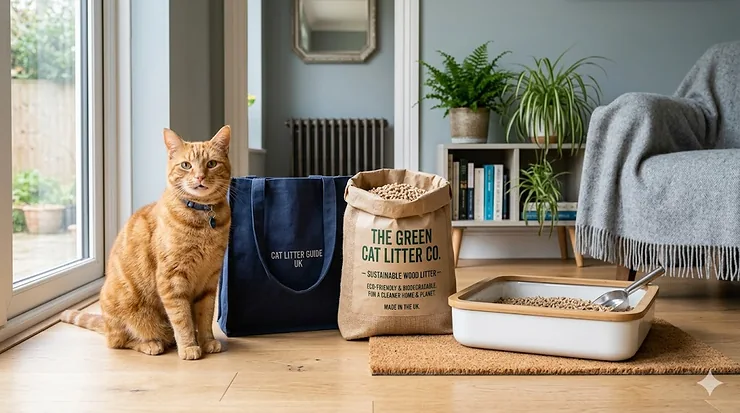
If you share your home with a cat — and there are somewhere between 11 and 12 million of us in the UK who do — you’re familiar with the peculiar ritual of the litter tray. The scooping. The bagging. The slow, dawning realisation that you’ve been consigning bag after bag of non-biodegradable clay straight to landfill, where it will sit, essentially unchanged, for centuries. Not a cheery thought over your morning coffee.
Here’s the thing: switching to eco friendly cat litter is one of the simplest, most painless green swaps a cat owner can make. No solar panels required. No lifestyle overhaul. Just a different product in the same tray. According to research into clay litter’s environmental footprint, conventional bentonite clay is strip-mined from the earth, releasing toxins and decimating habitats — and once used, it doesn’t biodegrade. It just accumulates. The good news is that biodegradable alternatives made from recycled paper, wood fibre, corn, and tofu are now widely available on Amazon.co.uk, often at comparable prices, and several of them genuinely outperform their clay counterparts.
This guide cuts through the noise and gives you seven real, rigorously assessed eco friendly cat litter options available to UK buyers right now — with honest commentary on who each one actually suits, what the specs mean in practice, and how to make the switch without your cat staging a protest.
Quick Comparison: Top 7 Eco Friendly Cat Litters at a Glance
| Product | Material | Clumping | Approx. Price Range | Best For |
|---|---|---|---|---|
| Breeder Celect Natural | 99% Recycled Paper | No | £10–£18 (10–20L) | Kittens, sensitive cats |
| Breeder Celect Plus | Recycled Paper + Probiotics | No | £13–£22 (10–25L) | Odour-prone homes |
| Cat’s Best Oko Plus | Wood Fibre | Yes | £18–£32 (10–40L) | Multi-cat households |
| KatKin Scoop Planet | Pea Fibre & Millet | Yes | £14–£20 (4.5kg) | Small flats, tracking concerns |
| World’s Best Cat Litter | Whole Kernel Corn | Yes | £18–£35 (3–12.7kg) | Owners wanting a flushable option |
| FUKUMARU Tofu | Tofu + Apple Wood | Yes | £18–£28 (10.8kg) | Allergy sufferers |
| Oscars Wood Pellets | Virgin Softwood | No | £14–£22 (30L) | Budget-conscious eco buyers |
The wood-based and paper-based options tend to be the most cost-effective per litre, but clumping litters like Cat’s Best Oko Plus and World’s Best often last longer overall — meaning the slightly higher upfront cost can balance out over a month. If odour control is your top priority, the probiotic-enhanced Breeder Celect Plus edges ahead of the standard formula; if tracking across your kitchen floor is the bane of your existence, KatKin’s pellet format is worth every penny.
💬 Just one click — help others make better buying decisions too! 😊
✨ Don’t Miss These Exclusive Deals!
🔍 Take your sustainable cat care to the next level with these carefully selected products. Click on any highlighted item to check current pricing and availability on Amazon.co.uk. These picks will help you find exactly what you need!
Top 7 Eco Friendly Cat Litters: Expert Analysis
1. Breeder Celect Natural Cat Litter (10L / 20L / 30L)
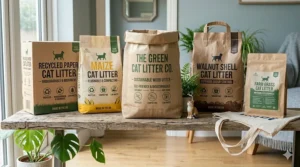
This is the one British cat owners keep coming back to — and for good reason. Made in the UK from 99% recycled paper (largely old newspapers, in a rather satisfying circularity), Breeder Celect Natural produces pellets that are soft underfoot, virtually dust-free, and genuinely gentle on sensitive paws. The pellets absorb moisture quickly, swelling and darkening when wet so you can see exactly what needs scooping — no rummaging around required.
It doesn’t clump, which some owners find off-putting at first. But in a compact flat or terraced house where you’re changing the tray every few days anyway, this is rarely a practical problem. The non-clumping format actually means less chance of pellets sticking together into a heavy, awkward mass at the bottom of a small tray. Soft on paws of all sizes, including kittens — vets and breeders regularly recommend it for young or convalescing cats precisely because it contains no chemicals, clay dust, or synthetic additives. UK reviewers consistently praise it for keeping odours at bay without a heavy artificial fragrance masking the smell rather than tackling it.
✅ Made in the UK — shorter transport miles
✅ 99% recycled material, compostable and biodegradable
✅ Exceptional for kittens and cats with respiratory sensitivities
❌ Non-clumping — requires more frequent tray changes
❌ Can be pricier per litre than basic wood pellet alternatives
Price range: around £10–£18 depending on bag size. Excellent value for the quality, and the 30L bag works out significantly cheaper per litre than the 10L.
2. Breeder Celect Plus Cat Litter with Probiotics (10L / 25L)
Think of Breeder Celect Plus as the upgraded sibling — same recycled paper base, same Made-in-UK credentials, same paw-friendly softness. The meaningful difference is the addition of natural probiotics, which actively feed on the bacteria in your cat’s waste rather than simply absorbing and masking odour. If you live in a smaller home — a flat, a cottage, anywhere without a spare utility room to exile the litter tray to — this distinction matters considerably.
The probiotic formula takes a day or two to get going at its best, so don’t judge it harshly in the first 24 hours. Once established, the odour reduction is noticeably superior to standard Breeder Celect. It also includes a natural attractant, which is genuinely useful when you’re transitioning a reluctant cat from clay to pellets. UK buyers report that even fussy cats warm to the Plus formula faster than expected.
✅ Probiotics tackle odour at source rather than masking it
✅ Built-in attractant eases the transition from conventional litter
✅ Biodegradable, compostable, free from chemicals and additives
❌ Non-clumping like the standard version
❌ The probiotic benefit requires consistent, regular use to reach full effect
Price range: around £13–£22. Worth the step up in price if odour control in a small living space is your primary concern.
3. Cat’s Best Oko Plus Clumping Cat Litter (10L / 20L / 40L)
Cat’s Best is a German brand with a formidable reputation across Europe, and its Oko Plus formula is the one that converted legions of sceptical clay-litter loyalists. Made from the wood fibres of untreated fir and spruce — sustainably sourced secondary raw materials, so no trees are felled specifically for litter production — it absorbs up to 700% of its own weight in moisture. Standard mineral litter, by comparison, manages about 200%. That extraordinary absorption is what makes it so long-lasting: a single tray can stay fresh for up to five weeks with diligent daily scooping.
This is the litter I’d most confidently recommend for multi-cat homes. The clumps form firmly and cleanly, which reduces how often you’re doing a full tray change, and the wood fibre’s natural pine scent does real odour-elimination work without being overpowering. The 40L bag (17.2kg) is a substantial commitment, but it lasts for months in a single-cat household — work out the cost per week and it’s often the most economical option on this list. Prime-eligible on Amazon.co.uk.
✅ Outstanding absorption — genuinely long-lasting
✅ 100% natural plant fibres, biodegradable and compostable
✅ Strong clumping makes daily maintenance quick and low-waste
❌ Heavier bags — a consideration if you’re carrying up stairs to a first-floor flat
❌ Fine texture means some tracking if your cat’s an enthusiastic digger
Price range: around £18–£32. The 40L bag delivers the best value and is well worth the upfront outlay.
4. KatKin Scoop Planet Litter (4.5kg / 12.8L)
KatKin Scoop Planet is the new kid on the UK eco litter scene, and it’s arrived with considerable confidence. Made from pea fibre and millet — two plant-based materials that are sustainably farmed and 100% biodegradable — it clumps quickly and compactly, producing tight, dry pellets that scoop cleanly without crumbling. The pellet size and weight is specifically designed to minimise tracking, which matters enormously if you’ve got pale carpets or laminate flooring and a cat with absolutely no respect for either.
For urban flat dwellers, this is a strong contender. The 4.5kg bag is compact enough to store in a kitchen cupboard without reorganising your entire pantry — a real consideration in the kinds of smaller homes most of us are managing in UK cities. No synthetic fragrances, no nasty additives, and Amazon.co.uk reviews from UK buyers consistently flag the low-tracking performance as a genuine selling point rather than marketing puff. The price per kilo sits at the higher end, but the tight clumping means less litter is wasted per use.
✅ Outstanding anti-tracking performance — ideal for flats and smaller spaces
✅ 100% plant-based, biodegradable, no artificial fragrance
✅ Compact packaging — practical for limited storage
❌ Higher cost per kilo than wood or paper alternatives
❌ Smaller bag sizes mean more frequent ordering
Price range: around £14–£20. Worth it for anyone who’s spent too much time hoovering litter dust off their kitchen floor.
5. World’s Best Cat Litter (3.18kg / 6.35kg / 12.7kg)
The name is bold. The litter, rather satisfyingly, comes close to living up to it. World’s Best Cat Litter is made from whole kernel corn — not processed or chemical-treated, just corn — and the result is a product that clumps firmly, controls odour impressively, and crucially, is flushable. That last point is worth dwelling on: being able to flush small amounts directly down the toilet removes the need for additional plastic bags entirely, which makes a meaningful difference to your weekly household waste.
The 12.7kg bag on Amazon.co.uk is the one to go for on a value-per-use basis. It’s certified 99% dust-free, which is welcome news for cats and owners prone to respiratory issues, and UK reviewers — particularly those with multiple cats — tend to describe it as one of the best-performing natural litters they’ve tried. One caveat worth noting: flushable doesn’t mean you should flush large quantities at once, and you should always check your local council’s guidance on flushing cat waste, as some water companies have specific advice due to Toxoplasma gondii concerns. The UK Water Industry Research body recommends caution here.
✅ Genuinely flushable — eliminates the need for litter disposal bags
✅ Excellent clumping from whole kernel corn
✅ 99% dust-free; safe for sensitive respiratory systems
❌ One of the pricier options by weight
❌ Corn scent is mild but present — most cats ignore it, some don’t
Price range: around £18–£35 depending on bag size. The 12.7kg bag offers the best cost-per-use.
6. FUKUMARU Tofu Cat Litter (10.8kg — 4 × 2.7kg bags)
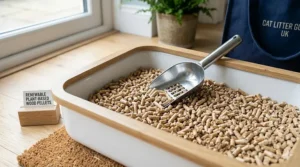
Tofu cat litter sounds like something from a lifestyle magazine trend piece. It is, in fact, genuinely excellent. FUKUMARU Tofu Cat Litter is made from 80% soya bean curd residue and 20% natural apple wood, neither of which involves any chemical processing or artificial additives. The result is a litter that’s 99.9% dust-free, absorbs liquid in roughly two seconds, and clumps firmly enough to lift cleanly from the tray without disintegrating.
What’s particularly compelling for UK buyers is the combination of flushability and compostability — this is one of the few litters that gives you both options. The apple wood component provides genuine odour neutralisation rather than fragrance masking, which means the tray smells of nothing very much rather than an aggressive pine forest. For households where someone has respiratory sensitivities or allergies, this is significant. Compact and lightweight (the multi-pack format stores easily even in a flat with minimal cupboard space), and Prime-eligible on Amazon.co.uk.
✅ 99.9% dust-free — genuinely suitable for allergy sufferers
✅ Both flushable and compostable
✅ Natural odour control via apple wood, not synthetic fragrance
❌ Pellet size may be slightly large for very small kittens
❌ Premium price point compared to wood pellet alternatives
Price range: around £18–£28 for the 10.8kg multi-pack. Strong value when you consider the quantity and dual disposal options.
7. Oscars Cat Litter Wood Pellets (30L)
Sometimes you just want something honest and unfussy that does the job well, costs a reasonable amount, and won’t contribute to a landfill pile the size of a small mountain. Oscars Cat Litter delivers exactly that. Made from virgin softwood pellets — natural, biodegradable, and sourced sustainably — the 30L bag offers generous coverage at a price that won’t make you wince. Non-clumping, dust-free, and impressively absorbent for a product at this price point.
The wood pellets are large enough that they don’t get stuck between your cat’s toes and tracked across the kitchen floor — a common frustration with finer granule litters. The pellets break down into sawdust as they absorb moisture, which you scoop or sieve out as needed. Some owners find this a touch more labour-intensive than the simple clump-and-scoop method; others prefer it precisely because the transformation is so visible and satisfying. Ideal for budget-conscious owners who are new to eco litter and want a low-risk introduction.
✅ Excellent value for money — 30L at an accessible price
✅ Natural virgin softwood — biodegradable, no synthetic additives
✅ Large pellets minimise tracking
❌ Non-clumping — the sawdust residue requires sieving
❌ Less odour control than probiotic or wood fibre alternatives for multi-cat homes
Price range: around £14–£22 for the 30L bag. Hard to beat as an entry point into biodegradable cat litter.
Making the Switch: A Practical Guide for UK Cat Owners
Here’s what the packet won’t tell you: most cats are resistant to change. Not dramatically resistant — this isn’t a standoff — but quietly, stubbornly reluctant in the way only cats can manage. The key is a gradual transition. Start by mixing roughly 25% eco litter with your cat’s existing litter for the first week. Increase to 50/50 in week two, then 75/25 in week three. By week four, most cats have accepted the new material without registering any protest whatsoever.
A few UK-specific practicalities worth bearing in mind. If you’re in a flat — particularly a Victorian conversion or purpose-built block where storage space is measured in centimetres — the compact packaging of options like KatKin and FUKUMARU’s multi-packs genuinely matters. A 40L bag of Cat’s Best is brilliant value but requires somewhere to put it. In damper conditions (which, in Britain, is simply called “autumn through spring”), wood pellet litters can be susceptible to moisture in the bag if stored in a shed or garage — keep bags sealed and elevated off a cold concrete floor.
For kittens, always opt for a dust-free, non-clumping formula initially. Young cats are prone to investigating their litter tray with rather more enthusiasm than hygiene would suggest appropriate, and veterinary guidance from the RSPCA recommends avoiding fine-particle or clumping litters with cats under 12 weeks, as ingestion is a real possibility. Breeder Celect is the obvious recommendation here.
Which Eco Litter Suits Your Home? Three UK Scenarios
The London flat-dweller with one cat and approximately six square metres of storage space. KatKin Scoop Planet or FUKUMARU Tofu are your friends. Both come in manageable, compact packaging, both clump tightly and produce minimal waste, and neither will fill your hallway cupboard. The anti-tracking performance of KatKin is particularly welcome when your kitchen floor is also your living room floor.
The family in a semi-detached in Sheffield with two cats and a utility room. Cat’s Best Oko Plus, bought in the 40L bag, makes compelling sense here. The absorption is extraordinary, the clumps are firm, and a single large bag lasts months. The slightly higher up-front cost disappears when you spread it over five or six weeks of use. The utility room gives you somewhere to store it properly, away from the damp.
The retiree in rural Somerset with an elderly, sensitive-stomached cat. Breeder Celect Plus, without question. The gentle paper pellets are soft on ageing paws, the probiotic formula manages odour without aggressive fragrance, and the product is made in the UK — so the environmental footprint from transport is low. The built-in attractant also helps if your cat has become set in its ways about litter type (and elderly cats absolutely do).
What Is Eco Friendly Cat Litter?
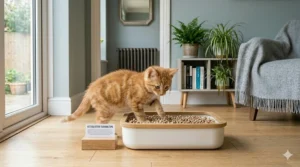
Eco friendly cat litter is litter made from natural, renewable, or recycled materials — such as recycled paper, sustainably sourced wood, corn, tofu, or plant fibres — rather than conventional sodium bentonite clay. It biodegrades after use, is typically compostable or flushable, involves far less environmental damage in production, and generates significantly less landfill waste. Most options are also free from synthetic fragrances, chemical additives, and silica dust.
How to Choose Eco Friendly Cat Litter in the UK: 6 Expert Steps
- Identify your priority. Clumping or non-clumping? Odour control or dust-free performance? Your cat’s preferences and your household’s habits should drive the decision, not the packaging design.
- Consider your living space. Smaller homes and flats benefit from compact, high-clumping litters that reduce how often you’re changing the tray. Multi-cat homes need superior odour management and absorption.
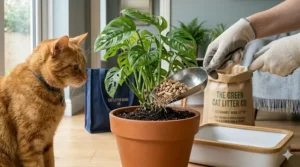
- Check disposal options. Flushable litters (World’s Best, FUKUMARU) reduce plastic waste. Compostable options (virtually all of the above) can go in your garden compost bin — though never in a council food waste collection, as cat waste is excluded.
- Factor in your cat’s age and health. Kittens and cats with respiratory conditions need dust-free, non-clumping formulas. Elderly cats with sensitive paws need softer materials. Don’t underestimate this step — cats will simply refuse to use a litter that causes them discomfort.
- Do the maths on cost per use. A higher-priced litter that lasts twice as long is often cheaper per week than a budget option that requires full tray changes every two days. Cat’s Best Oko Plus is a good example of this paradox.
- Transition gradually. No matter which product you choose, give your cat two to four weeks to adapt. Abrupt switches often result in a protest vote cast somewhere inconvenient in your home.
Eco Friendly vs Traditional Clay Litter: The Real Comparison
| Factor | Clay (Bentonite) | Eco Friendly Alternatives |
|---|---|---|
| Environmental impact | Strip-mined, non-biodegradable | Renewable, biodegradable/compostable |
| Dust levels | Often high (silica risk) | Generally low to none |
| Odour control | Good (synthetic) | Good to excellent (natural) |
| Disposal | Landfill only | Compost, flush, or landfill |
| Price range | £5–£12 for 10L | £10–£20 for 10L |
| Longevity | Standard | Often longer-lasting |
The price gap between clay and eco litter has narrowed considerably in 2026, particularly for wood pellet and recycled paper options. Clay’s apparent cheapness is also somewhat illusory when you factor in higher replacement frequency — you tend to go through it faster. The environmental calculus is unambiguous: research consistently shows that plant-based litters reduce landfill contribution by up to 70% compared to conventional clay, and they skip the energy-intensive strip-mining process entirely.
Common Mistakes When Buying Natural Cat Litter
Buying based on price per litre without checking absorption rate. A 30L bag of wood pellets at £14 looks like a bargain until you realise that the pellets break down rapidly and you’re replacing the tray every three days. Cat’s Best at twice the price per litre, used properly, can last five times longer. Always look at cost per week, not cost per bag.
Assuming “natural” means odour-free. Natural litters control odour through absorption and, in some cases, probiotics — not through heavy fragrance. The result is a genuinely neutral smell rather than the overwhelming pine or lavender cloud of cheap clay litters. Some owners mistake “neutral” for “not working.” It’s working. Your nose has just recalibrated.
Switching abruptly with a house cat. For indoor cats that have used clay litter their entire lives, a cold switch to pellets is asking for trouble. The texture, weight, and sound underfoot are all different. Go gradually — see the transition guide above.
Ignoring local disposal rules. Most UK councils do not accept cat litter — of any type — in food waste or garden waste collections, due to the risk of Toxoplasma gondii in cat faeces. Compostable litters can go in your private home compost bin (not touching edible crops), but check GOV.UK’s waste disposal guidance for your area before assuming anything.
Buying a heavily fragranced “natural” litter. Fragrance and natural are not synonyms. Some products marketed as eco-friendly contain essential oil fragrances that cats find deeply off-putting. Cats have a sense of smell roughly 14 times more powerful than ours — what reads as “fresh” to you may read as “assault” to them. When in doubt, go unscented.
✨ Don’t Miss These Exclusive Deals!
🔍 Ready to make the switch? Click on any highlighted product above to check current pricing and availability on Amazon.co.uk.
Long-Term Cost & Value: Is Eco Litter Worth the Extra Outlay?
The honest answer is: often not extra outlay at all, once you account for usage. Let’s work through it. A standard clay clumping litter for a single cat costs around £8–£12 for 10L and typically requires a full tray change every seven to ten days — plus daily scooping. Cat’s Best Oko Plus, at roughly £18–£22 for 10L, can sustain a single tray for up to five weeks with proper daily scooping. Run the weekly maths and the eco option is cheaper.
Where eco litter does cost more is in the premium plant-based options like KatKin and FUKUMARU. These are genuinely more expensive per kilo than basic clay, and the honest position is that you’re paying partly for performance and partly for environmental credentials. Whether that premium feels worthwhile is a personal decision — but neither product is without merit on pure performance grounds.
The secondary costs are worth considering too. Biodegradable and compostable litters don’t require separate waste bags for disposal (or minimal bags if you’re composting), which saves a few pounds per year. And if you’re on a Subscribe & Save arrangement through Amazon Prime, most of these products offer a further discount — worth setting up for something you’ll be buying every month regardless.
FAQ: Eco Friendly Cat Litter UK
❓ Is eco friendly cat litter as effective as clay at controlling odour?
❓ Can I compost used eco cat litter in my garden?
❓ Which eco cat litter is best for a kitten in the UK?
❓ Are tofu cat litters really flushable, and is it safe in UK plumbing?
❓ Does eco cat litter cost more than conventional litter in the UK?
Conclusion: The Switch Is Easier Than You Think
There’s a quiet revolution happening in UK cat care. In 2026, eco friendly cat litter is no longer the niche, compromise-heavy option it was even five years ago. The products on this list genuinely perform — some spectacularly so. Breeder Celect remains the gold standard for kittens and sensitive cats; Cat’s Best Oko Plus is the one to beat for multi-cat households; KatKin Scoop Planet has earned its reputation in smaller UK homes where tracking and storage space matter; and World’s Best and FUKUMARU give you the genuinely planet-friendly option of skipping the bin bag entirely.
The environmental case barely needs restating: clay litter requires destructive strip mining to produce and sits in landfill for centuries after use. The alternatives on this list break down, compost, or flush — and they’re increasingly available on Amazon.co.uk at prices that make the swap a no-brainer. Your cat won’t thank you. But the planet might.
✨ Ready to Make the Switch?
🔍 Explore all seven eco friendly cat litters above and click any highlighted product to check current availability and pricing on Amazon.co.uk. Your cat’s tray — and your carbon footprint — will both be better for it.
Recommended for You
- Best Wood Pellet Cat Litter UK 2026: 7 Expert Picks Reviewed
- Best Silica Gel Cat Litter UK 2026: 7 Top Crystal Picks
- Best Long Lasting Clumping Cat Litter UK: 7 Expert Picks for 2026
Disclaimer: This article contains affiliate links. As an Amazon Associate, I earn from qualifying purchases. If you purchase products through these links, we may earn a small commission at no additional cost to you.
✨ Found this helpful? Share it with your mates! 💬🤗
