
In This Article
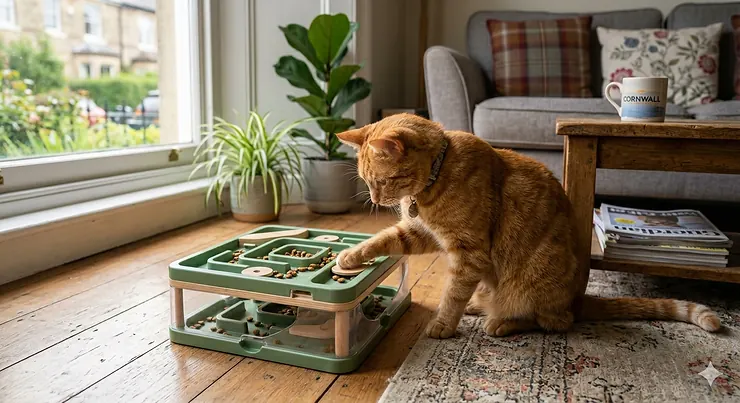
Does your cat wolf down their food in seconds and then beg for more? You’re not alone. According to PDSA, vets estimate that over a third of cats in the UK are overweight, and traditional feeding bowls aren’t helping matters. As a cat owner myself, I’ve watched my British Shorthair transform from a greedy gobbler to a healthier, happier hunter—all thanks to puzzle feeders.
A cat puzzle feeder for weight loss does more than just slow down eating. It taps into your feline’s natural hunting instincts, turning mealtime into an engaging mental workout. Instead of mindlessly munching from a bowl, your cat must work for their kibble, pawing, pushing, and problem-solving to release each morsel. This not only extends feeding time from 30 seconds to 15-20 minutes but also burns calories through physical activity.
Weight gain occurs when cats take in more calories than they use, and the excess energy is stored as fat. Puzzle feeders tackle both sides of this equation: they reduce the speed of consumption (helping your cat feel fuller on appropriate portions) whilst increasing activity levels. For indoor cats especially, who lack the stimulation of outdoor hunting, these feeders provide crucial enrichment.
In this comprehensive guide, I’ll walk you through the seven best cat puzzle feeders available on Amazon.co.uk in 2026, complete with pricing in GBP, real customer feedback from UK buyers, and expert analysis to help you choose the perfect feeder for your chunky moggy.
Quick Comparison Table
| Product | Type | Difficulty | Price (£) | Best For |
|---|---|---|---|---|
| Catit Senses 2.0 Food Tree | Tower feeder | Adjustable (3 levels) | £15-£18 | Multi-cat households |
| Trixie Activity Fun Board | Flat puzzle | Level 1-2 | £24.99 | Paw dexterity training |
| PetSafe SlimCat | Rolling ball | Adjustable | £8-£12 | Active cats |
| Catit Play Treat Puzzle | Multi-activity | Level 1 | £18-£22 | Beginners |
| Cat Amazing Sliders | Cardboard puzzle | Progressive | £12-£16 | Budget-conscious owners |
| Trixie Rod Box | Tube puzzle | Level 2 | £10-£14 | Determined diggers |
| ALL FOR PAWS Interactive Maze | Maze feeder | Level 1 | £9-£13 | Small portions |
💬 Just one click – help others make better buying decisions too! 😊
Top 7 Cat Puzzle Feeders for Weight Loss: Expert Analysis
1. Catit Senses 2.0 Food Tree – The All-Rounder Champion
The Catit Senses 2.0 Food Tree remains my top recommendation for 2026, and for good reason. This transparent green tower transforms mealtime into a strategic game where your cat must paw kibble through progressively narrower levels until it reaches the base dish.
Key Specifications:
- Three adjustable difficulty settings (rotate middle disc)
- Holds approximately 2/3 cup of dry food
- Dimensions: 30.5cm (H) x 30.5cm (W) x 25.4cm (D)
UK Price Range: £15-£18
British cat owners consistently praise this feeder’s effectiveness. One reviewer from Bristol noted: “My previously bored British Shorthair now spends 20 minutes fully engaged at mealtime instead of inhaling food in seconds.” The improved 2.0 design features a sturdier base to prevent determined cats from toppling it over, though some larger cats still manage the feat.
What sets the Food Tree apart is its versatility. You can start on the easiest setting for puzzle novices and gradually increase difficulty as your cat masters each level. It’s particularly brilliant for households with multiple cats of varying skill levels—each can tackle their preferred sections simultaneously.
Pros:
✅ Three difficulty settings for progression
✅ Large capacity suitable for daily meals
✅ Transparent design lets you monitor kibble levels
Cons:
❌ Some larger cats can still knock it over
❌ Requires regular cleaning between levels
2. Trixie Activity Fun Board – The Variety Expert
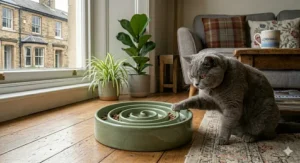
For cats who get bored easily, the Trixie Activity Fun Board offers five different puzzle types in one compact unit. This flat board features tunnels, pegs, sliders, globes, and tongue sections—each requiring different problem-solving approaches.
Key Specifications:
- Five distinct puzzle mechanisms
- Non-slip rubber feet for stability
- Made from durable BPA-free plastic
- Dimensions: 30cm x 40cm (flat design)
UK Price Range: £24.99
UK customers particularly appreciate the variety this board provides. A reviewer from Leeds shared: “Our three cats each have their favourite sections, which prevents squabbling at mealtimes.” The flat design means it stores easily and stays stable during enthusiastic play sessions.
The Fun Board excels at developing fine motor skills through its diverse challenges. The globe section requires precise paw movements to scoop treats out, whilst the slider mechanism encourages nose-pushing and strategic thinking. For intelligent cats who master single-mechanism puzzles quickly, this variety keeps them engaged for months.
Pros:
✅ Five puzzle types prevent boredom
✅ Flat, stable design won’t tip
✅ Suitable for wet food in certain sections
Cons:
❌ Higher price point
❌ Requires significant storage space
3. PetSafe SlimCat – The Budget Champion
Don’t let the low price fool you—the PetSafe SlimCat is a proven weight-loss tool that’s been helping cats slim down for years. This simple ball dispenser requires cats to bat it around to release kibble through adjustable openings.
Key Specifications:
- Two hole sizes (adjustable openings)
- Holds 2/3 cup of food
- Top-rack dishwasher safe
- Diameter: 8cm
UK Price Range: £8-£12
The SlimCat’s simplicity is its strength. A UK reviewer noted: “The vet recommended this to help him lose weight, and it seems to be working. Poor little guy went from leisurely eating to having to work for every kibble.” The adjustable openings mean you can control difficulty—start wide for beginners, narrow for experienced puzzle cats.
One clever feature: you can use it for treats or meals. Fill it with their daily food allowance and let your cat “hunt” throughout the day, mimicking natural feeding patterns. The ball’s unpredictable rolling pattern keeps cats engaged as they chase it across floors.
Pros:
✅ Extremely affordable
✅ Easy to clean (dishwasher safe)
✅ Encourages active play and exercise
Cons:
❌ Can be noisy on hard floors
❌ Some cats learn to open it
4. Catit Play Treat Puzzle – The Beginner-Friendly Option
The Catit Play Treat Puzzle offers six different activities in a colourful, approachable design perfect for cats new to puzzle feeding. Its bright colours and varied textures make it instantly engaging for curious felines.
Key Specifications:
- Six puzzle activities
- BPA-free plastic construction
- Easy-clean design
- Quite large footprint
UK Price Range: £18-£22
UK buyers report excellent results with food-motivated cats. One reviewer shared: “It’s bigger than I thought but it’s a game changer. From 30 seconds eating time in a bowl to 15 minutes in this puzzle.” The size, whilst requiring storage space, means multiple cats can use it simultaneously without competition.
The various puzzle types accommodate different skill levels. Some sections are straightforward scooping exercises, whilst others require more strategic thinking. This makes it ideal for households introducing puzzle feeding for the first time—your cat can build confidence with easier sections before tackling harder challenges.
Pros:
✅ Multiple difficulty levels in one unit
✅ Bright, engaging design
✅ Sturdy construction
Cons:
❌ Large size (not ideal for small spaces)
❌ May be too easy for clever cats
5. Cat Amazing Sliders – The Eco-Friendly Choice
The Cat Amazing Sliders brings an innovative cardboard design that’s both environmentally friendly and surprisingly durable. The sliding inner boxes create an ever-changing puzzle that keeps even clever cats guessing.
Key Specifications:
- Recyclable cardboard construction
- Sliding boxes for progressive difficulty
- Lightweight and portable
- Works with treats, kibble, or small toys
UK Price Range: £12-£16
Whilst cardboard might seem flimsy, UK reviewers report impressive longevity. One owner used the smaller version for over a year before accidentally stepping on it. The sliding mechanism means treats fall to different levels, requiring cats to problem-solve which opening to use.
The lightweight design makes it perfect for moving around your home—hide it in different rooms to encourage hunting behaviour. It’s particularly effective when combined with scatter feeding techniques recommended by feline behaviourists.
Pros:
✅ Eco-friendly recyclable materials
✅ Constantly changing puzzle
✅ Excellent value for money
Cons:
❌ Not suitable for wet food
❌ Less durable than plastic options
6. Trixie Rod Box – The Digger’s Delight
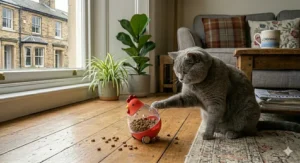
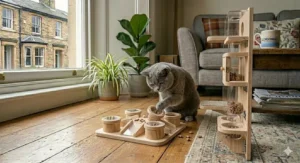
For cats who love to dig and forage, the Trixie Rod Box provides tubes of varying depths that encourage natural pawing behaviours. It’s particularly effective for cats who dig at their food bowls.
Key Specifications:
- Multiple tubes at different depths
- Level 2 difficulty
- Anti-slip rubber mat base
- Compact design
UK Price Range: £10-£14
The different tube sizes add challenge variation—shallow tubes are easy wins, whilst deeper ones require determination and precision. The rubber base prevents the whole unit from sliding across floors during enthusiastic digging sessions.
UK customers note it’s especially popular with younger, more active cats who have energy to burn. The vertical digging motion provides good exercise whilst slowing down eating considerably.
Pros:
✅ Encourages natural digging instincts
✅ Anti-slip base for stability
✅ Compact storage footprint
Cons:
❌ Not suitable for large kibble
❌ Can be frustrating for less determined cats
7. ALL FOR PAWS Interactive Maze – The Mental Stimulator
The ALL FOR PAWS Interactive Maze combines multiple puzzle elements in a brain-teasing layout that keeps cats mentally stimulated whilst controlling portions.
Key Specifications:
- Maze-style layout with multiple paths
- Transparent design to track treats
- Easy to clean
- Level 1 difficulty
UK Price Range: £9-£13
This maze excels at portion control. Its design naturally limits how much food cats can access at once, making it perfect for cats prone to overeating. The transparent top means you can watch your cat’s problem-solving process, which is both educational and entertaining.
UK reviewers appreciate how it slows down even the greediest eaters. The maze paths require cats to use strategic thinking rather than just brute force, providing genuine mental enrichment alongside weight management.
Pros:
✅ Excellent portion control
✅ Transparent for monitoring
✅ Affordable entry-level puzzle
Cons:
❌ May be too easy for experienced puzzle cats
❌ Limited capacity
✨ Don’t Miss These Exclusive Deals!
🔍 Take your cat’s weight loss journey to the next level with these carefully selected products. Click on any highlighted item to check current pricing and availability on Amazon.co.uk. These tools will help you create authentic health improvements your feline friend will love!
What Is a Cat Puzzle Feeder for Weight Loss?
A cat puzzle feeder for weight loss is an interactive feeding device designed to slow down eating whilst stimulating your cat’s natural hunting instincts. Unlike traditional bowls where food is freely available, puzzle feeders require cats to work—pawing, pushing, rolling, or manipulating the feeder—to access small portions of kibble.
These feeders serve multiple purposes beyond weight management. They provide mental stimulation that reduces boredom-related behaviours like excessive meowing or destructive scratching. They encourage physical activity, turning sedentary mealtimes into active play sessions. Most importantly for weight loss, they dramatically extend feeding time from seconds to minutes, allowing your cat’s satiety signals to kick in before they’ve consumed excessive calories.
Overweight cats are usually defined as being more than 10% over their ideal weight, whilst obese cats are more than 20% over their ideal weight. According to Cats Protection, if your cat is overweight or obese, it greatly increases their risk of certain health conditions, many of which can be life-limiting. For cats in either category, puzzle feeders offer a behavioural intervention that complements dietary changes and veterinary guidance.
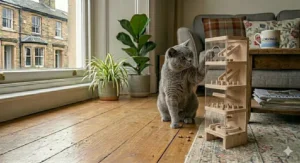
Benefits of Puzzle Feeders Beyond Weight Loss
Mental Enrichment and Cognitive Health
Indoor cats often lack the mental stimulation their outdoor counterparts enjoy. Puzzle feeders fill this gap by challenging your cat’s problem-solving abilities. Each feeding session becomes a cognitive workout, keeping their minds sharp and engaged.
Research from feline behaviour experts suggests that mental stimulation can reduce anxiety and stress-related behaviours. Cats with adequate enrichment are less likely to develop compulsive behaviours or depression, particularly in single-cat households.
Physical Activity and Muscle Tone
Whilst not replacing dedicated play sessions, puzzle feeders do encourage movement. Cats batting balls across floors, stretching to reach high tubes, or digging into compartments engage muscle groups that might otherwise atrophy in sedentary lifestyles.
For arthritic senior cats, gentle puzzle feeding can actually help maintain joint mobility when exercises are low-impact and appropriate for their condition. Always consult your vet before introducing puzzles to cats with mobility issues.
Digestive Health Improvements
Rapid eating contributes to vomiting, particularly in cats who gulp air alongside food. By forcing slower consumption, puzzle feeders reduce instances of post-meal regurgitation. The extended feeding time also promotes better chewing, aiding digestion and nutrient absorption.
Some cats develop a healthier relationship with food through puzzle feeding. The RSPCA recognises obesity as a serious welfare issue in pets because it can cause suffering and can be extremely disabling. Instead of anxious gulping driven by scarcity fears, puzzle feeders help cats learn that food is available through engagement and play, reducing food-related stress.
Natural Behaviour Expression
Domestic cats retain strong hunting instincts despite thousands of years of domestication. Puzzle feeders allow them to express these natural behaviours in appropriate ways. The stalk-pounce-consume sequence mimics hunting, providing psychological satisfaction that goes beyond mere feeding.
According to International Cat Care, puzzle feeding is particularly beneficial for cats who display hunting frustration through inappropriate behaviours like attacking owners’ ankles or excessive nighttime activity.
How to Choose the Right Puzzle Feeder
Assess Your Cat’s Current Skill Level
Never throw an advanced puzzle at a complete beginner—it’s a recipe for frustration. Start with Level 1 puzzles where food is visible and relatively easy to access. The Catit Play Treat Puzzle or PetSafe SlimCat make excellent starter feeders.
Watch how quickly your cat masters the basics. Some clever cats progress to Level 2 puzzles within days, whilst others need weeks to build confidence. Progress at your cat’s pace, not yours.
Consider Your Cat’s Physical Abilities
Age and mobility matter. Senior cats with arthritis won’t appreciate feeders requiring extensive bending or stretching. Flat board puzzles like the Trixie Fun Board might suit them better than tall towers.
Polydactyl cats (those with extra toes) often excel at puzzles requiring precise paw movements. Declawed cats may struggle with certain mechanisms and benefit from nose-push or rolling designs instead.
Match Feeder Type to Personality
Food-motivated cats: Thrive with harder puzzles that provide satisfying rewards. The Catit Food Tree’s three difficulty levels offer long-term engagement.
Easily frustrated cats: Need confidence-building easier puzzles. The Cat Amazing Sliders’ progressive difficulty lets them succeed early whilst building skills.
Highly active cats: Benefit from mobile feeders like the SlimCat that incorporate exercise.
Timid cats: Prefer stationary puzzles with visible food, avoiding unpredictable rolling mechanisms that might startle them.
Evaluate Kibble Compatibility
Check your cat food’s kibble size against feeder specifications. Large kibble won’t fit through small SlimCat openings. Flat, wide kibble may jam in narrow tubes. Most feeders work best with standard 6-10mm round or triangular kibble.
Some feeders like the Trixie Fun Board accommodate wet food in certain sections, offering flexibility for cats on mixed diets.
Think About Household Dynamics
Multi-cat homes: Need either multiple feeders or large units like the Catit Food Tree where several cats can eat simultaneously without competition.
Single cats: Can use smaller, more challenging puzzles that might cause squabbles in group settings.
Homes with dogs: Require cat-specific placement (elevated surfaces, cat-only rooms) or dog-proof designs.
Factor in Cleaning Requirements
Puzzle feeders require regular cleaning to prevent bacterial growth. Dishwasher-safe options like the PetSafe SlimCat simplify this task. Complex multi-part puzzles need more hands-on cleaning but offer better enrichment.
Consider how often you’ll realistically clean the feeder. Daily meal feeders need easier cleaning than weekly treat toys.
Portion Control and Weight Loss Strategy
Understanding Caloric Needs
Weight loss requires consuming fewer calories than your cat burns. Your vet can calculate your cat’s ideal daily caloric intake based on target weight, age, and activity level. This typically ranges from 180-280 calories daily for average-sized cats.
Measure portions precisely using kitchen scales, not volume measurements which vary with kibble density. A “cup” of one brand might contain significantly more calories than another brand’s cup.
Gradual Transition Protocol
Don’t switch to puzzle-only feeding overnight. Introduce puzzles alongside regular bowls for the first week, placing particularly appealing treats or favourite kibble in the puzzle. As your cat gains confidence, gradually shift more food to the puzzle whilst reducing bowl portions.
Monitor your cat’s stress levels during transition. If they’re crying excessively or showing food anxiety, slow the process. Some cats need several weeks to fully adapt.
Daily Feeding Schedule
Divide daily food allowance across multiple puzzle sessions rather than one or two large meals. This mimics natural feline eating patterns—cats should ideally graze throughout the day, taking small frequent meals.
Consider “hiding” filled puzzles around your home before work, allowing your cat to “hunt” throughout the day. This prevents boredom and provides activity during your absence.
Monitoring Progress
Weigh your cat weekly on consistent digital scales (baby scales work perfectly). Regular monitoring of a pet’s weight is important to allow early recognition of any changes. Healthy weight loss is gradual—aim for 1-2% body weight reduction per week.
Track body condition score (BCS) alongside weight. A cat might maintain weight whilst building muscle and losing fat, which scales won’t detect but BCS will.
Adjusting Strategy Over Time
As your cat loses weight, caloric needs decrease. Reassess portion sizes every 4-6 weeks with your vet to prevent weight loss plateaus. You may need to increase puzzle difficulty or activity levels as your cat becomes fitter and more adept.
Remember, it may take up to a year for a severely overweight cat to reach their ideal body condition. Patience and consistency trump quick fixes.
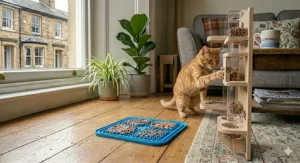
Common Mistakes to Avoid
Rushing the Introduction
The biggest mistake is forcing puzzle feeders on unprepared cats. Start simple, make it easy, and build confidence before increasing difficulty. Frustrated cats will abandon puzzles entirely, defeating the purpose.
Inconsistent Use
Puzzle feeders work best as regular feeding tools, not occasional toys. Inconsistent use confuses cats and prevents habit formation. Commit to puzzle feeding for at least 80% of meals to see results.
Ignoring Food Preferences
If your cat loathes their current kibble, no puzzle will make it appealing. Use favourite foods or high-value treats during initial training, transitioning to regular kibble once the puzzle concept is understood.
Over-Reliance Without Exercise
Puzzle feeders aren’t magic bullets. They must complement, not replace, dedicated play sessions. Aim for at least 15-20 minutes of interactive play daily using wand toys or laser pointers.
Neglecting Veterinary Guidance
Always consult your vet before implementing weight loss strategies. The British Veterinary Association recognises obesity as a legitimate clinical condition and serious health concern in all animals. Some conditions require specific dietary approaches, and rapid weight loss can trigger serious liver problems in cats. Professional oversight is essential.
Using Puzzles for Treats Only
Treats should comprise less than 10% of daily calories. If you’re only using puzzles for treats whilst free-feeding meals, you’re missing the point. Transition meal portions to puzzles for genuine impact.
Safety Considerations
Supervision Requirements
Always supervise first use of any new puzzle feeder. Watch for inappropriate behaviours like aggressive chewing (which could break plastic) or attempts to dismantle the feeder. Some cats try to open removable parts, potentially creating choking hazards.
Material Safety
Choose feeders made from BPA-free, food-grade plastics. Avoid painted or coated feeders where paint might chip into food. Wood or cardboard feeders should be untreated and non-toxic.
Hygiene Maintenance
Bacteria multiply rapidly in leftover food particles. Clean feeders at least weekly (daily for wet food) with hot soapy water. Dishwasher-safe models offer convenience but check they’re truly top-rack safe before washing.
Choking Hazards
Small removable parts pose choking risks, particularly for aggressive chewers. Inspect feeders regularly for cracks, broken pieces, or loosening components. Replace damaged feeders immediately.
Multi-Cat Safety
In multi-cat homes, ensure each cat can access adequate food without bullying. Dominant cats may guard popular puzzles, preventing submissive cats from eating. Provide multiple feeders in separate locations if needed.
Complementary Weight Loss Tools
Interactive Play Sessions
Puzzle feeders address the intake side of weight loss; play tackles energy expenditure. Aim for two 10-15 minute sessions daily using toys that encourage running, jumping, and pouncing.
Wand toys (fishing rod style) are particularly effective. They allow you to control the “prey” movements, triggering your cat’s hunting instincts. Rotate toys weekly to maintain interest.
Elevated Feeding Stations
Placing puzzles at various heights (floor, cat tree platforms, window sills) adds physical challenge. Cats must jump or climb to access food, burning additional calories whilst eating.
Slow Feeder Bowls
For cats who absolutely won’t engage with puzzles, slow feeder bowls with raised obstacles offer a compromise. Whilst less enriching than puzzles, they still extend eating time and prevent gulping.
Automated Portion Feeders
Combine puzzle feeders with timed automatic feeders for consistent portion control. Set the auto-feeder to dispense measured amounts at specific times, teaching your cat regular eating schedules.
Real-Life Success Stories from UK Owners
Sarah from Manchester shared: “My 7kg British Shorthair was heading towards diabetes according to our vet. Six months with the Catit Food Tree, combined with twice-daily play, brought him down to a healthy 5.5kg. His energy levels are incredible now!”
James from Edinburgh reported: “We adopted a rescue cat who was morbidly obese at 8kg. The Trixie Fun Board was a game-changer. It took nearly a year, but she’s now a trim 4.8kg and actually plays for the first time in her life.”
Lisa from Cardiff found success with multiple feeders: “I rotate three different puzzles throughout the week—the SlimCat for breakfast, the Food Tree for dinner, and the Cat Amazing Sliders for weekend treats. My cat never gets bored, and he’s lost 800g in four months.”
These stories highlight a common theme: patience, consistency, and professional veterinary guidance. According to PDSA, working with your vet ensures safe, sustainable weight loss rather than dangerous crash dieting.
Frequently Asked Questions
❓ How quickly will my cat lose weight with a puzzle feeder?
❓ Can I use puzzle feeders with wet food?
❓ My cat refuses to use the puzzle feeder—what should I do?
❓ How many puzzle feeders should I have for multiple cats?
❓ Are puzzle feeders suitable for kittens or senior cats?
Conclusion: Your Cat’s Path to a Healthier Weight
Choosing the right cat puzzle feeder for weight loss can transform your cat’s health, behaviour, and quality of life. Whether you opt for the versatile Catit Senses 2.0 Food Tree, the variety-packed Trixie Activity Fun Board, or the budget-friendly PetSafe SlimCat, you’re taking an important step towards addressing feline obesity.
Remember, puzzle feeders are tools, not magic solutions. They work best when combined with:
- Veterinary-approved portion sizes
- Regular interactive play sessions
- Consistent feeding schedules
- Patience and realistic expectations
If your cat is overweight or obese, it greatly increases their risk of certain health conditions, many of which can be life-limiting. But the good news is that with commitment and the right tools, you can help your cat achieve and maintain a healthy weight.
Start with one feeder appropriate to your cat’s skill level. Monitor their response, adjust difficulty as needed, and celebrate small victories along the way. Your cat might initially protest the new feeding method, but persistence pays off when you see them actively hunting their meals, mentally engaged, and gradually slimming down to a healthier size.
The journey to feline fitness starts with a single paw reaching into a puzzle feeder. Make that first step today, and give your cat the gift of a longer, healthier, more active life.
Recommended for You
- 7 Best Cat Puzzle Feeders UK 2026
- 7 Best Wide Shallow Ceramic Cat Bowls UK (2026 Expert Guide)
- 7 Best Ceramic Cat Bowls UK 2026
Disclaimer: This article contains affiliate links. If you purchase products through these links, we may earn a small commission at no additional cost to you. Prices shown are approximate and may vary.
✨ Found this helpful? Share it with your mates! 💬🤗
