
In This Article
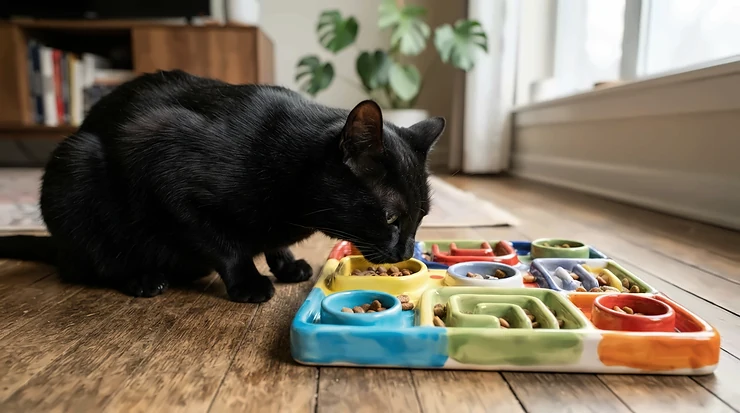
A slow feeder puzzle bowl for cats is a dish with ridges, mazes, chambers or hidden compartments that makes a cat work around obstacles to reach its food. Instead of hoovering a meal in under a minute, your cat eats in smaller mouthfuls. That can ease regurgitation, cut down on swallowed air and add a dash of mental stimulation to dinner.
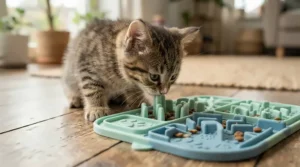
You know the scene. The tin opens, the bowl lands, and thirty seconds later it’s licked spotless while your cat stares at you as if you’ve been holding out. Ten minutes on, a small, soggy souvenir turns up on the rug. That is cat vomiting after eating in its most familiar form, and it’s the reason a slow feeder puzzle bowl for cats has become such a popular mealtime fix.
Welfare charity International Cat Care goes further than most. It recommends that all of a cat’s food be delivered through puzzle feeders, because cats are wired to hunt, paw and graft for their meals. You needn’t go that far on day one. This guide sorts 7 real products, from a humble anti-gulp cat bowl to a multi-level food tree. Each is judged on what its specs mean in practice, what owners report in reviews and which cat it suits. It draws on manufacturer specifications and aggregated retailer reviews, not hands-on testing.
Slow Feeder Puzzle Bowl for Cats: Quick Comparison
Short on time? This snapshot matches five of the picks to the kind of cat (and wallet) they suit best.
| Product | Type | Best For | Price Range |
|---|---|---|---|
| Trixie Slow Feeding Bowl Triangle | Ridged anti-gulp cat bowl | Everyday wet or dry meals on a budget | Under £8 |
| Catstages Kitty Slow Feeder | Compact maze bowl | Confirmed gulpers needing a firmer speed bump | Around £6–£12 |
| LickiMat Classic Kitty | Lick mat | Wet food and small, frequent portions | Around £5–£8 |
| PetSafe Slimcat Feeder Ball | Rolling puzzle ball | Dry-food cats who enjoy a chase | Around £8–£15 |
| Catit Senses 2.0 Food Tree | Multi-level puzzle | Cats who need a real challenge | Around £20–£30 |
Looking at the comparison above, the Trixie Slow Feeding Bowl Triangle is the lowest-risk way to find out whether your cat responds to slower feeding at all. The Catit Senses 2.0 Food Tree only earns its higher price if your cat enjoys pawing and problem-solving. Wet-food devotees should look hard at the LickiMat Classic Kitty, because mazes and rolling balls tend to frustrate pâté fans.
💬 Just one click — help others make better buying decisions too!😊
Top 7 Slow Feeder Puzzle Bowl for Cats: Expert Analysis
The picks run from simplest to most demanding, so you can start where your cat’s patience and your budget allow. Prices are ranges at the time of research (October 2026), so check the current price before buying.
1. Trixie Slow Feeding Bowl Triangle — flat, whisker-friendly budget speed bump
The standout here is restraint: it slows a cat without turning dinner into an escape room. At roughly 15 cm across and 3 cm tall, with a 350 ml capacity, it uses concentric rings and an inner circle to break up the food. In practice, the low walls leave room for a cat’s face (the manufacturer pitches the flat profile as whisker-friendly), while the rings force smaller mouthfuls. A rubber ring underneath and dishwasher-safe plastic round out the spec sheet.
Based on the spec comparison, this is the anti-gulp cat bowl for owners who want a gentle experiment before spending serious money. It copes with wet food, dry food and treats, so it slots into most routines. Short-nosed cats may find the outer channel fiddly, though.
Reviewers on UK retail pages report that some cats stop gulping altogether. Others struggle to reach food in the outer dip or shove the bowl around despite the rubber ring, and a few find the plastic lightweight.
Pros:
- ✅ Flat profile suits shallow-bowl fans
- ✅ Handles wet, dry and treats
- ✅ Dishwasher-safe and easy to clean
Cons:
- ❌ Lightweight; can skate across tiles
- ❌ Outer channel awkward for some cats
Price: under £8, which makes it excellent value as a low-risk trial.
2. Catstages Kitty Slow Feeder — compact maze for committed gulpers
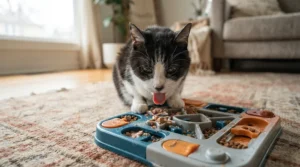
The standout is a tight, raised maze packed into a small dish. It holds 3/4 cup and measures about 5 inches (roughly 13 cm) across. It’s made of hard plastic with a non-slip base, and the maker states it’s free of BPA, PVC, phthalates and lead. It’s also dishwasher-safe. The capacity comfortably covers a typical single dry meal, but check it against your cat’s actual portion.
On paper, the dense pattern makes this the stricter of the two bowls so far. It’s the one to reach for when a gentle ridge hasn’t made a dent in your cat’s speed. Chunky wet food and kibble should suit the pattern better than smooth pâté, which can smear into the grooves.
Aggregated owner feedback is split in an instructive way. Several owners with regurgitating cats say it slowed meals nicely, and one called it better than licking mats. Others found it too difficult, and one food-obsessed young kitten simply gave up.
Pros:
- ✅ Tight maze genuinely interrupts gulping
- ✅ Non-slip base; BPA, PVC and phthalate-free
- ✅ Dishwasher-safe for easy cleaning
Cons:
- ❌ Can be too tricky for small kittens
- ❌ Hard plastic with a small footprint
Price: around £6–£12, strong value for a confirmed fast eater.
3. LickiMat Classic Kitty — the wet-food specialist
Rather than a maze, this one uses texture. The cat can only lick, so gulping becomes physically impossible. It’s a 10 cm square (4 by 4 inches) of food-grade TPR. UK retailers list it as freezer-safe, microwave-friendly and hand washable, and suitable for wet, dry, raw and liquid food. The small footprint forces a thin spread, which is a built-in portion control and a handy trick for slow, frequent mini-meals.
Here’s the honest catch: a mat this size can’t hold a full meal. Treat it as a part-meal tool, or pair it with a larger bowl for the remainder. Freezing a thin layer stretches the session further.
Cat-specific reviews for this exact Kitty size were thin at the time of research, so treat the evidence as limited. Reviews of the larger LickiMat Classic Buddy say it slowed eating, but wet food could lodge in the corners and get washed away.
Pros:
- ✅ Licking physically prevents gulping
- ✅ Freezer-safe for longer sessions
- ✅ Tiny, tidy footprint
Cons:
- ❌ Hand wash only
- ❌ Small surface limits portion size
Price: around £5–£8, good value as a wet-food side-kick rather than a sole bowl.
4. Bifeaw Slow Feeder Cat Bowl — flexible silicone with a non-slip grip
The standout is the material. Listings describe a puzzle-patterned silicone bowl that is non-slip and dishwasher-safe, and positioned for dry and wet food. The dog-sized Bifeaw listing quotes roughly 7.5 inches wide and 1.2 inches deep, and sizes vary between variants, so check the dimensions against your cat. Soft silicone tends to grip floors and stays quiet against them, with none of the clatter of hard plastic.
As an analytical take, this is a sensible all-rounder for households that want one bowl to handle both the tinned and the kibble days. The pattern also doubles as a light lick surface. That said, deep reviewer evidence was hard to verify for the cat version. Rather than guess, this entry rests on the specs and the general strengths of silicone, so it’s a considered punt rather than a proven winner.
Pros:
- ✅ Quiet, flexible, grippy material
- ✅ Dishwasher-safe
- ✅ Suits wet and dry food
Cons:
- ❌ Soft silicone isn’t chew-proof
- ❌ Sizing varies; check dimensions
Price: under £15, fair value if the size suits your cat.
5. PetSafe Slimcat Feeder Ball — adjustable difficulty for dry-food chasers
The standout is a ball whose openings you can resize. Fill it with dry food or treats and your cat has to bat it around to release a few pieces at a time. Twisting the openings wider for small kibble or tighter for a challenge means one toy can grow with your cat. The lid unscrews for filling and washing.
This turns mealtime into the stalk-chase-capture sequence that cats are built for. It’s also the gentlest on-ramp to puzzle feeding, which is why it often starts cats off before moving to something harder. The trade-off is that it only handles dry food, and a rolling ball needs open floor.
UK reviewers praise the adjustable holes and the way it slows greedy cats. One reported the holes were too big for tiny kibble, and another noted the ball occasionally needs rescuing from under furniture.
Pros:
- ✅ Adjustable openings suit different kibble
- ✅ Adds activity as well as slower eating
- ✅ Simple, sturdy and easy to fill
Cons:
- ❌ Dry food and treats only
- ❌ Can roll out of reach
Price: around £8–£15, great value for dry-food cats who like to chase.
6. Nina Ottosson Buggin’ Out — a level 2 hunt-and-seek board
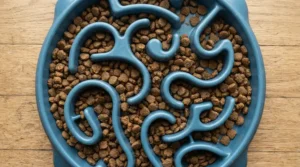
The standout is the hide-and-seek feel. It’s a puzzle board roughly 35 by 29 cm with sliding pieces and domes covering hidden compartments. The maker rates it difficulty level 2, states it holds up to 1/4 cup of food, and says it can be used with wet or dry food and treats. It’s BPA-, PVC- and phthalate-free, has no removable parts and is hand washed.
The 1/4-cup capacity matters more than it sounds. For many cats that’s a snack or a part-meal, not dinner, so the Nina Ottosson Buggin’ Out works best as a daily enrichment slot rather than a sole feeder. The sliding mechanics reward a cat that likes to fish with its paws.
Reviewers describe a mixed learning curve: in one household two cats cracked it in seconds while a third still hadn’t grasped it. That fits the maker’s advice to start easy by swivelling the pieces off their tracks.
Pros:
- ✅ Genuine paw-and-brain challenge
- ✅ Adjustable difficulty as cats learn
- ✅ Food-safe materials, no loose parts
Cons:
- ❌ Small capacity limits full meals
- ❌ Hand wash only
Price: around £15–£25, worthwhile for bright, bored cats.
7. Catit Senses 2.0 Food Tree — premium multi-level challenge
The standout is a multi-level tower roughly 37.5 cm across and 34 cm tall. Cats reach through side openings to push kibble through the levels. Rotating the middle disc offers three difficulty settings, a tray catches stray pellets, and the shallow design is billed as kind to whiskers. It comes apart for cleaning, and Catit recommends hand washing with mild soap.
What the spec sheet implies is room to grow. A cat that masters the widest setting can be stepped up without buying anything new, and the wide base is the maker’s answer to the older Food Maze’s tipping complaints. It’s a kibble-and-treat device, so wet-food cats need a different pick.
Review themes are encouraging but honest. One reviewer-sourced collection found cats preferred the Food Tree among the Senses toys they tried, and a retail reviewer said two cats used it at once. Another reported two of three cats figured it out while the third ignores all puzzle feeders.
Pros:
- ✅ Three adjustable difficulty settings
- ✅ Wide base and pellet-catching tray
- ✅ Two cats can paw at it together
Cons:
- ❌ Dry food and treats only
- ❌ Bulkier than a bowl; hand wash
Price: around £20–£30, premium but justified for multi-cat or high-energy homes.
Top 7 at a Glance
| Product | Format | Food Type | Key Spec | Price Range | Best For |
|---|---|---|---|---|---|
| Trixie Slow Feeding Bowl Triangle | Ridged bowl | Wet, dry, treats | 350 ml; about 15 cm wide | Under £8 | Budget trial |
| Catstages Kitty Slow Feeder | Maze bowl | Wet or dry | 3/4 cup; about 13 cm | £6–£12 | Fast gulpers |
| LickiMat Classic Kitty | Lick mat | Wet, raw, soft food | 10 x 10 cm | £5–£8 | Wet-food fans |
| Bifeaw Slow Feeder Cat Bowl | Silicone bowl | Dry and wet | Size varies by variant | Under £15 | Mixed-diet homes |
| PetSafe Slimcat Feeder Ball | Rolling ball | Dry and treats | Adjustable openings | £8–£15 | First puzzle feeder |
| Nina Ottosson Buggin’ Out | Puzzle board | Wet or dry (per maker) | 1/4 cup; level 2 | £15–£25 | Bored, clever cats |
| Catit Senses 2.0 Food Tree | Tiered puzzle | Dry and treats | 37.5 x 34 cm; 3 settings | £20–£30 | Multi-cat challenge |
Taken together, the table shows a clear split. The bowls and mat (the first four) slow how a cat eats, while the ball, board and tree change what eating involves. If your main worry is cat vomiting after eating, start in the bowl half. Move to the puzzle half once your cat is calm and curious.
Your First 30 Days: Introducing a Slow Feeder Puzzle Bowl for Cats
International Cat Care advises introducing puzzle feeders gradually to avoid frustration, and that is the whole game. Here’s a practical rhythm.
Week 1 — meet and greet. Put the new feeder beside the old bowl and split the meal between them. Set puzzles to their easiest level: widest holes on the PetSafe Slimcat Feeder Ball, or pieces swivelled off the tracks on the Nina Ottosson Buggin’ Out.
Week 2 — promote it. Once your cat eats confidently from it, serve the main meal there. Show hesitant cats how it works by dropping a few pieces out yourself.
Week 3 — nudge the difficulty. Narrow the openings, turn the Catit Senses 2.0 Food Tree disc a notch or move to a denser maze such as the Catstages Kitty Slow Feeder.
Week 4 — rotate. Change locations and formats so it stays interesting.
Wash wet-food feeders after every meal. Wash dry-food ones at least every few days, following the care instructions (the Trixie Slow Feeding Bowl Triangle is dishwasher-safe, while the LickiMat Classic Kitty is hand wash).
The classic first-month mistakes are overfilling, ditching the old bowl too soon and giving up after two grumpy days. If your cat actually skips meals, step back to the easier setup. If appetite stays off, phone your vet.
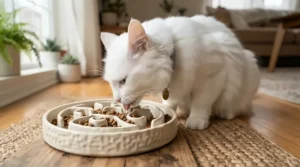
Real-World Scenarios: Matching a Slow Feeder Puzzle Bowl for Cats to Your Cat
Specs only matter in a real home, so here are three profiles with budget, setting and frequency of use.
The flat-dwelling greedy tabby (dry food, twice daily, budget around £10). Lack of floor space argues against rolling balls. Start with the Trixie Slow Feeding Bowl Triangle. If that doesn’t slow things enough, step up to the Catstages Kitty Slow Feeder for morning and evening meals.
The senior cat on wet food (three small meals a day, budget around £15). Reviewers and researchers note that puzzle feeders can work for cats of all ages, including seniors and cats with disabilities, provided the challenge is gentle. A LickiMat Classic Kitty for part-meals plus a shallow bowl keeps effort low and texture friendly.
The two-cat household with one speed-eater (mixed diet, budget around £30). Keep separate feeding stations, give the fast eater the Catstages Kitty Slow Feeder, and add a Catit Senses 2.0 Food Tree as a daily bonus challenge. Bonus play beats a bowl-side standoff every time.
Problem → Solution: Fixing Common Slow Feeder Headaches
Problem: your cat gives up. Solution: drop to an easier setting, scatter a few treats where they are visible, and put the old bowl back alongside until confidence returns.
Problem: the bowl slides across the floor. Solution: choose a rubber-ring or suction-style base, as on the Trixie Slow Feeding Bowl Triangle or the Bifeaw Slow Feeder Cat Bowl. A damp cloth or silicone mat underneath helps on tiles.
Problem: wet food clogs the grooves. Solution: spread a thin layer, avoid deep mazes and consider a flatter surface like the LickiMat Classic Kitty.
Problem: the ball vanishes under the sofa. Solution: use the PetSafe Slimcat Feeder Ball on open, hard floor and keep a retrieval tool handy.
Problem: the second cat steals the leftovers. Solution: separate feeding stations are the foundation, and International Cat Care’s multi-cat household advice explains how to arrange resources to reduce tension.
✨ Ready to Slow Dinner Down?
🔍 Click any highlighted product name above to check current pricing and availability on amazon.co.uk. A well-matched slow feeder puzzle bowl for cats could turn gulped dinners into calmer, longer, more enriching meals your cat will genuinely look forward to!
How to Choose a Slow Feeder Puzzle Bowl for Cats
The best slow feeder puzzle bowl for cats matches your cat’s food, face shape and patience. Work through these seven checks in order.
- Match the food type. Wet food suits shallow, open patterns and lick mats, while dry food works in mazes, balls and towers.
- Check the face fit. Shallow, wide channels suit flat-faced or whisker-sensitive cats better than deep, narrow ones.
- Choose the right difficulty. Start easier than you think. A puzzle bowl for fast eaters should slow, not defeat, your cat.
- Prioritise safe materials. Look for food-safe, BPA-free construction and follow the washing instructions.
- Test the stability. Rubber rings and suction bases save you chasing the bowl round the kitchen.
- Compare capacity with the portion. A 1/4-cup puzzle is a snack feeder, not a full meal.
- Think about the household. In multi-cat homes, buy one feeder per cat and keep them apart.
Cat Vomiting After Eating: When a Slower Meal Helps and When to Call the Vet
Cat vomiting after eating has many causes, and eating too fast is only one of them. A cat that gulps swallows air along with food, and the meal can reappear soon afterwards. A slower pace may reduce that, but slow feeders are not a cure-all and won’t fix every cause.
Know your red flags. PDSA’s guidance on vomiting in cats says it isn’t always necessary to see a vet the first time a cat is sick. It does advise monitoring closely and calling your vet if it happens more than once or your cat seems unwell. It also says to seek advice straight away if vomiting lasts more than 24 hours, your cat can’t keep food or water down, or the cat is very young or old.
Think of a slow feeding bowl as a sensible first step for an otherwise well cat. It is not a substitute for a vet when the pattern is repeated, forceful or paired with lethargy or weight loss. Filming an episode on your phone can help your vet tell vomiting from regurgitation.
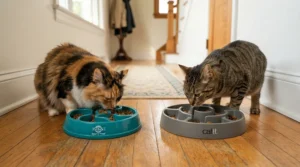
Slow Feeding Bowl vs Standard Bowl vs Puzzle Feeder
The labels get muddy. “Slow feeding bowl” and “anti-gulp cat bowl” usually describe the same thing: a dish with obstacles. “Puzzle feeder” is the broader family, covering balls, boards and towers that ask for a bit of work.
| Option | Eating Pace | Mental Stimulation | Cleaning | Best For |
|---|---|---|---|---|
| Standard bowl | Fastest | Minimal | Easiest | Calm, steady eaters |
| Slow feeding bowl | Moderately slower | Low | Easy | Trixie Slow Feeding Bowl Triangle users |
| Lick mat | Slower, steady | Low to moderate | Moderate (hand wash) | LickiMat Classic Kitty wet-food fans |
| Rolling puzzle ball | Slowest per piece | High | Moderate | PetSafe Slimcat Feeder Ball chasers |
| Stationary puzzle | Slow and varied | High | Moderate to fiddly | Catit Senses 2.0 Food Tree or Nina Ottosson Buggin’ Out thinkers |
The takeaway: if your cat’s only issue is speed, an anti-gulp cat bowl does the job with least fuss. If your cat is also bored or carrying a few extra grams, a puzzle adds enrichment on top. The extra effort in cleaning is the price of that extra stimulation.
Where an Anti-Gulp Cat Bowl Fits
An anti-gulp cat bowl is the entry point, not the finish line. It suits owners who want a measurable change without changing the cat’s routine. Pair it with a puzzle toy later if the cat wants more of a challenge.
Mealtime Pacing: How to Build a Routine That Sticks
Mealtime pacing is about more than the bowl. Cats are natural small-meal eaters, and veterinary feeding guidance commonly suggests dividing the daily allowance into several smaller meals rather than one or two big ones. Combine that with a slow feeding bowl and you stack two gentle brakes on speed.
A workable pattern is: main meals in a bowl like the Catstages Kitty Slow Feeder, plus a daily bonus portion from a PetSafe Slimcat Feeder Ball or Nina Ottosson Buggin’ Out. Keep the total daily food the same, deduct puzzle portions from the main meals and weigh the food, so enrichment doesn’t quietly become overfeeding.
Consistency helps. Serve meals at similar times, in the same quiet corner and away from the litter tray. Then watch the clock rather than the bowl, and look for a noticeably longer meal without signs of frustration such as pacing, yowling or walking away. If those appear, ease the difficulty rather than persisting.
Digestive Health: What Slower Eating Can Realistically Do
Better digestive health is the promise on every pack, so it’s worth being precise. Eating more slowly may reduce swallowed air and ease the post-meal regurgitation some fast eaters suffer. Puzzle feeding also encourages activity and can support weight management, an indirect benefit for digestive comfort.
The evidence base is still modest. A widely cited review of food puzzles for cats in the Journal of Feline Medicine and Surgery describes the effect of food puzzles on cats as a relatively new area of study. It relies on existing evidence plus case studies from its authors’ practices showing health and behaviour benefits. That is encouraging but not a guarantee.
You may also see dramatic percentages for “reduced vomiting” quoted on retail blogs. These couldn’t be traced to verifiable peer-reviewed data, so they’re deliberately left out here. The realistic expectation is a helpful nudge to digestive health, not a cure. Persistent signs belong with your vet.
Long-Term Cost & Value of a Slow Feeder Puzzle Bowl for Cats
A slow feeder puzzle bowl for cats is a small purchase, so think in cost-per-meal. A bowl in the mid-£5 to £8 range used twice daily for a year covers about 730 meals, which works out at roughly a penny a meal. Even a premium puzzle in the £20–£30 range, used daily over two years, lands at a couple of pence per use.
| Product | Upfront Band | Upkeep | Best For |
|---|---|---|---|
| Trixie Slow Feeding Bowl Triangle | Under £8 | Dishwasher | Low-cost trial |
| Catstages Kitty Slow Feeder | £6–£12 | Dishwasher | Fast eaters |
| LickiMat Classic Kitty | £5–£8 | Hand wash | Wet food |
| Bifeaw Slow Feeder Cat Bowl | Under £15 | Dishwasher | Mixed diets |
| PetSafe Slimcat Feeder Ball | £8–£15 | Wash lid and ball | Active dry-food cats |
| Nina Ottosson Buggin’ Out | £15–£25 | Hand wash | Enrichment |
| Catit Senses 2.0 Food Tree | £20–£30 | Hand wash; disassembles | Multi-level challenge |
The numbers show that upfront price is a poor guide to value. A cheap bowl your cat refuses is dearer than a pricier one used daily. Factor in the washing effort, too: dishwasher-safe designs win for busy households, while hand-wash designs trade convenience for enrichment. Watch plastic bowls for scratches that can trap grime, and keep an eye on your cat’s chin. If irritation appears, ask your vet about switching material.
Frequently Asked Questions
❓ Is a slow feeder puzzle bowl for cats worth the money?
❓ Which puzzle bowl for fast eaters suits wet food best?
❓ Is silicone or plastic better for a slow feeding bowl?
❓ How many feeders do I need for two cats?
❓ Can kittens and senior cats use a slow feeder puzzle bowl for cats?
Conclusion
Choosing a slow feeder puzzle bowl for cats comes down to matching the tool to the eater. For most gulpers, start simple: the Trixie Slow Feeding Bowl Triangle is a low-cost, whisker-friendly test, and the Catstages Kitty Slow Feeder is the firmer option if a gentle bowl doesn’t cut it. Wet-food devotees should add the LickiMat Classic Kitty, and the Bifeaw Slow Feeder Cat Bowl is a flexible silicone choice for mixed diets. Cats who like to chase or think will get more from the PetSafe Slimcat Feeder Ball, the Nina Ottosson Buggin’ Out or the Catit Senses 2.0 Food Tree.
Remember the bigger picture. Slower meals can support digestive health and make mealtime pacing calmer, but they won’t solve every cause of cat vomiting after eating. If sickness is frequent, forceful or paired with lethargy or weight loss, your vet should be the next call. Introduce any new feeder gradually, keep portions measured and let your cat set the pace of progress.
Recommended for You
- Puzzle Feeder For Overweight Cats: 7 Best UK Picks (2026)
- Ball Track Toy Vs Food Puzzle Toy: 7 Best Picks For UK Cats (2026)
- Interactive Puzzle Toy Vs Treat Dispensing Toy: 7 Best Picks (2026)
Disclaimer: This article contains affiliate links. As an Amazon Associate, I earn from qualifying purchases. If you purchase products through these links, we may earn a small commission at no additional cost to you.
✨ Found this helpful? Share it with your friends! 💬🤗
