
In This Article
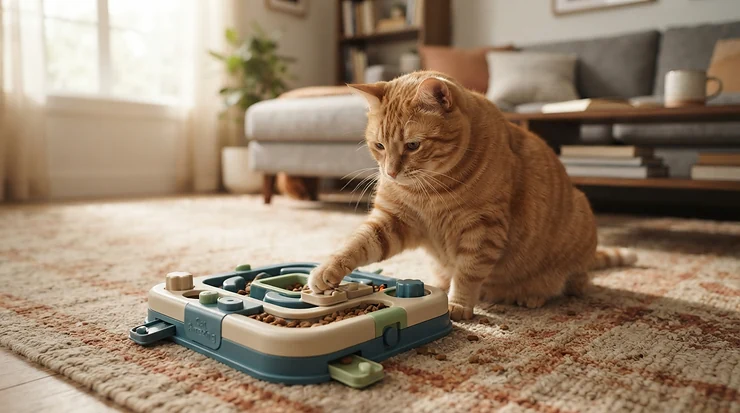
A puzzle feeder for overweight cats is a food-dispensing toy that makes your cat paw, roll, slide or fish for small portions of their daily ration. It slows down gulping, adds gentle activity and swaps the effortless bowl for something closer to hunting. It supports weight loss only when paired with a measured, vet-approved calorie plan.
Here’s the uncomfortable bit. A bowl delivers a full meal in under two minutes with zero effort, and cats, being supremely rational creatures, adore the arrangement. PDSA estimates that around 34% of UK cats are overweight or obese. Its vets and nurses name the same culprits again and again: owners not noticing the extra padding, generous treats and portion sizes that creep upwards. Feline obesity rarely arrives with a bang. It builds, biscuit by biscuit.
That’s where a puzzle feeder for overweight cats earns its keep. Done properly, it turns one rushed meal into several small “hunts”, which is much closer to how cats evolved to eat. Think of it as a weight management cat toy and a slow feeder in one. It’s not a magic wand, though.
This guide compares seven real, UK-available options, from a simple rolling ball to a bowl-free hunting system. One note on method: none of these products was personally tested for this article. The analysis rests on manufacturer specifications, retailer listings and the genuine, aggregated themes in published owner reviews. Where review evidence is thin, I say so rather than pretend otherwise. Speak to your vet before changing any diet.
Puzzle Feeder for Overweight Cats: Quick Comparison
Short on time? This table sorts the seven picks by style, difficulty and who they suit. Prices are ranges only, based on UK listings at the time of research, so check current price before buying.
| Product | Style | Difficulty | Holds | Price range | Best For |
|---|---|---|---|---|---|
| PetSafe Slimcat Feeder Ball | Rolling ball | Easy to medium (adjustable opening) | About 150 ml dry food | Under £15 | Sedentary cats that need to chase |
| Trixie Cat Activity Fun Board | Five-task board | Mixed | Treats and small portions | £15–£25 | Greedy cats that get bored easily |
| Catit Senses 2.0 Food Tree | Tower maze | Three settings | A measured kibble meal | £15–£25 | First-timers and less mobile cats |
| Nina Ottosson Buggin’ Out | Sliding board | Level 2 | Up to 1/4 cup | £15–£25 | Cats ready for a step up |
| Nina Ottosson Kitty Lickin’ Layers | Spinning layers | Level 2 | 1/2 cup dry or 1 cup wet | £15–£25 | Cats on a wet-food diet |
| Nina Ottosson Rainy Day | Pegs, wheel, raindrops | Level 3 | Up to 1/4 cup | £20–£30 | Clever, experienced puzzlers |
| Doc & Phoebe’s Indoor Hunting Feeder | Hide-and-find mice | Medium | Five small feeders | £25–£40 | Multi-meal grazers |
Looking at the comparison above, the PetSafe Slimcat Feeder Ball is the cheapest way to find out whether your cat takes to puzzle feeding at all. The Trixie Cat Activity Fun Board offers the most variety for a similar outlay. If you’re feeding a vet-prescribed wet diet, the Nina Ottosson Kitty Lickin’ Layers is the only option here with a genuine wet-food capacity. Budget buyers should note that the Doc & Phoebe’s Indoor Hunting Feeder costs more because you’re buying a multi-piece system, not a single toy.
💬 Just one click — help others make better buying decisions too!😊
Top 7 Puzzle Feeder for Overweight Cats: Expert Analysis
Each pick gets the same treatment. You’ll find what the specs mean in practice, who it suits, what real owners report and an honest value verdict. They run roughly from simplest to most demanding, which is also the order in which many cats can graduate through them.
1. PetSafe Slimcat Feeder Ball — the chase-and-bat budget starter
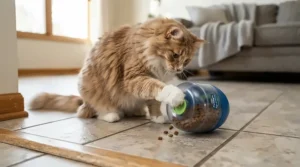
Rolling is the whole gimmick. Your cat has to chase, bat and nudge the ball before kibble tumbles out, which makes this the most active design on the list.
The ball holds roughly 150 ml of dry food, about two-thirds of a cup, and has an adjustable opening so you control how generously kibble escapes. That modest capacity suits a weight-loss ration nicely, though bigger portions need a second fill. Manufacturer-sourced listings describe it as BPA-free and top-rack dishwasher safe, which matters because stale kibble dust is nobody’s friend.
Based on the spec comparison, this is the best activity feeder for overweight cats whose problem is a sofa-shaped lifestyle rather than pure gulping. It won’t torch calories, since a few minutes of batting is a nudge rather than a gym session. But it converts one dull bowl-dump into dozens of tiny “catches”. The catch is that a cat with sore joints or low motivation may decide it’s far too much like work.
Reviewers on Zooplus UK (a pool of 30-odd reviews at the time of research) consistently describe it as a good way to slow fast eaters and keep indoor cats busy. Recurring gripes are that some cats need reminding what it’s for, the ball gets wedged under furniture and crumbs end up on the floor. One owner reported that their heavier cat simply wasn’t interested.
Pros:
- ✅ Encourages chasing and batting, not just pawing
- ✅ Adjustable opening controls dispensing speed
- ✅ Simple to fill and clean
Cons:
- ❌ Dry food only; no wet-food option
- ❌ Ball can wedge under furniture
Price range: typically under £15 (check current price). Verdict: a low-risk first experiment before you spend more.
2. Trixie Cat Activity Fun Board — five challenges on a single board
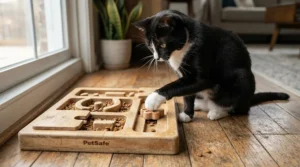
Five separate tasks share one 30 × 40 cm board, so a cat that masters the easy bits still has something left to puzzle over.
The retailer description credits the design to Helena Dbalý and lists the board as machine washable, with tasks ranging from shallow cups to a tunnel maze. Reviewers mention removable cups that make cleaning easy. The low profile also matters: the retailer positions it as suitable for older cats with limited mobility, and several reviewers describe using it for 13- and 14-year-olds.
On paper, variety is the selling point. A greedy cat can’t memorise one trick and coast. It’s also the board’s weakness in multi-cat homes. One reviewer with four cats found their most skilled cat cleared the board in seconds and ate nearly all the treats. Based on how owners describe using it, it suits treats and small kibble portions better than full meals, so it works best as one stop on a multi-feeder meal plan.
With more than 100 reviews on Zooplus UK at the time of research, it has the largest review pool here. Reviewers repeatedly report that it slows treat-gobbling, entertains older cats and offers a good mix of easy and hard tasks. Complaints include a tunnel some cats can’t crack, no spare cups to buy separately and at least one owner who gave up after repeated attempts.
Pros:
- ✅ Five different tasks keep it fresh
- ✅ Low profile suits less mobile cats
- ✅ Removable cups ease cleaning
Cons:
- ❌ Some tasks defeat some cats
- ❌ A skilled cat can empty it fast
Price range: around £15–£25. Verdict: strong value if you have one cat and a short attention span to beat.
3. Catit Senses 2.0 Food Tree — adjustable tower that catches stray kibble
Food travels down a labyrinth of levels, so your cat has to push kibble through side openings with a paw.
The tower measures 37.5 cm across and 34 cm tall. Turning the middle disc shrinks the openings, giving three difficulty settings, and stray pellets drop into a bottom tray instead of scattering. Catit says the revised design has a wider base and smaller top openings than the old Food Maze, both aimed at stability. The tray also means your cat eats from a shallow dish at the end, which doubles as a slow-feed bowl.
For feline obesity programmes, this is the gentlest on-ramp from bowl to puzzle. It’s easy to understand, and a dry-food gulper sees results quickly. The trade-off is that gravity does much of the work, so a determined cat will still finish faster than on a sliding-board puzzle. Graduate to something harder once success is routine.
The UK review pool I could find was tiny, just two reviews on Zooplus UK. One owner reported two cats using it at once, while another suspected the cheaper original looked identical. A larger set of German-language reviews on Zooplus Germany describes it as a good start for inexperienced or less mobile cats, while also noting that lively young cats can tip it and some simply ignore it.
Pros:
- ✅ Three adjustable difficulty settings
- ✅ Tray catches stray kibble
- ✅ Wider base than the old Food Maze
Cons:
- ❌ Hand-wash only
- ❌ Energetic cats may topple it
Price range: around £15–£25. Verdict: a sensible, forgiving first puzzle for dry-fed cats.
4. Nina Ottosson Buggin’ Out — level 2 sliding puzzle with no loose parts
A Level 2 rating on Nina Ottosson’s scale means “moderate challenge”, and this one delivers it with swivelling leaves and sliding pegs.
The board measures roughly 33 × 24 cm and holds up to 1/4 cup of food. The US manufacturer’s listing counts 16 compartments in total, a mix of cups under swivelling leaves and holes on sliding pegs. Nothing detaches, so there are no small parts to lose or swallow. It’s also free from BPA, PVC and phthalates. Difficulty is adjustable: beginners place treats in the cups and swivel leaves off their tracks, while experts hide food under the pegs.
Because it only holds 1/4 cup, you may split a weight-loss ration across two or three sittings. That’s no bad thing, as it enforces smaller meals. Level 2 is a sensible step above a ball or tower. The cat has to think, but you won’t trigger the frustration that a Level 3 board can bring.
Verified review evidence on UK retailer sites was thin. Overseas retailer reviews are mixed in an instructive way. One household reported two cats solved it within seconds while a third hadn’t grasped it, and another owner said their cat still enjoyed it after two months. Cats clearly vary, so treat the first week as a trial.
Pros:
- ✅ Adjustable difficulty as your cat learns
- ✅ No removable parts to lose
- ✅ Works with dry or wet food and treats
Cons:
- ❌ Only 1/4 cup per fill
- ❌ Quick learners may master it fast
Price range: around £15–£25. Verdict: good value as the “second” feeder in a rotation.
5. Nina Ottosson Kitty Lickin’ Layers — three spinning layers, wet food friendly
Spin a layer and a hidden compartment appears, over 80 of them across three tiers.
This is the roomiest puzzle here. It holds up to 1/2 cup of dry food or 1 cup of wet, and the layers come apart by squeezing the middle post, so they can go on the top rack of the dishwasher at low heat. Start easy by filling only the top layer, then fill all three for a proper workout.
If your vet has put your cat on a wet weight-loss diet, this is the only pick on the list built to take it. That makes it a genuine meal replacement rather than a treat toy. The flip side is that 80-plus compartments are fiddly to fill, so allow a couple of extra minutes. Used as a slow feeder for fat cats, it spreads one ration across many tiny mouthfuls.
I couldn’t verify a sizeable independent UK review pool for this product, so judge it on specifications rather than owner testimonials. Listings repeat the manufacturer’s claims about slow feeding but offer little real-world feedback.
Pros:
- ✅ Holds up to 1 cup of wet food
- ✅ Over 80 compartments extend mealtime
- ✅ Dishwasher-safe layers
Cons:
- ❌ Fiddly to fill and clean thoroughly
- ❌ Little independent review evidence
Price range: around £15–£25. Verdict: the pragmatic choice for wet-fed cats.

6. Nina Ottosson Rainy Day — level 3 challenge for clever cats
Pegs to bat, a wheel to spin and raindrops to swivel: this is the brain-teaser of the bunch.
Listings describe 14 hidden compartments, a Level 3 rating and a 1/4-cup capacity, usable with wet or dry food. A UK retailer notes a non-slip base, and one overseas listing gives dimensions of about 39.5 × 23.5 cm. There are no removable parts, which keeps cleaning simple, though you’ll want to wipe it thoroughly after wet food.
Be wary of buying this first. A cat new to puzzles can give up on Level 3, and a cat that quits learns nothing. Its real value is later in a programme. A veterinary review of feline weight loss suggests a 3 kg loss can take 24–60 weeks, and that’s a long time to keep a clever cat engaged. A harder puzzle added around week six or eight prevents the mid-programme boredom plateau.
Review evidence was thin, with no sizeable independent UK pool I could verify. The recommendation therefore rests on the specifications and the logic of difficulty progression.
Pros:
- ✅ Highest difficulty here for clever cats
- ✅ Non-slip base (UK retailer listing)
- ✅ Handles wet or dry food
Cons:
- ❌ Can frustrate beginners
- ❌ Small 1/4 cup capacity
Price range: roughly £20–£30; prices vary by retailer. Verdict: a smart “graduation” purchase, not a starter.
7. Doc & Phoebe’s Indoor Hunting Feeder — turns one meal into five small hunts
Instead of a puzzle you stand over, you get five fabric-skinned mice to hide around the house.
The set includes five feeders, each with two dispensing holes sized for any kibble, plus five prey-textured skins, a trainer and a scoop. The scoop holds 1.6 tablespoons, which the maker says is one-fifth of an average 10 lb cat’s daily ration. That’s important for weight loss. Your cat’s reduced allowance is probably smaller than average, so weigh your vet-set ration and divide it by five rather than trusting the scoop.
Cat behaviourist Anita Kelsey’s review reports that International Cat Care gave the feeder a Cat Friendly Award in July 2017. She judged it a good fit for indoor cats and said it can aid weight loss. International Cat Care’s own guidance says cats should be fed several, if not all, daily portions from puzzle feeders, and this product is that principle in plastic form.
Retailer reviews are more mixed. Some owners report cats that aren’t hungry enough to search, and one found results patchy compared with an easier feeder. Expect a learning period using the trainer first.
Pros:
- ✅ Five small meals mirror natural grazing
- ✅ Award-recognised by International Cat Care
- ✅ Hide anywhere to boost activity
Cons:
- ❌ Five pieces to wash and rotate
- ❌ Some cats take weeks to learn
Price range: around £25–£40. Verdict: the best option for cats that thrive on hide-and-find.
How do the seven stack up on the practical details that decide whether you’ll still use them in month three?
| Product | Wet food? | Cleaning | Review evidence at time of research | Best For |
|---|---|---|---|---|
| PetSafe Slimcat Feeder Ball | No | Top-rack dishwasher (listing) | About 30 UK retailer reviews, mixed to positive | Chasers who need to move |
| Trixie Cat Activity Fun Board | Mainly treats | Removable cups | 100+ UK retailer reviews | Variety seekers |
| Catit Senses 2.0 Food Tree | Dry | Hand-wash | Two UK reviews; larger German pool | Beginners |
| Nina Ottosson Buggin’ Out | Yes (listing) | No removable parts | Thin | Cats ready to step up |
| Nina Ottosson Kitty Lickin’ Layers | Yes, up to 1 cup | Top-rack dishwasher | Thin | Wet-diet cats |
| Nina Ottosson Rainy Day | Yes | No removable parts | Thin | Experienced puzzlers |
| Doc & Phoebe’s Indoor Hunting Feeder | Dry kibble | Washable pieces | Expert review plus mixed retailer feedback | Multi-meal grazers |
The table shows a pattern: the cheapest options have the most evidence, while the more specialised ones rely on specifications. If evidence matters most to you, the Trixie Cat Activity Fun Board and PetSafe Slimcat Feeder Ball are the safest bets. If you’re feeding wet food, accept that you’re buying the Nina Ottosson Kitty Lickin’ Layers on its spec sheet and a short trial.
✨ Ready to Swap the Bowl?
🔍 Take your cat’s weight plan to the next level with these carefully selected feeders. Click any highlighted product name to check current pricing and availability. A little effort at mealtime can help create a healthier, happier routine your cat will love
How to Introduce a Puzzle Feeder for Overweight Cats: A 30-Day Guide
Most puzzle feeders fail in the first fortnight, usually because they were introduced badly rather than because the cat is “thick”. Here’s a month-long plan.
Week 1 — easy mode and a demonstration. Set the puzzle to its easiest setting: food in open cups, the Catit Senses 2.0 Food Tree disc at its widest, the PetSafe Slimcat Feeder Ball opening open. Show your cat how it works with a few visible pieces. Cats Protection’s behaviour team also recommends keeping feeding enrichment away from water bowls, since cats prefer to eat and drink in different places.
Week 2 — replace a meal. Weigh the day’s ration on kitchen scales and put one meal in the puzzle. This is the step people skip: if you serve the puzzle and the bowl, you’ve added calories rather than effort.
Week 3 — raise the difficulty one notch. Tighten an opening or move food under a peg. Success should still happen within a few minutes.
Week 4 — rotate and clean. Move feeders between rooms and wash them. Wet food calls for same-day washing, and dry feeders for a regular wash-down.
Common first-month mistakes are starting too hard, leaving the bowl out and forgetting to deduct treats from the daily allowance.
Real-World Scenarios: Matching a Puzzle Feeder for Overweight Cats to Your Home
Scenario 1: the flat-dwelling commuter. Your six-year-old neutered tabby is home alone nine hours a day, eats dry food and has crept up a body-condition point. Budget: around £30. Use the Catit Senses 2.0 Food Tree for breakfast and the PetSafe Slimcat Feeder Ball for the evening meal, moving the ball to a different room each day. Frequency: twice daily, ration weighed on kitchen scales.
Scenario 2: the two-cat household with one greedy eater. The slim cat grazes, the round one inhales. A board like the Trixie Cat Activity Fun Board can backfire here, because reviewers note a skilled cat can empty it in seconds. Hide the Doc & Phoebe’s Indoor Hunting Feeder mice at different heights and in different rooms for the greedy cat, and feed the other cat separately. Budget: £25–£40.
Scenario 3: the senior cat on a wet diet. Jumping and crouching are out, so use something low and wet-friendly. The Nina Ottosson Kitty Lickin’ Layers takes up to a cup of wet food and is operated by paw and nose rather than chasing. The Trixie Cat Activity Fun Board adds a low-profile option for treats. Budget: roughly £30–£50 for both. Keep sessions short and supervise.
Problem → Solution: Fixing Common Puzzle Feeder Headaches
- My cat ignores it. Run the puzzle before a meal, when hunger is on your side, and demonstrate with a few visible pieces. Both the Catit Senses 2.0 Food Tree and Nina Ottosson Buggin’ Out start on easy settings.
- My cat finishes in two minutes. Raise difficulty one notch at a time: turn the disc on the Catit Senses 2.0 Food Tree, tighten the opening on the PetSafe Slimcat Feeder Ball or place food in the peg holes of the Nina Ottosson Buggin’ Out.
- My cat gets frustrated and walks off. Drop back a level for a few days. Success matters more than challenge, and the Nina Ottosson Rainy Day is best saved for later.
- My cat still begs afterwards. Split the ration into more, smaller sessions, as four or five mini-meals beat two, and check that treats are counted in the daily allowance.
- One cat hogs the puzzle. Feed in separate rooms, and use the Doc & Phoebe’s Indoor Hunting Feeder to give each cat its own hunt.
How to Choose a Puzzle Feeder for Overweight Cats
Choosing the right puzzle feeder for overweight cats comes down to six checks.
- Confirm the weight problem with your vet. PDSA’s 9-point body condition score treats 4–5 as ideal and 6–9 as overweight. A vet can confirm where your cat sits and rule out medical causes.
- Match capacity to the ration. Weigh the daily allowance, then check whether a feeder’s capacity suits one meal. The Nina Ottosson Rainy Day holds just 1/4 cup, while the Nina Ottosson Kitty Lickin’ Layers holds much more.
- Pick a difficulty your cat can crack. Adjustable designs like the Catit Senses 2.0 Food Tree let you start easy and raise the challenge as skills grow.
- Match the format to the food. Dry-only feeders such as the PetSafe Slimcat Feeder Ball won’t suit a wet diet.
- Consider mobility and household. Senior cats need low, simple designs, while multi-cat homes need separate stations.
- Plan for cleaning. Hand-wash-only designs get skipped, and dirty puzzles put cats off.
Feline Obesity: What the Extra Weight Really Costs Your Cat
Feline obesity is more than a cosmetic issue. PDSA’s guidance warns that overweight cats are more likely to develop health problems, and its vets name arthritis and diabetes. Being overweight can also aggravate existing conditions such as heart disease, and operations carry more risk.
Spotting the problem early is half the battle, because many owners don’t recognise it, according to PDSA. Look at your cat from the side and from above, then feel along the ribs and back. A healthy cat has a visible waist and ribs you can feel without pressing hard. Rounded flanks and a swinging belly are warning signs.
Why does this matter for puzzle feeders? Because feline obesity is a daily-routine problem, and the feeding routine is the part you control. An indoor cat that eats from a bowl twice a day has almost no way to burn off the energy it takes in. A puzzle feeder for overweight cats can’t fix feline obesity alone, but it nudges the routine in the right direction.
Weight Loss for Cats: Safe Speed, Calories and the Puzzle Feeder’s Real Role
If there’s one sentence every guide should print in bold, it’s this: a puzzle feeder doesn’t remove calories. Weight loss for cats still comes from a calorie deficit set by your vet. The feeder simply makes that smaller ration last longer and feel more like a meal.
Speed matters as much as size. A veterinary review of feline weight-loss management recommends losing 0.5%–2% of body weight per week. The aim is to preserve lean muscle and reduce the risk of hepatic lipidosis, a serious liver condition linked to too-rapid loss. For a cat needing to shed 3 kg, it estimates 24–60 weeks. Put practically, a 6 kg cat should drop roughly 30–120 g a week. Anything faster isn’t a triumph, it’s a reason to call your vet.
Two things follow. A months-long programme needs a feeder that won’t bore your cat by week six, which is why adjustable difficulty earns points. And you need measurement: weigh your cat on the same scales every couple of weeks and let your vet adjust the ration.
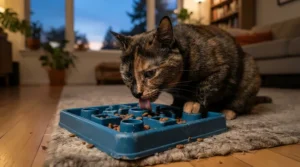
Vet-Recommended Feeding: What UK Charities and Vets Actually Advise
“Vet-recommended feeding” gets stamped on plenty of packaging, so here’s the substance. PDSA’s guidance is to feed a complete pet food suitable for your cat’s age and weight, with only occasional healthy treats. A small piece of white fish or meat is the charity’s example for cats. It also notes that many vet practices now run weight clinics, which are worth asking about.
On puzzles specifically, International Cat Care advises feeding several, if not all, daily portions from puzzle feeders. It adds that all cats can use them, including seniors, kittens and cats with disabilities. The UK Pet Food industry association adds the practical rule: weigh out the daily portion and take food-puzzle treats from it, so enrichment doesn’t become extra calories.
Pull those threads together and vet-recommended feeding looks like this: a measured ration, a suitable complete diet, treats counted rather than tossed and food delivered in small, effortful instalments. Your own vet will tailor the numbers. The feeder is merely the delivery mechanism.
Slow Feeding for Fat Cats: Does Eating Slower Actually Help?
Honest answer: partly. Slow feeding for fat cats changes how a meal feels, not what it contains. A cat that eats 40 g in ten seconds and one that eats 40 g in ten minutes has taken in identical calories.
So where does slower eating earn its place? First, it breaks the “inhale and beg” cycle. Reviewers on Zooplus UK repeatedly say feeders slowed their cats’ eating, and one Trixie reviewer credited the board with supporting a weight loss programme. Second, it makes a small ration feel like more of an event, which is useful when the portion itself has shrunk. Neither point is proof of better weight loss, but both are reasonable behavioural benefits.
For slow feeding for fat cats, match the feeder to the problem. The Catit Senses 2.0 Food Tree is the gentlest brake for dry food. The PetSafe Slimcat Feeder Ball adds movement. The Nina Ottosson Kitty Lickin’ Layers handles wet food. A simple practical test is to time a meal. If it still takes seconds rather than minutes, increase the difficulty.
Activity Feeder for Overweight Cats: Ball, Board or Hunting Mouse?
Movement is the second lever. An activity feeder for overweight cats won’t replace play, but it adds many small bouts of effort across the day. Peer-reviewed work by Dantas and colleagues in the Journal of Feline Medicine and Surgery argues that indoor housing carries physical and behavioural risks. It presents food puzzles as one practical way to use cats’ instinct to work for food.
The three styles in this guide deliver activity differently. A ball like the PetSafe Slimcat Feeder Ball involves the most chasing. Hunting mice such as the Doc & Phoebe’s Indoor Hunting Feeder add carrying, batting and pouncing, and they move around the house. Boards like the Trixie Cat Activity Fun Board and Nina Ottosson Buggin’ Out are mostly stationary, so the effort is mental and paw-based rather than athletic.
For a cat with limited mobility, boards win. For a young, healthy cat that needs to burn energy, choose a ball or hunting system. Pair either with a short wand-toy session, since an activity feeder supports play but doesn’t replace it.
Weight Management Cat Toy: Features That Actually Matter (And Those That Don’t)
Marketing language around any weight management cat toy is generous. Here’s what to weigh.
Features that matter:
- Adjustable difficulty. Weight loss is a months-long project, so a toy that can get harder matters more than one that’s merely clever.
- Capacity that fits your ration. A feeder that holds a third of a meal means refills and mess.
- Cleanability. Dishwasher-safe layers beat hand-wash-only towers.
- Stability. A tippy tower teaches your cat to topple it.
Features that don’t: bright colours, bug-and-raindrop theming and compartment counts. Eighty compartments sound impressive, but what counts is whether your cat can empty them in a sensible time.
Value is easy to quantify. A £20 feeder used twice a day for a year works out at under 3p per meal, which is a bargain next to the veterinary costs PDSA links to obesity. The PetSafe Slimcat Feeder Ball, at under £15, is the cheapest to trial. If your cat takes to it, graduating to the Nina Ottosson Buggin’ Out or Nina Ottosson Rainy Day later is the sensible way to spend.
Puzzle Feeder vs Bowl: Benefits vs Traditional Alternatives
How does a puzzle feeder compare with the alternatives you might already be using? DIY options such as cardboard tubes in a box work for testing interest, and a mug on its side works for wet food, according to UK Pet Food’s feeding-enrichment advice.
| Method | Slows eating | Adds activity | Portion control | Cost | Best For |
|---|---|---|---|---|---|
| Standard bowl | No | None | Good if weighed | Minimal | Lean, calm eaters |
| Free-feeding | No | None | Poor | Minimal | Rarely suits overweight cats |
| DIY food puzzle | Yes | Low to medium | Good if weighed | Pennies | Testing your cat’s interest |
| Puzzle feeder (e.g. Trixie Cat Activity Fun Board) | Yes | Medium | Good | Low to mid | Most overweight indoor cats |
| Hunting feeder (e.g. Doc & Phoebe’s Indoor Hunting Feeder) | Yes | Medium to high | Good if pre-measured | Mid | Cats who love hide-and-find |
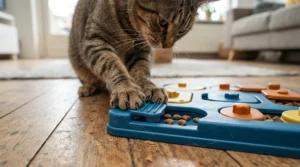
The table makes the case plainly. Bowls and free-feeding give you control over nothing but the food bag. DIY puzzles are a smart, cheap experiment, and if your cat loves a cardboard tube it’s a good sign a shop-bought feeder will pay off. A proper puzzle feeder for overweight cats is the best all-round choice because it combines slower eating, activity and portion control.
FAQ
❓ How much food should I put in a puzzle feeder for overweight cats each day?
❓ Can a puzzle feeder for overweight cats work with wet food?
❓ Is a puzzle feeder safe for an older, arthritic overweight cat?
❓ How often should I wash a weight management cat toy?
❓ Is it worth buying a puzzle feeder if my cat ignores it?
Conclusion
Choosing a puzzle feeder for overweight cats doesn’t need a PhD in feline psychology. It needs a measured ration, a vet-approved plan and a feeder your cat can actually crack. Start with the cheapest sensible option and let your cat’s reaction guide the next purchase.
Based on the evidence, the PetSafe Slimcat Feeder Ball is the lowest-risk trial for a sedentary cat. The Trixie Cat Activity Fun Board has the strongest review base and the most variety. The Catit Senses 2.0 Food Tree is the gentlest on-ramp, and the Nina Ottosson Kitty Lickin’ Layers is the pick for wet-fed cats. Step up to the Nina Ottosson Buggin’ Out or Nina Ottosson Rainy Day as your cat gets clever. If your cat loves hide-and-find, the Doc & Phoebe’s Indoor Hunting Feeder is a premium way to deliver five small meals.
Remember the fundamentals: weight loss for cats is slow, vet-guided and calorie-led, and puzzle feeders make that process more comfortable rather than replacing it. Weigh the food, count the treats, check progress and keep things fun.
✨ Your Cat’s Healthier Routine Starts at Mealtime!
🔍 Compare the picks above, click any highlighted product name to check current pricing and availability, and give your cat a mealtime worth working for. 🐾
Recommended for You
- Ball Track Toy Vs Food Puzzle Toy: 7 Best Picks For UK Cats (2026)
- Interactive Puzzle Toy Vs Treat Dispensing Toy: 7 Best Picks (2026)
- Food Puzzle Toy For Cats: 7 Brilliant Picks For UK Homes (2026)
Disclaimer: This article contains affiliate links. As an Amazon Associate, I earn from qualifying purchases. If you purchase products through these links, we may earn a small commission at no additional cost to you.
✨ Found this helpful? Share it with your friends! 💬🤗
