
In This Article
Picture a Tuesday afternoon. The radiator is warm, the window ledge has been inspected twice, and your indoor cat is staring into the middle distance with the intensity of a retired detective. Boredom in a cat is rarely quiet. It shows up as 5am yowling, shredded wallpaper and a sudden, personal interest in your ankles.
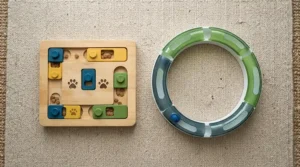
So you go shopping and hit a fork in the road: ball track toy vs food puzzle toy. One promises a chase. The other promises a hunt for dinner. Both promise a calmer, busier, happier cat, and only one is likely to be right for yours.
The research suggests you aren’t choosing between a good option and a bad one. A randomised controlled trial from the University of Copenhagen split 92 cats with little or no outdoor access into a food puzzle group and a non-food object play group. It concluded that consistent enrichment around feeding may help curb attention-seeking, and that the two formats can be used interchangeably. Interchangeable isn’t identical, though. Ball tracks feed the swat, food puzzles feed the forage, and your cat will lean one way.
This guide compares seven real products available to UK buyers. It draws on published specifications, retailer review pages and veterinary guidance. We haven’t test-driven any of them, and we won’t pretend otherwise. Instead you get honest analysis: what each spec means in practice, what reviewers keep repeating, and which format suits which cat, home and budget.
What is the difference between a ball track toy vs food puzzle toy?
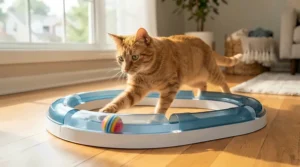
A ball track toy is a closed or covered plastic circuit in which a ball rolls freely for your cat to bat, rewarding paw speed and reflexes. A food puzzle toy hides kibble or treats behind holes, discs or tubes, rewarding problem-solving and patience. The first stimulates the chase; the second stimulates the forage.
Quick Comparison: Ball Track Toy vs Food Puzzle Toy at a Glance
Here’s the short version before we dig into individual products. Prices are ranges at the time of research (October 2026) and may vary.
| Feature | Ball track toy | Food puzzle toy |
|---|---|---|
| Core instinct | Chase, swat, pounce | Forage, extract, problem-solve |
| Movement style | Fast paw bursts, light upper-body work | Slower, deliberate paw and head work |
| Mental load | Moderate (tracking a moving target) | Moderate to high (working out access) |
| Needs food? | No | Yes (mostly dry kibble or treats) |
| Example picks | Catstages Tower of Tracks, Catit Senses 2.0 Play Circuit | Catit Senses 2.0 Food Tree, Trixie Cat Activity Fun Board |
| Typical UK cost | Roughly £10-£18 | Roughly £12-£28 |
| Best For | Kittens, keen swatters, owners who hate lost balls under the sofa | Fast eaters, clever cats, weight-conscious households |
Read across the rows and a pattern emerges. Ball tracks cover the “chase” half of the predatory sequence, and food puzzles cover the “eat” half. A cat that bolts dinner and then brings it back up needs the slow-down of something like the Catit Senses 2.0 Food Tree more than another bat-able gadget. A restless kitten with a taste for ankles will usually get more from the Catstages Tower of Tracks. If you can only buy one, buy for the problem you actually have, not the format you find prettier.
💬 Just one click — help others make better buying decisions too!😊
Top 7 Ball Track and Food Puzzle Toys: Expert Analysis
Seven products follow: three ball tracks and four food puzzles, spanning budget to mid-range. Specifications come from manufacturer and retailer listings and can differ by version, so check the listing before buying. Review comments are aggregated from public retailer pages, many of them non-UK, and we say so where the evidence is thin.
| Product | Format | Key spec | Price range | Best For |
|---|---|---|---|---|
| Catstages Tower of Tracks | Ball track | 3 tiers, up to 6 balls, non-slip base | £10-£15 | Catstages Tower of Tracks: kittens, solo play |
| Catit Senses 2.0 Play Circuit | Ball track | Modular, 100+ layouts | £10-£15 | Catit Senses 2.0 Play Circuit: layout tinkerers |
| Catit Senses Wave Circuit | Ball track | Raised sections for speed | £13-£18 | Catit Senses Wave Circuit: owners of a flat circuit |
| Catit Senses 2.0 Food Tree | Food puzzle | 37.5 x 34 cm, adjustable disc | £18-£28 | Catit Senses 2.0 Food Tree: gulpers |
| Catit Play Treat Puzzle | Food puzzle | 6 activities, ~40 x 40 cm | £17-£25 | Catit Play Treat Puzzle: first-time puzzle cats |
| Trixie Cat Activity Fun Board | Food puzzle | 30 x 40 cm, 5 modules | £15-£25 | Trixie Cat Activity Fun Board: clever, food-driven cats |
| Catit Senses 2.0 Digger | Food puzzle | Removable scoop cups | £12-£20 | Catit Senses 2.0 Digger: scoopers |
The Catstages Tower of Tracks and Catit Senses 2.0 Play Circuit share a price band but solve different problems: compact vertical play versus expandable floor layouts. The food puzzles cost a little more, but they double as slow feeders. Treat the Catit Senses Wave Circuit as a booster for an existing track, not a starter.
1. Catstages Tower of Tracks — best budget ball track for solo play
Three tiers give a cat three chances to find a favourite angle of attack. It’s sold elsewhere as the Petstages Tower of Tracks.
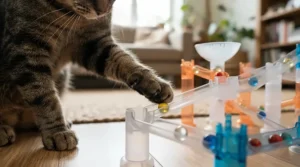
Listings describe three stacked tracks, a closed top, a non-slip base and no batteries. Newer versions ship with six balls (older ones had three), and retailer dimensions put it at roughly 25 cm across and 15 cm tall. The closed top matters most: the balls can’t escape under the sofa, and the rubber base stops your cat skidding the whole thing across laminate. The maker positions it for kittens from 12 weeks and for multi-cat homes.
On paper, this is the lowest-commitment way to find out whether your cat is a batter at all. Separate tiers mean two cats could in theory play at once, though that’s a manufacturer claim we can’t verify. It suits kittens, young adults and any cat whose idea of exercise is slapping things.
Retailer pages (largely US-based) carry thousands of reviews. Buyers repeatedly praise the simplicity, the compact size and the way cats keep returning to it over the long haul. A minority report their cat simply ignored it.
Pros:
- ✅ Enclosed balls can’t vanish under furniture
- ✅ No batteries, no fuss, easy to store
- ✅ Multiple tiers suit kittens and shared play
Cons:
- ❌ Fixed layout can go stale for clever cats
- ❌ Gives no food reward or problem-solving
Expect to pay around £10-£15 (check current price). That makes it the strongest entry-level value in this round-up.
2. Catit Senses 2.0 Play Circuit — best modular track for rearranging
Think of it as a model railway for cats, minus the tiny station staff.
This is a flat “speed track” with a peek-a-boo cover, so paws can reach in but the ball stays put. Listings say it’s 25 cm longer than the original Play Circuit, supports 100+ layouts and clicks together with other Senses 2.0 pieces. The plastic is described as scratch and chew-resistant, and the ball can be replaced. A flat track lets the ball build speed, and a longer run means longer chases. The maker’s own advice is to rebuild the layout every few days, which counters the novelty fade that kills most toys.
Honestly, this suits cats that tire of static toys and owners who don’t mind rearranging a track on the hallway floor. It’s less suited to cats who want a vertical, three-dimensional target.
Reviews of the earlier Catit Design Senses Play Circuit on zooplus (around 200) describe kittens batting the ball for hours. One owner said adding a second track and ball in a figure-of-eight made it better still. Another noted a younger cat playing alone happily.
Pros:
- ✅ Rearrangeable into 100+ layouts
- ✅ Replaceable ball and easy cleaning
- ✅ Expands with other Senses 2.0 pieces
Cons:
- ❌ Needs floor space and some assembly effort
- ❌ Single ball can be “solved” quickly
Around £10-£15 at the time of research; good value, especially if you plan to expand.
3. Catit Senses Wave Circuit — raised sections for faster, trickier ball runs
This is the track for cats who’ve outgrown the flat version.
According to the retailer listing, elevated pieces let the ball gain height and speed at certain corners. A bright orange ball against the green track makes it easier to spot. It uses the same click-together peek-a-boo cover as the Play Circuit. On paper, the variable speed makes the ball harder to predict, so timing matters more than sheer paw speed. The Senses 2.0 range includes three track variants, so confirm exactly which version a listing shows.
It’s best bought as an add-on. A cat that has already conquered a flat circuit may find the raised sections a welcome twist. A first-time owner is better served by the cheaper, simpler tracks.
We couldn’t verify a meaningful review pool for this variant (one UK retailer page showed none), so treat its performance as an extension of the Play Circuit’s reputation rather than independent proof.
Pros:
- ✅ Raised sections vary the ball’s speed
- ✅ High-contrast ball is easy for cats to find
- ✅ Clicks together with other Catit tracks
Cons:
- ❌ Little verifiable review evidence for this version
- ❌ Poor first buy compared with the flat circuit
Roughly £13-£18; worth it only as an upgrade.
4. Catit Senses 2.0 Food Tree — best adjustable-difficulty feeder
A turnable disc is the difficulty dial most food puzzles lack.
The Food Tree stands about 37.5 cm across and 34 cm high. Cats push kibble through a labyrinth via side openings, and it drops into a bowl at the bottom. Turning the middle disc shrinks the openings, making it harder. Compared with the older Food Maze, the cover holes are smaller and the base wider for stability, and it comes apart for hand washing. In practice, that wider base is what stops the toy tipping over and spilling dinner across your kitchen.
It suits fast eaters and any “hoover” cat. Dry food is the realistic fuel.
The review pool is small. One owner credited it with finally stopping a heavier cat from demolishing both bowls. Another said two cats used it simultaneously. A reviewer on a different listing noted their cat mastered a feeding tree within days, so plan to raise the difficulty. One buyer also suspected the older Food Tree looked identical and cost half as much, so check which version you’re buying.
Pros:
- ✅ Adjustable disc raises or lowers difficulty
- ✅ Wide base resists tipping and cheating
- ✅ Dismantles for thorough cleaning
Cons:
- ❌ Practically limited to dry food
- ❌ Smart cats may master it within days
Around £18-£28 (check current price); a fair price for a feeder that scales with your cat.
5. Catit Play Treat Puzzle — best six-activities-in-one tray
Six mini-challenges on one tray means a built-in difficulty ladder.
It measures roughly 40 x 40 cm and about 8-9 cm high, is BPA-free and takes apart for cleaning. The six zones are Treat Tubs, Pyramid Forest, Treat Cave, Slow Feeder Bubbles, Tunnels and Food Spiral. Variety is the point here. Beginners can start on the easy zones while confident cats go straight for the tricky ones, and the broad footprint leaves room for more than one cat at a time. The maker advises supervising use.
It’s the sensible first food puzzle for a cat that has only ever met a bowl. In a shared home, though, the quickest cat will likely clear the tray first.
Reviewers on a retailer page called it good quality and easy to clean. One said it fitted two to three cats at once. Another felt it occupied a puzzle-savvy cat only briefly and that the Food Tree was more challenging. The PetsRadar review was broadly positive about its anti-overeating role.
Pros:
- ✅ Six different activities on one tray
- ✅ Washable and simple to dismantle
- ✅ Room for shared use
Cons:
- ❌ Experienced puzzlers finish it fast
- ❌ Needs supervision per the maker’s advice
Typically in the high-teens to low-£20s range; strong value as a starter.
6. Trixie Cat Activity Fun Board — best for brainy, food-obsessed cats
This is the board game your cat didn’t ask for but will probably win.
The board measures 30 x 40 cm with five puzzle modules, is dishwasher-safe, and comes with a training guide. Mixed modules (scoops, jars, balls, a tunnel) mean some areas are easy and others properly hard, so you set difficulty by choosing which pockets to load. That’s useful, because every cat has different paws and patience.
It suits intelligent, food-motivated cats, and gulpers in particular.
Zooplus UK reviews (100+) are the richest evidence here. Many owners report slower eating and fewer post-meal sickness episodes. The recurring complaints: big-paw cats can’t reach into some modules, jars and balls can defeat cats entirely, and a skilled cat can clear the board in seconds. One reviewer said their cleverest cat cleared it and ate most of the treats in a four-cat home.
Pros:
- ✅ Mixed difficulty across five modules
- ✅ Dishwasher-safe and easy to keep hygienic
- ✅ Includes a training guide for introductions
Cons:
- ❌ Large paws struggle with some modules
- ❌ Fast learners can master it quickly
Around £15-£25 (check current price); good value for a multi-challenge board.
7. Catit Senses 2.0 Digger — best for scooping-style foragers
Instead of pushing food around, your cat digs for it.
Listing details give about 24 cm square, 14.5 cm tall and roughly 600 g. It has narrow and wide tubes and small removable cups that hold kibble, and the cups pop out for washing. The scooping action mimics digging, and the weight helps keep it planted. It’s most useful for cats that struggle with the maze-style puzzles. One reviewer even recommends it for that purpose.
On retailer listings, owners call it sturdy, easy to clean and good for greedy cats. One noted a cat that learned to lift the cups out with her mouth and tip the treats out, wishing for a locking mechanism. Availability varies by retailer, so check the listing before buying.
Pros:
- ✅ Removable cups make cleaning easy
- ✅ Sturdy build suits rough players
- ✅ Narrow and wide tubes vary the challenge
Cons:
- ❌ Determined cats can pull the cups out
- ❌ Small cups limit portion size
Roughly £12-£20; a sensible, tidy option for scoopers.
Your First 30 Days: Setup, Introduction and Rotation Guide
A good toy used badly becomes expensive clutter. This is the simple routine we’d follow.
Days 1-3: make it easy. Put a ball track along a wall where your cat already hangs out. For a food puzzle, set the difficulty to easy (open the Catit Senses 2.0 Food Tree‘s disc fully, or load only the simplest zones on the Trixie Cat Activity Fun Board). Cats Protection’s feeding enrichment guidance advises showing your cat how the puzzle works rather than leaving them to push it around for hours. It also advises placing feeding toys away from water bowls.
Week 2: raise the bar. Once your cat succeeds reliably, narrow the openings or move treats into harder zones.
Week 3: rotate. Keep a ball track out for three to five days, then rebuild it. The maker of the Catit Senses 2.0 Play Circuit recommends changing layouts every few days.
Week 4: audit. Wash puzzles by hand with neutral soap and rinse thoroughly. Check every toy for cracks, because the Catit Play Treat Puzzle maker advises removing damaged toys immediately.
Common first-month mistakes:
- Adding puzzle food on top of normal meals, which quietly adds calories.
- Starting on hard mode.
- Leaving the same toy out all month.
If weight is a concern, ask your vet how to count puzzle food towards the daily allowance.
Real-World Scenarios: Matching Format to Home
Three typical UK households show how the ball track toy vs food puzzle toy decision plays out.
Scenario 1: the flat-dweller with a six-month-old kitten (budget £15). The kitten explodes off the walls at 6pm and ignores everything else. Here the Catstages Tower of Tracks wins on price, size and enclosed balls. Short daily sessions of 10-15 minutes is a realistic target.
Scenario 2: the working couple with a seven-year-old gulper. Dinner vanishes in 40 seconds and reappears on the rug. A food puzzle is the targeted fix. The Catit Senses 2.0 Food Tree suits a cat that needs an adjustable challenge, while the Trixie Cat Activity Fun Board suits a thinker. Budget £20-£30 and use it for at least one meal a day.
Scenario 3: the three-cat terrace (budget £40). The boldest cat dominates everything. Combine one Catit Play Treat Puzzle per feeding area with a Catstages Tower of Tracks for between-meal play, and keep stations visually separate (more on that below).
Across all three, frequency of use matters more than the format. A modest toy used daily beats a premium one used twice.
✨ Don’t Miss These Top Picks!
🔍 Take your cat’s playtime to the next level with these carefully selected toys. Click on any highlighted product name to check current pricing and availability. These tools will help you create a calmer, busier and happier cat!
Physical Play Toy Comparison: Which of the Seven Gets Your Cat Moving?
Let’s be blunt: none of these is a treadmill. An honest physical play toy comparison is about what kind of movement each format asks for.
Ball tracks demand fast, repeated paw strikes and quick head-tracking. The Catstages Tower of Tracks spreads that across three tiers, so a cat tends to reposition between levels. The Catit Senses 2.0 Play Circuit rewards a crouch-and-swat rhythm along a longer, flatter run. The raised sections on the Catit Senses Wave Circuit vary ball speed on paper, which should reward sharper reactions.
Food puzzles ask for slower, finer motor work: hooking kibble with a paw, nudging a disc, or scooping with the cups on the Catit Senses 2.0 Digger. The Trixie Cat Activity Fun Board and Catit Play Treat Puzzle add a little walking-around, since there are several stations to work through.
What the spec sheet won’t tell you is that the physical payoff depends on the cat. A cat that masters a puzzle in ten seconds, as one Fun Board reviewer reported, isn’t doing much work any more. So when you make your own physical play toy comparison, count effort per session rather than trusting the box. For genuine cardio, pair either format with a wand toy session.
Feeding Toy Comparison: Food Puzzles vs Bowls, Loose Toys and Ball Tracks
A feeding toy comparison shows what the format does that a bowl can’t.
| Option | Movement | Mental load | Slows eating? | Best For |
|---|---|---|---|---|
| Standard food bowl | Minimal | Minimal | No | Cats with no weight or speed issues |
| Food puzzle (e.g. Catit Senses 2.0 Food Tree) | Low-moderate | Moderate-high | Yes | Gulpers and bored cats |
| Loose toy ball | Variable | Low | No | Short, unsupervised play |
| Ball track (e.g. Catit Senses 2.0 Play Circuit) | Low-moderate | Moderate | No (no food link) | Chasers and swatters |
Bowls win on convenience and lose everywhere else. International Cat Care states that all cats can use puzzle feeders, including seniors, kittens, three-legged and blind cats, and recommends delivering 100% of food this way. That’s a high bar, so build up gradually.
The uptake gap is telling. A survey of cat owners in the Journal of Feline Medicine and Surgery found about 30% offered food puzzles, while a further 18% had tried and stopped. Many said they didn’t know how to choose or introduce one. The survey’s authors also note that more research is needed on welfare effects.
In short, puzzles beat bowls on enrichment and eating pace. Ball tracks aren’t feeding toys at all, but they pair well with puzzles because they cover the chase that puzzles skip. For wet food, check the design, since the Catit pieces here are built mainly around dry kibble and treats.
Cat Toy Format Guide: How to Choose Between Ball Tracks and Food Puzzles
This cat toy format guide boils the decision down to six steps.
- Watch how your cat already plays. Do they bat, stalk or ignore everything? Batters usually take to ball tracks quickly; cats that sit by the bowl look more like puzzle candidates.
- Check eating speed and weight. If your cat gulps, or is carrying extra pounds, a food puzzle tackles the cause. A ball track won’t.
- Count your cats. More than one cat means more than one station or toy, and a few extra pounds in the budget.
- Look at the floor. Modular circuits need room, while the Catstages Tower of Tracks is compact.
- Match paws and age. Large-pawed cats may struggle with some Trixie Cat Activity Fun Board modules. Seniors usually do best with simple, open designs.
- Start cheap, rotate often. Buy one of each format rather than one expensive piece, and see which your cat returns to.
Use this cat toy format guide with the comparison table above, and a clear winner will usually emerge by step three.
Physical Exercise for Cats: What Each Format Really Delivers
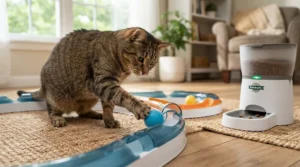
Physical exercise for cats comes in short bursts, mimicking hunting, rather than long workouts. Domestic cats are sprinters, not joggers, which is why a few intense minutes beat a lazy hour.
A ball track gives you a convenient, self-serve burst: your cat swats, pounces and resets without you present. It’s best viewed as a snack of activity rather than a meal. Food puzzles contribute a different kind of effort, a slow, repetitive foraging that is gentler but spread through the day.
Veterinary guidance supports spreading meals out. Feline feeding guidelines recommend splitting the daily food into several small portions and using puzzle feeders where possible. Some advice goes further and suggests placing portions in different parts of the house, preferably elevated, so the cat forages for them.
For physical exercise for cats that’s genuinely effective, combine three things: a ball track for solo bursts, a food puzzle for gradual effort, and a wand-toy session with you. And if you’re targeting weight loss, check portions with your vet rather than relying on toys alone.
Cognitive Enrichment: Where Food Puzzles Win and Ball Tracks Surprise
Cognitive enrichment sounds fancy, but it just means giving a cat’s brain something to do. Cats Protection notes that cats are designed to work for their food, and a bowl takes that job away.
Food puzzles are the more obvious source of cognitive enrichment. The cat must work out where the food is, how to access it and which action releases it. The adjustable disc on the Catit Senses 2.0 Food Tree and the mixed modules on the Trixie Cat Activity Fun Board let you scale that challenge. The caveat is that clever cats master puzzles fast. One reviewer reported a kitten clearing a board in ten seconds after two hours of practice.
Ball tracks provide a subtler kind of cognitive enrichment: tracking a moving target, predicting its path and timing a strike. The Catit Senses Wave Circuit‘s raised sections should, on paper, make that prediction harder.
The best approach mixes both and keeps changing. Rotate layouts on tracks, raise puzzle difficulty weekly, and keep an eye on the signs of under-stimulation: night-time yowling, destructive scratching and over-grooming. If those persist or worsen, speak to your vet, because boredom is only one possible cause.
Multi-Toy Households: Making Ball Tracks and Food Puzzles Work Together
Multi-toy households (homes with several cats, several toys, or both) need a little planning to avoid turning enrichment into a turf war.
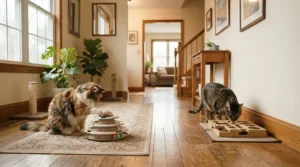
Veterinary feeding guidance is clear on the risk. In its feline feeding guidelines, the AAFP and ISFM note that in multi-cat homes cats don’t share space equally. They recommend multiple, visually separated feeding stations that account for each cat’s agility and dietary needs. A dominant cat parked in front of the Catit Play Treat Puzzle is exactly the problem that guidance describes.
In practice, a smart multi-toy households plan looks like this:
- Give every cat its own food puzzle, in a different room or behind a visual barrier.
- Use ball tracks for shared play. The tiered Catstages Tower of Tracks is designed for solo or multi-cat use, though how well that works depends on your cats’ temperaments.
- Mix compatible pieces. Several Catit Senses 2.0 products are designed to be combined, which suits multi-toy households that want to expand gradually.
- Watch for hoarding. One Fun Board reviewer found their most skilled cat was eating most of the treats.
Done well, multi-toy households end up with less boredom, less competition and a cat that stops using your sofa as a scratching post.
Long-Term Cost & Value: What Each Format Really Costs
Neither format is expensive up front, but the long-term picture differs.
| Format | Upfront range | Ongoing costs | Value verdict | Best For |
|---|---|---|---|---|
| Entry ball track (Catstages Tower of Tracks) | £10-£15 | None | High value if used | Kittens, tight budgets |
| Modular track (Catit Senses 2.0 Play Circuit) | £10-£15, plus add-ons | Extra tracks if desired | Good if you enjoy tinkering | Layout-lovers |
| Food puzzle board (Trixie Cat Activity Fun Board) | £15-£25 | Treats or kibble | Strong for brainy cats | Fast eaters |
| Adjustable feeder (Catit Senses 2.0 Food Tree) | £18-£28 | Kibble | Good if your cat doesn’t master it fast | Gulpers |
Ball tracks cost nothing to run. Puzzles use food you’d buy anyway, as long as you subtract it from the regular meal. The hidden cost is novelty fade: if your cat masters a toy in a week, its value drops fast.
As a rule of thumb, spread £30-£45 across one track and one puzzle rather than buying two of the same format. Hand-washing the puzzles adds a few minutes a week, and the cost is time, not money. Prices change often, so check current listings before you buy.
Frequently Asked Questions
❓ Which is better for a new kitten: ball track toy or food puzzle toy?
❓ Can a food puzzle toy work with wet food?
❓ How many ball track toys do two cats need?
❓ Is it safe to leave a ball track toy out while I'm at work?
❓ What does a basic cat enrichment set cost in the UK?
Conclusion
Back to the Tuesday afternoon and your detective-eyed cat. The ball track toy vs food puzzle toy question has a practical answer: buy for the behaviour you want to change.
If your cat is a restless swatter, start with the Catstages Tower of Tracks for compact value, or the Catit Senses 2.0 Play Circuit if you like reconfiguring layouts. If your cat gulps dinner or needs a mental workout, reach for the Catit Senses 2.0 Food Tree for adjustable difficulty, or the Trixie Cat Activity Fun Board for a cat that loves a challenge. The Catit Play Treat Puzzle is the friendliest first puzzle, and the Catit Senses 2.0 Digger suits scoopers. The Catit Senses Wave Circuit is best as an upgrade to an existing track.
Better still, don’t treat ball track toy vs food puzzle toy as an either-or. The Copenhagen trial suggests the formats are interchangeable for attention-seeking, but together they cover the chase and the forage. Rotate them, raise the difficulty gradually, keep stations separate in multi-cat homes, and talk to your vet if boredom, weight or eating habits worry you.
Recommended for You
- Interactive Puzzle Toy Vs Treat Dispensing Toy: 7 Best Picks (2026)
- Food Puzzle Toy For Cats: 7 Brilliant Picks For UK Homes (2026)
- Treat Dispensing Cat Toy: 7 Best Picks For UK Cats (2026)
Disclaimer: This article contains affiliate links. As an Amazon Associate, I earn from qualifying purchases. If you purchase products through these links, we may earn a small commission at no additional cost to you.
✨ Found this helpful? Share it with your friends! 💬🤗
