
In This Article
Your cat is staring at you. It isn’t a loving stare. It’s the flat, unblinking look of a small predator whose working day consists of a bowl, a sunbeam and a moth that never arrives. If that sounds familiar, you’ve probably typed interactive puzzle toy vs treat dispensing toy into a search bar at an ungodly hour, wondering which gadget deserves your money.

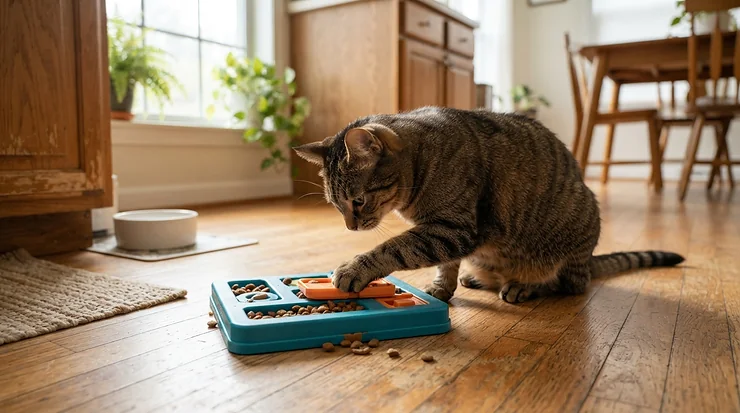
The short answer is more nuanced than most buying guides admit. An interactive puzzle toy asks your cat to think: slide, spin, lift, work out the order. A treat dispensing toy asks your cat to move: bat, roll, chase, and get paid in kibble as it goes. Both turn food into a job. Neither is automatically the winner. The right choice depends on whether your cat is bored in the brain, bored in the body, or (quite often) both.
In this guide I compare seven real products from Catstages (Nina Ottosson), Catit, PetSafe and LickiMat. The analysis rests on published specs, tester reports and aggregated owner reviews, not on any claim of hands-on testing by me. Cats Protection’s behaviour team points out that feeding enrichment suits any cat but is especially valuable for indoor-only cats, whose daily menu otherwise involves almost no effort. By the end you’ll have a clear view of puzzle toy pros and cons, treat dispenser pros and cons, a mental stimulation comparison, the warning signs of cat boredom, workable enrichment strategies and a toy rotation plan you can start tonight.
Interactive Puzzle Toy vs Treat Dispensing Toy: Quick Comparison
Before the product deep-dives, here’s the high-level picture.
| Factor | Interactive puzzle toy | Treat dispensing toy |
|---|---|---|
| How it works | Cat solves a mechanism (spin, slide, paw, dig) | Cat bats, rolls or tips; food falls out |
| Main workout | Brain first, paws second | Body first, brain second |
| Typical food | Dry food and treats (some suit wet) | Dry kibble and treats only |
| Learning curve | Steeper, needs a demonstration | Gentle, often understood in minutes |
| Mess factor | Low to moderate | Moderate (rolling, scattered crumbs) |
| Best for | Clever, confident, food-motivated cats: Catstages Buggin’ Out Puzzle & Play, Catstages Rainy Day Puzzle & Play | Fast eaters, active cats, weight management: PetSafe SlimCat, Catit Senses 2.0 Food Tree |
The table shows a trade-off rather than a verdict. Puzzle toys such as the Catstages Buggin’ Out Puzzle & Play deliver more cognitive work per biscuit but demand patience from both of you. Dispensers like the PetSafe SlimCat are quicker to get started and burn more energy, but they ask less of your cat’s brain. If you’re unsure, a hybrid such as the Catit Senses 2.0 Food Tree sits neatly in the middle.
💬 Just one click — help others make better buying decisions too!😊
Top 7 Interactive Puzzle Toy and Treat Dispensing Toy Picks: Expert Analysis
1. Catstages Buggin’ Out Puzzle & Play — best first real puzzle
The standout is the stepping-stone difficulty. It’s rated Level 2 in the Nina Ottosson range, which sits between “give me a biscuit” and “I need a degree”. It measures roughly 35 × 29cm (13.9″ × 11.5″) and holds about a quarter-cup of food, hidden behind spinning pegs and pawable leaves. That capacity makes it a slow-feed snack station rather than a full-meal solution for a big eater. The multi-step reveal also demands more thinking than a rolling ball does.
Based on the spec comparison, this suits a cat that has outgrown the bowl but hasn’t yet shown any puzzle talent. The spec sheet won’t mention that PetsRadar’s tester found it slides around on hard flooring, so a rubber mat is a sensible add-on. PetsRadar’s tester also reported that both of her cats used it happily as a dry-food feeder and that it slowed their eating. I couldn’t verify a large independent UK review pool, and several rankings elsewhere are affiliate-driven, so treat the praise as encouraging rather than conclusive.
Pros:
- ✅ Mid-level difficulty suits beginners progressing upwards
- ✅ Spinning pegs reward patient, deliberate pawing
- ✅ Free from BPA, PVC and phthalates
Cons:
- ❌ Slides about on hard flooring
- ❌ Small capacity for large appetites
Price: typically in the teens-to-low-£20s range (check current price). Good value for a first proper puzzle.

2. Catstages Rainy Day Puzzle & Play — best step-up for clever cats
The hook here is difficulty. It’s a Level 3 toy on a larger surface of roughly 35 × 36cm (13.8″ × 14″), so it’s built for cats that have already mastered something simpler. A bigger, busier layout means more places for treats to hide and more problem-solving per session. The flip side is that it can turn a hungry cat into a frustrated one if introduced too early.
PetsRadar rated it their best advanced puzzle in a separate cat-toy guide, yet its tester’s cats preferred the easier Catstages Buggin’ Out Puzzle & Play as a primary feeder. I read that as a useful reality check. The Catstages Rainy Day Puzzle & Play works better as occasional brain-training than as an everyday bowl replacement. It suits confident, food-obsessed cats, particularly in single-cat homes where nobody is hovering over the prize.
I couldn’t find enough verifiable owner reviews to summarise honestly, so I won’t pretend otherwise. If you buy it, follow the staged approach from Cats Protection and the Mayhew: show your cat how it works first, and make the early rounds easy.
Pros:
- ✅ Genuine Level 3 challenge for experienced puzzlers
- ✅ Large surface gives plenty of hiding spots
- ✅ Great for occasional mental workouts
Cons:
- ❌ Too hard for beginners; risks frustration
- ❌ Less practical as a daily meal feeder
Price: usually in the £15–£25 range (check current price). Worth it only if your cat has outgrown simpler puzzles.
3. Catstages Kitty Lickin’ Layers — best digging-style foraging puzzle
Its distinctive trick is layers that your cat spins and digs through, which mimics the rummaging side of foraging. It holds up to half a cup, double the Catstages Buggin’ Out Puzzle & Play, so it works for small meals as well as treats. It’s dishwasher-safe and made from BPA-, PVC- and phthalate-free material, which matters for something your cat will lick and paw daily.
My take: this is the best “thinking plus scavenging” option in the line-up for cats that love poking about. PetsRadar’s tester crowned it best overall, noting it slowed her cat’s eating and, unexpectedly, encouraged her to eat food she’d recently gone off. That last point is a single tester’s report, but it hints at the toy’s appeal for fussy eaters. The one genuine downside is prep time, because filling those layers is fiddly.
Because I couldn’t verify a wide pool of UK owner reviews, I’m relying on that single detailed tester report. Treat it as a good sign rather than gospel.
Pros:
- ✅ Half-cup capacity suits small meals
- ✅ Dishwasher-safe, easy to keep hygienic
- ✅ Encouraged a fussy eater in testing
Cons:
- ❌ Fiddly and time-consuming to fill
- ❌ Not designed for large kibble-hungry multi-cat homes
Price: roughly £10–£20 range (check current price). Strong value for the build quality.
4. Catit Senses 2.0 Digger — best gateway toy that doubles as a treat dispenser
What sets it apart is the tube design. Narrow and wide tubes sit on a sloped base, so your cat paws food along and out. That makes it a hybrid, part puzzle and part dispenser. It’s light, BPA-free and compatible with the wider Catit Senses 2.0 range, so it slots into a rotation easily.
Honestly, reviews are mixed, which makes this the toy I’d approach with calibrated expectations. Some owners report that it was emptied quickly and wasn’t challenging enough. Another said one cat took ten minutes to realise effort was required, while a younger cat ignored it entirely. A reviewer also praised the non-slip mat for stopping it skidding across laminate. That pattern is telling: the Catit Senses 2.0 Digger is a confidence-builder, not a long-term brain-burner.
Use it to teach “paw equals prize” before moving to something harder.
Pros:
- ✅ Gentle introduction to food-work for novices
- ✅ Light and easy to clean
- ✅ Compatible with other Catit Senses 2.0 pieces
Cons:
- ❌ Can be emptied too quickly by clever cats
- ❌ Some cats ignore it completely
Price: around the £12–£20 range (check current price). Fair value as a starter, less so for experts.
5. Catit Senses 2.0 Food Tree — best for fast eaters and multi-cat homes
The headline feature is adjustable difficulty. Three stacked levels let food drop through side openings into a bowl at the base, and rotating the middle disc narrows the gaps. It stands about 34cm tall on a 37.5cm-wide base and comes apart for washing. In practice, that wide base is what keeps it upright when an enthusiastic cat starts pawing.
Because the reward lands in a bowl, I’d class this as a feeder-dispenser hybrid. It works well for kibble gulpers because it forces them to pause and paw between mouthfuls. One UK owner on a retailer’s review page said two cats use it simultaneously, that the base is stable and that the adjustable disc lets them tweak difficulty. A Business Insider reviewer’s cats also preferred it over some of the other Senses 2.0 pieces. Another reviewer noted the older version looked similar but cost less, so compare listings before buying.
Pros:
- ✅ Adjustable difficulty via the middle disc
- ✅ Stable base copes with enthusiastic pawing
- ✅ Disassembles for proper cleaning
Cons:
- ❌ Bulky, so needs a permanent floor spot
- ❌ Not suited to wet food
Price: roughly £15–£25 range (check current price). Good value as a long-term feeding station.
6. PetSafe SlimCat — best classic treat dispensing toy
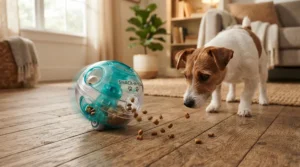
The hook is simplicity. It’s a rolling ball with an adjustable opening, a roughly two-thirds-cup capacity and a BPA-free, dishwasher-safe build, and it’s intended for dry food only. Adjusting the opening is the clever bit, because it controls how generously the ball pays out. Wider means easier and faster, narrower means longer sessions.
This is the purest expression of a treat dispensing toy. It rewards chasing and batting, so it suits active, food-motivated cats and anyone managing portions. Aggregated owner feedback on a UK retailer is mostly positive, with reviewers describing busy, entertained cats and food-obsessed pets kept occupied while owners are out. But there are consistent complaints: it rolls into odd corners, crumbs end up on the floor, some cats need teaching, and a kitten and an overweight cat were uninterested because it seemed like too much effort.
Pros:
- ✅ Adjustable opening controls the difficulty
- ✅ Encourages active chasing and batting
- ✅ Dishwasher-safe and simple to refill
Cons:
- ❌ Rolls under furniture and scatters crumbs
- ❌ Dry food only
Price: around the £10–£12 range (check current price). Excellent value for a first dispenser.
7. LickiMat Catster — best wildcard for wet-fed cats
The twist is that it’s neither a classic puzzle nor a dispenser. It’s a textured mat you spread wet food across, so your cat licks rather than solves. It’s hand-wash only and free from BPA, silicone, PVC and phthalates according to PetsRadar. For wet-food households, it fills a gap that almost every rolling or tower-style toy leaves open.
My honest view is that cognitive load is low, but the benefits are real. Licking slows eating dramatically, and PetsRadar’s tester reported her cat slowed noticeably, a point they linked to saliva production and digestion. Hand-washing is the main chore. This isn’t the answer if your cat needs serious brain work, but it makes a handy complement in a rotation, particularly for cats that find rolling toys frustrating.
I couldn’t verify a substantial pool of independent UK reviews, so the evidence here is mainly that one detailed tester report.
Pros:
- ✅ Handles wet food where most toys can’t
- ✅ Slows eating with minimal training
- ✅ Light, flat and easy to store
Cons:
- ❌ Hand-wash only
- ❌ Little real problem-solving
Price: typically under £10 to the low teens (check current price). Cheap enough to try as a rotation extra.
| Product | Type | Food suited | Difficulty | Price range | Best for |
|---|---|---|---|---|---|
| Catstages Buggin’ Out Puzzle & Play | Puzzle | Dry, some wet | Level 2 | Mid-teens to low £20s | First real puzzle |
| Catstages Rainy Day Puzzle & Play | Puzzle | Dry, treats | Level 3 | £15–£25 | Experienced puzzlers |
| Catstages Kitty Lickin’ Layers | Puzzle | Dry, treats | Moderate | £10–£20 | Foraging fans |
| Catit Senses 2.0 Digger | Hybrid | Dry, treats | Easy | £12–£20 | Beginners |
| Catit Senses 2.0 Food Tree | Hybrid feeder | Dry | Adjustable | £15–£25 | Fast eaters, multi-cat |
| PetSafe SlimCat | Dispenser | Dry only | Adjustable | £10–£12 | Active, food-driven cats |
| LickiMat Catster | Lick mat | Wet | Very easy | Under £10–low teens | Wet-fed cats |
The table shows how little overlap there is between price and difficulty. The cheapest options, PetSafe SlimCat and LickiMat Catster, are the easiest to get started with, while the Catstages Rainy Day Puzzle & Play is the only genuinely demanding toy. If you can afford just one, the Catstages Buggin’ Out Puzzle & Play offers the broadest range.
What Is an Interactive Puzzle Toy vs Treat Dispensing Toy?
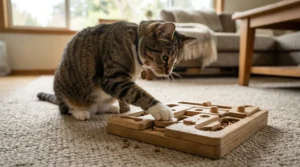
An interactive puzzle toy hides food behind a mechanism (sliding lids, spinning pegs, layered discs) that your cat must work out to reach the reward. A treat dispensing toy releases kibble or treats as your cat bats, rolls or tips it. The puzzle tests problem-solving, while the dispenser mainly rewards movement and persistence.
In reality the categories blur. The Catit Senses 2.0 Food Tree is a puzzle feeder with a dispensing action, and the Catit Senses 2.0 Digger blends tubes with paw-driven release. The LickiMat Catster belongs to neither camp. What matters is the job your cat is being asked to do.
Tufts University’s veterinary nutrition team offers a useful design principle. Transparent puzzles with many holes let a cat see and smell the food, which makes them easier, while opaque designs with fewer, smaller holes raise the challenge. It also notes that most commercial puzzles are built for dry food or treats. Wild cats, the same source observes, succeed in only about half their hunts, so a toy that sometimes frustrates isn’t unnatural, but one that always frustrates will simply be abandoned.
How to Choose an Interactive Puzzle Toy vs Treat Dispensing Toy
Use these steps to narrow down the options without wasting money.
- Diagnose the boredom. A cat that destroys things or yowls at 4am may need physical outlets, which favours a treat dispensing toy. A cat that stares at you may be crying out for mental work, which favours a puzzle.
- Check the food type. If your cat eats mostly wet food, favour the LickiMat Catster. Most others in this guide are designed for dry food.
- Start easier than you think. Cats Protection and the Mayhew both recommend beginning with something simple. A cat that wins early will try harder things later.
- Match capacity to purpose. For slowing a meal, pick something like the Catit Senses 2.0 Food Tree. For small treat sessions, the Catstages Buggin’ Out Puzzle & Play is enough.
- Think about your floors and space. Rolling toys bounce off skirting boards, while lightweight puzzles slide on hard floors.
- Count your cats. Bulky multi-access designs suit shared homes, but a one-cat puzzle can trigger competition.
- Plan the cleaning. Dishwasher-safe pieces like the PetSafe SlimCat save time. Hand-wash-only toys are less convenient.
Puzzle Toy Pros and Cons
The upside of puzzle toys is depth. A good one makes your cat solve something, which engages the hunting-and-foraging sequence far more fully than a bowl. Toys like the Catstages Kitty Lickin’ Layers extend meal times and can encourage fussy eaters, as PetsRadar’s tester noted. Cleaning is usually easy, and because puzzles are quieter than rolling dispensers, they won’t wake you at 3am.
The downsides are real, though. Puzzles need introducing properly, and a cat that gives up early may decide the toy is a waste of time. Filling can be fiddly, capacity is often small, and the hardest models (the Catstages Rainy Day Puzzle & Play, say) can frustrate rather than reward. Puzzles are also more likely to be ignored by cats with low food drive. Several owner reviews of related toys describe exactly that: an uninterested cat shrugging at an apparently clever device.
The practical lesson is that puzzle toys reward patience. If you’re willing to demonstrate, start easy and tweak difficulty, the payoff can be substantial. If you want something your cat will use unprompted on day one, a dispenser might be a better opening move.
Treat Dispenser Pros and Cons
Treat dispensers win on simplicity and energy burn. The PetSafe SlimCat needs little teaching for many cats, adjusts easily and gets your cat moving, which matters for weight control. Because food emerges in small amounts, it also spreads a day’s ration across more eating moments, closer to the little-and-often pattern cats evolved for.
The drawbacks are mess, noise and limited thought. Rolling toys end up in odd places, crumbs get everywhere and some cats treat the toy as a mild annoyance. The mental workload is lower than with a true puzzle, so a clever cat can get bored with a dispenser quickly. As the PetSafe SlimCat reviews show, a lethargic or overweight cat may judge the effort not worth the reward.
There’s also a calorie-control issue. Treats and kibble dispensed through any toy still count toward your cat’s daily allowance. Cats Protection advises taking the food from the daily weighed amount, which is easy to forget when a toy feels like “just play”.
Interactive Puzzle Toy vs Treat Dispensing Toy: Mental Stimulation Comparison
If mental stimulation is your priority, the evidence is more modest than the marketing suggests. A randomised controlled trial from the University of Copenhagen gave 44 indoor cats food puzzles and 48 cats ordinary toys for four weeks. Both groups showed similar improvement in attention-seeking behaviour, and food puzzles did not outperform plain toys. The researchers also lacked a no-enrichment group, so the exact cause of the improvement remains uncertain. You can read the University of Copenhagen summary for the details.
That doesn’t mean puzzles and dispensers are pointless. It suggests consistency matters more than the specific gadget. The study didn’t compare puzzles with dispensers directly either, so nobody can honestly claim one beats the other. My reading is that puzzles probably give more cognitive load, dispensers give more physical load, and the best results come from using both regularly.
| Factor | Standard bowl | Puzzle toy | Treat dispenser |
|---|---|---|---|
| Mental effort | Almost none | Moderate to high | Low to moderate |
| Physical effort | None | Low | Moderate to high |
| Slows eating | No | Yes | Yes |
| Setup effort | None | Moderate | Low |
| Best for | Convenience | Clever cats | Active cats |
The table reinforces the point: a bowl delivers convenience but no enrichment, while both toy types improve on it in different ways. A cat that needs brain work might thrive with a Catstages Buggin’ Out Puzzle & Play, and a cat that needs exercise might prefer the PetSafe SlimCat. Mixing both, as the rotation section below explains, is the most defensible approach.
Cat Boredom: Signs, Causes and What Actually Helps
Cat boredom rarely looks like boredom. It looks like waking you up at night, shredding a sofa, over-grooming or hovering around the food bowl. Tufts lists aggression, attention-seeking, over-grooming and urinary problems among the behavioural issues owners report in indoor cats. Some of those need a vet’s attention, so if a sudden change in behaviour appears, get it checked first.
The root cause is usually mismatch. Cats are predators built to search, stalk and work for each meal, while a bowl offers none of that. Cats Protection’s behaviour team describes feeding enrichment as a way to restore some of that effort, especially for indoor cats.
What helps? Consistent daily enrichment, the Copenhagen study suggests, matters more than the perfect gadget. A Catit Senses 2.0 Food Tree at breakfast, a play session with a wand toy and a LickiMat Catster in the evening can already transform a day. Remember that boredom isn’t fixed by toys alone: climbing space, window perches and your own attention all count. Treat the toys as one part of a bigger enrichment plan.
Enrichment Strategies That Actually Work
Good enrichment strategies start small and build up. Here are three profiles to show how the pieces fit.
The flat-dwelling worker (out eight hours). Your cat is alone all day, with limited space. Try a Catit Senses 2.0 Food Tree as the morning feeder and a PetSafe SlimCat with part of the evening ration. The tree slows breakfast while the ball encourages evening activity. Add a window perch and finish with a wand-toy session when you’re home.
The multi-cat household. Competition is the issue here. The Food Tree’s wide base lets two cats use it together, according to one UK reviewer, but separate feeding stations for each cat reduce friction. Avoid placing puzzles side by side, and watch for guarding.
The senior or overweight cat. Gentle is the keyword. A LickiMat Catster for wet food or a Catit Senses 2.0 Digger with generous openings gives low-effort stimulation. Check with your vet about diet and mobility first.
For every profile, the Mayhew’s food-enrichment advice offers a sound routine: begin with an easy method, offer half the meal in the toy, and leave leftovers in it rather than immediately handing over the rest. That last step avoids rewarding your cat for walking away.
Toy Rotation: How to Keep Puzzles and Dispensers Fresh
Cats lose interest in the familiar. Cats Protection’s enrichment guidance says toys should be rotated regularly to maintain novelty, and the Mayhew suggests either changing the method each meal or sticking with one for a week before switching. Neither source prescribes a rigid schedule, so treat the following as a sensible starting point rather than gospel.
A simple four-week plan:
- Week 1: Catit Senses 2.0 Digger for treats, plus the LickiMat Catster for wet meals.
- Week 2: Catstages Buggin’ Out Puzzle & Play at a main meal.
- Week 3: PetSafe SlimCat with part of the daily dry ration.
- Week 4: Catit Senses 2.0 Food Tree for breakfast and Catstages Kitty Lickin’ Layers for treats.
Put toys away between rounds so they feel new on return. Rinse and wash everything before storing, and note which toy your cat attacks with enthusiasm. If one earns repeat appearances, run it more often. If your cat is mastering something quickly, step up to the Catstages Rainy Day Puzzle & Play rather than buying yet another easy toy.
Problem → Solution: Fixing Common Puzzle and Dispenser Headaches
“My cat ignores it completely.” Don’t give up after one try. Show the toy, make it easy and let the cat win early. Open the toy so food is freely accessible at first, then increase difficulty gradually.
“My cat gives up halfway.” The toy is probably too hard. Step down a level, widen the openings on a Catit Senses 2.0 Food Tree, or put treats where they’re easy to reach.
“The toy keeps sliding or rolling away.” Hard floors are the culprit. A non-slip mat helps flat puzzles like the Catstages Buggin’ Out Puzzle & Play, and a quiet carpeted room suits a PetSafe SlimCat.
“Food gets stuck.” Check kibble size against the openings. Sticky or oversized food jams most toys. Dry food in dispensers should match what the manufacturer intends.
“My cat gobbles the food anyway.” Switch to something that forces pauses, such as the Catit Senses 2.0 Food Tree or the LickiMat Catster, and spread the meal across several smaller portions.
“My cat won’t use it near the bowl.” Cats Protection suggests placing feeding enrichment away from water bowls, since cats prefer to eat and drink in different locations.
Long-Term Cost and Maintenance
Most of the toys here sit between roughly £10 and £25, so the real cost isn’t the purchase price. It’s the care. Dishwasher-safe designs like the PetSafe SlimCat and Catstages Kitty Lickin’ Layers save effort over months of use, while hand-wash-only items like the LickiMat Catster need a few minutes after each wet meal. Disassembling the Catit Senses 2.0 Food Tree is straightforward, but you do need to do it, because residue from dry food builds up.
Cost per use is where these toys shine. A toy used daily for a year costs pennies per session, and most of the plastic designs are durable. Check them periodically for cracks or missing parts, as the retailer guidance for the PetSafe SlimCat advises, and replace any damaged toy.
Don’t forget the hidden cost: calories. Cats Protection advises deducting food in toys from the daily ration. If you routinely add extra treats, a “free” enrichment habit can quietly become a weight-gain habit.
Common Mistakes When Buying and Using These Toys
Buying the hardest toy first. The Catstages Rainy Day Puzzle & Play is excellent for the right cat, but PetsRadar’s tester found her cats preferred the easier model. Start gentle.
Skipping the demonstration. Both Cats Protection and PetsRadar’s vet contributor stress showing your cat how the toy works. A cat that fails alone may conclude it’s pointless.
Forgetting the daily ration. Feeding extra on top of normal meals defeats the purpose of weight-friendly dispensing.
Using the wrong food. Cardboard feeders go soggy with wet food, and several of these toys are strictly for dry food. Match food to toy.
Leaving everything out all the time. Novelty fades. Rotate.
Ignoring wear and tear. Cracked plastic or missing parts become a hazard. Supervise early sessions, particularly with kittens.
Expecting one toy to fix everything. The Copenhagen study suggests consistency counts more than the specific device, and boredom needs more than a feeder. If behaviour changes suddenly or worsens, check with your vet.
FAQ
❓ Is an interactive puzzle toy or a treat dispensing toy better for a bored cat?
❓ Can I use wet food in a treat dispensing toy?
❓ How should I count treat dispenser calories?
❓ How often should I rotate a puzzle toy?
❓ Are shop-bought puzzle toys worth buying over DIY options?
Conclusion
So, interactive puzzle toy vs treat dispensing toy: who wins? On the evidence, neither. Puzzles such as the Catstages Buggin’ Out Puzzle & Play and Catstages Kitty Lickin’ Layers give your cat’s brain a proper workout. Dispensers like the PetSafe SlimCat get paws and shoulders moving. Hybrids such as the Catit Senses 2.0 Food Tree and Catit Senses 2.0 Digger split the difference, and the LickiMat Catster rescues wet-food households from being left out. The Catstages Rainy Day Puzzle & Play is the graduate-level option for cats that have outgrown the rest.
My practical advice is to pick one puzzle and one dispenser, introduce each slowly, deduct the food from the daily ration and rotate them weekly. The Copenhagen trial suggests the habit matters more than the hardware, so the best toy is the one your cat uses consistently. Cat boredom won’t vanish overnight, but a clever feeding routine is one of the cheapest, kindest ways to give an indoor cat a reason to get up from the sofa.
✨ Ready to end the 4am stare-down?
🔍 Compare the seven picks above, check current pricing and availability, and start your cat’s new foraging routine this week. Your cat (and your sleep) will thank you! 🐾
Recommended for You
- Food Puzzle Toy For Cats: 7 Brilliant Picks For UK Homes (2026)
- Treat Dispensing Cat Toy: 7 Best Picks For UK Cats (2026)
- Top Ball Track Toy For Cats: 7 Best Picks For UK Homes (2026)
Disclaimer: This article contains affiliate links. As an Amazon Associate, I earn from qualifying purchases. If you purchase products through these links, we may earn a small commission at no additional cost to you.
✨ Found this helpful? Share it with your friends! 💬🤗
