
In This Article
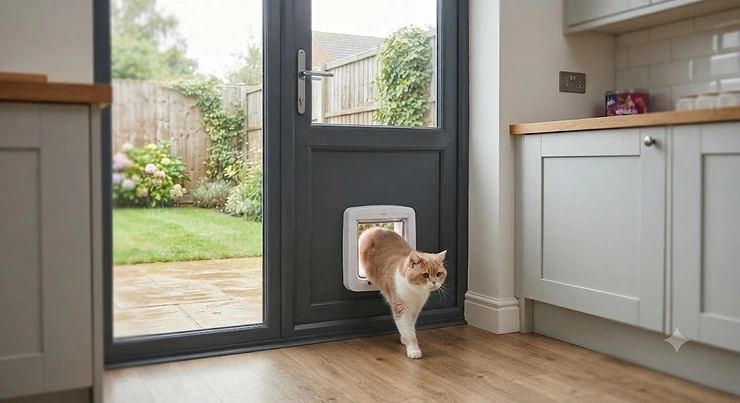
There’s a very specific kind of 2am wake-up call that only cat owners know: the thud-thud-thud of a paw against glass, followed by a yowl that says, quite clearly, “I have decided the outdoors is over, let me in.” A door mounted cat flap solves this before it starts. Instead of a hole cut into a wall or a bulky tunnel through brick, the flap goes straight into the door you already have — wood, UPVC or composite — which usually means a quicker install and a smaller bill.
The tricky part is that “cat flap” now covers everything from a £12 hinged square of plastic to a £600 AI camera that scans for dead mice before it lets your cat through the door mounted cat flap. Somewhere in between sits the sweet spot most households actually need: secure, draught-resistant, and fitted properly the first time. This guide walks through seven real products currently sold in the UK, breaks down which door types they suit, and covers the fitting details — measuring, sealing, avoiding a wonky cut — that most listings skip entirely. Every cat entering or leaving through one of these also needs to be legally microchipped in England if they’re over 20 weeks old, as the RSPCA confirms, so we’ve woven that requirement through the buying advice too rather than treating it as a footnote.
Quick Comparison Table
For readers who want the short version before diving into full reviews, here’s how the seven products stack up on the fundamentals that actually change day-to-day life with the flap.
| Product | Type | Best Door Fit | Price Range | Best For |
|---|---|---|---|---|
| SureFlap Microchip Cat Flap | Microchip, single-scan | Wood, UPVC, glass | £50-£85 | All-round first-time buyers |
| SureFlap DualScan Microchip Cat Flap | Microchip, dual-scan | Wood, UPVC | £85-£120 | Multi-cat households |
| SureFlap Pet Door | Microchip, large opening | Wood, UPVC, composite | £100-£140 | Large cats & small dogs |
| PetSafe Microchip Cat Door | Microchip, budget | Wood, UPVC (adaptor for others) | £45-£75 | Budget-conscious microchip buyers |
| Cat Mate Elite Microchip Cat Flap (355) | Microchip, timer + LCD | Wood, UPVC, glass | £65-£100 | Owners who want curfew scheduling |
| Cat Mate 4-Way Locking Cat Flap (235W) | Manual, non-electronic | Wood, UPVC, thin panels | £15-£30 | Budget buyers, indoor doors |
| OnlyCat AI Prey Detection Flap | AI camera + microchip | Wood, UPVC (reinforced frame) | £550-£650 | Cats who bring home “gifts” |
A pattern jumps out immediately: price climbs with intelligence, not with build quality. The cheapest flap here, the Cat Mate 4-Way Locking Cat Flap, uses roughly the same tough polymer shell as the £100+ models — what you’re paying extra for further up the table is the electronics deciding who gets through, not a sturdier door. That reframes the whole decision. If your only concern is a neighbourhood cat helping itself to your kitchen, a manual lock might genuinely be enough. If the concern is squirrels, foxes, or a specific rival cat, you need the chip reader, and the only real argument at that point is single-scan versus dual-scan versus AI.
💬 Just one click — help others make better buying decisions too!😊
Top 7 Door Mounted Cat Flaps: Expert Analysis
1. SureFlap Microchip Cat Flap — the reliable default for most UK homes
The SureFlap Microchip Cat Flap earns its reputation the boring way: it just works, year after year, which is precisely what you want from something bolted into your back door. It reads your cat’s existing microchip — the same one now legally required in England — and only unlocks for IDs you’ve programmed in, up to 32 pets, which covers even the most sprawling multi-cat household.
On paper the spec sheet is unremarkable: four AA batteries, a 4-way manual lock (locked, in-only, out-only, open), and a flap opening around 145mm × 145mm. What that means in practice is a battery life that typically stretches 6-12 months depending on how often your cat commutes, and a lock you can flip to “in only” the night before a vet visit so nobody escapes at 6am. Reviewers consistently report that the RFID recognition is near-instant — cats rarely have to pause and “present” themselves the way some early microchip flaps demanded.
This is the flap for a household with one to three cats, a standard-sized cat, and no unusual door material. Owners of larger breeds should skip ahead to the Pet Door variant below, since this opening genuinely is snug for anything Maine Coon-sized.
Aggregated review sentiment across major UK retailers is strongly positive, with the most common praise centred on ease of programming and quiet operation; the most common complaint is that battery contacts can corrode after a year or two in a very exposed, weather-facing door.
Pros:
- ✅ Reads existing microchips — no collar tag needed
- ✅ Programs up to 32 cats for shared or multi-cat homes
- ✅ Quiet mechanism that won’t startle a nervous cat
Cons:
- ❌ Opening is tight for cats over 6-7kg
- ❌ Battery contacts can corrode in very exposed positions
Typically priced in the £50-£85 range depending on retailer promotions, this sits as the value benchmark every other microchip flap on this list gets measured against.
2. SureFlap DualScan Microchip Cat Flap — best for multi-cat households with an indoor-only resident
Where the standard SureFlap only checks a chip on the way in, the SureFlap DualScan Microchip Cat Flap checks it both ways — a small change with a big real-world consequence if you’re juggling an outdoor cat and an indoor-only one under the same roof.
The dual-reader system means you can register some cats for full in-and-out access while keeping others locked to “indoors only,” with the flap itself enforcing that boundary rather than you having to police it. Specs otherwise mirror the standard SureFlap: 4-way manual override, AA battery power, similar opening dimensions, similar 6-12 month battery life in typical use.
Based on the spec comparison, the DualScan earns its premium almost entirely from that exit-side scanning — if every cat in your home already has full outdoor access, you’re paying £30-£40 extra for a feature you won’t use. But for households managing an FIV-positive cat, a recovering-from-surgery cat, or simply an anxious cat who shouldn’t be roaming yet, this is the only flap on the list built for exactly that scenario.
Reviewers who own multiple cats with different access needs describe it as the piece of kit that finally let them stop manually shutting doors and hoping for the best; a smaller number note the exit-scan can occasionally introduce a beat of hesitation compared to the instant push-through of a standard flap.
Pros:
- ✅ Controls exit as well as entry per individual cat
- ✅ Ideal for mixed indoor/outdoor multi-cat homes
- ✅ Same trusted SureFlap mechanism and lock options
Cons:
- ❌ Costs more than the standard SureFlap for a feature not everyone needs
- ❌ Occasional slight hesitation on the exit scan
Expect to pay in the £85-£120 range, positioning it as a genuinely mid-range purchase rather than a budget one.
3. SureFlap Pet Door — best for large cats and small dogs sharing a flap
Cats don’t come in one size, and the SureFlap Pet Door exists because a Ragdoll or British Shorthair squeezing through a standard 145mm opening looks — and often is — uncomfortable. This model bumps the opening to roughly 178mm × 170mm, big enough for most large-breed cats and small dogs like a Yorkshire Terrier or Chihuahua.
Under the hood it’s the same trusted microchip electronics as the standard SureFlap, just wrapped around a bigger door and running on C-cell batteries rather than AAs — a sensible swap, since C-cells simply last longer, which matters more when the flap is being pushed open by a heavier animal more often. What most buyers overlook about this model is that the larger cut-out means a bigger hole in your actual door, so it’s worth confirming your door has enough clear panel space before committing, particularly on doors with decorative glazing bars.
The trade-off for the larger frame is a footprint that doesn’t suit every door — narrow UPVC panels or doors with a lot of glazing can struggle to accommodate the wider unit, which is why professional fitters typically confirm the aperture before quoting on this model specifically.
Pros:
- ✅ Fits large cat breeds and small dog breeds comfortably
- ✅ Longer-lasting C-cell battery power
- ✅ Same reliable SureFlap microchip recognition
Cons:
- ❌ Larger cut-out isn’t compatible with every door panel
- ❌ Heavier flap door than standard-size alternatives
Priced around £100-£140, it’s a premium pick, but for a genuinely large cat it’s the only mainstream microchip flap that avoids a tight squeeze.
4. PetSafe Microchip Cat Door — best budget microchip alternative
Not every household needs the SureFlap name to get a working microchip flap, and the PetSafe Microchip Cat Door is the clearest proof of that. It reads standard FDX-B microchips (the type used in the vast majority of UK cats), programs up to 40 pets, and offers the same 4-way lock logic — locked, unlocked, in-only, out-only — as its pricier rivals.
Where it saves money is largely in fit-and-finish rather than function: the frame is a slightly simpler moulded plastic, and installing it into anything other than wood or UPVC — metal, brick, glass — requires a separate adaptor kit sold on its own. Reviewers consistently note the recognition speed is a touch slower than SureFlap’s, often described as needing the cat to pause for a beat rather than walking straight through, though this settles as cats learn the routine.
Here’s what to weigh: if your budget tops out around £60 and your door is straightforward wood or UPVC, this delivers essentially the same security outcome as a flap costing 30-40% more. If you’re installing into glass or a wall, the adaptor cost narrows that gap considerably, and it’s worth pricing the full kit before deciding.
Pros:
- ✅ Genuine microchip security at a lower price point
- ✅ Programs up to 40 registered pets
- ✅ Straightforward three-step installation on standard doors
Cons:
- ❌ Slightly slower chip recognition than premium rivals
- ❌ Needs a separate adaptor for glass, metal or wall fitting
Typical pricing sits between £45 and £75, making it the go-to for anyone who wants a door mounted cat flap with microchip security but doesn’t want to spend SureFlap money to get it.
5. Cat Mate Elite Microchip Cat Flap (355) — best for curfew scheduling
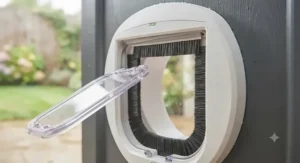
The standout feature of the Cat Mate Elite Microchip Cat Flap is its built-in digital timer and LCD display, which lets you set the flap to lock automatically at a chosen hour — genuinely useful if your cat’s idea of “bedtime” and yours don’t currently align.
Beyond the timer, this is a fully-featured microchip flap: it self-lines up to 100mm, meaning it copes with unusually thick doors without extra parts, and it’s rated for single or double glazing, UPVC, wood and metal doors alike, which is broader out-of-the-box compatibility than most rivals offer. The LCD display also logs which registered cat last used the flap and in which direction — a small but genuinely handy feature if you’re trying to work out whether a specific cat is coming home later than the others.
Reviewers frequently mention the display and timer as the reasons they chose this over a SureFlap, but a recurring theme in aggregated feedback is that the flap needs firmer, more deliberate pushes from the cat to trigger reliably compared with SureFlap’s lighter action — something worth factoring in for older or smaller cats.
Pros:
- ✅ Programmable curfew timer with LCD status display
- ✅ Self-lines up to 100mm — suits thicker doors out of the box
- ✅ Logs which cat used the flap and when
Cons:
- ❌ Needs a firmer push than some rivals to trigger
- ❌ Timer programming has a learning curve on first setup
Priced roughly £65-£100, this is the pick for anyone who wants scheduling control without stepping up to a full smart-hub system.
6. Cat Mate 4-Way Locking Cat Flap (235W) — best budget non-electronic option
Sometimes the simplest answer is the right one, and the Cat Mate 4-Way Locking Cat Flap is exactly that: no microchip reader, no batteries, no app — just a tough, draught-sealed flap with a manual 4-way lock, self-lining up to 50mm.
What most buyers overlook about “basic” flaps like this is that the draught-proofing hardware — a fully brush-sealed flap plus magnetic closure — is often just as good as what you get on a £90 microchip model, because that part of the engineering hasn’t really changed across price tiers. The genuine trade-off is security: without a chip reader, any cat willing to push through can get in, which makes this best suited to single-cat households in low-traffic areas, or for internal doors where you’re simply managing which room a cat can access rather than guarding against outside intruders.
Reviewers overwhelmingly describe it in similar terms — sturdy, quiet, no-nonsense — and several long-term owners report replacing a broken unit with the exact same model years later simply because “it just works.” The main criticism in aggregated feedback is that determined neighbourhood cats do occasionally learn to push through a locked flap if the household leaves it on “in and out” permanently rather than actually using the lock settings.
Pros:
- ✅ Genuinely weatherproof brush seal and magnetic closure
- ✅ No batteries, app or ongoing running costs
- ✅ Self-lines up to 50mm for varied door panel cat flap thicknesses
Cons:
- ❌ No selective entry — any pushing cat can get through
- ❌ Manual lock only works if you actually remember to use it
At £15-£30, this remains the cheapest genuinely reliable option on the list, and arguably the best value per pound of any product here.
7. OnlyCat AI Prey Detection Flap — best for cats that bring home “gifts”
The newest genuine innovation in this category in years, the OnlyCat AI Prey Detection Flap pairs standard microchip recognition with an onboard camera and AI model trained to spot when your cat is carrying prey — a mouse, a bird, the occasional unlucky vole — and locks the flap for a short delay rather than letting the “gift” straight into your hallway.
Mechanically it still functions as a conventional microchip flap the rest of the time, reading each cat’s chip and enforcing your programmed permissions. What sets it apart is entirely software: machine-vision detection running locally on the unit, mains power with battery backup so the camera stays live, and a companion app that shows you exactly what triggered a lockout, prey photo included (brace yourself). Based on the spec comparison, this is not a subtle upgrade over a standard microchip flap — it’s solving one specific, very particular problem, and it’s solving it well according to early UK adopters.
Here’s what to weigh: at roughly 6-8 times the price of a standard SureFlap, this only makes financial and practical sense if prey-dragging is an actual, recurring problem in your household. If your cat has never brought home so much as a leaf, a standard microchip flap will do everything you need for a fraction of the outlay.
Pros:
- ✅ AI camera reliably identifies and blocks prey deliveries
- ✅ Full microchip access control as standard
- ✅ App shows exactly what triggered each lockout
Cons:
- ❌ Substantially more expensive than any other flap on this list
- ❌ Requires mains power access near the door for full functionality
Priced around £550-£650, this is a niche but genuinely valuable premium buy for the specific households it’s built for.
Practical Usage Guide: DIY Cat Flap Fitting Without the Guesswork
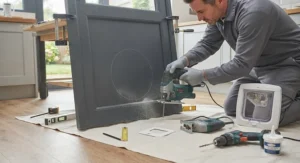
Fitting a door mounted cat flap yourself is entirely achievable in an afternoon, but the difference between a professional-looking result and a wonky, draughty one comes down to prep, not tools. Start by measuring a door for a cat flap properly: most manufacturers recommend the bottom of the flap opening sits roughly 5-15cm above your cat’s shoulder height when standing, which for an average adult cat usually lands the cut-out somewhere between 15cm and 30cm from the floor — always check the specific template supplied with your chosen model rather than guessing.
Before you touch a drill, check what’s actually inside your door. Hollow-core interior doors, foam-core composite doors and old fibreglass panels all behave differently under a jigsaw, and cutting blind into a composite door can void its warranty — always check with the manufacturer first. For UPVC doors, confirm there’s no metal reinforcement bar running through the exact panel you’re planning to cut; most manufacturers’ templates include a spot to check this with a strong magnet before drilling. Wooden doors are generally the most forgiving material for a DIY cut, provided you support the panel from behind to stop it splintering as the jigsaw exits.
Once the aperture is cut, dry-fit the frame before applying any sealant, check it sits flush on both faces, then seal the outer frame edge with an exterior-grade silicone to stop water tracking into the door core — this single step is the one most first-time fitters skip, and it’s the most common cause of a swollen or delaminating panel eighteen months later. Common mistakes in the first 30 days include forgetting to reprogram the flap after a battery change (most models default back to “unlocked” or lose stored chip IDs) and mounting the flap too close to a door handle or lock, which can trap a cat’s collar or interfere with the door’s own hardware.
Real-World Scenarios: Which Flap Suits Which Household
The single-cat renter in a Victorian terrace with a wooden back door. Budget is tight, the landlord’s fine with a straightforward flap so long as it’s not a structural change, and there’s no need for elaborate multi-pet permissions. The Cat Mate 4-Way Locking Cat Flap or the entry-level SureFlap Microchip Cat Flap both fit this brief — wood takes a clean DIY cut, and neither purchase represents a big financial commitment if the tenancy ends sooner than planned.
The multi-cat family with one indoor-only senior cat. Here the priority isn’t cost, it’s control — specifically, stopping one cat from following the others outside. The SureFlap DualScan Microchip Cat Flap is built for precisely this, since its exit-side scanning can be set to block a specific registered cat while still granting the others full freedom.
The owner of a large-breed cat whose old flap was always a squeeze. A Maine Coon or big British Shorthair pushing through a standard 145mm opening day after day is uncomfortable at best and can eventually damage the flap’s hinge mechanism. The SureFlap Pet Door‘s wider aperture removes that friction entirely, and its C-cell battery setup copes better with the extra daily use a bigger, more athletic cat puts it through.
Cat Flap for Wooden Door vs Cat Flap for UPVC Door
The two most common installation surfaces in the UK behave very differently under a saw, and the difference matters more than most buying guides admit. A cat flap for wooden door installs is the most forgiving job on this list: solid or panel timber cuts cleanly with a jigsaw, holds screws securely without extra reinforcement, and rarely causes the delamination or warping issues that plague other materials if sealed properly afterward.
A cat flap for UPVC door installs is a slightly different proposition. UPVC panels are typically foam-filled with internal reinforcement — sometimes metal, sometimes just extra plastic ribbing — which means checking for obstructions before cutting is non-negotiable, not optional. Most manufacturers, including SureFlap and PetSafe, publish specific UPVC fitting guidance and recommend using their supplied template exactly rather than eyeballing the cut, since a slightly-off aperture on UPVC is much harder to patch neatly than on wood.
| Factor | Wooden Door | UPVC Door |
|---|---|---|
| DIY difficulty | Low — clean cut, forgiving material | Medium — must check for internal bars first |
| Warranty risk | Low, unless door is under a specific guarantee | Can void manufacturer warranty if not checked |
| Sealing needs | Exterior silicone on cut edges | Frame-specific sealant to prevent water ingress |
| Best For | Cat Mate 4-Way Locking Cat Flap, SureFlap Microchip Cat Flap | SureFlap Microchip Cat Flap, PetSafe Microchip Cat Door |
Looking at the comparison above, wood remains the lower-risk option for a confident DIYer, while UPVC installs benefit from either a professional fitter or, at minimum, a very careful reading of the manufacturer’s template before any cutting starts. Composite and glass doors fall outside both categories and generally need a specialist regardless of budget, since a botched cut on either is expensive to fix.
Common Mistakes When Buying a Door Mounted Cat Flap
The single biggest mistake is buying on flap opening size alone without checking the overall unit dimensions against the actual clear panel space on the door — a common issue with decorative UPVC doors that have less flat, uninterrupted surface than they appear to from the front. A close second is skipping the microchip compatibility check: not every microchip is the same frequency, and while most UK vets implant standard FDX-B chips, older or imported pets occasionally carry a type a budget reader can’t detect.
Buyers also frequently underestimate battery logistics, assuming a microchip flap is “install and forget” when in reality most need a battery swap every 6-12 months, and several models reset stored pet IDs during that change unless you follow the manufacturer’s specific procedure. Finally, a surprising number of buyers pick a stylish flap for a door panel cat flap installation without checking the panel is even solid enough to support a cut — thin decorative or glazed panels sometimes need a specific reinforcement kit that isn’t included in the box.
Draught-Proof Cat Flaps: What Actually Works
Every product on this list claims to be draught-proof, but the phrase covers a fairly wide range of actual performance. The genuine indicators of a well-sealed flap are a full brush seal around the flap edge, a magnetic (rather than gravity-only) closure, and a frame that seats flush against the door with no visible gap once fitted — magnets specifically stop the flap swinging open in strong wind, which a purely weighted hinge can’t guarantee.
Given that draught proofing works by sealing the gaps around doors, windows and floors that let cold air in, as the Energy Saving Trust explains, a poorly-sealed cat flap can quietly undo a decent chunk of that effort — it’s effectively a permanent, cat-sized gap in your door if the seal isn’t doing its job. In practice, the Cat Mate Elite Microchip Cat Flap and Cat Mate 4-Way Locking Cat Flap both use a fully brush-sealed design that reviewers specifically praise for cutting whistling draughts compared with older flaps, while the SureFlap Microchip Cat Flap range relies on a tight-fitting magnetic flap that performs similarly well once correctly fitted. The lesson across every model here is the same: the seal only works if the surrounding cut is clean and the frame is properly sealed to the door during installation — the best draught-proofing hardware in the world can’t compensate for a rough, gappy DIY cut.
How to Choose a Door Mounted Cat Flap: 6 Decision Points
- Measure your cat, not just the door. Stand height at the shoulder is the number that matters most — an opening too small forces a squeeze, one too large invites larger unwanted visitors.
- Confirm your door material before you shop. Wood, UPVC, composite and glass all have different fitting requirements, and some flaps simply aren’t rated for every surface.
- Decide how much selectivity you actually need. A manual lock suits low-risk, single-cat homes; microchip recognition suits anywhere with neighbourhood cat traffic or multiple pets with different access rules.
- Check the self-lining depth against your door thickness. Most flaps self-line up to 40-100mm; anything thicker needs an additional tunnel or liner accessory.
- Factor in battery logistics, not just price. A flap that needs monthly battery changes will cost more in the long run than its sticker price suggests.
- Match the lock modes to your routine. If you regularly need to keep a cat in overnight or during building work, a 4-way lock with a clear “in only” setting saves real hassle.
Long-Term Cost & Maintenance
A microchip flap’s true cost isn’t the sticker price — it’s the sticker price plus roughly £8-£15 a year in batteries, plus the occasional replacement flap door (typically £10-£20) once the hinge wears from years of daily use. Spread across a realistic 5-7 year lifespan, even the priciest mainstream option here works out at under £20 a year, which is difficult to argue with given the alternative of manually opening a door multiple times daily.
The OnlyCat AI Prey Detection Flap breaks this pattern slightly, since its higher upfront cost is offset by near-zero running costs if it genuinely stops repeated vet trips or carpet-cleaning bills caused by prey deliveries — for the right household, the maths can work out favourably even against its steep initial price. Maintenance across every model here is minimal: an occasional wipe of the sensor area, a check that the brush seal hasn’t worn thin, and — for microchip models — reprogramming after any battery change to confirm stored pet IDs haven’t reset.
Safety, Regulations and Compliance Guide
Since June 2024, every keeper of a cat in England has had a legal duty to ensure that cat is microchipped, under the Microchipping of Cats and Dogs (England) Regulations 2023. This isn’t just a compliance footnote for cat flap buyers — it directly affects which flap makes sense for your household, since every microchip model on this list depends on that chip already being fitted and its details kept current on a registered database.
Beyond microchipping, Cats Protection’s cat flap guidance notes that a well-chosen flap gives cats a genuine sense of security and control over their environment, which is worth bearing in mind when deciding between a manual and a selective-entry model — a flap that lets in every neighbourhood cat can turn a previously confident cat anxious in its own home. Renters should also check tenancy terms before any DIY cutting; most standard tenancies treat a cat flap as a minor, reversible alteration, but it’s worth confirming in writing before drilling into a rented property’s door.
Features That Actually Matter (And Those That Don’t)
Microchip recognition, a genuine magnetic seal, and self-lining depth that matches your actual door thickness — these three consistently separate a flap that performs well for years from one that becomes a source of daily frustration. App connectivity and location tracking, by contrast, are pleasant extras rather than essentials for most households; they add cost and another thing that can go wrong without meaningfully improving the flap’s core job of letting your cat in and out securely.
Curfew timers sit in an interesting middle ground — genuinely useful if your routine needs it, entirely skippable if it doesn’t. The lesson across this whole category is to buy for the problem you actually have (a specific unwanted visitor, a large cat, multiple pets with different needs) rather than the longest features list on the box.
Frequently Asked Questions
❓ What size door mounted cat flap do I need?
❓ Can I fit a cat flap for UPVC door myself?
❓ Do microchip cat flaps work with any microchip?
❓ Is a door panel cat flap installation different from a full door replacement?
❓ How do I stop a cat flap being draughty?
Conclusion
There’s no single “best” door mounted cat flap — there’s a best one for your specific door, your specific cat, and your specific tolerance for faff. For most UK households, the SureFlap Microchip Cat Flap remains the sensible middle ground: proven reliability, genuine microchip security, and a price that doesn’t demand a second thought. Multi-cat homes juggling different access needs are better served by the SureFlap DualScan, large-breed owners should look straight at the SureFlap Pet Door, and anyone on a tighter budget can get genuinely solid results from either the PetSafe Microchip Cat Door or the entirely manual Cat Mate 4-Way Locking Cat Flap.
What matters more than the badge on the box is the fitting. A £600 AI flap cut into a door with no seal around the frame will draught worse than a £15 manual flap fitted properly. Measure carefully, check your door material before you cut, and match the flap’s security level to the actual problem you’re solving — not the longest features list you can find.
Recommended for You
- Top 7 Top Cat Flaps Under £50 in 2026: Budget Picks
- Microchip Cat Flap UK: 7 Best Picks Ranked for 2026
- Clear vs Fabric Sofa Protector for Cats 2026: 7 Honest Picks
Disclaimer: This article contains affiliate links. As an Amazon Associate, I earn from qualifying purchases. If you purchase products through these links, we may earn a small commission at no additional cost to you.
✨ Found this helpful? Share it with your friends! 💬🤗
