
In This Article
Picture this: you’ve got a vet appointment in 20 minutes, and your cat has vanished under the bed with the energy of someone who absolutely knows what’s happening. You’re fumbling with a flimsy zip-up bag, your cat has opinions, and the whole morning is rapidly unravelling. Sound familiar?
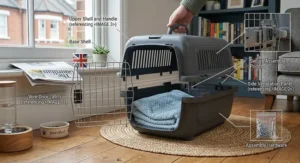
A quality hard sided cat carrier changes this dynamic entirely. Unlike their soft-sided cousins that flex, sag, and occasionally surrender entirely under the pressure of a determined moggy, a well-built rigid plastic carrier holds its shape, its locks, and — crucially — your cat. The rigid plastic shell means there’s no chance of a claw puncturing through during the car journey, no sagging on the vet’s table, and no dramatic escape mid-waiting-room.
A hard sided cat carrier is a rigid, plastic-bodied pet transport box featuring ventilation slits or mesh panels, a locking door (usually steel or plastic-coated metal), and a two-part construction that can be disassembled for cleaning. It’s the gold standard for short journeys, vet visits, and airline travel. And given the British climate — damp mornings, unpredictable drizzle, the occasional gale-force wind — the wipe-clean, weatherproof interior is frankly essential.
In this guide, I’ve done the research on Amazon.co.uk to bring you seven genuinely available, properly reviewed hard sided cat carriers across every budget. No fictional products, no inflated claims — just honest, practical analysis for UK cat owners.
Quick Comparison Table: Top 7 Hard Sided Cat Carriers at a Glance
| Product | Dimensions (cm) | Max Weight | Key Feature | Price Range | Best For |
|---|---|---|---|---|---|
| Amazon Basics Hard-Sided (Large) | 58 × 38 × 33 | ~8–10 kg | Two-door top-load | Around £25–£35 | Budget buyers, first-timers |
| Ferplast Clipper 2 | 57 × 37 × 36 | 8 kg | IATA-approved, steel door | Around £35–£50 | Regular travellers |
| Ferplast Clipper 3 | 64 × 43 × 43 | 15 kg | IATA, large capacity | Around £45–£65 | Large cats, international travel |
| Rosewood Vision Classic 60 | 58 × 38 × 41 | ~8 kg | Reversible metal door | Around £30–£45 | Style-conscious buyers |
| Rosewood Vision Free 55 | 55 × 36 × 33 | ~6 kg | Dual top + front opening | Around £25–£40 | Anxious cats, vet visits |
| Iris Ohyama PDPC-600 | 59 × 38 × 37 | 12 kg | Top-opening, foldable | Around £40–£60 | Space-limited homes |
| Kerbl Pet Expedion Box | 45 × 30 × 30 | ~5 kg | Compact, lightweight | Around £20–£30 | Kittens, small cats |
From this table, the Ferplast Clipper range stands out for anyone needing IATA compliance, while the Amazon Basics model wins on accessibility and sheer value for money. The Iris Ohyama’s foldable design is the obvious choice for flat-dwellers who can’t justify permanent storage for a cat carrier — a very real consideration in a terraced house with a single airing cupboard.
💬 Just one click — help others make better buying decisions too! 😊
In This Article
✨ Don’t Miss These Exclusive Deals!
🔍 Take your cat travel to the next level with these carefully selected products. Click on any highlighted item to check current pricing and availability on Amazon.co.uk. These picks will help you find exactly what you need!
Top 7 Hard Sided Cat Carriers: Expert Analysis
1. Amazon Basics Hard-Sided Cat Carrier, Two-Door Top-Load (Large, 58 × 38 × 33 cm)
The Amazon Basics carrier is the one you’ll see in vet waiting rooms across the country, and there’s a reason it has over 60,000 ratings on Amazon.co.uk. It’s not glamorous. But it works.
The 58 × 38 × 33 cm shell accommodates most average-sized domestic cats comfortably, and the two-door design — top-load and front-load — is more useful than it sounds. For the vet visit scenario where your cat needs to stay in the bottom half while being examined, a top-opening carrier is invaluable. Battersea Dogs & Cats Home specifically recommends hard plastic carriers with removable tops, noting they’re better for protecting cats from injury and easier to clean. The ventilation panels on the sides allow a decent through-draught, and the plastic interior wipes down in seconds — handy after the inevitable stress-related accident on the way home.
What most UK buyers overlook is that the build quality here is purely adequate rather than exceptional. The clips are functional, not confidence-inspiring. For monthly vet trips with a calm cat, it’s brilliant. For a highly anxious escape artist? You might want to look further down this list.
UK buyers with Amazon Prime get next-day delivery; otherwise, free standard delivery applies on orders over £25.
✅ Unbeatable value for money
✅ Two-door top-load design
✅ Thousands of genuine UK reviews
❌ Clips feel lightweight under stress
❌ Colourway (blue) won’t suit everyone
Price range: around £25–£35. A solid first carrier for budget-conscious UK buyers.
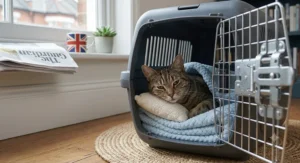
2. Ferplast Clipper 2 IATA-Approved Cat Carrier (57 × 37 × 36 cm, max 8 kg)
Ferplast is one of Europe’s largest pet product manufacturers, and the Clipper range is genuinely engineered rather than merely assembled. The Clipper 2 hits the sweet spot for the majority of British cats: at 57 × 37 × 36 cm with an 8 kg maximum capacity, it fits a generously proportioned domestic shorthair without the unnecessary bulk of a larger box.
The steel-coated iron door with its two-point knob lock is the headline feature here. When you turn that knob, two separate fixing points anchor simultaneously — so there’s no single point of failure the way there is with simple spring-clip doors. The side ventilation slits run the full length of the shell, providing genuine airflow rather than token perforations, and the two-shell construction means the whole thing splits apart for thorough cleaning. The folding handle slots into a recess in the lid, reducing storage footprint — a small but thoughtful detail for anyone with limited kitchen cupboard space.
IATA compliance (with the optional net kit sold separately) makes this the right choice if you’re planning to travel by train or ferry. For a Sunday drive to the vet in Bristol or Leeds, the compliance is irrelevant, but the door quality absolutely isn’t.
UK customers note it arrives requiring assembly, though the process is straightforward. Available on Amazon.co.uk with Prime delivery.
✅ Two-point steel door lock
✅ IATA-compliant with net kit
✅ Made from recycled plastic — a bonus for eco-conscious buyers
❌ Net kit required for full IATA compliance sold separately
❌ Assembly required on arrival
Price range: around £35–£50. Excellent mid-range value with the build quality to match.
3. Ferplast Clipper 3 IATA-Approved Travel Crate (64 × 43 × 43 cm, max 15 kg)
If you have a Maine Coon, a Norwegian Forest Cat, or simply a very well-fed British Shorthair, the Clipper 2 won’t cut it. The Clipper 3, at 64 × 43 × 43 cm with a 15 kg capacity, is built for serious cats.
All the engineering quality from the Clipper 2 carries over: two-point knob lock, steel mesh door, split-shell construction, IATA capability. What changes is space — and space matters enormously for feline stress. Research published in PMC found that carrier choice has a significant impact on cat stress during veterinary visits, with adequate space being a key welfare consideration. A large cat in a cramped box arrives at the vet already wound up before anyone’s even looked at them sideways.
The Clipper 3 is the one I’d recommend for any cat over 5 kg, or any cat that simply loathes confined spaces and needs room to shift position during a journey. The folding handle, the label slot for name and address details, the extra securing screws — these are the details that tell you this carrier was designed by people who’ve actually thought about international travel.
UK customer reviews are mixed on sturdiness — some find it robust, others have received damaged units in transit — so it’s worth checking your carrier carefully on arrival and using the Amazon returns window if needed.
✅ Ample space for large breeds
✅ IATA-rated, suitable for train and ferry travel
✅ Eco-conscious recycled plastic construction
❌ Some UK buyers report inconsistent quality control on arrival
❌ Bulky for compact home storage
Price range: around £45–£65. The correct choice for large cats or international journeys.
4. Rosewood Vision Classic 60 Pet Carrier (58 × 38 × 41 cm)
Rosewood is a British pet brand with over 50 years in the trade, and the Vision Classic range reflects that heritage. Where Ferplast goes for engineering rigour, Rosewood goes for everyday usability — and the Vision Classic 60 is, genuinely, a pleasure to use once assembled.
The standout feature is the reversible metal door: it opens to the left or right, which sounds like a minor detail until you’re trying to manoeuvre a carrier through a narrow corridor in a Victorian terraced house with the door opening the wrong way. At 58 × 38 × 41 cm, the interior is generously proportioned, and the clips that hold the two shells together allow the unit to be nested flat when not in use — a genuine space saver.
What most buyers overlook is the assembly. The clips require some initial effort to seat correctly, and several UK reviewers note they felt uncertain about the security. The correct technique is to ensure the opposing side is firmly pressed together before engaging the clip — once you’ve done it a couple of times, it becomes second nature. The plastic is lighter gauge than the Ferplast equivalent, which is why this carrier sits in a lower price bracket, but for regular vet trips with an average-weight cat, it’s perfectly fit for purpose.
Sold on Amazon.co.uk and Prime-eligible; made in Italy.
✅ Reversible door opens left or right
✅ Flat-pack nesting for storage
✅ British brand, widely available
❌ Assembly clips require a learning curve
❌ Lighter plastic than premium alternatives
Price range: around £30–£45. A smart everyday carrier from a trusted British brand.
5. Rosewood Vision Free 55 Cat Carrier (55 × 36 × 33 cm, dual opening)
The Vision Free 55 does something the Classic doesn’t: it opens at the top as well as the front. That single design addition transforms the vet visit experience entirely.
Cats.org.uk recommends specifically looking for a carrier that is “ideally top opening” — and the reason is practical, not aesthetic. When a nervous cat is in the bottom half of an open-topped carrier, a vet can conduct much of the examination without ever forcing the animal out into a completely exposed environment. It’s less stressful for the cat, less stressful for the vet nurse, and considerably less stressful for you watching the whole performance.
At 55 × 36 × 33 cm, this suits cats up to around 6 kg comfortably. The durable plastic construction with metal doors is solid, though — and I’ll be honest here — several UK reviewers have flagged that the clips holding the two halves together can be temperamental. Some units arrive with clips that need extra effort to secure; occasional users have resorted to cable ties for added peace of mind with escape-prone cats. If your cat is a serial escapologist, factor in a pack of zip ties.
Still, the dual-door design alone makes this one of the most functionally useful carriers on this list for routine UK vet visits.
✅ Dual top and front opening
✅ Ideal for vet examination without full removal
✅ Decent ventilation
❌ Some units have clip security issues
❌ Not suitable for very large cats
Price range: around £25–£40. Best value for anxious cats and frequent vet-goers.
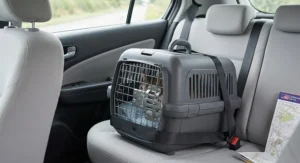
6. Iris Ohyama PDPC-600 Pet Carrier (59 × 38 × 37 cm, top-opening, foldable, max 12 kg)
Iris Ohyama is a Japanese brand with a reputation built on practical, well-engineered storage solutions — and that engineering DNA is evident in the PDPC-600. The headline feature is foldability: when your cat isn’t in residence, this carrier collapses flat for storage. In a one-bedroom flat in Manchester or a terrace in Birmingham where storage space is a genuine constraint, that matters.
At 59 × 38 × 37 cm with a 12 kg weight limit, it handles larger cats without drama. The top-opening design mirrors the advice from veterinary behaviour experts — allowing cats to exit on their own terms rather than being tipped or dragged — and the lockable door operates on a two-way mechanism that UK reviewers consistently describe as “very sturdy once assembled.” The BPA-free polypropylene, ABS plastic, and steel construction feels premium for its price bracket.
Assembly is required, but customers on Amazon.co.uk rate it highly for ease and note the carrier folds down again just as efficiently. The folding handle keeps the profile clean during storage. For a Japanese brand with excellent build standards, it’s reassuringly available on Amazon.co.uk and ships from UK warehouse stock.
✅ Folds flat for storage — ideal for small UK homes
✅ BPA-free, quality materials
✅ Top-opening, large capacity for the price
❌ Assembly required
❌ Fewer UK reviews than the top-ranked options
Price range: around £40–£60. The smart choice for anyone who prizes storage efficiency without sacrificing quality.
7. Kerbl Pet Expedion Transport Box (45 × 30 × 30 cm, lightweight)
The Kerbl Expedion is the compact option on this list — 45 × 30 × 30 cm, lightweight plastic, no-fuss design. It’s the carrier you buy for a kitten, or for a small adult cat that doesn’t fill a full-sized box and seems to feel more secure in a cosier space.
What I appreciate about this carrier is its honesty. It doesn’t pretend to be IATA-certified or premium-engineered. It’s a solid, practical, mint-and-grey plastic box that will get your kitten to the vet and back without incident. The ventilation is adequate, the construction is simple, and the price reflects exactly what it is: a no-nonsense hard sided cat carrier for small cats and short trips.
For UK buyers in the budget tier who’ve been swayed by a flimsy fabric bag in the past, this is the step up you need without the premium price tag. Available on Amazon.co.uk via the hard-sided cat carrier category.
✅ Compact and lightweight
✅ Budget-friendly entry point
✅ Good for kittens and small cats
❌ Not suitable for medium or large cats
❌ No IATA compliance
Price range: around £20–£30. The sensible starter carrier for small cats and kittens.
How to Choose a Hard Sided Cat Carrier in the UK: 6 Key Criteria
Buying a cat carrier should be simple. It rarely is. Here’s the framework I’d use:
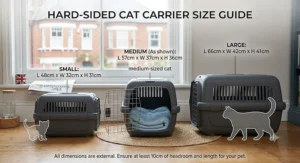
1. Measure your cat first, not the box. Your cat should be able to stand, turn around, and lie down without touching the walls. Measure them from nose to tail base, then add 10–15 cm. A carrier that’s too large, conversely, offers no sense of security — cats actually find a snug space more calming.
2. Prioritise top-opening access. As recommended by the Cats Protection and veterinary welfare experts, a removable or opening top means your cat can be examined in the familiar bottom half without forced extraction. Non-negotiable for vet visits.
3. Check the locking mechanism honestly. Squeeze the door hard. Does it flex? Does the clip hold? A two-point lock (like the Ferplast Clipper range) is significantly more secure than a single spring clip. For a cat that’s previously escaped, this isn’t optional.
4. Consider your storage situation. In a typical British terrace or flat, a large rigid carrier is awkward to store. The Iris Ohyama’s foldable design or the Rosewood’s nesting flat configuration are worth considering if cupboard space is tight.
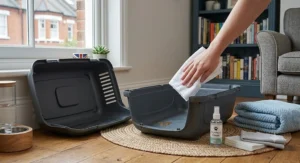
5. Think about cleaning, not just aesthetics. Cats occasionally have accidents in carriers. A smooth plastic interior with no fabric lining wipes clean. A split-shell design (Ferplast, Rosewood) means you can take the whole thing apart and scrub it properly. This matters more than colour.
6. Match your journey to the spec. For a 10-minute drive to the local vet, the Amazon Basics is fine. For a train journey from Edinburgh to London, you want IATA compliance and a steel door. Know your use case before you spend.
Hard Sided vs Soft Sided Cat Carriers: Which One Should You Choose?
The debate has two camps, and both have legitimate arguments. Let me settle it practically.
Soft-sided carriers fold flat, weigh next to nothing, and your cat may find the fabric walls less imposing than rigid plastic. For a very calm cat taking a short trip, they work beautifully. The problem is that fabric has limits — a stressed cat can claw through lightweight mesh, zip fasteners can fail under pressure, and the whole structure loses integrity if the bag is set down awkwardly. In wet British weather, a fabric carrier that’s been rained on becomes a cold, damp environment for its occupant. Not ideal.
Hard sided carriers hold their shape regardless of what’s happening inside. They protect the cat from being bumped, squeezed, or accidentally dropped without cushioning. They clean with a cloth rather than a washing machine. And crucially, as Battersea notes, they protect against injury if the carrier is accidentally dropped. For vet visits — which are the most common reason UK cat owners need a carrier — hard plastic wins on welfare grounds every single time.
The honest verdict: if your cat is relaxed and you’re going somewhere warm and dry, a quality soft carrier is fine. For everyone else, for most situations, hard sided is the more responsible choice.
| Factor | Hard Sided | Soft Sided |
|---|---|---|
| Durability | Excellent | Moderate |
| Weather resistance | Excellent | Poor |
| Escape resistance | Excellent | Variable |
| Storage | Bulkier | Compact |
| Cleaning | Very easy | Difficult |
| Best for | Vet visits, travel | Calm cats, short trips |
The table above makes the trade-offs clear. Hard sided carriers are easier to clean and significantly more secure — both relevant in wet Britain where the carrier will inevitably see rain and a cat who’d rather not be in it. Soft carriers’ storage advantage is real, but the Iris Ohyama’s foldable hard shell addresses this directly.
Getting Your Cat Comfortable with Their New Carrier
Here’s the thing nobody tells you when they sell you a carrier: your cat doesn’t automatically understand that it’s safe. The first time they see it is probably right before a vet visit, which means they immediately associate it with stress. You’re going to fix that.
In the first week: Don’t put the carrier away. Leave it open in the living room with a familiar blanket inside. Ignore it yourself — the goal is for the carrier to become ambient furniture, not a threat. Some cats will investigate within hours; others will take a fortnight. Both are fine.
Days 7–14: Put treats at the entrance of the carrier. Then gradually further inside. Never push or coax. Let the cat make the decision — you’re building a positive association, not training a specific behaviour. Calder Vets also recommend rubbing a cloth with your cat’s own scent around the interior to make it smell familiar.
Before any journey: Spray Feliway Classic (a synthetic feline pheromone) inside the carrier 30 minutes before you need to use it. Don’t feed your cat for at least 4–6 hours before travel to reduce the risk of nausea — a damp, smelly carrier makes the return journey considerably more unpleasant than necessary.
In the car: Cover the carrier with a light blanket that smells of home. Drive smoothly — your cat feels every gear change. Keep the music low. Place the carrier on the floor rather than the seat; it’s more stable and less exposed.
A carrier that lives in the corner of your sitting room, with a familiar blanket and occasional treats inside, becomes a den rather than a threat. This single change makes every subsequent vet visit measurably calmer.
Real-World Scenarios: Which Carrier Suits Your Situation?
Scenario A: The urban flat-dweller in Leeds or London. You’re in a one-bed flat with limited storage, and your cat — a standard moggy of around 4 kg — goes to the vet twice a year. Budget: under £45. Go for the Rosewood Vision Free 55 for its dual opening (great for nervous cats at the vet) or the Iris Ohyama PDPC-600 if storage is the primary concern. The foldable design earns its premium in a flat.
Scenario B: The family in a semi-detached in Manchester with a large cat. You’ve got a Maine Coon mix, approximately 7 kg, who travels to the vet four times a year and once took the carrier door apart for fun. Budget: £50–£70. The Ferplast Clipper 3 is the only answer here. The two-point steel door lock is what stands between you and chaos, and the 64 cm length gives your large cat genuine comfort.
Scenario C: The new cat owner with a kitten. You’ve just brought home a 10-week-old kitten, you’re not sure how big they’ll get, and you want something cheap and cheerful for now. Budget: under £35. The Kerbl Pet Expedion gets the job done for a small cat, or the Amazon Basics gives you room to grow into a larger size as the kitten develops.
Common Mistakes When Buying a Hard Sided Cat Carrier in the UK
Buying by size of carrier, not size of cat. The dimensions on the listing refer to the external shell. Internal dimensions are always smaller. Measure your cat and check whether the carrier’s interior accommodates them.
Ignoring the locking mechanism entirely. The door is the critical failure point on any carrier. Single spring clips are fine for a cooperative cat. For a determined escape artist, two-point locks (Ferplast Clipper range) are not a luxury — they’re a necessity.
Assuming “airline approved” means what you think it means. IATA compliance requires a specific net kit applied to the ventilation slots, not just the base structure. The Ferplast Clipper range achieves full IATA compliance only with the optional net accessory. Always contact your airline directly before flying with any carrier.
Buying EU voltage-specific accessories for a hard carrier. This doesn’t apply to a simple plastic box, but if you’re buying any accessory — heated pads, electronic calming devices — verify UK plug compatibility (Type G, 230V).
Choosing based on looks rather than ventilation. A tinted plastic shell looks smart but reduces airflow significantly. Your cat needs to breathe comfortably, and good ventilation also means you can cover the carrier with a towel (recommended for anxious cats) without blocking airflow entirely.
FAQ
❓ What size hard sided cat carrier do I need for my cat?
❓ Can I take a hard sided cat carrier on a train in the UK?
❓ Are hard sided cat carriers better than soft carriers for vet visits?
❓ How do I clean a hard sided cat carrier after an accident?
❓ Is the Ferplast Clipper range available for next-day delivery in the UK?
Conclusion
Finding the right hard sided cat carrier isn’t about the most expensive option or the one with the most stars. It’s about matching the carrier to your cat’s size, your journey type, and your storage reality.
For most UK cat owners, the Ferplast Clipper 2 hits the sweet spot: robust enough to handle a determined cat, IATA-capable if you ever need it, and built with a two-point steel lock that won’t suddenly let you down in the vet’s car park. Budget-conscious buyers won’t go wrong with the Amazon Basics for routine trips. And anyone squeezed for storage space should seriously consider the Iris Ohyama PDPC-600 — it folds, it’s sturdy, and it doesn’t compromise on size.
Whatever you choose, remember: the carrier you leave open in the living room with a blanket inside is infinitely more effective than the one your cat only sees twice a year. A familiar, scent-marked carrier is the single biggest thing you can do to make every future vet visit calmer. The rest is just logistics.
✨ Don’t Miss These Exclusive Deals!
🔍 Check current pricing and availability on all seven carriers above by clicking any highlighted product name. Amazon.co.uk stock and prices update frequently — always worth a quick look before you decide!
Recommended for You
- Best Litter Box Odour Control UK 2026: 7 Expert Picks That Work
- Best Litter Tray Liners UK 2026: 7 Expert Picks for Hassle-Free Cats
- Best Cat Litter Deodoriser UK 2026: 7 Brilliant Picks Reviewed
Disclaimer: This article contains affiliate links. As an Amazon Associate, I earn from qualifying purchases. If you purchase products through these links, we may earn a small commission at no additional cost to you.
✨ Found this helpful? Share it with your mates! 💬🤗
